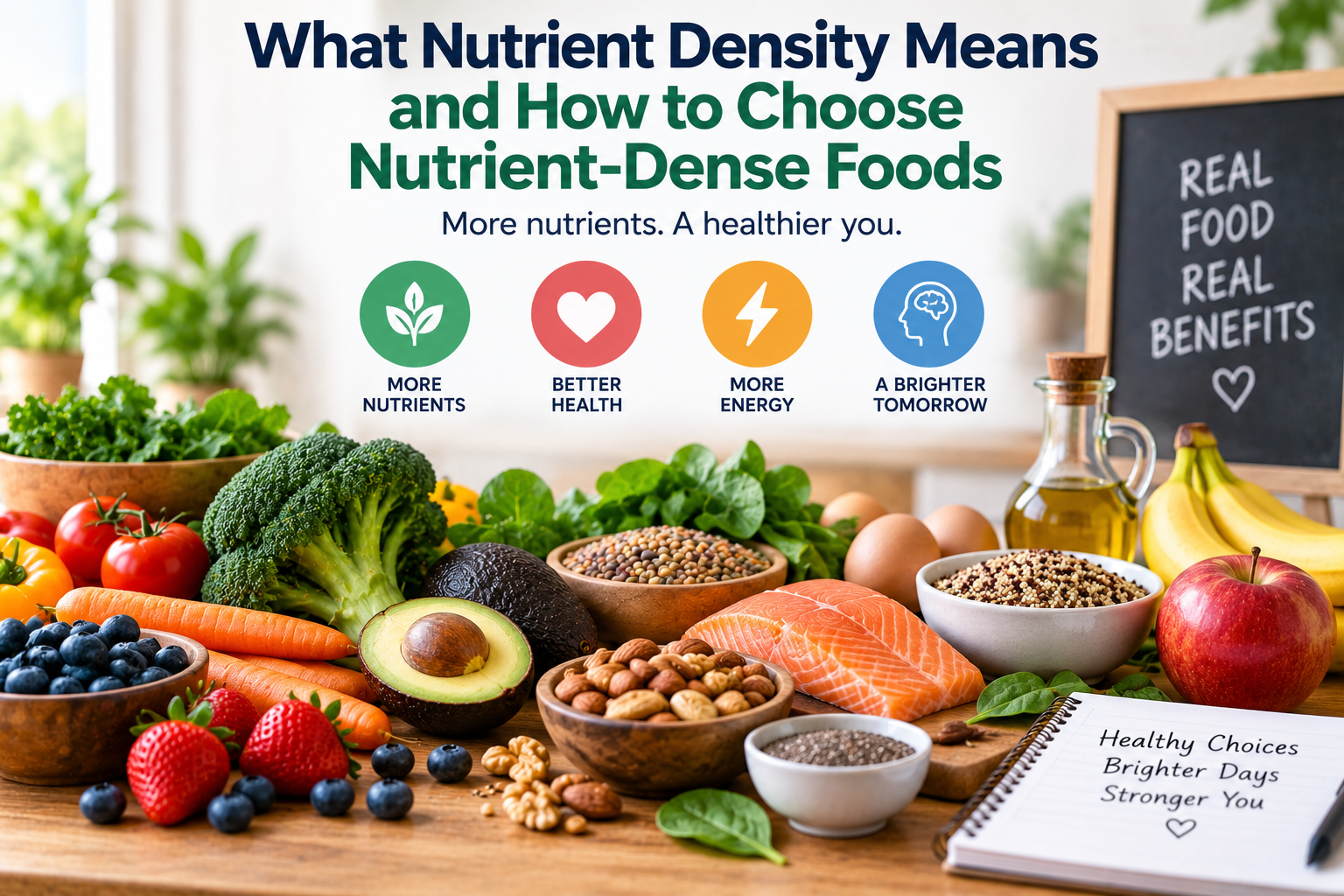

What Nutrient Density Means and How to Choose Nutrient-Dense Foods
Not all foods provide the same amount of nutrition for the amount of energy they contain. Some foods supply a wide range of vitamins, minerals, protein, fiber, and other beneficial compounds, while others may provide substantial calories with relatively few essential nutrients.
This difference is often described using the term nutrient density.
Understanding nutrient density can make everyday food choices easier without requiring complicated diets or strict rules. Instead of focusing only on calories, nutrient density encourages people to consider what nutrients a food contributes to the overall diet.
What Is Nutrient Density?
Nutrient density refers to how many beneficial nutrients a food provides relative to the amount of energy, usually measured in calories.
A nutrient-dense food generally provides a meaningful amount of vitamins, minerals, protein, fiber, or other useful nutrients for its calorie content.
Examples can include:
- Leafy green vegetables
- Beans and lentils
- Fruits
- Whole grains
- Eggs
- Fish
- Nuts and seeds
- Plain dairy or fortified alternatives
- Lean meats
- A variety of other minimally processed foods
Nutrient density does not mean that a food must be low in calories. Nuts, seeds, and some dairy products can be relatively energy-dense while still providing important nutrients.
The concept is about the quality and variety of nutrients provided, not simply the number of calories.
Why Nutrient Density Matters
The body requires many different nutrients to maintain normal functions.
Proteins provide amino acids needed for building and repairing tissues. Carbohydrates can provide energy and fiber. Fats contribute energy and help the body absorb certain vitamins. Vitamins and minerals participate in numerous biological processes.
A diet built around a variety of nutrient-dense foods can make it easier to obtain these nutrients regularly.
This is one reason nutrient density fits naturally into a balanced approach to eating. The Complete Guide to Healthy Eating and Balanced Nutrition provides a broader look at how different food groups and nutrients can fit into an overall eating pattern.
Nutrient Density Is More Than Vitamins and Minerals
When people hear the word “nutrients,” they may immediately think about vitamins and minerals. These are important, but they are only part of the picture.
Nutrient-dense foods can also provide:
- Protein
- Fiber
- Essential fatty acids
- Complex carbohydrates
- Water
- Plant compounds such as polyphenols
- Other naturally occurring beneficial compounds
The combination can vary considerably from one food to another.
For example, an orange provides vitamin C, carbohydrates, fiber, water, and various plant compounds. Beans provide protein, fiber, carbohydrates, minerals, and other nutrients.
Eating a variety of foods is therefore important because individual foods rarely provide everything the body needs.
Vitamins Play Different Roles in the Body
Vitamins are organic compounds required in relatively small amounts for normal physiological functions.
Different vitamins perform different roles. For example, vitamin C contributes to normal collagen formation and supports normal immune function, while vitamin A is involved in vision and immune function.
Rather than focusing on a single vitamin, it is generally more useful to obtain a broad range through a varied diet.
The Complete Guide to Vitamins and Their Roles explains the functions of individual vitamins and why they are important.
Minerals Are Also Essential
Minerals are inorganic elements that the body needs for functions ranging from bone structure and fluid balance to nerve signaling and oxygen transport.
Calcium, iron, magnesium, potassium, zinc, and iodine are examples of essential minerals, although the body requires different minerals in different amounts.
Food sources vary considerably. Dairy products, legumes, seafood, vegetables, whole grains, nuts, seeds, and other foods can contribute important minerals.
For a closer look at these nutrients, see Minerals Explained: Essential Nutrients Your Body Needs Every Day.
Vegetables Are Often Nutrient-Dense Choices
Vegetables can provide vitamins, minerals, fiber, water, and numerous plant compounds while contributing relatively few calories.
Different vegetables provide different nutritional profiles, so variety matters.
Dark leafy greens can provide nutrients such as folate and vitamin K. Orange and yellow vegetables can provide carotenoids. Cruciferous vegetables such as broccoli and cabbage contribute fiber and various plant compounds.
Rather than searching for one “perfect” vegetable, including different colors and types throughout the week can increase dietary variety.
Fruits Can Be Nutrient-Dense Too
Fruit provides carbohydrates, fiber, vitamins, minerals, water, and naturally occurring plant compounds.
Whole fruit also has a physical structure that can contribute to fullness and slower eating compared with many highly processed sweet foods.
Apples, berries, oranges, bananas, mangoes, melons, and other fruits can all contribute different nutrients.
Fruit does contain naturally occurring sugars, but this does not make whole fruit nutritionally equivalent to foods containing large amounts of added sugar.
Protein-Rich Foods Can Provide Multiple Nutrients
Protein sources often provide more than protein alone.
Eggs, fish, poultry, dairy foods, legumes, nuts, and seeds can contribute combinations of protein, minerals, vitamins, and other nutrients.
Fish, for example, can provide protein along with nutrients such as vitamin B12, selenium, and, depending on the type, omega-3 fatty acids.
Legumes can provide protein and fiber along with minerals and other nutrients.
Choosing a variety of protein sources can therefore improve the overall diversity of a diet.
Whole Grains Can Add Nutritional Value
Whole grains contain the grain’s naturally occurring bran, germ, and endosperm.
Examples include:
- Oats
- Brown rice
- Whole-wheat products
- Barley
- Millet
- Sorghum
- Quinoa
- Whole-grain maize products
They can contribute fiber, carbohydrates, protein, vitamins, minerals, and other compounds.
Refined grains can still be part of a balanced diet, but choosing whole-grain options more often can increase fiber and nutrient intake.
Legumes Are Versatile Nutrient-Dense Foods
Beans, lentils, chickpeas, and peas can be especially useful because they combine several nutritional characteristics.
They can provide:
- Plant protein
- Fiber
- Complex carbohydrates
- Folate
- Iron
- Magnesium
- Potassium
- Other nutrients
They are also versatile and can be incorporated into soups, stews, salads, spreads, and main meals.
For people looking to increase plant-based foods in their diets, legumes can provide an accessible foundation.
Nuts and Seeds Pack Many Nutrients Into Small Portions
Nuts and seeds contain fats, protein, fiber, vitamins, minerals, and other compounds.
Because they are relatively energy-dense, portion size can matter when overall calorie intake is a consideration. Nevertheless, their nutritional value makes them useful components of many balanced eating patterns.
Almonds, peanuts, walnuts, pumpkin seeds, sunflower seeds, chia seeds, and other varieties can provide different combinations of nutrients.
Choosing unsalted or minimally processed versions can make it easier to control added sodium and other ingredients.
Minimally Processed Does Not Always Mean Better
The term “processed” covers a very broad range of foods.
Cooking, freezing, drying, fermenting, grinding, and pasteurizing are all forms of food processing, but they do not automatically make a food unhealthy.
Frozen vegetables can be highly nutritious. Canned beans can be convenient sources of protein and fiber. Plain yogurt is processed but can provide protein and calcium.
The more useful question is often what happened during processing and what the finished food contains.
Foods heavily formulated with large amounts of added sugars, sodium, or certain fats may provide fewer nutrients relative to their calorie content, although individual products still need to be evaluated on their own nutritional characteristics.
How to Identify a Nutrient-Dense Food
There is no single label that automatically identifies every nutrient-dense food.
Instead, consider several characteristics.
Look at the Nutrients Provided
Ask what the food contributes beyond calories.
Does it provide protein, fiber, vitamins, minerals, or other useful nutrients?
Consider the Portion
A food can be nutritious while still being high in calories.
Understanding portion size can help place energy-dense foods such as nuts, seeds, oils, and some dairy products into an overall balanced diet.
Check Added Ingredients
Nutrition labels can help identify added sugars, sodium, and other ingredients that may be present in packaged foods.
Comparing similar products can reveal meaningful differences.
Consider the Overall Food
Instead of judging a food based on one nutrient, consider its complete nutritional profile.
A food containing fat is not automatically unhealthy, just as a food labeled “low-fat” is not automatically nutrient-dense.
Nutrient Density and Calorie Density Are Different
These two concepts are sometimes confused.
Calorie density describes how much energy a food contains relative to its weight or volume.
Nutrient density considers how much nutritional value a food provides relative to its energy content.
A food can therefore be high in calories but still provide important nutrients.
For example, nuts contain considerable energy because of their fat content, but they also provide protein, fiber, minerals, and other compounds.
Understanding both concepts can create a more complete picture of food choices.
Read Nutrition Labels With Context
Nutrition labels can be useful tools for comparing packaged foods.
Look at the serving size first, because the listed nutritional values are usually based on that amount. Then consider nutrients such as protein, fiber, vitamins, minerals, sodium, and added sugars.
No single number tells the entire story.
For example, a food may contain more sodium but also provide substantial protein and other nutrients. Another product may contain fewer calories but contribute little nutritional value.
Labels are most useful when several characteristics are considered together.
Watch for Added Sugar
Added sugars can increase the energy content of foods without providing the same range of essential nutrients found in many whole foods.
Foods such as sweetened drinks, confectionery, desserts, and some packaged snacks can contain substantial amounts of added sugar.
This does not mean every sweet food must be eliminated. Rather, making nutrient-dense foods the foundation of meals can leave less room in the diet for foods that provide primarily added sugar and calories.
Sodium Is Another Nutrient to Monitor
Sodium is an essential mineral, but excessive intake can be a concern for many people.
Large amounts of sodium can be present in processed meats, packaged meals, sauces, salty snacks, and other prepared foods.
Comparing labels and choosing lower-sodium alternatives when appropriate can help manage overall intake.
At the same time, sodium needs vary between individuals, and dietary recommendations should take personal health circumstances into account.
Build Meals Around Nutrient-Dense Ingredients
One practical way to apply the concept is to make nutrient-dense foods the foundation of meals.
A simple meal might include:
- A source of protein
- A variety of vegetables
- A whole-grain or other carbohydrate source
- A source of healthy fats
- Fruit or another nutrient-rich food when appropriate
This does not require every meal to contain every possible nutrient.
The goal is to create variety across the day and week.
Variety Is Essential
Eating the same highly nutritious food every day does not guarantee a complete diet.
Different foods contain different combinations of nutrients.
Rotating vegetables, fruits, protein sources, grains, nuts, and seeds can increase nutritional variety and make meals more interesting.
Variety can also make healthy eating more practical because it provides more options when certain foods are unavailable, expensive, or simply unappealing.
Nutrient Density and Nutrient Deficiencies
A diet consistently lacking particular nutrients can contribute to nutritional deficiencies, although deficiencies can have many causes.
Medical conditions, medication use, restricted diets, impaired absorption, increased nutritional requirements, and other factors can influence nutrient status.
Understanding How Nutrient Deficiencies Develop and Get Identified can help put nutrient intake into a broader health context.
People who suspect they have a nutrient deficiency should seek appropriate medical evaluation rather than relying solely on symptoms or self-prescribed supplements.
Supplements Are Not a Substitute for a Varied Diet
Supplements can be useful in specific circumstances, particularly when a healthcare professional identifies an increased need or deficiency.
However, supplements generally should not be viewed as replacements for a varied diet.
Whole foods can provide combinations of nutrients and other beneficial compounds that may not be replicated by a single supplement.
The appropriate use of supplements depends on the individual’s nutritional status, health circumstances, diet, and professional medical advice.
Budget-Friendly Nutrient-Dense Choices
Eating nutrient-densely does not necessarily require expensive specialty foods.
Affordable options can include:
- Beans and lentils
- Eggs
- Oats
- Seasonal vegetables
- Frozen vegetables
- Whole grains
- Bananas
- Local fruits
- Canned fish where appropriate
- Peanuts and other affordable nuts or seeds
Buying foods that are in season, comparing prices, using frozen or canned options appropriately, and preparing meals at home can also help manage costs.
Make Nutrient Density a Practical Habit
Nutrient density is best understood as a flexible principle rather than a strict diet.
Instead of asking whether every food is “good” or “bad,” consider what nutritional value it contributes and how it fits into the overall eating pattern.
Choosing more vegetables, fruits, whole grains, legumes, protein-rich foods, nuts, and seeds can increase the range of nutrients available in the diet. Reading labels, considering portions, and limiting excessive amounts of added sugar and sodium can further support balanced choices.
Most importantly, nutrient-dense eating is about patterns over time. No single meal needs to be perfect, and no individual food needs to provide every nutrient. A varied diet built around foods that offer substantial nutritional value can make it easier to meet the body’s needs while leaving room for enjoyment, flexibility, and personal preferences.
Continue Reading
Similar Posts

How to Recover After Breaking Healthy Habits
Breaking a healthy routine is usually a temporary interruption rather than a permanent failure. The important part is learning how to return to healthier behaviors without turning a short setback into a long-term pattern.
Read article
How Your Environment Affects Everyday Health
Understanding these connections can help people make practical changes that support healthier daily living.
Read article
How Aerobic Exercise Supports Cardiovascular Health
Understanding how aerobic exercise affects cardiovascular health can make it easier to choose activities that are enjoyable, sustainable, and appropriate for your fitness level.
Read article

Join 10,000+ Readers Building Healthier Habits
Get actionable wellness tips every week plus our newest articles delivered straight to your inbox.