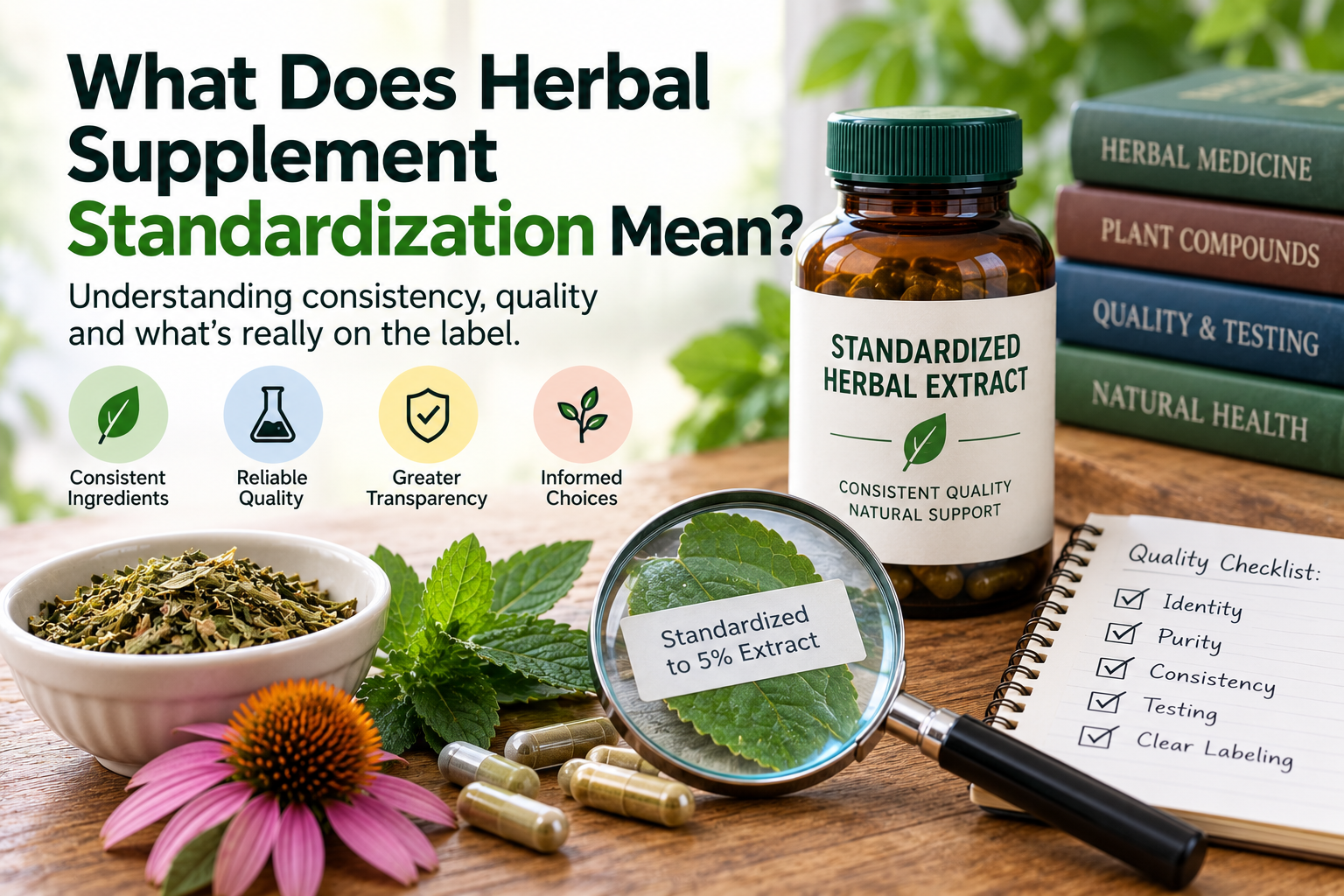

What Does Herbal Supplement Standardization Mean?
Herbal supplements are often made from plants that contain dozens or even hundreds of naturally occurring compounds. Because the concentration of those compounds can vary from one batch to another, manufacturers may use a process called standardization to make certain characteristics of an herbal product more consistent.
The term sounds straightforward, but it can be misunderstood.
A standardized herbal supplement does not necessarily mean that the product is stronger, safer, more effective, or completely identical from batch to batch. Instead, standardization generally refers to efforts to establish consistency around specified characteristics, such as the amount of a particular chemical constituent or group of constituents.
Understanding what standardization actually means can help consumers interpret supplement labels and distinguish standardization from broader concepts such as quality control, purity, identity, and testing.
What Is an Herbal Supplement?
An herbal supplement is a product made from plant material or substances derived from plants and intended to supplement the diet.
These products may contain:
- Whole herbs
- Ground plant material
- Herbal powders
- Botanical extracts
- Concentrated plant preparations
- Combinations of several botanical ingredients
They can be sold in capsules, tablets, powders, liquids, teas, and other forms.
The composition of a plant-based ingredient can depend on many factors, including the plant species, growing conditions, harvesting time, processing methods, storage, and extraction technique.
The Complete Guide to Dietary Supplements provides broader information about supplements, their ingredients, forms, and considerations surrounding their use.
What Does Standardization Mean?
In herbal products, standardization generally refers to a manufacturing process intended to make a defined characteristic of an ingredient consistent between batches.
That characteristic might involve a particular chemical compound or a group of compounds.
For example, a manufacturer could establish a target concentration for a selected constituent in an extract and test batches to determine whether they meet the specified range.
The exact meaning of “standardized” can vary depending on the product and the manufacturer’s procedures. The word should therefore not be interpreted as a universal guarantee of product quality or clinical effectiveness.
Why Herbal Ingredients Can Vary
Plants are biological materials, so their chemical composition is not necessarily identical every time they are harvested.
Variation can occur because of:
- Plant species or variety
- Geographic location
- Soil conditions
- Climate
- Rainfall
- Temperature
- Harvesting season
- Plant maturity
- Which part of the plant is used
- Drying methods
- Storage conditions
- Extraction methods
Even plants identified as the same species can contain different concentrations of particular compounds.
Manufacturers therefore need processes for controlling this natural variation when producing consistent commercial products.
Standardization Usually Applies to Specific Characteristics
One important point is that standardization does not mean every compound in an herbal product has been made identical.
A plant can contain numerous chemical constituents. A manufacturer may focus on only one or a selected group when establishing a standard.
For instance, an extract could be manufactured to contain a specified concentration of a particular marker compound.
Other compounds in the extract may still vary.
Consequently, the word “standardized” should be understood in relation to what has actually been standardized.
Marker Compounds and Active Constituents
Manufacturers may use particular chemical compounds as markers when developing specifications for an herbal ingredient.
A marker can help identify, characterize, or monitor an ingredient during manufacturing.
Importantly, a marker compound is not necessarily the substance responsible for all of an herb’s biological effects.
In some plants, scientists may have a good understanding of particular constituents and their properties. In others, the relationship between individual compounds and the effects of the whole extract may be much less certain.
This distinction is important because consumers may incorrectly assume that a standardized marker represents the complete activity of the plant.
Standardized Does Not Automatically Mean More Potent
A common misconception is that a standardized product must be stronger than a non-standardized product.
That is not necessarily the case.
Standardization is primarily concerned with consistency around specified characteristics. It does not automatically mean that a product contains a higher concentration of every potentially relevant compound.
A non-standardized herbal product can still contain substantial quantities of naturally occurring constituents.
The meaningful question is what the manufacturer has measured, what specification has been established, and how that specification relates to the actual composition of the product.
Standardization and Extraction Are Different
Standardization and extraction are related but distinct concepts.
An extract is produced by processing plant material to transfer selected compounds into a solvent or another preparation method. The resulting product can have a different chemical profile from the original whole herb.
Standardization can then be used as part of the manufacturing process to help control the composition of that extract.
The distinction becomes clearer when comparing different types of botanical products.
How Botanical Extracts Differ From Whole Herbs explains why extracts and whole herbs can have substantially different compositions and characteristics.
Whole Herbs Can Also Have Specifications
Standardization is not necessarily limited to highly concentrated extracts.
Manufacturers can establish specifications for various botanical ingredients, including raw plant materials and powdered herbs.
Those specifications may address characteristics such as:
- Plant identity
- Moisture
- Microbial limits
- Contaminants
- Chemical constituents
- Physical characteristics
The specific tests used depend on the ingredient and manufacturing process.
Standardization Is Part of Quality Control
Standardization should be viewed as one component of a broader quality-control system.
Quality control can involve verifying that the correct plant was used, checking for contaminants, testing chemical characteristics, controlling manufacturing conditions, and ensuring that finished products meet established specifications.
A product can have a standardized chemical marker while still requiring additional quality checks.
This is why the term “standardized” should not be treated as a complete description of product quality.
Identity Testing Matters
Before an herbal ingredient can be evaluated for consistency, manufacturers need to establish what the ingredient actually is.
Identity testing helps determine whether the material corresponds to the intended plant or botanical ingredient.
This can involve analytical techniques designed to distinguish one plant species from another or to characterize specific chemical patterns.
Correct identification is particularly important because different plants can have similar common names or appearances.
The broader process is discussed in How to Evaluate the Quality, Purity, Identity and Labeling of Herbal Products.
Purity Is a Separate Consideration
An herbal ingredient can meet a chemical standard and still need to be evaluated for unwanted substances.
Quality-control programs may look for contaminants such as:
- Microorganisms
- Heavy metals
- Pesticide residues
- Undeclared pharmaceutical ingredients
- Adulterants
- Other unwanted substances
The appropriate testing depends on the botanical ingredient, its origin, manufacturing process, and potential risks.
Standardization of one chemical constituent does not by itself establish that a product is free from every possible contaminant.
Potency and Standardization Are Related but Not Identical
People sometimes use the terms “potency” and “standardization” interchangeably, but they describe different ideas.
Potency generally concerns the strength or concentration of a particular component or preparation.
Standardization concerns the process of establishing and maintaining consistency around specified characteristics.
A standardized extract may therefore have a defined range for a particular constituent without that specification telling consumers everything about the biological activity of the finished product.
Why Testing Is Important
Testing allows manufacturers to determine whether raw materials and finished products meet their established specifications.
Depending on the product, testing can examine:
- Identity
- Chemical composition
- Microbial quality
- Contaminants
- Physical characteristics
- Stability
- Consistency between batches
Testing methods need to be appropriate for the substance being measured.
How Supplement Quality and Testing Work provides additional information about how quality and testing can be approached in the supplement industry.
Standardization Does Not Guarantee Clinical Effectiveness
One of the most important distinctions is between chemical consistency and proven health effects.
A manufacturer may successfully produce an extract containing a consistent concentration of a specified constituent. That does not automatically establish that the product will provide a particular health benefit.
Clinical effectiveness depends on evidence from appropriate research involving the specific preparation, dose, population, and outcome being studied.
Two products containing the same standardized marker can potentially differ in other ways that affect their overall composition.
Therefore, standardization should not be interpreted as proof that an herbal supplement has been clinically proven to produce a particular effect.
Standardized Extracts Can Still Differ
Two products can both be described as standardized while having different specifications.
They might use:
- Different plant species
- Different plant parts
- Different extraction solvents
- Different extraction ratios
- Different marker compounds
- Different concentration targets
- Different manufacturing processes
Consequently, the word “standardized” alone does not provide enough information to determine whether two products are equivalent.
Consumers interested in comparing products should look at the actual ingredient information and specifications available for each product.
The Plant Part Can Matter
Plants contain different compounds in different parts of the plant.
Roots, leaves, flowers, bark, seeds, fruits, and stems can have distinct chemical profiles.
A standardized extract made from one part of a plant is therefore not necessarily equivalent to a preparation made from another part.
Product labels that identify the plant material used can provide important context when evaluating an herbal ingredient.
Extraction Methods Can Change Composition
The way an herb is processed can influence which compounds are present in the final preparation.
Different solvents and extraction conditions can favor different groups of compounds.
For example, an extraction process designed to capture water-soluble constituents may produce a substantially different chemical profile from a process designed to capture compounds that dissolve more readily in other solvents.
This is another reason why a standardized extract should be considered as a specific preparation rather than simply as the plant itself.
What Consumers Can Look for on a Label
When evaluating an herbal supplement, consumers can look beyond a general claim that the product is standardized.
Useful information may include:
- Botanical name
- Plant part used
- Amount of extract
- Extract ratio, when provided
- Specified marker compounds
- Amount of standardized constituents
- Other listed ingredients
- Manufacturer information
- Batch or lot information
- Recommended serving
- Relevant quality certifications, where applicable
The amount and quality of information available can vary considerably between products.
Standardization and Third-Party Testing
Third-party testing and certification can provide another layer of quality assurance when a reputable independent organization evaluates products against defined standards.
However, third-party certification programs differ in what they test and what their certification means.
Consumers should therefore understand what a particular certification actually covers rather than assuming that every third-party mark represents the same type of evaluation.
Why Manufacturing Consistency Matters
Consistency is important because researchers, healthcare professionals, manufacturers, and consumers need to know what a product contains.
If the composition of an herbal product changes dramatically from one batch to another, the product’s characteristics can also change.
Manufacturing specifications can help reduce unnecessary variation.
For manufacturers, this can make production more predictable. For researchers, well-characterized preparations can make studies easier to interpret. For consumers, clearer product specifications can make labels more informative.
Standardization Is Not the Same as Regulation
Standardization is a manufacturing and quality-control concept. It should not automatically be interpreted as evidence that a government regulator has independently verified the product’s effectiveness or every claim made about it.
Regulatory systems differ between countries, and the requirements applied to dietary and herbal products vary.
Consumers should therefore consider the regulatory environment in their country as well as the manufacturer’s quality information.
Why the Word Can Be Misleading
“Standardized” sounds like a comprehensive quality guarantee, but it is actually a more specific concept.
Without additional information, the term does not necessarily tell consumers:
- Which compounds were measured
- What concentration was targeted
- How testing was performed
- Whether contaminants were evaluated
- Whether the product was clinically studied
- Whether different products are equivalent
- How consistent all constituents are
Reading the full product information is therefore more useful than relying on one word on the label.
How Standardization Fits Into the Bigger Picture
A high-quality herbal product involves multiple stages of control.
These can include:
- Correctly identifying the plant.
- Selecting appropriate raw materials.
- Controlling harvesting and processing.
- Using suitable extraction or preparation methods.
- Establishing manufacturing specifications.
- Testing ingredients and finished products.
- Controlling contamination risks.
- Maintaining consistency between batches.
- Providing accurate labeling.
- Monitoring product quality throughout manufacturing.
Standardization can contribute to this process, but it is only one piece of the overall quality system.
Questions to Ask About a Standardized Herbal Product
If a product is described as standardized, useful questions include:
What Has Been Standardized?
Look for the specific compound or group of compounds involved.
What Is the Target Amount?
A meaningful specification should indicate the concentration or range being targeted when that information is available.
What Plant Material Was Used?
Check the botanical name and plant part.
Is It an Extract or Whole Herb?
These preparations can have different compositions and should not automatically be treated as interchangeable.
How Was the Product Tested?
Testing methods and quality-control procedures can provide more useful information than a general standardization claim.
Has the Specific Preparation Been Studied?
Evidence for one herbal preparation does not necessarily apply to every product made from the same plant.
A More Precise Way to Think About Standardization
The simplest way to understand herbal supplement standardization is to think of it as an effort to control defined characteristics of a botanical product so that batches are more consistent with established specifications.
It does not mean that every molecule is identical.
It does not automatically mean that the product is clinically effective.
It does not by itself guarantee purity or safety.
Instead, standardization is one tool manufacturers can use alongside identity testing, contaminant testing, manufacturing controls, and other quality-assurance practices.
Reading Beyond the Label Claim
Herbal supplements can be chemically complex, and natural variation makes consistency an important manufacturing challenge. Standardization can help address part of that challenge by establishing measurable specifications for selected characteristics.
For consumers, the most useful approach is to look beyond the word “standardized” and examine what the manufacturer actually means by the claim.
Understanding the botanical identity, plant part, extract type, measured constituents, testing procedures, and broader quality controls provides a much clearer picture of what an herbal product contains and how consistently it is manufactured.
Continue Reading
Similar Posts

How Nutrient Deficiencies Develop Over Time
Understanding how deficiencies develop can make it easier to recognize potential risk factors and appreciate why a balanced diet, appropriate medical evaluation, and targeted treatment can matter.
Read article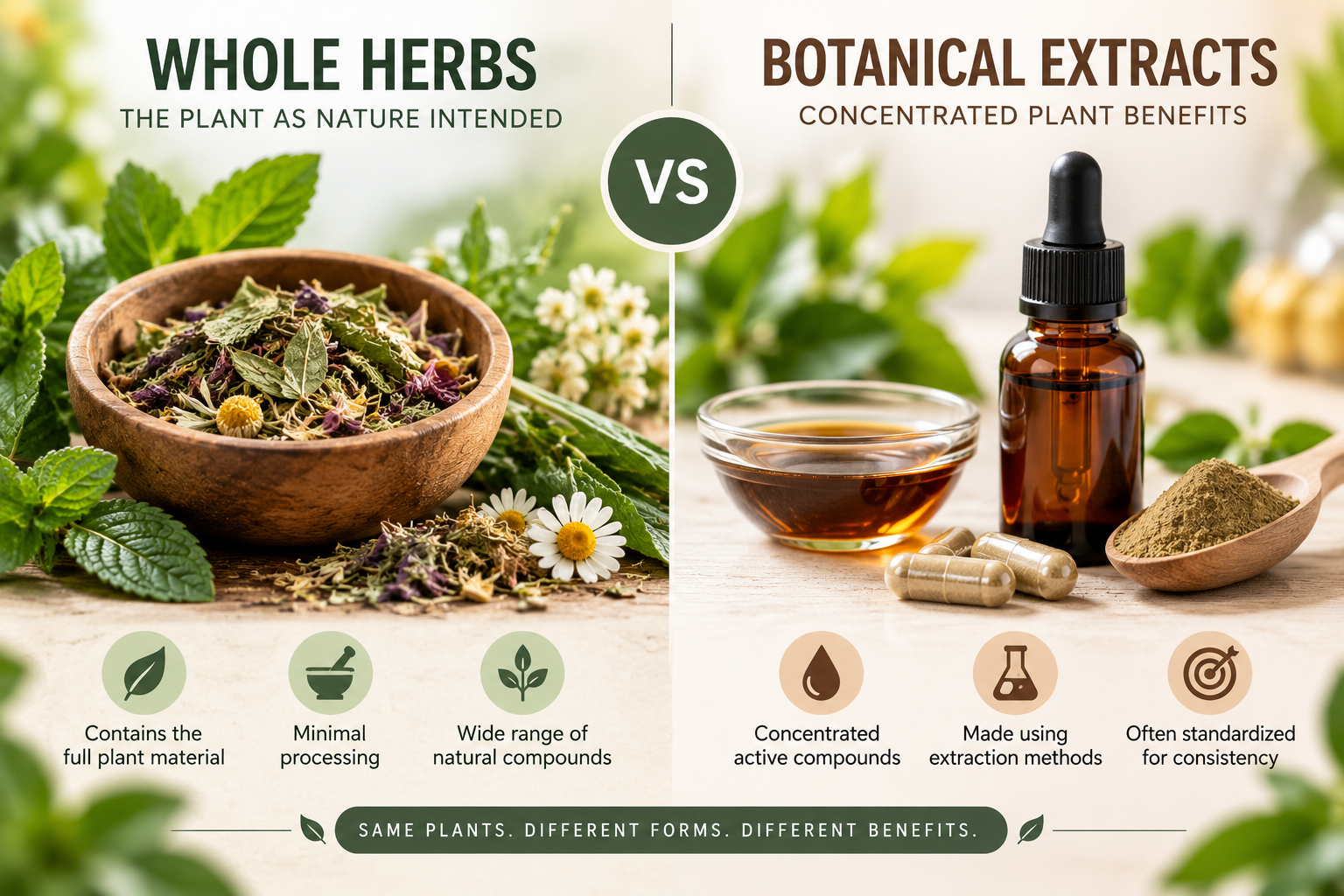
How Botanical Extracts Differ From Whole Herbs
Understanding how extracts differ from whole herbs can make it easier to interpret supplement labels, compare products, and evaluate claims about herbal ingredients.
Read article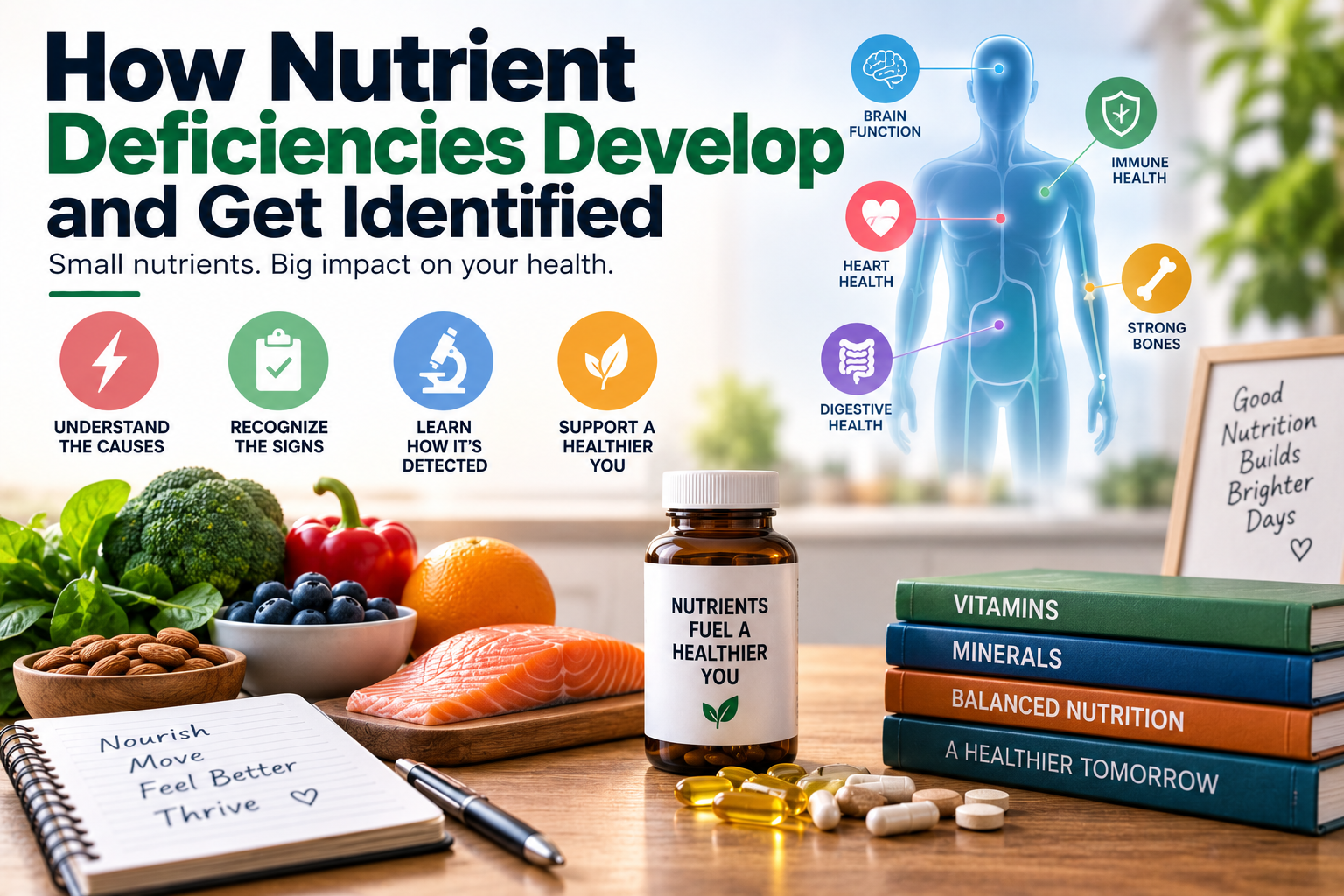
How Nutrient Deficiencies Develop and Get Identified
Understanding how nutrient deficiencies develop—and how healthcare professionals identify them—can make it easier to recognize potential problems before they become more serious.
Read article

Join 10,000+ Readers Building Healthier Habits
Get actionable wellness tips every week plus our newest articles delivered straight to your inbox.