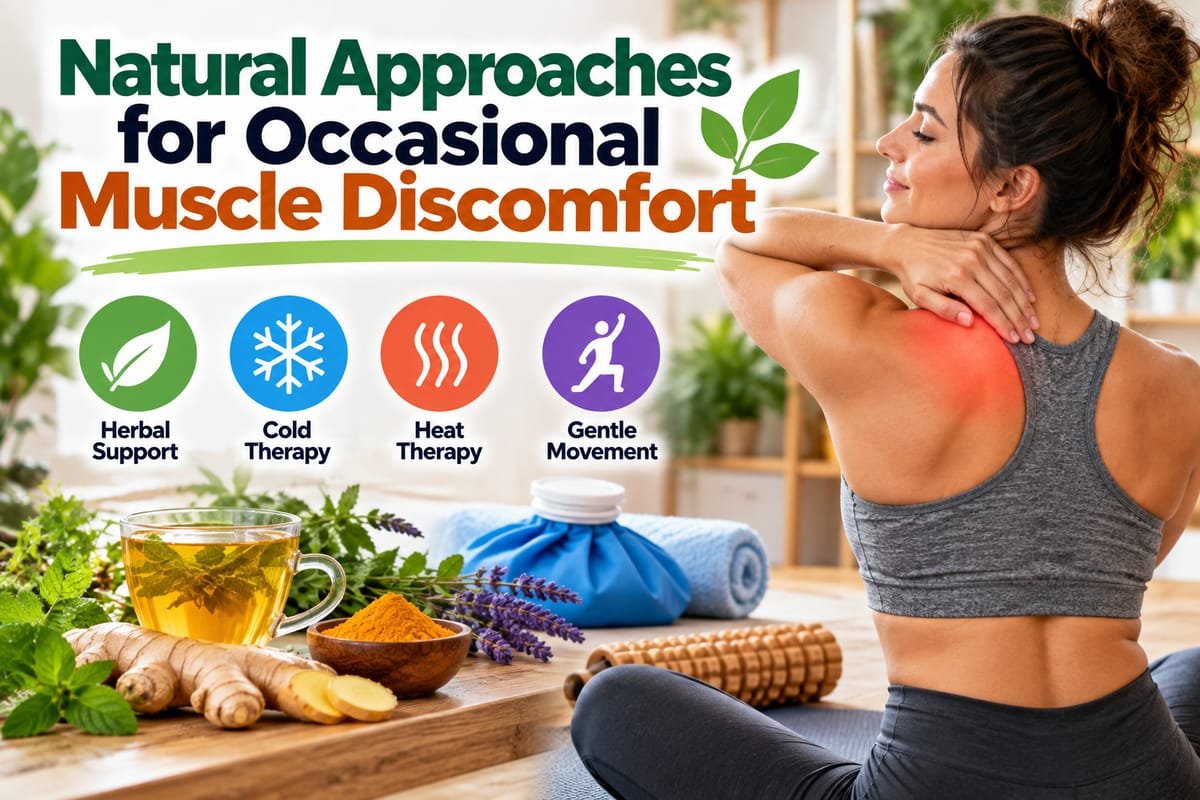

Natural Approaches for Occasional Muscle Discomfort
Occasional muscle discomfort is a common experience. It can follow a workout, a long day of physical activity, an unfamiliar movement, prolonged sitting, or simply spending too much time in one position.
For many people, mild muscle discomfort improves with time and basic self-care. Gentle movement, adequate rest, heat or cold, hydration, and other simple approaches may help make the experience more manageable.
The important distinction is between supporting comfort and trying to treat an underlying medical problem without knowing what is causing it. Natural approaches may be useful for minor, short-lived discomfort, but persistent, severe, or unexplained muscle symptoms deserve appropriate medical attention.
Understanding the available options can help people choose practical approaches while recognizing when self-care is no longer enough.
What Causes Occasional Muscle Discomfort?
Muscle discomfort can have many possible causes.
Common everyday situations include:
- Exercising harder than usual
- Trying a new physical activity
- Repeating the same movement
- Spending long periods sitting or standing
- Maintaining an awkward posture
- Carrying heavy objects
- Minor strains
- Muscle fatigue
- Normal soreness after unfamiliar exercise
The sensation may range from mild tenderness to aching, stiffness, tightness, or temporary soreness.
The cause matters because different problems can require different approaches.
What Does a Natural Approach Mean?
A natural approach generally refers to a strategy that uses non-drug measures, lifestyle practices, or naturally derived products to support comfort or general well-being.
Examples include:
- Rest and recovery
- Gentle movement
- Stretching
- Heat
- Cold
- Massage
- Relaxation techniques
- Adequate hydration
- Appropriate nutrition
- Sleep
- Certain traditionally used herbal preparations
Natural does not automatically mean safe, effective, or appropriate for every situation.
Some natural products can interact with medicines or cause side effects. Likewise, a non-drug approach can be inappropriate when an injury or medical condition requires professional assessment.
Start by Understanding the Discomfort
Before choosing a self-care approach, consider what happened before the symptoms appeared.
Ask:
- Did the discomfort begin after exercise?
- Was there a specific injury?
- Did the pain develop suddenly?
- Is the area swollen?
- Is movement difficult?
- Is the discomfort improving?
- Has it continued longer than expected?
- Are there other symptoms?
These questions can help distinguish ordinary temporary soreness from symptoms that may need further evaluation.
Gentle Movement Can Help
Complete inactivity is not always necessary for minor muscle discomfort.
Gentle movement can help maintain normal mobility and prevent the affected area from becoming unnecessarily stiff.
Depending on the situation, this might include:
- Slow walking
- Gentle range-of-motion exercises
- Light stretching
- Easy mobility movements
- Gradually returning to normal activities
The movement should remain comfortable.
If an activity causes sharp or increasing pain, it is generally better to stop rather than push through it.
Gentle Stretching
Stretching can be part of a comfortable recovery routine, particularly when muscles feel tight after prolonged inactivity.
A gentle stretch should generally feel like mild tension rather than intense pain.
Useful principles include:
- Move slowly.
- Avoid bouncing.
- Do not force a joint beyond a comfortable range.
- Breathe normally.
- Stop if symptoms worsen.
Stretching is not a universal treatment for every type of muscle discomfort. A significant injury may require a different approach.
Rest and Recovery
Muscles need time to recover after physical activity.
If discomfort follows unusually demanding exercise, temporarily reducing the intensity of the activity can give the affected tissues time to recover.
Rest does not necessarily mean remaining completely inactive.
For mild soreness, people may be able to continue ordinary low-intensity activities while avoiding the movements that aggravate the discomfort.
The appropriate balance depends on the severity and cause of the symptoms.
Sleep and Muscle Recovery
Sleep is an important part of physical recovery.
During sleep, the body carries out processes involved in tissue maintenance, energy regulation, and recovery.
Poor sleep can also affect how people experience discomfort and fatigue.
Maintaining a consistent sleep routine can therefore support overall recovery.
Helpful habits may include:
- Keeping regular sleep and wake times
- Creating a comfortable sleeping environment
- Limiting unnecessary late-night stimulation
- Allowing enough time for sleep
- Avoiding excessive caffeine close to bedtime
Sleep alone is not a treatment for an injury, but it is an important part of general recovery.
Heat Therapy
Heat is one of the simplest non-drug approaches for everyday muscle discomfort.
Warmth may help muscles feel more relaxed and can be particularly comforting when stiffness or tension is prominent.
Common forms include:
- Warm showers
- Warm baths
- Heating pads
- Warm towels
- Other appropriate heat sources
Heat should be comfortably warm rather than excessively hot.
People should avoid falling asleep while using heating devices and should follow the manufacturer’s safety instructions.
For more detail on this approach, How Heat Therapy Is Used for Everyday Pain Relief explains how heat can be incorporated into everyday comfort routines.
When Heat May Be Comfortable
Heat may feel useful when muscles are:
- Stiff
- Tight
- Tense
- Sore after ordinary activity
Some people prefer warmth before gentle movement because it can make the muscles feel more comfortable.
Individual responses vary, so comfort and safety should guide its use.
Cold Therapy
Cold therapy is another commonly used approach.
A cold pack or similar method may temporarily reduce the sensation of discomfort and can be useful after certain minor injuries or physical activity.
Cold should not be applied directly to bare skin for prolonged periods.
A protective layer can help reduce the risk of skin irritation or cold injury.
The article How Cold Therapy Is Used for Pain and Discomfort provides additional information about using cold as part of a pain-management routine.
Heat or Cold: Which Should You Use?
There is no universal answer.
Some people find warmth more comfortable for stiffness and muscle tension, while others prefer cold after certain types of activity or minor injury.
The choice can depend on:
- The cause of the discomfort
- Whether swelling is present
- How recently an injury occurred
- Personal comfort
- The body’s response
Neither heat nor cold should be used as a substitute for evaluation when symptoms suggest a significant injury.
Massage for Muscle Comfort
Gentle massage can be relaxing and may temporarily make sore or tense muscles feel more comfortable.
Approaches can include:
- Self-massage
- Massage with the hands
- Massage balls
- Foam rollers
- Professional massage
Pressure should remain appropriate for the situation.
Aggressive pressure over a fresh injury, significant swelling, or unexplained severe pain may make symptoms worse.
Massage should feel supportive rather than like an attempt to force a painful area to loosen.
Foam Rolling
Foam rollers are commonly used for self-massage and mobility work.
A person can slowly move a body area over the roller while applying controlled pressure.
Foam rolling may feel uncomfortable, but intense pain is not the goal.
Avoid rolling directly over:
- Open wounds
- Significant swelling
- Areas of acute injury
- Bony structures
- Areas where a healthcare professional has advised against pressure
The purpose should be gentle mobility and comfort rather than aggressive treatment.
Warm Baths
A warm bath can combine heat with relaxation.
It may be especially appealing when muscle discomfort occurs alongside general physical fatigue.
A warm bath can also create an opportunity to slow down and relax before sleep.
Water should be comfortably warm rather than excessively hot.
People who are sensitive to heat, prone to dizziness, or have conditions affected by temperature should take appropriate precautions.
Hydration and Muscle Comfort
Adequate fluid intake is important for normal body function.
After exercise or significant sweating, replacing lost fluids can be particularly relevant.
However, muscle discomfort should not automatically be attributed to dehydration.
If symptoms are persistent, severe, recurrent, or accompanied by other concerning signs, hydration alone should not be treated as the explanation or solution.
A balanced approach considers the entire situation.
Nutrition and Recovery
The body requires energy and nutrients to support normal tissue maintenance and physical activity.
A balanced diet can provide:
- Protein
- Carbohydrates
- Healthy fats
- Vitamins
- Minerals
- Fluids
People who exercise regularly may have greater nutritional needs depending on the intensity and duration of their activities.
Rather than relying on a single food or supplement as a solution for muscle discomfort, a varied diet generally provides a more useful foundation for overall recovery.
Protein and Muscle Repair
Protein provides amino acids needed for many processes in the body, including the maintenance and repair of muscle tissue.
Protein-rich foods can include:
- Eggs
- Fish
- Poultry
- Beans
- Lentils
- Dairy products
- Soy foods
- Nuts and seeds
Individual nutritional needs vary.
People with particular dietary requirements may benefit from discussing their nutritional needs with a qualified professional.
Magnesium and Other Nutrients
Magnesium is often discussed in relation to muscles because it participates in normal muscle and nerve function.
Other nutrients also contribute to normal physiological processes.
However, the presence of a nutrient in the body does not mean that taking more of it will necessarily relieve muscle discomfort.
Supplements should not be used simply because a nutrient is associated with normal muscle function.
A person’s diet, nutritional status, medications, and individual circumstances all matter.
Herbal Approaches
Various herbs and plant preparations have traditionally been used for muscle discomfort and general relaxation.
Examples found in traditional practices include preparations involving:
- Ginger
- Turmeric
- Peppermint
- Arnica preparations
- Certain aromatic herbs
Evidence varies considerably between products and uses.
A traditional use does not automatically establish that an herb is effective for a particular condition.
Herbal products can also have pharmacological effects and may interact with medicines.
Anyone considering a concentrated herbal product should examine its ingredients, preparation, dosage information, and potential safety concerns.
Topical Natural Products
Some natural products are applied directly to the skin rather than consumed.
These may include creams, oils, gels, or balms containing plant-derived ingredients.
Topical products can sometimes cause skin irritation or allergic reactions.
Before using a new product extensively, follow its instructions and consider testing a small area when appropriate.
Avoid applying products to damaged skin unless specifically intended for that purpose.
Essential Oils and Muscle Discomfort
Essential oils are sometimes used in massage or aromatherapy.
Commonly promoted oils include peppermint, lavender, eucalyptus, and others.
Essential oils are highly concentrated substances and should not automatically be treated like ordinary cooking oils or harmless natural products.
Depending on the substance, they may cause skin irritation, allergic reactions, or other problems when used improperly.
They should be used according to appropriate safety guidance, and some should not be used by particular groups.
Relaxation Techniques
Muscle tension can sometimes accompany stress.
Relaxation techniques may help people reduce general tension and become more aware of how their bodies feel.
Options include:
- Slow breathing
- Meditation
- Progressive muscle relaxation
- Gentle yoga
- Quiet stretching
- Guided relaxation
These practices are generally aimed at relaxation rather than treating an underlying injury.
They can be particularly useful when discomfort is associated with prolonged tension or sedentary work.
Breathing and Muscle Tension
Stress can influence how people hold their bodies.
Some people unconsciously tense their shoulders, neck, jaw, or other muscles during stressful periods.
Slow, controlled breathing can encourage relaxation.
A simple practice is to breathe comfortably and slowly while consciously relaxing areas that feel tense.
This should not be viewed as a treatment for unexplained or severe pain, but it can be a useful relaxation habit.
Gentle Yoga and Mobility
Gentle yoga can combine stretching, controlled movement, balance, and breathing.
For someone experiencing mild stiffness, selected low-intensity movements may provide a comfortable way to maintain mobility.
However, yoga positions should be modified or avoided if they increase pain.
People recovering from significant injuries should follow appropriate professional guidance rather than assuming that all stretching or yoga movements are beneficial.
Posture and Everyday Muscle Discomfort
Muscle discomfort is sometimes associated with spending long periods in one position.
Desk work, driving, standing, or using electronic devices for extended periods can contribute to stiffness and tension.
Simple changes can include:
- Taking regular movement breaks
- Adjusting the workstation
- Changing sitting positions
- Walking periodically
- Avoiding prolonged static positions
- Using appropriate ergonomic support
These habits can address some of the everyday factors that contribute to muscle tension.
Movement Breaks During Desk Work
A short movement break can be simple.
Every so often, stand up and:
- Walk around
- Move your shoulders
- Gently rotate your neck within a comfortable range
- Stretch your legs
- Change your posture
The objective is not an intense workout.
It is simply to avoid remaining in the same position for excessively long periods.
Exercise Recovery
Muscle soreness following unfamiliar or demanding exercise can be part of the body’s normal response to increased physical workload.
A gradual approach to exercise can reduce unnecessary spikes in training intensity.
Useful principles include:
- Increase activity gradually.
- Allow recovery time.
- Warm up appropriately.
- Use proper technique.
- Stay hydrated.
- Sleep adequately.
- Avoid repeatedly training through significant pain.
Persistent or worsening pain should not automatically be dismissed as ordinary exercise soreness.
Warm-Up and Cool-Down
A warm-up can prepare the body for physical activity by gradually increasing movement and intensity.
It may include:
- Walking
- Gentle jogging
- Dynamic movements
- Activity-specific exercises
A cool-down can provide a gradual transition from more intense activity to lower-intensity movement.
Neither routine guarantees that soreness or injury will be prevented, but both can be useful parts of a thoughtful exercise routine.
Do Natural Approaches Replace Conventional Treatment?
Natural self-care and conventional healthcare do not necessarily have to be treated as competing systems.
Many people use simple non-drug measures alongside professional medical care when appropriate.
The distinction between the two approaches is explored in Natural Remedies vs Conventional Medicine.
The appropriate approach depends on the cause and severity of the problem.
A warm bath may be reasonable for mild post-exercise soreness, while a serious injury may require examination and targeted treatment.
Evidence Matters
Natural approaches can have different levels of scientific support.
Some strategies, such as applying heat or cold for certain types of discomfort, have established practical uses.
Other approaches may be based primarily on traditional practice or limited evidence.
When evaluating a natural remedy, consider:
- What is the proposed benefit?
- What evidence supports it?
- How was the remedy studied?
- Is the evidence relevant to this specific type of discomfort?
- Are there known risks?
- Could it interact with medication?
- Is the product appropriately prepared?
The Natural Pain Relief: Evidence-Based Complete Guide provides a broader framework for distinguishing evidence-supported approaches from claims that may require more caution.
Natural Does Not Mean Risk-Free
The word “natural” describes an origin or type of preparation, not a guarantee of safety.
Some natural products contain active compounds that can affect the body.
Potential concerns can include:
- Allergic reactions
- Skin irritation
- Drug interactions
- Excessive doses
- Contaminated products
- Incorrect preparation
- Use during pregnancy
- Use in children
- Effects on people with certain medical conditions
This is particularly important when a product is concentrated or taken internally.
When Self-Care May Be Appropriate
Simple self-care may be reasonable when discomfort is:
- Mild
- Clearly associated with ordinary physical activity
- Short-lived
- Gradually improving
- Not accompanied by concerning symptoms
Even in these situations, the goal should be comfort and recovery rather than masking symptoms that need evaluation.
When to Stop Self-Treatment
Self-care should not continue indefinitely if symptoms are not improving.
Consider professional evaluation when:
- Pain is severe
- Symptoms continue or worsen
- There was a significant injury
- Swelling is substantial
- Movement is severely restricted
- The area becomes unusually weak
- There is numbness or tingling
- Symptoms repeatedly return without a clear explanation
- Fever or other systemic symptoms occur
- The discomfort interferes significantly with everyday activities
These signs can have many possible explanations, and professional assessment can help determine the appropriate next step.
Sudden or Severe Muscle Symptoms
Sudden severe muscle pain deserves particular attention.
Do not assume that a severe symptom is simply ordinary soreness because it follows exercise.
If discomfort is intense, rapidly worsening, associated with significant weakness, major swelling, unusual changes in urine, fainting, breathing difficulty, chest symptoms, or another serious symptom, seek prompt medical attention.
The appropriate response depends on the overall situation.
Children and Natural Remedies
Children are not simply smaller adults.
Their bodies can respond differently to medicines, supplements, and concentrated natural products.
Parents and caregivers should be particularly cautious about giving herbal products or supplements to children for muscle discomfort without appropriate professional guidance.
For a child’s unexplained or significant pain, determining the cause should take priority over experimenting with remedies.
Pregnancy and Natural Muscle Remedies
Pregnancy can change how the body responds to substances and physical interventions.
Some herbs and supplements may not be appropriate during pregnancy, and certain topical products may require additional caution.
Pregnant people experiencing persistent or unusual muscle discomfort should seek appropriate advice rather than assuming that a natural product is automatically suitable.
Older Adults and Muscle Discomfort
Older adults may have different health conditions, medications, mobility limitations, and risks that influence which self-care approaches are appropriate.
For example, heat may require additional caution in people who have difficulty sensing temperature or regulating body temperature.
Medication interactions can also become more important when multiple prescriptions and supplements are involved.
A personalized approach is therefore useful.
Combining Several Self-Care Approaches
There is often no need to use numerous remedies at once.
A simple routine might include:
- Reducing strenuous activity temporarily.
- Maintaining comfortable movement.
- Using heat or cold when appropriate.
- Getting adequate sleep.
- Eating regular balanced meals.
- Drinking enough fluids.
- Gradually returning to normal activity.
Keeping the routine simple makes it easier to identify what feels helpful and avoid unnecessary products.
Keeping a Simple Symptom Record
For recurring muscle discomfort, a basic record can sometimes provide useful information.
Write down:
- When symptoms started
- What activity preceded them
- Where the discomfort occurred
- How severe it felt
- What made it better or worse
- How long it lasted
- Whether other symptoms appeared
Patterns may emerge over time.
For example, discomfort might repeatedly follow a particular exercise, workstation setup, or activity.
A symptom record can also give a healthcare professional more useful information if an evaluation becomes necessary.
Avoiding the “More Is Better” Approach
Using several natural remedies at once does not necessarily produce better results.
Combining supplements, topical products, essential oils, heat, massage, and intense stretching can introduce unnecessary risks or make it difficult to determine what caused an improvement or adverse reaction.
A gradual approach is generally easier to evaluate.
Start with simple, low-risk measures that are appropriate for the situation and reassess how the body responds.
A Practical Natural Self-Care Routine
For mild, occasional muscle discomfort after ordinary activity, a simple routine might look like this:
Step 1: Identify the Likely Trigger
Consider exercise, posture, repetitive movement, or another recent activity.
Step 2: Reduce the Aggravating Activity
Temporarily avoid movements that clearly make the discomfort worse.
Step 3: Keep Moving Gently
Use comfortable movement rather than remaining completely still when appropriate.
Step 4: Consider Heat or Cold
Choose the approach that fits the situation and feels comfortable.
Step 5: Prioritize Recovery
Allow enough time for rest and sleep.
Step 6: Support Normal Nutrition and Hydration
Maintain regular meals and appropriate fluid intake.
Step 7: Monitor Progress
Symptoms should generally be moving in a reasonable direction rather than steadily worsening.
Step 8: Seek Help When Necessary
Persistent, severe, or concerning symptoms should be evaluated appropriately.
Common Mistakes With Natural Muscle Remedies
Assuming Natural Means Safe
Natural products can still cause adverse effects and interactions.
Ignoring the Cause
Treating discomfort without considering why it developed can delay appropriate care.
Stretching Through Sharp Pain
Gentle movement and stretching should not become an excuse to force an injured area.
Applying Excessive Heat or Cold
Extreme temperatures can damage skin and tissues.
Using Too Many Products
More remedies do not automatically provide better results.
Delaying Professional Care
Persistent or severe symptoms should not be repeatedly treated at home without considering whether evaluation is needed.
Building a Sensible Approach to Muscle Comfort
Natural approaches can have a useful place in everyday self-care when the discomfort is mild, the cause is reasonably understood, and there are no warning signs.
Simple strategies such as gentle movement, rest, adequate sleep, appropriate hydration, massage, relaxation, and carefully applied heat or cold can support comfort for some everyday situations.
The key is to keep expectations realistic.
A natural remedy should not automatically be considered a cure, and traditional use should not be confused with strong scientific evidence. Products containing herbs or concentrated compounds also deserve the same careful attention to dosage, interactions, quality, and individual circumstances as other active substances.
Most importantly, self-care should have limits. When muscle discomfort is severe, persistent, worsening, associated with significant injury, or accompanied by other concerning symptoms, identifying the underlying problem becomes more important than continuing to experiment with home remedies.
A thoughtful approach combines practical comfort measures with awareness of evidence, safety, and the point at which professional assessment is appropriate.
Continue Reading
Similar Posts

What Foods Are Considered Anti-Inflammatory?
Certain foods are commonly described as **anti-inflammatory foods** because they contain nutrients and plant compounds associated with healthier inflammatory responses.
Read article
When Natural Self Care Is Not Appropriate
Knowing when to stop relying on self-care and seek appropriate medical attention is an important part of using natural approaches responsibly.
Read article
How Botanical Extracts Are Produced
Understanding how botanical extracts are produced also helps explain why an extract is not necessarily equivalent to simply consuming the original plant.
Read article

Join 10,000+ Readers Building Healthier Habits
Get actionable wellness tips every week plus our newest articles delivered straight to your inbox.