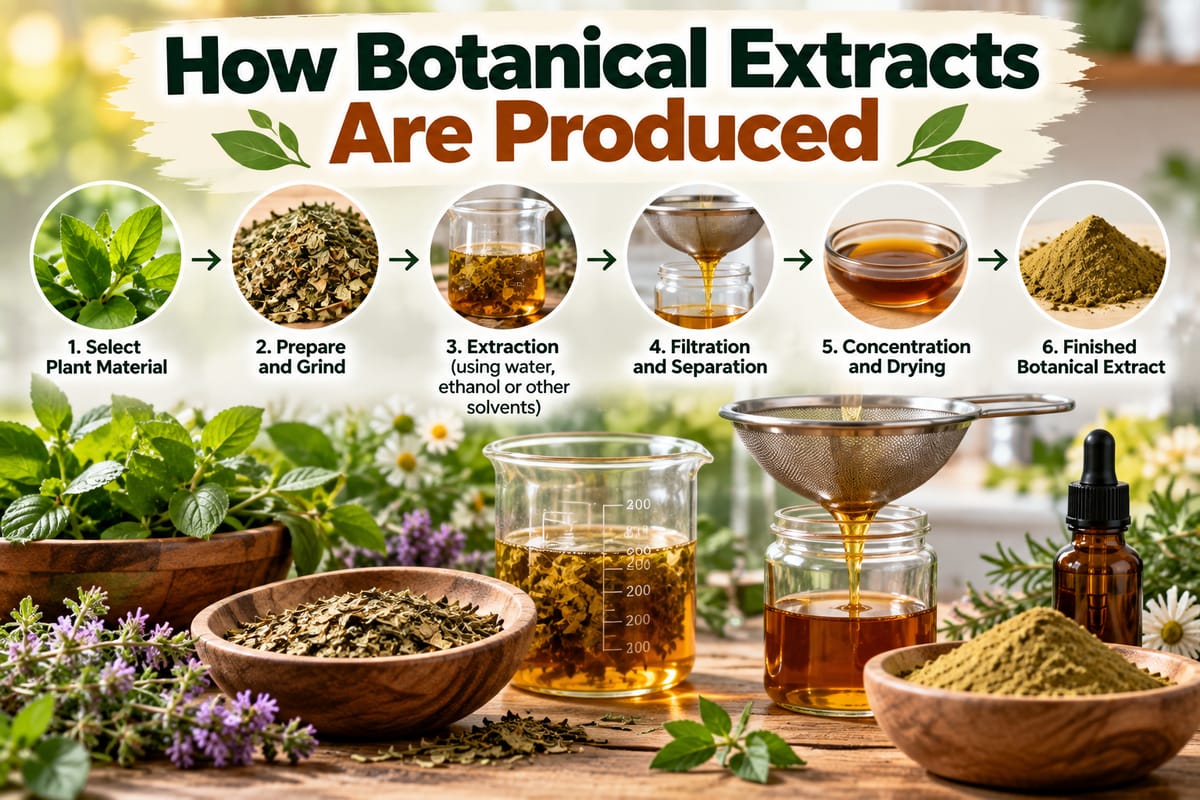

How Botanical Extracts Are Produced
Botanical extracts are concentrated preparations made from plants or specific plant parts. They are used in herbal products, dietary supplements, cosmetics, foods, beverages, traditional preparations, and a wide range of other applications.
Although the finished extract may appear simple—a liquid, powder, capsule ingredient, or concentrated solution—the production process can involve multiple carefully controlled stages. Plant material must first be identified and prepared, followed by extraction, filtration, concentration, drying, testing, and packaging.
The methods used can significantly influence what compounds are present in the final extract, how concentrated it is, how stable it remains, and how consistently it can be produced.
Understanding how botanical extracts are produced also helps explain why an extract is not necessarily equivalent to simply consuming the original plant.
What Is a Botanical Extract?
A botanical extract is a preparation produced by using a process to remove or concentrate selected compounds from plant material.
The starting material may include:
- Leaves
- Flowers
- Roots
- Rhizomes
- Stems
- Bark
- Seeds
- Fruits
- Peels
- Whole aerial portions
The extraction process uses a suitable medium, often called a solvent, to separate certain compounds from the plant material.
Depending on the plant and the intended product, the solvent might be:
- Water
- Ethanol
- A mixture of water and ethanol
- Glycerin
- Oils
- Other specialized extraction solvents
After extraction, the desired compounds may be concentrated while some plant material and other components are removed.
This is one reason it is useful to understand How Botanical Extracts Differ From Whole Herbs. A whole herb contains the plant material in a relatively complete form, while an extract has undergone processing designed to separate and concentrate particular components.
Why Are Plants Extracted?
Extraction allows manufacturers to produce preparations with characteristics that can be difficult to achieve using the raw plant alone.
For example, extraction can:
- Concentrate selected plant compounds
- Reduce the amount of bulky plant material
- Improve consistency between batches
- Produce liquid or powdered preparations
- Make certain compounds easier to incorporate into products
- Remove some unwanted components
- Extend the practical uses of plant-derived ingredients
The purpose of extraction depends heavily on the intended application.
An extract designed for a tea, cosmetic product, food ingredient, or dietary supplement may use different processing methods and specifications.
Step 1: Selecting the Botanical Material
Production begins with the selection of the plant material.
The manufacturer needs to establish exactly what botanical is being used and which part of the plant is appropriate.
For example, an extraction process may use the root of one plant but the leaves or flowers of another.
Important considerations can include:
- Botanical identity
- Plant species
- Plant variety
- Plant part
- Geographic origin
- Harvest conditions
- Growing conditions
- Harvest date
- Storage conditions
Correct identification is essential because closely related plants can have different chemical profiles.
The raw material may be obtained from cultivated plants, controlled agricultural operations, or other supply sources depending on the botanical.
Step 2: Authentication and Quality Checks
Before extraction begins, raw plant material may undergo identification and quality testing.
Authentication helps establish that the material is actually the intended botanical.
Testing can involve different techniques depending on the plant and the manufacturing process.
Possible evaluations include:
- Visual inspection
- Microscopic examination
- Chemical profiling
- Chromatographic testing
- Genetic identification methods
- Moisture analysis
- Microbial testing
- Contaminant screening
The specific testing program varies by product and manufacturer.
This stage is important because extraction does not correct every problem with poor-quality raw material. If the starting material is incorrectly identified, contaminated, degraded, or improperly stored, those issues can affect the finished extract.
For a broader look at evaluating herbal products, see How to Evaluate the Quality, Purity, Identity and Labeling of Herbal Products.
Step 3: Cleaning and Preparing the Plant
Once the botanical material has been approved, it may be cleaned and prepared for extraction.
Preparation can include removing:
- Soil
- Stones
- Foreign plant material
- Damaged material
- Insects
- Other unwanted matter
The plant may then be cut, chopped, crushed, or milled.
The objective is generally to create an appropriate particle size for the extraction method.
Why Particle Size Matters
Particle size can influence how effectively the extraction medium interacts with the plant.
Smaller particles provide greater surface area, which can make it easier for the extraction medium to contact the plant’s internal structures.
However, simply making the material as fine as possible is not always ideal.
Excessively fine material can create filtration difficulties, compaction, or other processing problems.
Manufacturers therefore select particle sizes based on the characteristics of the botanical and the intended extraction process.
Step 4: Choosing the Extraction Method
There is no single method for producing every botanical extract.
Different plants contain different types of compounds, and those compounds have different chemical properties.
Common extraction approaches include:
- Maceration
- Percolation
- Infusion
- Decoction
- Reflux extraction
- Pressurized extraction
- Steam-based processes
- Supercritical fluid extraction
- Oil extraction
The selected method depends on factors such as the plant material, target compounds, desired product format, production scale, and stability requirements.
Water Extraction
Water is one of the oldest and simplest extraction media.
A water-based extraction may involve soaking plant material in water or heating it with water.
Traditional preparations such as teas and decoctions use variations of this principle.
Water is particularly useful for compounds that dissolve effectively in water.
However, not every plant compound is water-soluble, meaning a water-only extraction may not recover the full range of compounds present in the plant.
Alcohol and Hydroalcoholic Extraction
Ethanol is widely used for botanical extraction because it can dissolve a broad range of plant compounds.
A mixture of water and ethanol can sometimes extract compounds with different solubility characteristics more effectively than either liquid alone.
The ratio between water and ethanol can therefore be an important part of the extraction process.
After extraction, the alcohol may be partially or substantially removed depending on the intended product.
Oil Extraction
Some plant compounds are more compatible with oils than with water.
Oil-based extraction methods can therefore be used when the desired constituents are suitable for an oil medium.
These preparations may be particularly relevant to topical products, cosmetic ingredients, and certain traditional preparations.
The resulting material can differ significantly from a water- or alcohol-based extract made from the same botanical.
Step 5: Contacting the Plant With the Extraction Medium
Once the plant and extraction medium have been selected, they are brought into contact.
During this stage, compounds move from the plant material into the extraction medium.
Several factors can influence the process:
- Temperature
- Time
- Particle size
- Solvent composition
- Plant-to-solvent ratio
- Agitation
- Pressure
- pH
- Moisture content
The manufacturer may carefully control these variables to achieve a consistent extraction.
Maceration
Maceration involves soaking plant material in a liquid for a defined period.
The material remains in contact with the solvent while compounds gradually move into the surrounding liquid.
After the desired extraction period, the liquid is separated from the remaining plant material.
Maceration is relatively straightforward but can require considerable time depending on the botanical.
Percolation
In percolation, the extraction liquid passes through prepared plant material.
The solvent gradually moves through the botanical material and collects compounds along the way.
This can provide a controlled extraction process and is used for various botanical preparations.
The design and operating conditions of the percolation system influence the resulting extract.
Infusion and Decoction
Infusion involves exposing plant material to hot or warm water for a defined period.
Tea preparation is a familiar example.
A decoction generally involves heating tougher plant materials, such as roots or bark, in water for longer periods.
Heat can help release compounds from plant structures that may not extract efficiently through simple soaking.
These traditional techniques demonstrate the basic principle behind extraction: creating conditions that allow compounds to move from plant material into a chosen medium.
Step 6: Separating the Extract From the Plant Material
After extraction, the liquid contains both dissolved plant compounds and potentially suspended plant particles.
The solid material needs to be separated.
Methods can include:
- Filtration
- Centrifugation
- Pressing
- Sedimentation
- Mechanical separation
The exact approach depends on the physical properties of the extract.
The resulting liquid is often called an extract solution, extractive, or another term depending on the manufacturing process.
Step 7: Concentrating the Extract
The extracted liquid may contain a substantial amount of water or solvent.
If the desired product is a concentrated extract, some of that liquid needs to be removed.
Concentration can be achieved through controlled evaporation or other separation techniques.
Heat-sensitive compounds require particular care because excessive temperatures can degrade certain constituents.
Manufacturers may therefore control:
- Temperature
- Pressure
- Evaporation rate
- Exposure time
- Oxygen exposure
Vacuum concentration is one approach that can allow some liquids to evaporate at lower temperatures.
The goal is to increase the concentration of the desired material while preserving important characteristics of the extract.
Step 8: Drying the Extract
If the finished product is intended to be a powder, the concentrated extract must generally be dried.
Several drying technologies can be used.
Spray Drying
In spray drying, a liquid extract is converted into small droplets and exposed to a controlled stream of heated air.
The liquid portion evaporates quickly, leaving a dry powder.
Spray drying can be useful for producing powders efficiently at commercial scale.
Freeze Drying
Freeze drying, also called lyophilization, involves freezing the material and removing water under controlled vacuum conditions.
This can be useful for certain heat-sensitive materials, although it may be more expensive or time-consuming than some other drying methods.
Other Drying Approaches
Manufacturers may use other drying systems depending on the physical and chemical characteristics of the extract.
The choice of drying technology can influence:
- Moisture content
- Powder characteristics
- Stability
- Solubility
- Color
- Aroma
- Compound retention
Processing therefore has a direct influence on the final ingredient. The broader principles are explored in How Processing Changes Natural Ingredients.
Step 9: Standardization
Some botanical extracts are standardized to contain a specified amount or range of one or more measurable compounds.
Standardization can help manufacturers produce batches with more consistent chemical characteristics.
For example, an extract might be manufactured to contain a defined concentration of a particular marker compound.
However, standardization does not necessarily mean that the extract is identical to the original plant.
A plant contains numerous compounds, and measuring one or several compounds cannot necessarily describe every aspect of its chemical composition.
The meaning of “standardized” can also vary depending on the product and regulatory environment, so consumers should examine product-specific information rather than assuming the term guarantees a particular quality level.
Step 10: Testing the Finished Extract
After extraction and processing, the finished material can undergo additional testing.
Testing may evaluate characteristics such as:
- Identity
- Potency
- Chemical profile
- Moisture
- Microbial quality
- Heavy metals
- Pesticide residues
- Solvent residues
- Other contaminants
- Physical characteristics
The testing requirements depend on the intended product, manufacturing standards, applicable regulations, and the botanical involved.
Testing helps manufacturers determine whether the finished extract meets established specifications.
Extract Ratios
Botanical products sometimes display an extract ratio, such as:
10:1
An extract ratio generally compares the amount of starting plant material with the amount of resulting extract under a particular manufacturing process.
For example, a theoretical 10:1 ratio could indicate that ten parts of starting material were used to produce one part of extract.
However, an extract ratio should not automatically be interpreted as meaning that the finished product is ten times stronger or ten times more effective.
The ratio does not by itself describe which compounds were extracted, their concentrations, or the biological effects of the final preparation.
Why Two Extracts From the Same Plant Can Differ
Two products made from the same botanical can have substantially different characteristics.
Differences can arise from:
- Plant species or variety
- Plant part
- Growing conditions
- Harvest timing
- Drying conditions
- Extraction solvent
- Solvent concentration
- Temperature
- Extraction duration
- Particle size
- Concentration method
- Drying method
- Standardization target
- Storage conditions
For example, a water extract and an ethanol extract may contain different proportions of compounds because the solvents dissolve different substances.
This is why simply knowing the plant name is often insufficient to understand an extract.
Whole Herbs Versus Extracts
A whole herb and a botanical extract represent different types of plant preparations.
A whole herb generally contains the plant material in a relatively intact or minimally processed form.
An extract has been processed to transfer certain constituents from the plant into another medium and may subsequently be concentrated or dried.
The differences can affect:
- Chemical composition
- Concentration
- Dosage size
- Texture
- Solubility
- Storage requirements
- Product formulation
An extract may therefore provide a concentrated source of certain compounds without containing the same amount of plant fiber, structural material, or other constituents found in the original herb.
Factors That Can Affect Extract Quality
The quality of a botanical extract depends on more than the extraction step itself.
Raw Material Quality
Poor-quality plant material can limit the quality of the finished extract.
Correct Identification
Using the correct botanical species and plant part is essential.
Manufacturing Controls
Consistent temperatures, extraction times, solvent ratios, and processing conditions can improve batch-to-batch consistency.
Contaminant Control
Botanical materials can potentially be exposed to contaminants during cultivation, harvesting, processing, transportation, or storage.
Testing
Appropriate analytical testing can help verify that the finished material meets established specifications.
Storage
Heat, moisture, oxygen, and light can affect certain plant compounds. Packaging and storage conditions can therefore influence stability.
Why Manufacturing Information Matters
Consumers often see only the finished label, while the manufacturing process happens far earlier.
Two products may use the same botanical name but have different extraction methods and chemical profiles.
Useful product information may include:
- Botanical name
- Plant part
- Extract type
- Extraction medium
- Extract ratio
- Standardization information
- Amount per serving
- Batch information
- Manufacturer details
- Testing information
Not every product will provide all of these details, but greater transparency can make it easier to understand what is actually being purchased.
Common Misunderstandings About Botanical Extracts
Several misconceptions can make botanical extracts difficult to understand.
“More Concentrated” Always Means “Better”
Concentration describes the amount of material relative to the starting plant or final product. It does not automatically establish that one preparation is more appropriate or useful than another.
Every Extract Contains the Same Compounds as the Plant
Extraction is selective. The compounds recovered depend on the plant and the extraction conditions.
A Higher Extract Ratio Automatically Means Greater Quality
An extract ratio describes a manufacturing relationship. It does not independently establish purity, safety, effectiveness, or overall quality.
Natural Means Unprocessed
Botanical extracts are natural-origin ingredients, but they can undergo considerable processing before reaching the finished product.
All Botanical Extracts Are Produced the Same Way
Extraction methods vary considerably depending on the plant, target compounds, intended use, and manufacturing requirements.
How Consumers Can Read an Extract Label
When examining a botanical product, it can be useful to look beyond the common plant name.
Consider checking:
- Botanical identity — Is the scientific name provided?
- Plant part — Does the label specify the root, leaf, flower, seed, or another part?
- Extract form — Is it a liquid, powder, tincture, or another preparation?
- Amount — How much extract is included per serving?
- Standardization — Does the label identify measurable marker compounds?
- Other ingredients — What additional substances are present?
- Manufacturer information — Is there enough information to identify the producer?
- Quality information — Does the manufacturer provide meaningful testing or quality information?
Labels cannot reveal every detail about manufacturing, but they can provide important clues about the identity and composition of the finished product.
The Role of Evidence and Safety
Understanding how an extract is made does not establish whether it is effective for a particular health purpose.
Those are separate questions.
Evidence about a botanical preparation depends on the specific plant, extract, dose, preparation, intended use, and available research.
A study involving a whole herb does not necessarily establish the same effects for a concentrated extract. Likewise, research involving one extraction method cannot automatically be applied to every product made from the same botanical.
Anyone evaluating a botanical product should therefore consider both how it was produced and what evidence exists for the specific preparation and intended use.
The broader principles involved in evaluating evidence and natural products are covered in the Complete Guide to Natural Remedies: Evidence.
From Plant Material to Finished Extract
The production of a botanical extract can be summarized as a sequence:
Plant Selection
↓
Authentication & Quality Testing
↓
Cleaning & Preparation
↓
Size Reduction
↓
Extraction
↓
Separation
↓
Concentration
↓
Drying
↓
Standardization or Blending
↓
Finished-Product Testing
↓
Packaging & Storage
Each stage can influence the characteristics of the final product.
The process begins with a plant but does not end with simply removing a substance from it. Manufacturers must also consider identity, extraction conditions, concentration, stability, contamination, consistency, testing, and storage.
That is why two botanical extracts made from the same plant can have noticeably different compositions.
Why the Production Process Matters
Botanical extracts are the result of a chain of decisions that begins with the raw plant and continues through processing, testing, and packaging. The plant species and part used, extraction medium, temperature, extraction time, concentration method, drying technology, and quality controls can all influence the finished material.
Understanding this process makes it easier to interpret terms such as extract, standardized extract, extract ratio, and whole herb without assuming that they mean the same thing.
For consumers, the most useful approach is to consider the complete picture: what plant was used, which part was extracted, how it was processed, what the finished product contains, how its quality is assessed, and what evidence exists for its intended use.
That context turns a botanical extract from a simple ingredient name on a label into something that can be evaluated more carefully and realistically.
Continue Reading
Similar Posts

What Foods Are Considered Anti-Inflammatory?
Certain foods are commonly described as **anti-inflammatory foods** because they contain nutrients and plant compounds associated with healthier inflammatory responses.
Read article
When Natural Self Care Is Not Appropriate
Knowing when to stop relying on self-care and seek appropriate medical attention is an important part of using natural approaches responsibly.
Read article
Natural Approaches for Occasional Muscle Discomfort
Understanding the available options can help people choose practical approaches while recognizing when self-care is no longer enough.
Read article

Join 10,000+ Readers Building Healthier Habits
Get actionable wellness tips every week plus our newest articles delivered straight to your inbox.