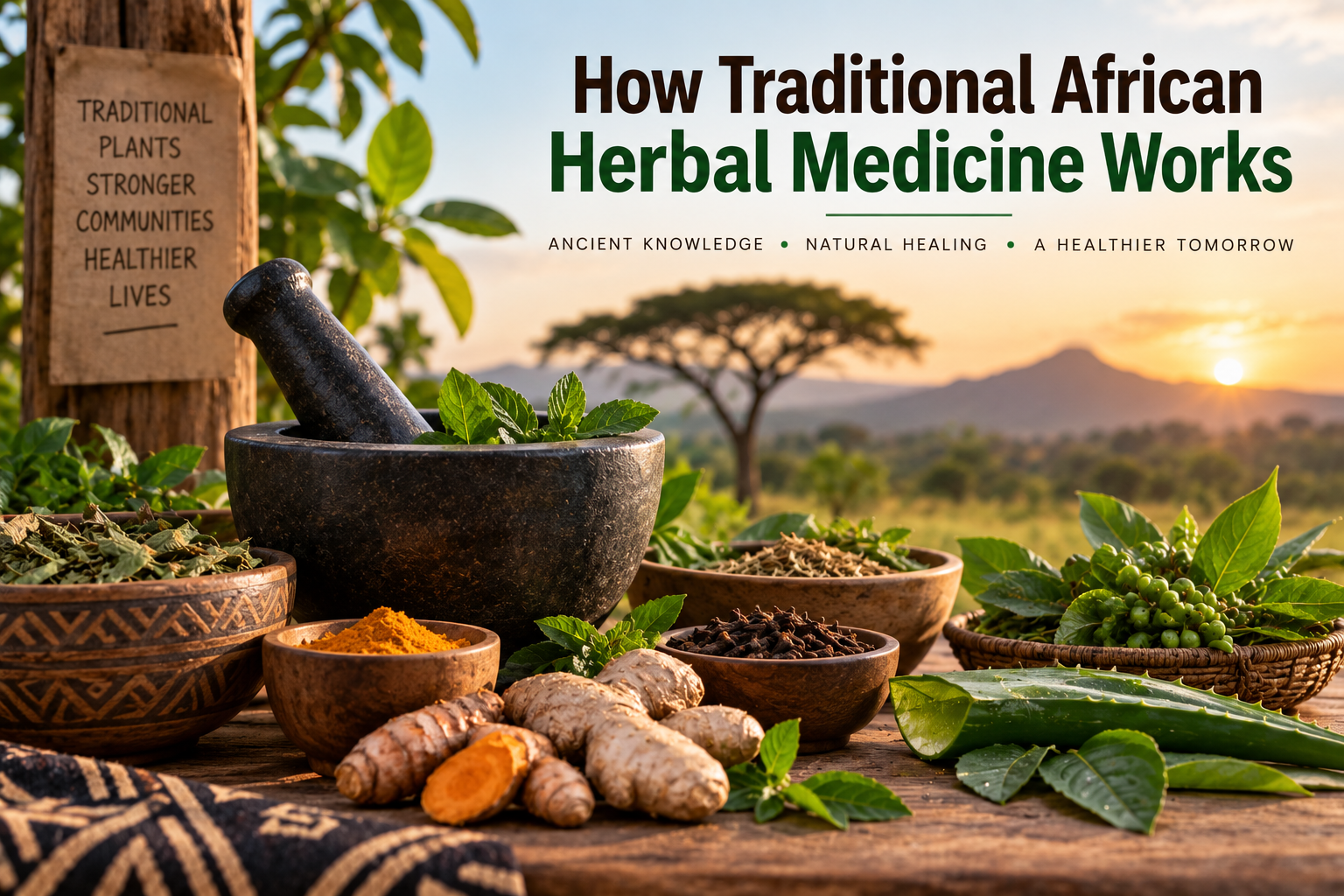
How Traditional African Herbal Medicine Works
Traditional African herbal medicine has been used for generations to support health and manage a wide range of conditions. Across the continent, communities have developed extensive knowledge of medicinal plants, preparation methods, and healing practices based on local environments and cultural traditions.
However, there is no single system that can accurately be called “traditional African herbal medicine.” Africa contains thousands of communities with different languages, cultures, ecosystems, and medical traditions. The plants used in one region may be completely different from those used elsewhere, and the meanings attached to particular remedies can vary considerably.
Understanding how these remedies work requires looking at both traditional knowledge and modern scientific research. Some medicinal plants contain compounds with biological effects that researchers can study, while evidence for other traditional uses remains limited or uncertain.
What Is Traditional African Herbal Medicine?
Traditional African herbal medicine refers broadly to health practices that use plants and plant-derived preparations within established traditional healing systems across African communities.
Depending on the tradition, medicinal plants may be used as:
- Teas and infusions
- Decoctions made by boiling plant material
- Powders
- Fresh plant preparations
- Pastes
- Extracts
- Poultices applied to the skin
- Bathing or washing preparations
- Ingredients in mixtures containing several plants
Traditional healers may use roots, leaves, stems, bark, flowers, seeds, fruits, or other parts of a plant. The preparation method can influence which compounds are extracted and how concentrated the resulting remedy becomes.
The broader principles behind plant-based healing are also explored in herbal medicine explained, including how medicinal plants can contain naturally occurring compounds that interact with biological processes.
A Diverse Tradition Rather Than One Medical System
One of the most important points about African herbal medicine is its diversity.
Traditional healing practices have developed independently across different regions and communities. Knowledge has often been transmitted orally from generation to generation, with experienced practitioners learning about plants, preparation techniques, traditional diagnoses, and appropriate uses.
Environmental conditions also influence traditional medicine. Communities living in forest, savannah, coastal, mountainous, or arid environments have access to different plant species.
This means that claims about “African herbal medicine” should be treated carefully. A remedy traditionally used in one community should not automatically be assumed to be a standard treatment across the continent.
How Medicinal Plants May Affect the Body
Plants contain naturally occurring chemical compounds known as phytochemicals. Some of these compounds can interact with biological systems.
Depending on the plant and its chemical composition, researchers may investigate effects involving inflammation, microorganisms, oxidative processes, digestion, the nervous system, or other physiological pathways.
This does not mean that every plant used traditionally has a proven medicinal effect. It means that plants are chemically complex organisms, and some contain substances capable of producing biological activity.
Modern pharmaceutical medicine has also benefited historically from compounds originally identified in plants. Researchers can isolate particular compounds, study their effects, determine appropriate doses, and develop medicines from them.
Traditional preparations, however, are often much more chemically complex because they may contain many compounds at once.
Why Preparation Matters
The way a plant is prepared can substantially affect what ends up in the final remedy.
For example, boiling plant material in water may extract certain water-soluble compounds, while other substances may be extracted more effectively using different methods.
The part of the plant used can also matter. Leaves, roots, bark, seeds, and fruits can have different chemical compositions.
Factors such as the plant’s age, growing conditions, harvesting season, storage conditions, and preparation technique may also influence the resulting mixture.
This creates an important distinction between a traditionally prepared remedy and a standardized pharmaceutical product. Two preparations made from what appears to be the same plant may not necessarily contain identical concentrations of active compounds.
Traditional Knowledge and Experience
Traditional medicine is often based on accumulated community experience.
Over many generations, people may observe that particular plants are associated with certain uses. Practitioners can develop detailed knowledge of where plants grow, which parts are collected, how they are prepared, and how they are traditionally administered.
This accumulated knowledge can provide valuable starting points for scientific investigation.
At the same time, traditional use and scientific proof are not identical. A remedy may have been used for generations without researchers having enough evidence to determine exactly how it works, how effective it is, what dose is appropriate, or whether it is safe for everyone.
The relationship between these two forms of knowledge is examined further in traditional remedies versus modern research.
Traditional Remedies and Modern Scientific Research
Modern research approaches herbal medicine differently from traditional practice.
Researchers may begin by identifying a plant that has a history of traditional use. They can then analyze its chemical constituents and investigate biological activity in laboratory studies.
Further research may involve:
- Cell-based experiments
- Animal studies
- Toxicity testing
- Pharmacological research
- Human observational studies
- Clinical trials
- Reviews of existing evidence
Each stage can answer different questions.
Laboratory research may suggest that a compound has a particular biological effect, but that does not automatically demonstrate that consuming the plant produces the same effect in humans.
Human clinical research is generally needed to determine whether a treatment provides meaningful benefits under controlled conditions.
Evidence Can Vary Considerably
The evidence supporting traditional herbal remedies is not uniform.
Some plants have been studied extensively, while others have received relatively little scientific attention. Even when research exists, studies may differ in quality, size, methodology, and findings.
This is why it is useful to evaluate evidence rather than assuming that a remedy is either automatically effective or automatically ineffective because it is traditional.
The complete guide to natural remedies evidence provides a useful framework for thinking about the strength and limitations of evidence surrounding natural treatments.
Important questions include:
- Has the remedy been studied in humans?
- How large were the studies?
- Were they properly controlled?
- Were the findings consistent?
- Was the preparation standardized?
- What dose was used?
- Were side effects documented?
- Have interactions with medicines been investigated?
These questions help separate promising traditional uses from claims that have not yet been adequately demonstrated.
Safety Is an Important Part of Herbal Medicine
Natural does not automatically mean safe.
Plants can contain powerful compounds, and some may cause adverse effects when consumed incorrectly or in excessive quantities. Others may be unsafe for particular groups of people.
Potential concerns can include:
- Allergic reactions
- Toxicity
- Contamination
- Incorrect identification of plants
- Excessive doses
- Interactions with prescription medicines
- Interactions with other supplements or herbs
- Variations in preparation strength
Some risks can be particularly difficult to assess when a traditional preparation contains several plants at once.
People taking prescription medication, pregnant or breastfeeding individuals, children, older adults, and people with significant medical conditions should be especially cautious about using unfamiliar herbal preparations.
Plant Identification Matters
Correctly identifying a medicinal plant is essential.
Different plants can have similar common names, and a mistaken identification may result in the use of a completely different species. Some plants may resemble others while having very different chemical properties and safety profiles.
Traditional practitioners may rely on detailed local knowledge to distinguish plants, but commercial products can introduce additional challenges.
For this reason, people should avoid consuming unidentified wild plants simply because they have been described as traditional remedies.
Dosage Can Be Difficult to Standardize
Conventional medicines generally contain carefully measured quantities of active ingredients. Traditional herbal preparations may not always have the same level of standardization.
A homemade preparation could vary depending on:
- The amount of plant material used
- The part of the plant selected
- The concentration of the preparation
- The amount consumed
- The preparation method
- The age and condition of the plant
- How long the preparation was stored
These differences can make it difficult to determine exactly how much of a particular compound a person is receiving.
Standardization is therefore an important issue when traditional herbal products are studied or developed for broader medical use.
The Role of Traditional Healers
Traditional healers have historically played important roles in many African communities.
Their practices may extend beyond the use of medicinal plants and can include approaches to physical symptoms, social relationships, cultural beliefs, spiritual concerns, and community wellbeing.
The role and recognition of traditional healers differ substantially between countries and communities.
In some settings, traditional medicine remains an important source of healthcare, particularly where conventional medical services may be difficult to access. In other settings, people use traditional and conventional approaches alongside one another.
Understanding this context is important when discussing herbal medicine because its significance cannot be reduced to the chemical properties of individual plants alone.
Herbal Medicine and Conventional Medicine
Traditional herbal medicine and conventional medicine are sometimes presented as opposing systems, but people’s real-world healthcare choices can be more complicated.
Some individuals use herbal preparations alongside prescribed medicines, while others use them as their primary approach to managing certain symptoms.
The important issue is understanding what is known about each treatment and whether combining approaches could create risks.
A broader comparison is provided in natural remedies versus conventional medicine, which considers differences in evidence, regulation, safety, and how treatments are evaluated.
People should tell healthcare professionals about herbal products they are using, particularly when taking prescription medicines. An apparently harmless supplement can sometimes affect how another medicine works.
Why Scientific Testing Still Matters
Scientific testing does not have to dismiss traditional knowledge. Instead, it can help determine which traditional practices are effective, which require further research, and which may carry unacceptable risks.
Researchers can investigate traditional remedies using methods that measure:
- Chemical composition
- Biological activity
- Dosage
- Absorption
- Metabolism
- Effectiveness
- Toxicity
- Drug interactions
This process can potentially identify useful compounds while also protecting people from unsafe applications.
Traditional knowledge can provide valuable leads, but rigorous research helps determine whether those leads translate into reliable health benefits.
Conservation and Sustainable Harvesting
The use of medicinal plants also raises environmental questions.
When demand for particular plants increases, excessive harvesting can threaten wild populations. This can be especially concerning when roots or bark are collected because removing these parts may damage or kill the plant.
Sustainable cultivation and harvesting practices can help protect medicinal plant resources.
Conservation is therefore connected to the future of traditional herbal medicine. Preserving plant biodiversity can help ensure that communities and researchers retain access to important botanical resources.
Preserving Traditional Knowledge
Traditional medicinal knowledge represents an important form of cultural heritage.
Much of this knowledge has historically been passed from one generation to another through teaching and practical experience. As communities change and natural environments are transformed, some traditional knowledge may become harder to preserve.
Documenting traditional plant knowledge responsibly can support research and conservation while respecting the communities from which that knowledge originates.
It is also important that research and commercial development involving traditional knowledge consider questions of cultural ownership, informed participation, recognition, and fair benefit sharing.
A Balanced Way to Understand Herbal Medicine
Traditional African herbal medicine sits at the intersection of culture, ecology, traditional knowledge, chemistry, and modern healthcare.
Some medicinal plants contain compounds with potentially useful biological effects, and scientific research continues to investigate many botanical substances. At the same time, traditional use alone cannot establish that a remedy is effective or safe for every person or condition.
A sensible approach is therefore neither to dismiss traditional medicine automatically nor to assume that every traditional remedy is proven simply because it is natural or longstanding.
The most useful perspective recognizes the value of traditional knowledge while applying careful standards of evidence and safety. As research continues, the combination of cultural knowledge, botanical conservation, laboratory science, and well-designed human studies may provide a clearer understanding of which traditional herbal practices can contribute meaningfully to modern approaches to health.
Continue Reading
Similar Posts
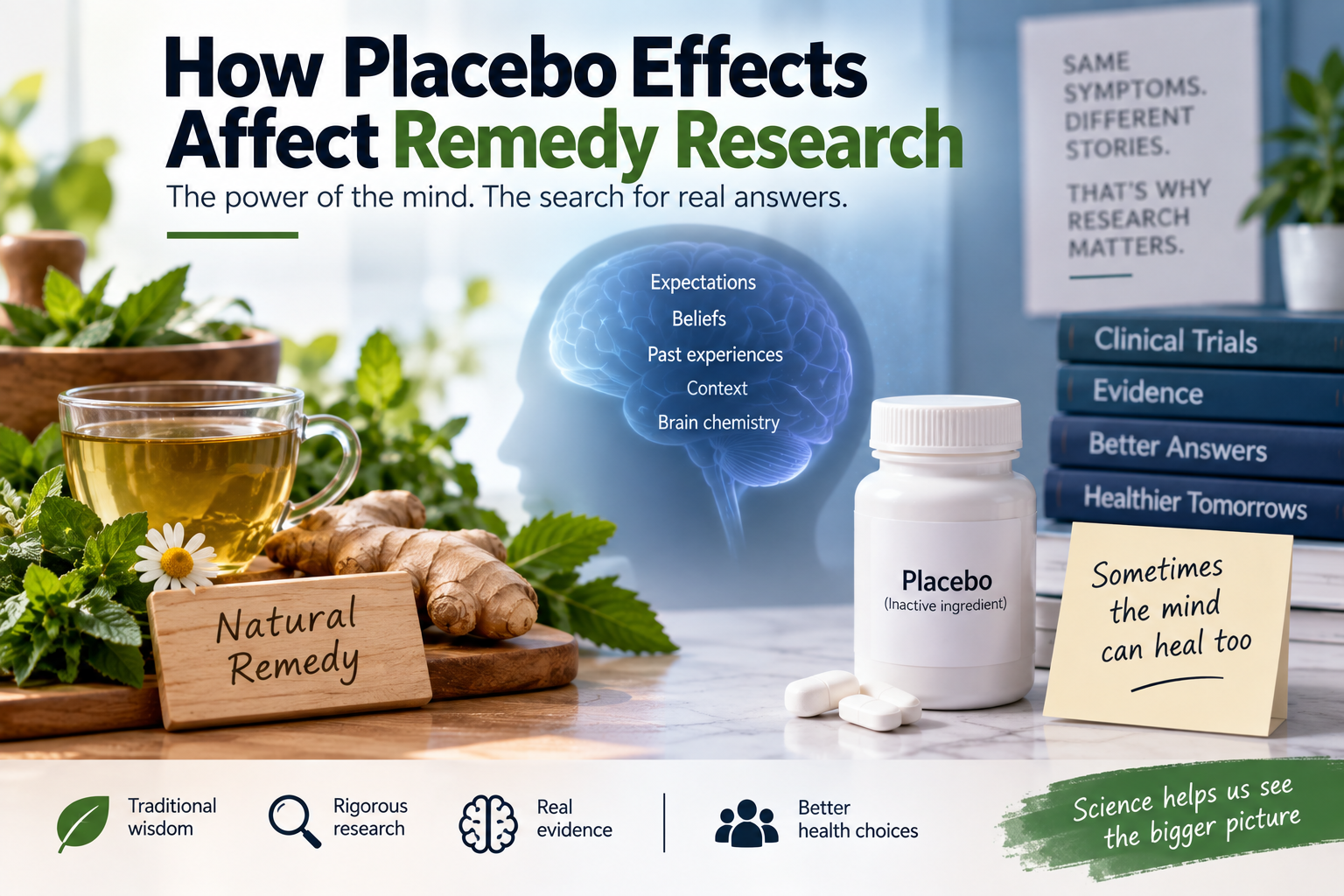
How Placebo Effects Affect Remedy Research
For natural remedies, this distinction can be particularly important. Many remedies have long histories of traditional use, and people may have strong expectations about their effectiveness. Carefully designed research is therefore needed to determine whether improvements are caused by the remedy, the context surrounding its use, natural changes in symptoms or some combination of factors
Read article
Are Natural Remedies Safe During Pregnancy
The safest approach is not to assume that a remedy is harmless simply because it is natural. Instead, its ingredients, dose, purpose, evidence, and potential risks should all be considered.
Read article
Natural Ways to Support Comfort and Recovery During a Common Cold
Most common colds are caused by viruses and improve on their own. The goal of supportive care is therefore not to eliminate the virus directly, but to ease symptoms, maintain hydration and give the body the conditions it needs to recover.
Read article

Join 10,000+ Readers Building Healthier Habits
Get actionable wellness tips every week plus our newest articles delivered straight to your inbox.