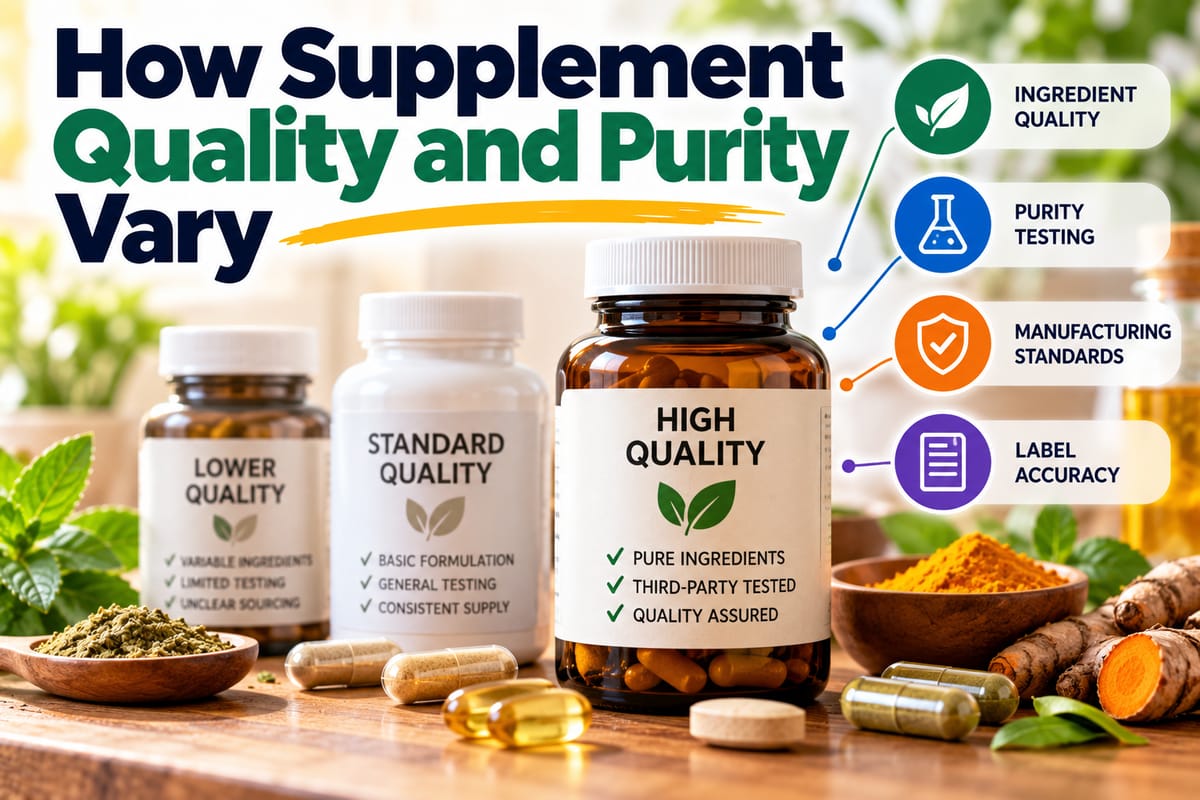

How Supplement Quality and Purity Vary
Dietary supplements can contain vitamins, minerals, herbs, amino acids, enzymes, oils, and many other substances. They are often sold as convenient ways to add specific nutrients or other compounds to a person’s diet.
But not every supplement is identical.
Two products that appear to contain the same ingredient can differ in concentration, formulation, manufacturing quality, purity, stability, and labeling. The quality of a supplement can also depend on how its ingredients were sourced, processed, stored, tested, and packaged.
This makes supplement quality more complicated than simply reading the name of an ingredient on the front of a bottle.
Understanding why quality and purity vary can help consumers ask better questions, interpret labels more carefully, and recognize why independent testing and responsible manufacturing practices matter.
What Does Supplement Quality Mean?
Supplement quality refers broadly to how reliably a product meets its intended specifications.
Quality can involve several characteristics, including:
- Correct ingredient identity
- Appropriate ingredient amounts
- Consistent formulation
- Acceptable purity
- Proper manufacturing
- Stability during storage
- Accurate labeling
- Appropriate packaging
- Testing and quality controls
A high-quality supplement should be manufactured according to processes designed to ensure that the product matches its specifications.
Quality is therefore broader than whether a supplement produces a particular health effect.
A product can contain the stated ingredient while still having questions surrounding purity, consistency, stability, or labeling.
What Does Purity Mean?
Purity generally refers to how free an ingredient or product is from unwanted substances.
Depending on the product, unwanted substances could include:
- Contaminants
- Residual materials from processing
- Microorganisms
- Unintended plant material
- Heavy metals
- Pesticide residues
- Undeclared ingredients
- Degradation products
- Foreign substances
The specific contaminants that matter depend on the type of supplement and how it was produced.
For example, an herbal product may require different quality considerations from a mineral supplement or an oil-based product.
Purity is therefore not a single measurement that applies identically to every supplement.
Quality and Purity Are Related but Different
Quality and purity overlap, but they are not interchangeable.
Consider a supplement that contains the correct ingredient but has an inaccurate amount listed on the label.
The product may have an ingredient-identity issue or a formulation consistency problem even if the ingredient itself is relatively pure.
Likewise, a product could contain the correct amount of an ingredient but also contain an unwanted contaminant.
A broader quality assessment therefore considers multiple characteristics at the same time.
Why Supplement Quality Can Vary
There are many stages between sourcing an ingredient and placing a finished supplement on a store shelf.
Quality can be influenced by:
- Raw-material sourcing
- Ingredient identification
- Processing
- Formulation
- Manufacturing
- Testing
- Packaging
- Storage
- Transportation
- Final distribution
Problems at any stage can potentially affect the finished product.
This is one reason manufacturing and quality-control systems matter.
Raw Materials Can Differ
The starting materials used to make supplements can vary considerably.
For plant-based ingredients, differences may occur because of:
- Plant species
- Plant variety
- Growing conditions
- Geographic origin
- Soil conditions
- Harvest timing
- Plant part used
- Drying methods
- Storage conditions
Two batches of a plant ingredient can therefore differ naturally even before processing takes place.
Good quality-control systems need ways to identify and manage this variation.
Plant Identity Matters
Herbal products present particular challenges because plants can have similar names or appearances.
A product may need to be identified using characteristics such as:
- Scientific name
- Plant part
- Physical characteristics
- Chemical markers
- Analytical testing
Correct identity is important because different species can have substantially different chemical profiles.
The article How to Evaluate the Quality, Purity, Identity and Labeling of Herbal Products provides a more detailed framework for evaluating these characteristics in herbal products.
Plant Parts Can Make a Difference
The same plant may contain different compounds in its:
- Roots
- Leaves
- Flowers
- Seeds
- Bark
- Fruit
- Stems
A label that identifies only the plant name may not provide enough information to understand exactly what material is being used.
For herbal supplements, the plant part can therefore be an important part of product identity.
Extraction Can Change Composition
Many herbal supplements are not simply dried plants.
They may be processed into extracts using water, alcohol, oils, or other extraction methods.
Extraction can concentrate certain compounds while leaving others behind.
As a result, an herbal extract may have a substantially different composition from the original plant material.
This makes extraction methods and standardization relevant considerations when evaluating product quality.
Standardization Does Not Mean Every Product Is Identical
Some supplements are described as standardized.
In general, standardization refers to controlling or adjusting a product according to specified characteristics, often involving particular chemical constituents.
This can help create greater consistency between batches.
However, the word “standardized” by itself does not tell consumers everything about a product’s overall quality, purity, safety, or effectiveness.
It is one characteristic within a larger quality system.
Ingredient Amounts Can Vary
The amount of an ingredient in a supplement matters.
For example, two products may both contain the same vitamin or botanical ingredient but provide different amounts per serving.
Even when the front of a package uses similar language, the actual serving size and ingredient quantities may differ.
Consumers should therefore examine the Supplement Facts or equivalent information rather than relying only on the product name or marketing claims.
Serving Size Matters
A label may list an amount per serving rather than per capsule, tablet, or scoop.
For example, a product could state that a serving consists of two capsules.
Someone taking only one capsule would receive approximately half of the listed amount, assuming the formulation is evenly distributed.
Understanding serving size is therefore essential when comparing products.
Label Accuracy Matters
Labels communicate important information about what a supplement is supposed to contain.
A label may provide:
- Serving size
- Ingredient names
- Amounts per serving
- Other ingredients
- Directions
- Storage information
- Manufacturer information
- Warnings or precautions
The article How to Read Supplement Labels Correctly provides a more detailed explanation of how consumers can interpret supplement labels and distinguish useful information from marketing language.
A careful label review is one of the simplest steps consumers can take before purchasing a supplement.
Other Ingredients Matter Too
The active or featured ingredient is not necessarily the only substance in a supplement.
Products can contain other ingredients used for purposes such as:
- Binding
- Coating
- Flavoring
- Coloring
- Preservation
- Stabilization
- Improving texture
- Maintaining product consistency
These ingredients may be appropriate for their intended purpose, but people with allergies, intolerances, dietary restrictions, or other considerations may want to examine them carefully.
Testing Can Help Assess Quality
Testing is an important part of supplement quality control.
Depending on the product, testing may examine:
- Identity
- Potency
- Purity
- Microbial contamination
- Heavy metals
- Residual substances
- Other relevant characteristics
Testing can occur at different stages of manufacturing.
Raw materials may be tested before they enter production, while finished products can be tested before release.
The exact testing program depends on the type of product and the manufacturer’s quality system.
Different Tests Answer Different Questions
There is no single test that establishes every aspect of supplement quality.
For example:
Identity testing: Is this actually the intended ingredient?
Potency testing: Is the ingredient present at the expected amount?
Purity testing: Are unwanted substances within appropriate specifications?
Microbial testing: Are relevant microorganisms controlled?
Stability testing: Does the product remain within specifications over its expected shelf life?
These tests answer different questions.
A product may therefore require multiple forms of testing to establish that it meets its specifications.
For a deeper look at this process, How Supplement Quality and Testing Work explains how testing and quality-control processes can be used to evaluate supplement products.
Why Batch-to-Batch Consistency Matters
A manufacturer may produce the same supplement repeatedly.
Consumers generally expect the product to remain reasonably consistent from one batch to another.
Quality-control systems can help establish specifications for:
- Ingredient identity
- Ingredient quantity
- Physical characteristics
- Purity
- Stability
Testing can then help determine whether individual batches meet those specifications.
Consistency is particularly important for products that consumers take regularly.
Storage Can Affect Supplement Quality
A supplement’s quality can change after manufacturing if it is stored improperly.
Factors that may affect stability include:
- Heat
- Moisture
- Light
- Oxygen
- Time
- Repeated exposure to air
Some ingredients are particularly sensitive to environmental conditions.
This is why products may include storage instructions such as keeping them in a cool, dry place or protecting them from excessive moisture.
Consumers should follow the manufacturer’s storage recommendations.
Packaging Has a Role
Packaging does more than make a product look attractive.
It can help protect the contents from environmental conditions and contamination.
Depending on the product, packaging may be designed to limit exposure to:
- Air
- Moisture
- Light
- Physical damage
A damaged seal, unusual appearance, or compromised container can be a reason to avoid using the product until its condition can be clarified.
Expiration and Best-By Dates
Many supplements have a date indicating when the manufacturer expects the product to remain within specified characteristics when stored appropriately.
The significance of the date depends on the product and the manufacturer’s stability information.
A supplement that has been stored under unsuitable conditions may deteriorate faster than one stored according to instructions.
Date information should therefore be considered alongside storage conditions and the physical condition of the product.
Contamination Can Occur at Different Stages
Contamination can potentially enter a product at several points.
Possible stages include:
- Farming or harvesting
- Transportation
- Ingredient processing
- Manufacturing
- Packaging
- Storage
For plant materials, environmental contaminants may be relevant.
During manufacturing, contamination can occur if facilities, equipment, or processes are not adequately controlled.
Strong quality systems are designed to identify and reduce these risks.
Microbial Contamination
Some supplements can provide conditions that allow microorganisms to become a concern.
This may be particularly relevant to products containing moisture-sensitive ingredients or certain raw materials.
Manufacturers can use appropriate testing and processing controls to manage microbial risks.
Consumers should also follow storage instructions and avoid using products that show obvious signs of spoilage or contamination.
Heavy Metals and Environmental Contaminants
Some raw materials can be exposed to environmental contaminants.
For plant-based ingredients, the growing environment can influence what substances are present in the raw material.
Depending on the ingredient, quality-control programs may therefore test for substances such as certain heavy metals or pesticide residues.
The relevant testing requirements and acceptable specifications can differ according to the product and applicable standards.
Undeclared Ingredients Are a Serious Quality Concern
One of the more significant concerns in supplement quality is the presence of ingredients that are not properly disclosed.
An undeclared ingredient can make it difficult for consumers and healthcare professionals to understand what someone is actually taking.
This can be particularly important when a person uses prescription medicines or has allergies or other health considerations.
A transparent ingredient list is therefore an important part of responsible product labeling.
Marketing Claims Do Not Prove Quality
Supplement packaging can contain attractive statements about purity, strength, natural ingredients, or advanced formulations.
These statements should not automatically be treated as proof of product quality.
Marketing language and quality evidence serve different purposes.
A more useful evaluation considers:
- What exactly is in the product?
- Is the ingredient clearly identified?
- How much is present?
- What testing has been performed?
- Is there credible quality-control information?
- Are the manufacturer’s claims specific and understandable?
Consumers should look beyond the front of the package.
Third-Party Testing
Some supplement manufacturers use independent laboratories or certification organizations to provide additional testing or verification.
Third-party testing can provide useful information when the program is transparent and meaningful.
However, a certification logo alone does not tell consumers everything about a product.
It can be useful to understand:
- What organization performed the testing
- What characteristics were evaluated
- Whether testing applies to the specific product
- Whether testing is performed on a batch basis
- What standards are being applied
The details matter more than the presence of a logo by itself.
Why Price Does Not Automatically Determine Quality
It is tempting to assume that an expensive supplement must be better than a cheaper alternative.
Price, however, can reflect many factors, including:
- Marketing
- Packaging
- Retail margins
- Ingredient costs
- Manufacturing costs
- Research and development
- Distribution
- Brand positioning
A higher price does not automatically establish greater purity or accuracy.
Similarly, a low price does not automatically prove poor quality.
Comparing product information and quality practices can provide more useful information than price alone.
Comparing Two Similar Supplements
Suppose two products both advertise the same herbal ingredient.
A useful comparison could examine:
| Factor | Product A | Product B |
|---|---|---|
| Ingredient identity | Check label | Check label |
| Plant part | Compare | Compare |
| Serving size | Compare | Compare |
| Ingredient amount | Compare | Compare |
| Extract information | Compare | Compare |
| Other ingredients | Compare | Compare |
| Testing information | Investigate | Investigate |
| Storage instructions | Check | Check |
| Manufacturer information | Check | Check |
This approach is more informative than comparing only the front-label claims.
Quality Is Also Relevant to Herbal Supplements
Herbal products can have additional quality considerations because plants naturally contain many different chemical compounds.
Factors such as species, plant part, growing conditions, harvesting, processing, and extraction can affect the final composition.
Consumers may therefore encounter products that use similar common names but differ significantly in what they actually contain.
This is why botanical identity and detailed labeling are particularly useful when evaluating herbal supplements.
Dietary Supplements Include Many Different Product Types
The term “supplement” covers a broad range of products.
These can include:
- Vitamins
- Minerals
- Herbal products
- Amino acids
- Enzymes
- Probiotics
- Fatty acids
- Protein products
- Combination formulas
Each category can have different quality considerations.
A liquid product may face different stability challenges from a tablet. An herbal extract may require different identity testing from a single mineral ingredient.
The Complete Guide to Dietary Supplements provides a broader overview of supplement categories, uses, formulations, and considerations.
Why Combination Supplements Can Be Harder to Evaluate
Some products contain many ingredients in one formula.
Combination products can be convenient, but they can also make evaluation more complicated.
Consumers may need to consider:
- The amount of each ingredient
- Whether doses overlap with other supplements
- Potential interactions
- The purpose of each ingredient
- Whether the combination has been adequately tested
- Whether the label clearly identifies all ingredients
More ingredients do not automatically mean a better product.
A simpler formulation can sometimes make it easier to understand exactly what is being consumed.
Natural Does Not Automatically Mean Pure
Natural ingredients can contain many compounds.
A plant-derived ingredient may naturally include substances that are desirable, neutral, or undesirable depending on the product and intended use.
Natural materials can also be exposed to contaminants through environmental conditions or processing.
Therefore, the terms natural, organic, plant-based, or herbal should not be treated as automatic guarantees of purity.
Quality still depends on sourcing, identification, processing, testing, and manufacturing controls.
Purity Does Not Automatically Mean Effectiveness
An important distinction is that purity and effectiveness answer different questions.
A product can meet a purity specification while evidence for a particular health benefit remains limited.
Likewise, a product’s effectiveness cannot be established simply because it contains a particular ingredient.
Consumers should therefore separate several questions:
- Is the ingredient actually present?
- Is the amount accurate?
- Is the product sufficiently pure?
- Is the product stable?
- Is there evidence that the ingredient produces the intended effect?
- Is the product appropriate for the individual?
These questions require different types of information.
What Consumers Can Look For
When evaluating a supplement, consumers can begin with basic checks.
Read the Entire Label
Do not rely solely on the front of the package.
Check the Serving Size
Determine how much product constitutes one serving.
Examine Ingredient Amounts
Look at the quantity of each listed ingredient.
Identify the Ingredients Clearly
For herbal products, check the botanical name and plant part when provided.
Look for Manufacturer Information
A transparent product should provide information that allows consumers to identify who is responsible for manufacturing or distributing it.
Consider Testing Information
Look for meaningful information about quality testing rather than relying solely on broad marketing statements.
Check Storage Instructions
Proper storage can affect stability.
Consider the Product’s Purpose
Ask whether the product actually fits the intended nutritional or health need.
Questions to Ask About Supplement Quality
Consumers do not necessarily need to become laboratory experts to evaluate supplements.
A few practical questions can help:
- What exactly is in this product?
- How much of each ingredient is provided?
- Is the ingredient clearly identified?
- Does the label explain the serving size?
- Is there information about testing?
- Is the product from a manufacturer with clear quality practices?
- Are there unusual or unexplained claims?
- Does the packaging appear intact?
- Has the product been stored appropriately?
- Could the ingredients interact with medicines or other supplements?
These questions create a more informed starting point.
When Professional Advice Is Useful
Supplement quality is only one part of deciding whether a product is appropriate.
Individual circumstances also matter.
A healthcare professional or pharmacist can help evaluate potential issues involving:
- Prescription medicines
- Multiple supplements
- Pregnancy
- Breastfeeding
- Children
- Older adults
- Allergies
- Chronic health conditions
- Planned medical procedures
This is especially important when someone is considering a concentrated product or taking multiple biologically active substances.
Why Transparent Information Matters
Consumers cannot independently verify every aspect of a supplement’s production.
They therefore rely partly on the information provided by manufacturers, retailers, testing organizations, and other sources.
Clear information about ingredients, amounts, testing, manufacturing, and storage makes it easier for consumers to evaluate products.
Vague claims make that process more difficult.
Transparency does not guarantee that a product is appropriate for everyone, but it provides a stronger basis for informed evaluation.
Building a More Careful Supplement-Selection Habit
Supplement quality should be evaluated as a collection of characteristics rather than reduced to a single word such as “pure,” “natural,” or “premium.”
The identity of the ingredient matters. So does its amount, formulation, processing, purity, stability, packaging, labeling, and testing.
Consumers can improve their decision-making by reading the full label, comparing serving sizes, examining ingredient details, looking for meaningful quality information, and considering how the product fits into their individual circumstances.
A supplement bottle may look simple on a store shelf, but the quality of the product inside depends on a long chain of decisions and controls. Understanding that chain makes it easier to distinguish between what a product claims to be and what its quality information can actually demonstrate.
Continue Reading
Similar Posts

What Foods Are Considered Anti-Inflammatory?
Certain foods are commonly described as **anti-inflammatory foods** because they contain nutrients and plant compounds associated with healthier inflammatory responses.
Read article
When Natural Self Care Is Not Appropriate
Knowing when to stop relying on self-care and seek appropriate medical attention is an important part of using natural approaches responsibly.
Read article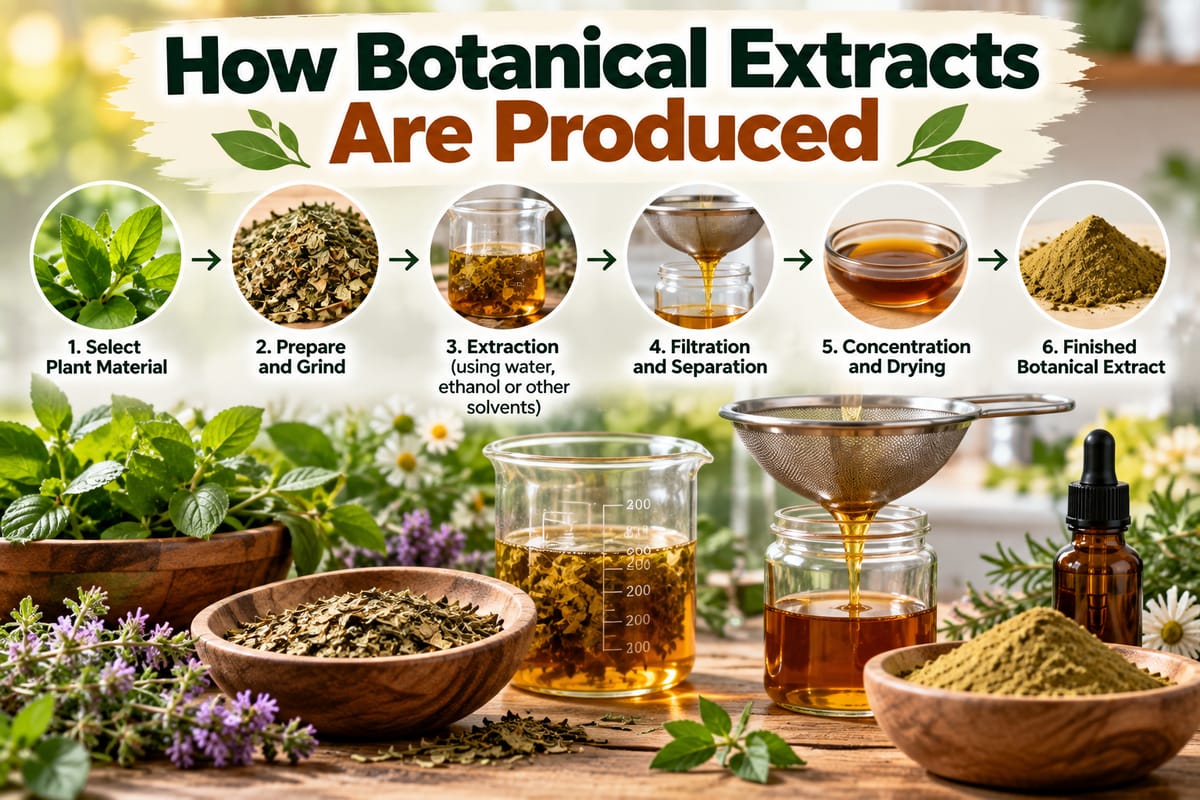
How Botanical Extracts Are Produced
Understanding how botanical extracts are produced also helps explain why an extract is not necessarily equivalent to simply consuming the original plant.
Read article

Join 10,000+ Readers Building Healthier Habits
Get actionable wellness tips every week plus our newest articles delivered straight to your inbox.