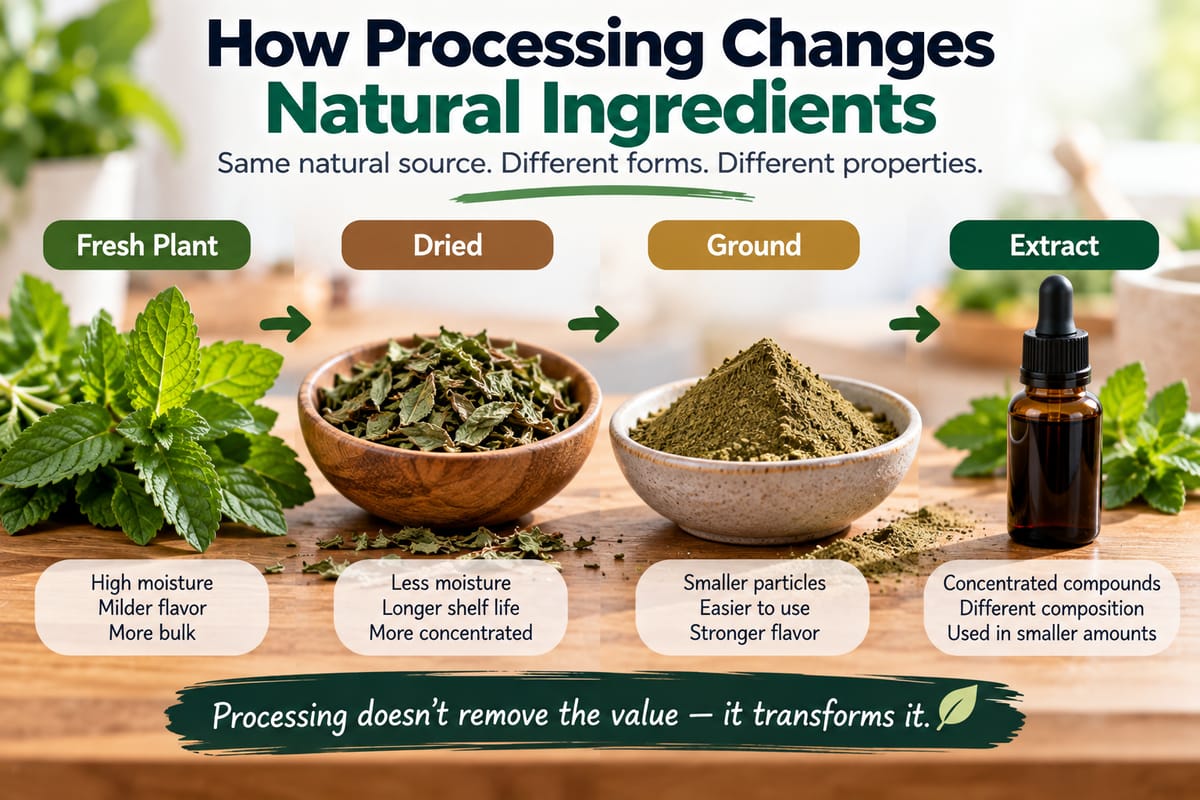

How Processing Changes Natural Ingredients
Natural ingredients often begin as whole plants, seeds, fruits, vegetables, grains, herbs, or other foods in relatively simple forms. But before they reach a kitchen, food product, supplement, or traditional preparation, they may go through several types of processing.
Washing, drying, grinding, heating, fermenting, pressing, extracting, filtering, and blending can all change an ingredient. These processes may alter its texture, moisture content, flavor, shelf life, concentration, digestibility, and the availability of certain nutrients or other compounds.
Processing is not automatically good or bad. Its effects depend on the ingredient, the method used, the degree of processing, and how the finished product is consumed.
Understanding these changes can help explain why a processed natural ingredient may behave differently from the original plant or food.
What Does Processing Mean?
Processing refers to physical or chemical changes made to an ingredient after harvesting or collection and before it is consumed or incorporated into another product.
Some processing is extremely simple.
For example:
- Washing a vegetable
- Removing seeds
- Peeling fruit
- Chopping herbs
- Drying leaves
- Grinding grains
Other processes are more intensive:
- Heating
- Roasting
- Fermentation
- Pressing
- Extraction
- Concentration
- Refining
- Dehydration
- Encapsulation
The term “natural” does not mean an ingredient has never been processed. Many foods people consider natural are routinely processed in some way before consumption.
Why Natural Ingredients Are Processed
Processing serves many purposes.
It can help:
- Extend shelf life
- Make ingredients easier to store
- Improve texture
- Develop flavor
- Reduce moisture
- Make ingredients easier to digest
- Concentrate particular components
- Remove unwanted materials
- Improve convenience
- Make ingredients easier to incorporate into recipes
- Control consistency between batches
For example, drying herbs reduces their moisture content and makes them easier to store for extended periods.
Grinding seeds or grains makes them easier to use in cooking.
Extracting a particular compound from a plant can produce a much more concentrated preparation than consuming the original plant.
Each process changes the original ingredient in some way.
Processing Does Not Always Mean Losing Nutrients
A common assumption is that processing automatically makes an ingredient less nutritious.
The reality is more complicated.
Some processing methods can reduce certain nutrients, particularly compounds that are sensitive to heat, light, oxygen, or water.
At the same time, other processes can make particular nutrients or plant compounds more accessible.
For example, cooking can soften plant tissues and change the structure of food, potentially making certain components easier to digest.
Processing can therefore produce both losses and changes in availability.
The outcome depends on what nutrient or compound is being considered.
Moisture Is Often the First Major Change
Drying is one of the simplest ways to transform a natural ingredient.
Fresh fruits, vegetables, herbs, and other plant materials can contain substantial amounts of water.
When they are dried, much of that water is removed.
This can change:
- Weight
- Texture
- Shelf life
- Flavor intensity
- Storage requirements
- Nutrient concentration per gram
Consider fresh herbs compared with dried herbs.
The dried herb weighs much less because water has been removed, but the remaining plant material is more concentrated by weight.
This means a teaspoon of dried herbs should not necessarily be considered equivalent to a teaspoon of fresh herbs.
Drying Can Concentrate Some Components
When water is removed, nutrients and other compounds that remain in the food can become more concentrated by weight.
This does not mean drying creates new nutrients.
Instead, there is less water surrounding the remaining material.
For example, dried fruit can contain considerably more sugar per 100 grams than fresh fruit because much of the original water has been removed.
This is one reason portion size matters when comparing fresh and dried ingredients.
The same principle can apply to herbs, vegetables, mushrooms, and other plant foods.
Grinding Changes Physical Structure
Grinding breaks an ingredient into smaller particles.
This can change how the ingredient behaves during cooking and digestion.
Examples include:
- Whole grains becoming flour
- Seeds becoming meal
- Spices becoming powder
- Nuts becoming nut flour
- Dried herbs becoming fine powders
Grinding increases surface area.
A powdered ingredient has much more surface exposed to air, moisture, heat, and other substances than the same ingredient in a whole form.
This can influence its stability and how quickly certain compounds interact with the surrounding environment.
Surface Area Can Affect Stability
A whole seed has a relatively limited exposed surface.
Once that seed is ground into powder, the total exposed surface increases dramatically.
Greater surface exposure can make some ingredients more vulnerable to:
- Oxidation
- Moisture absorption
- Light exposure
- Flavor loss
- Rancidity
- Degradation of sensitive compounds
This is one reason storage conditions can become increasingly important as an ingredient becomes more finely processed.
Packaging, temperature, humidity, light, and exposure to oxygen can all affect quality.
Heating Changes Natural Ingredients
Heat can produce some of the most noticeable changes in food.
Cooking may:
- Soften plant tissues
- Change proteins
- Alter starches
- Reduce moisture
- Create new flavor compounds
- Change color
- Affect certain vitamins
- Improve digestibility of some foods
The outcome depends heavily on temperature and duration.
Gentle heating and prolonged high-temperature processing do not necessarily produce the same results.
A natural ingredient should therefore not be viewed simply as either “raw” or “processed.” There is a broad range of processing conditions.
Cooking Can Improve Accessibility
Some nutrients and plant compounds are affected by the structure of the food around them.
Heating can break down cell structures and soften tissues, potentially making certain components easier for the body to access.
Cooking can therefore sometimes improve the availability of particular compounds even while reducing others.
This illustrates why the question “Does cooking destroy nutrients?” does not have one universal answer.
The more useful question is:
Which nutrient or compound, in which food, processed in what way?
Water-Soluble Nutrients Can Be Affected by Processing
Some vitamins are water-soluble.
When foods are cooked in water, certain water-soluble compounds can move from the food into the cooking liquid.
The amount affected depends on the food, cooking method, temperature, duration, and whether the cooking liquid is consumed.
For example, boiling vegetables and then discarding the cooking water can produce a different nutrient outcome from steaming them or using the cooking liquid as part of a soup.
This is one reason cooking technique matters alongside the ingredient itself.
Fat-Soluble Nutrients Behave Differently
Other nutrients are fat-soluble.
These include vitamins such as:
- Vitamin A
- Vitamin D
- Vitamin E
- Vitamin K
The presence of dietary fat can influence the absorption of certain fat-soluble nutrients.
The relationship between dietary fat and nutrient absorption is explored in greater detail in How Dietary Fat Affects Absorption of Fat-Soluble Nutrients.
This is another example of why processing and preparation cannot always be evaluated simply by asking whether a food is raw or cooked.
The entire meal and preparation method can influence how nutrients are ultimately consumed and absorbed.
Fermentation Can Transform Natural Ingredients
Fermentation is another form of processing that can significantly change an ingredient.
During fermentation, microorganisms such as bacteria or yeasts transform components of the original food.
This can alter:
- Flavor
- Acidity
- Texture
- Aroma
- Shelf life
- Digestibility
- Chemical composition
Foods such as yogurt, fermented vegetables, and certain traditional grain or bean preparations demonstrate how microorganisms can transform natural ingredients into substantially different foods.
The resulting product is not chemically identical to the original ingredient, even though it may retain many of its original components.
Fermentation Can Affect Digestibility
Fermentation can modify certain carbohydrates, proteins, and other compounds.
Depending on the food and microorganisms involved, fermentation may reduce or transform some compounds that can be difficult for certain people to digest.
It can also produce new compounds as microorganisms metabolize components of the original food.
The effects vary widely between fermented foods, so it is important not to assume that every fermented ingredient has the same nutritional characteristics.
Extraction Creates a Different Kind of Ingredient
Extraction can produce a much more concentrated preparation.
An extract is made by separating selected compounds or components from a larger natural material.
This can involve:
- Water
- Alcohol
- Oil
- Other solvents
- Mechanical pressing
- Specialized extraction methods
For example, a whole herb may contain many different substances in relatively low concentrations.
An extract can selectively concentrate some of those compounds.
The resulting preparation may therefore have a very different composition from the original plant.
Why Concentration Matters
Concentration changes the amount of an ingredient consumed in a particular serving.
Eating a plant as food is not necessarily equivalent to consuming a concentrated extract made from that plant.
This distinction is particularly important when natural ingredients are used in supplements or other concentrated products.
A concentrated preparation may deliver substantially more of particular compounds than someone would normally consume through the whole food.
That does not automatically make the concentrated product better or worse. It simply means the two preparations should not be treated as identical.
Pressing Can Separate Components
Mechanical pressing can separate liquids from solids.
Examples include:
- Pressing fruits to make juice
- Pressing seeds to produce oils
- Pressing plant materials to release certain liquids
The resulting products can have very different compositions from the original ingredient.
For example, pressing seeds to produce oil concentrates their fat while leaving behind much of the non-fat material.
Similarly, fruit juice contains components of the original fruit but may have less fiber than the whole fruit, depending on how it is produced.
Refining Can Remove Components
Refining generally involves removing certain parts of an ingredient to produce a more uniform or specialized product.
Depending on the food, refining may remove:
- Fiber
- Bran
- Germ
- Seeds
- Certain pigments
- Some minerals
- Other naturally occurring components
Refining can improve texture, appearance, consistency, or shelf life.
However, it can also change the nutritional profile.
This is why a refined ingredient and its original whole-food form should not automatically be considered nutritionally equivalent.
Processing Can Change Nutrient Density
Nutrient density refers broadly to the amount of useful nutrients a food provides relative to its energy content or serving size.
The What Nutrient Density Means and How to Choose Nutrient-Dense Foods guide provides a broader explanation of this concept.
Processing can influence nutrient density in several ways.
For example:
- Removing water can concentrate nutrients and calories by weight.
- Removing fiber can change the nutritional profile.
- Adding sugar can increase energy without proportionally increasing micronutrients.
- Adding fat can increase energy density.
- Fortification can add specific nutrients.
- Refining can remove some naturally occurring nutrients.
The effect therefore depends on exactly what happens during processing.
Fortification Is Another Type of Change
Some processed foods have nutrients added during manufacturing.
This is known as fortification when nutrients are added to improve or maintain nutritional value.
A processed product may therefore contain more of a particular nutrient than the original raw ingredient.
For example, a grain-based product may have selected vitamins or minerals added after processing.
This demonstrates why it is difficult to classify foods simply according to how “natural” they are.
A processed product can lose some nutrients while gaining others through fortification.
Processing Can Change Fiber Content
Fiber is an important component of many plant foods.
Some forms of processing can reduce or remove fiber.
For example, extracting juice from fruit can separate much of the solid material from the liquid.
Grinding whole grains into flour does not necessarily eliminate fiber, but refining the grain can remove portions of the bran and germ.
The final fiber content therefore depends on the specific processing method.
Because fiber contributes to digestion, fullness, and overall dietary quality, these changes can matter when comparing different forms of the same ingredient.
Processing Can Change Texture
Texture is one of the most obvious consequences of processing.
A natural ingredient can become:
- Soft
- Crispy
- Powdery
- Creamy
- Chewy
- Dry
- Liquid
- Gel-like
depending on what happens to it.
Grinding, heating, drying, freezing, fermenting, and blending all affect physical structure.
These changes can influence how people consume the ingredient and how easily it can be incorporated into meals.
Processing Can Change Flavor
Processing can also create or intensify flavors.
Roasting can produce toasted and nutty characteristics.
Heating can create browning reactions.
Fermentation can introduce acidity and complex aromas.
Drying can concentrate existing flavors.
Grinding spices can release aromatic compounds that were previously enclosed within plant structures.
This is one reason processing is an important part of culinary traditions around the world.
Processing and Shelf Life
Fresh natural ingredients can deteriorate relatively quickly.
Microorganisms, enzymes, oxygen, moisture, and temperature can contribute to spoilage or quality loss.
Processing can slow some of these processes.
Methods such as:
- Drying
- Freezing
- Fermentation
- Canning
- Pasteurization
- Refrigeration
- Pickling
can extend the useful life of ingredients.
Longer shelf life can reduce food waste and make seasonal ingredients available for longer periods.
Does More Processing Always Mean Worse Nutrition?
Not necessarily.
The nutritional impact depends on what was done during processing and what the final product contains.
For example, washing and chopping vegetables are forms of processing but do not automatically make them nutritionally poor.
Cooking can reduce some heat-sensitive nutrients while making other components easier to digest.
Freezing can preserve many characteristics of foods for long periods.
Fermentation can change the chemical composition of an ingredient in ways that may be useful.
On the other hand, highly processed products may contain significant amounts of added sugars, sodium, refined carbohydrates, or fats depending on how they are formulated.
The important issue is therefore what processing did, rather than simply whether processing occurred.
Whole Foods and Processed Ingredients Can Both Fit Into a Diet
A balanced diet can contain foods at different levels of processing.
Fresh vegetables, frozen vegetables, canned beans, whole grains, fermented foods, and other prepared ingredients can all serve different purposes.
The Complete Guide to Healthy Eating and Balanced Nutrition provides broader guidance on building a balanced dietary pattern.
Rather than focusing exclusively on whether an ingredient has been processed, it can be more useful to examine:
- Nutrient content
- Portion size
- Added ingredients
- Fiber
- Energy density
- Sodium
- Added sugars
- Fat content
- Overall dietary pattern
Natural Ingredients Can Become More Convenient Through Processing
One major advantage of processing is convenience.
A whole grain may require cooking before it can be eaten.
Grinding it into flour makes it useful for baking.
Drying herbs makes them easier to store.
Freezing vegetables can make them available without the need for immediate consumption.
Processing can therefore make nutritious ingredients easier to incorporate into everyday meals.
Convenience itself is not inherently a nutritional problem. The overall composition of the finished product matters more.
Processing Can Affect Portion Size
When ingredients become concentrated, portion sizes can become smaller while delivering similar or greater amounts of certain components.
Consider dried fruit.
A large amount of fresh fruit may shrink dramatically when its water is removed.
The resulting dried fruit is smaller and easier to eat quickly.
Because the water has been removed, a person can consume more of the original fruit material in a relatively small portion.
This is one reason concentrated or dried foods can require attention to serving size.
Processing Can Influence How Quickly Food Is Consumed
Physical structure affects eating behavior.
A whole apple takes time to chew.
Apple juice can be consumed much more quickly.
Whole nuts require chewing, while finely ground nut products may be easier to consume in larger quantities.
This does not mean one form is automatically inappropriate. It demonstrates that processing can change not only the chemical composition of food but also the way people interact with it.
Natural Ingredients and Nutrient Deficiencies
Processing can sometimes affect whether a food remains a significant source of particular nutrients.
If a processing method consistently removes or reduces a nutrient, relying heavily on the processed form may provide less of that nutrient than consuming the original food.
Understanding nutritional deficiencies involves looking at overall dietary intake, absorption, individual requirements, and other factors.
The How Nutrient Deficiencies Develop and Get Identified guide explores how deficiencies can develop and how they may be identified.
This is another reason to evaluate an ingredient within the context of an overall diet rather than judging it from a single processing step.
Storage After Processing Matters Too
Processing does not end the story.
Once an ingredient has been dried, ground, extracted, cooked, or otherwise transformed, storage conditions can continue to affect its quality.
Factors such as:
- Heat
- Light
- Oxygen
- Humidity
- Time
- Packaging
can influence stability.
A powdered ingredient stored in a humid environment may behave differently from the same powder stored in a dry, sealed container.
Likewise, oils and other ingredients containing oxidation-sensitive compounds may require appropriate storage to maintain quality.
Why Processing Methods Should Be Considered Individually
It is tempting to place foods into two simple categories:
Natural = good
Processed = bad
But this approach overlooks the complexity of food preparation.
Processing exists on a spectrum.
Washing, chopping, freezing, drying, cooking, grinding, fermenting, extracting, refining, and reformulating all produce different effects.
Even two products made from the same original ingredient can have very different nutritional profiles because they were processed differently.
The more useful approach is to ask what happened to the ingredient during processing and what remains in the finished product.
A Simple Example: From Whole Plant to Powder
Imagine a plant ingredient that begins as fresh leaves.
The leaves may go through several stages:
Fresh leaves → Washing → Drying → Grinding → Packaging
At each stage, the ingredient changes.
Washing
Removes dirt and other surface material.
Drying
Removes much of the water and increases concentration by weight.
Grinding
Reduces particle size and increases surface area.
Packaging
Protects the resulting powder from environmental conditions.
The final powder may have a very different weight, texture, storage life, and concentration than the original leaves.
Yet it still originates from the same natural ingredient.
A More Complex Example: Extract Production
Consider another pathway:
Plant material → Drying → Grinding → Extraction → Filtration → Concentration → Packaging
This process can selectively separate certain compounds from the original plant.
The finished extract may therefore contain a much higher concentration of selected components than the whole plant.
That difference should be considered when comparing traditional food use with concentrated preparations.
How Consumers Can Evaluate Processed Natural Ingredients
When choosing a processed natural ingredient, several questions can help.
What Was the Original Ingredient?
Identify the plant, grain, fruit, seed, or other natural material.
What Processing Was Used?
Look for terms such as dried, roasted, fermented, extracted, refined, concentrated, or powdered.
What Was Added?
Check whether the finished product contains:
- Added sugar
- Salt
- Oils
- Preservatives
- Flavorings
- Other ingredients
What Was Removed?
Some processing removes water, fiber, seeds, bran, or other components.
Is It Concentrated?
A concentrated product may provide substantially more of certain components per serving than the original food.
How Should It Be Stored?
Storage instructions can reveal important information about stability.
How Does It Fit Into the Overall Diet?
A single ingredient rarely determines the nutritional quality of an entire diet.
Processing Is About Transformation, Not Simply Improvement or Damage
Natural ingredients change when they are processed because their physical and chemical structures change.
Drying removes water.
Grinding changes particle size.
Heating alters proteins, starches, and other compounds.
Fermentation introduces microbial activity.
Extraction separates and concentrates components.
Refining removes selected parts.
Fortification can add nutrients.
None of these processes can be described accurately with a single label such as “good” or “bad.”
The effect depends on the ingredient, the processing method, and the final product.
Understanding the Journey From Nature to the Plate
A natural ingredient can undergo a surprisingly long journey before it reaches a meal or finished product. Along the way, processing can alter its moisture, structure, concentration, flavor, digestibility, nutrient profile, and shelf life.
That does not make the resulting ingredient inherently inferior to its original form. In many cases, processing improves convenience, safety, storage, or usability. In other situations, processing can remove important components or add ingredients that change the nutritional profile.
The most useful way to evaluate a processed natural ingredient is therefore to look beyond the word “natural” and examine what actually happened during processing.
Understanding that journey—from whole ingredient to finished food—makes it easier to interpret nutrition information, compare different forms of the same ingredient, and make choices that fit into a balanced overall diet.
Continue Reading
Similar Posts

What Foods Are Considered Anti-Inflammatory?
Certain foods are commonly described as **anti-inflammatory foods** because they contain nutrients and plant compounds associated with healthier inflammatory responses.
Read article
When Natural Self Care Is Not Appropriate
Knowing when to stop relying on self-care and seek appropriate medical attention is an important part of using natural approaches responsibly.
Read article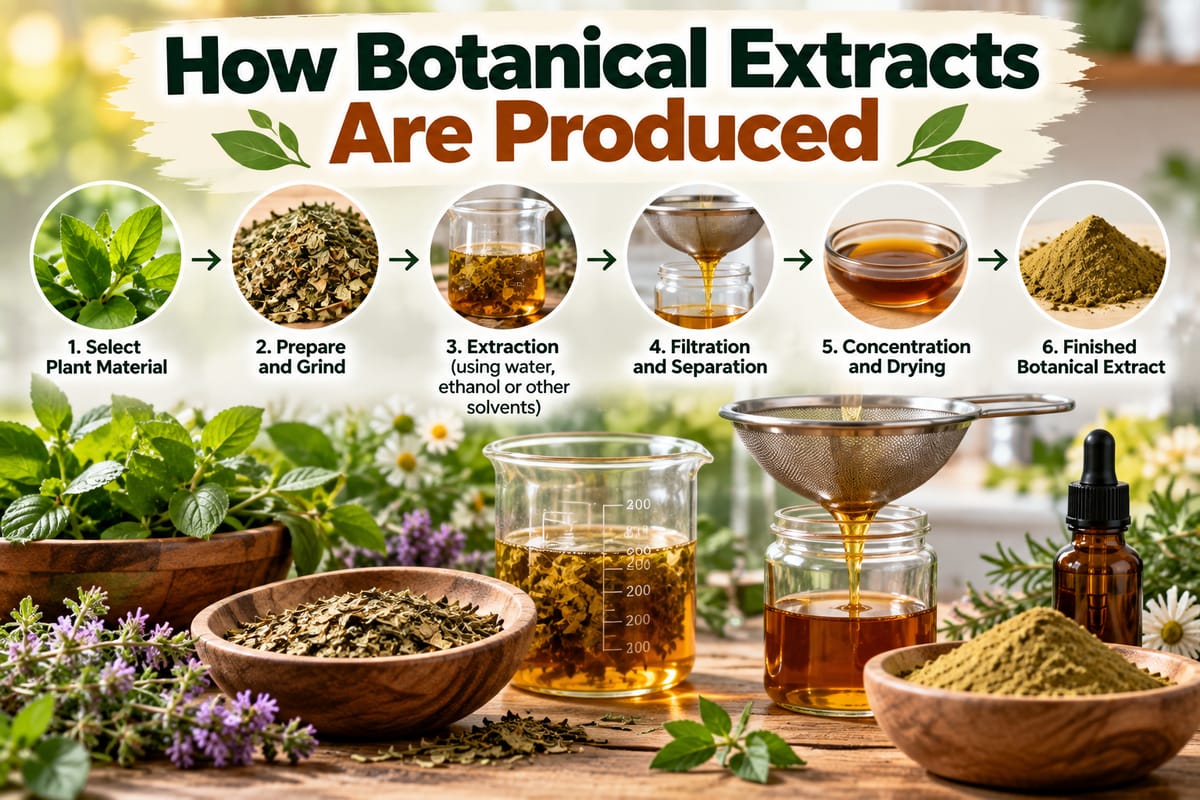
How Botanical Extracts Are Produced
Understanding how botanical extracts are produced also helps explain why an extract is not necessarily equivalent to simply consuming the original plant.
Read article

Join 10,000+ Readers Building Healthier Habits
Get actionable wellness tips every week plus our newest articles delivered straight to your inbox.