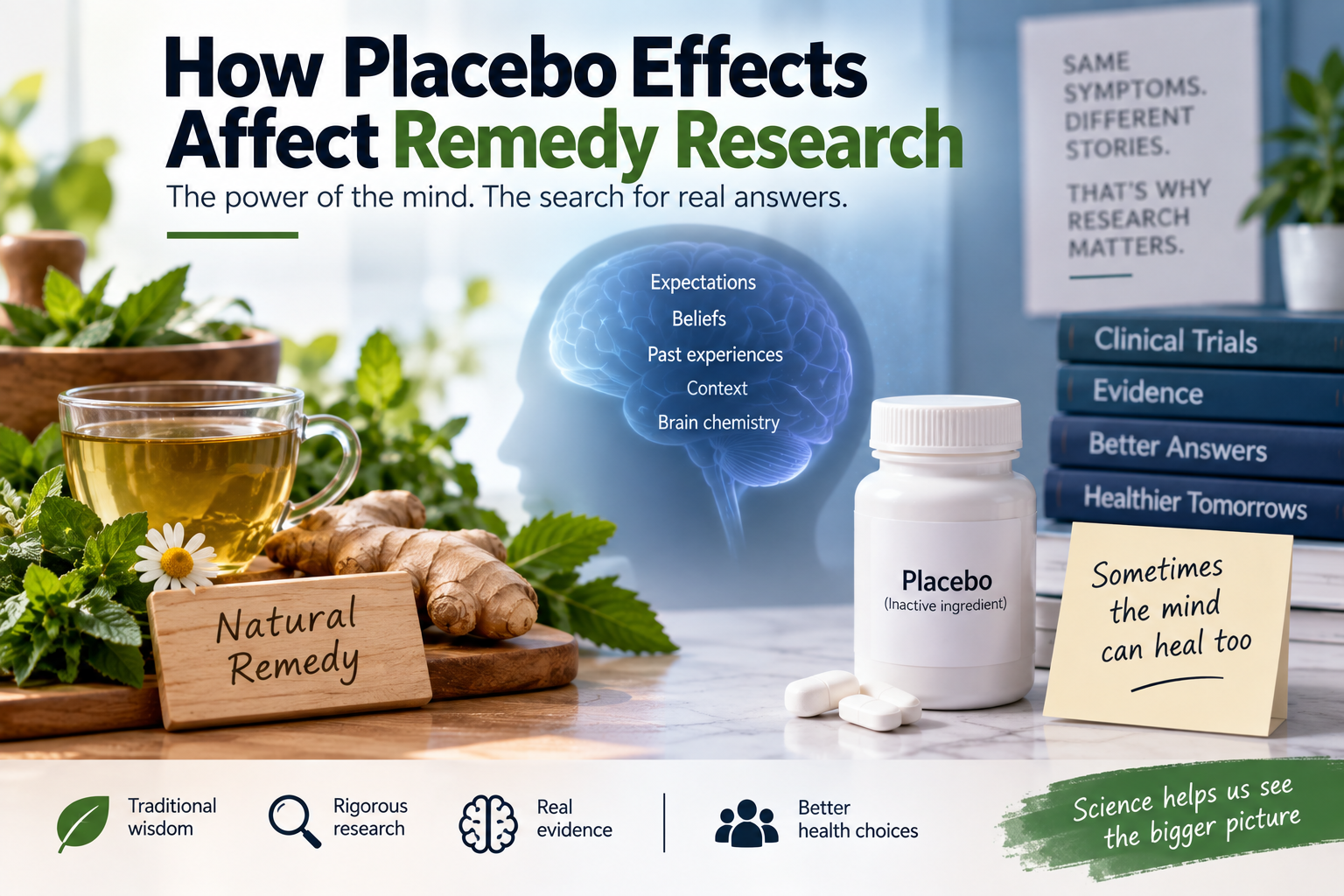

How Placebo Effects Affect Remedy Research
When researchers study whether a natural remedy actually works, one of the biggest challenges is determining whether the remedy itself caused an improvement.
People can sometimes feel better after receiving a treatment even when that treatment contains no active ingredient capable of producing the expected biological effect. This phenomenon is broadly associated with the placebo effect, and it plays an important role in how scientists design and interpret clinical research.
The placebo effect does not mean that symptoms are imaginary or that people are deliberately deceiving themselves. Expectations, previous experiences, interactions with healthcare professionals and other psychological and physiological factors can all influence how people perceive symptoms and respond to treatment.
For natural remedies, this distinction can be particularly important. Many remedies have long histories of traditional use, and people may have strong expectations about their effectiveness. Carefully designed research is therefore needed to determine whether improvements are caused by the remedy, the context surrounding its use, natural changes in symptoms or some combination of factors.
What Is the Placebo Effect?
A placebo is a treatment or intervention that does not contain the specific active ingredient being tested but is presented in a way that resembles the treatment under investigation.
A placebo might be an inactive tablet, for example, used as a comparison in a clinical trial.
The placebo effect refers to improvements in symptoms or other outcomes that can occur because of factors surrounding treatment, including expectations and conditioning.
This can be particularly relevant when researchers study subjective outcomes such as:
- Pain
- Fatigue
- Nausea
- Anxiety
- Sleep quality
- Headaches
- Perceived energy
- General well-being
These symptoms can naturally fluctuate, making it difficult to determine whether an intervention produced a genuine effect.
Why Placebos Matter in Natural Remedy Research
Natural remedies are often evaluated using the same fundamental scientific principles applied to other health interventions.
Suppose researchers want to determine whether an herbal product reduces a particular symptom. If participants know they are receiving the herbal remedy and strongly expect it to help, some may report improvement simply because they anticipate feeling better.
Researchers therefore need a comparison group.
If people taking the natural remedy improve more than people receiving a suitable placebo under otherwise similar conditions, researchers have stronger evidence that the remedy itself may have contributed to the difference.
This is one reason a complete guide to natural remedies evidence needs to consider not only whether studies report positive results but also how those studies were designed.
Expectations Can Influence How People Experience Symptoms
Expectations can affect how people interpret changes in their symptoms.
Someone who strongly believes that a particular remedy will help may pay closer attention to signs of improvement. Positive expectations can potentially influence the way certain symptoms are perceived and reported.
The reverse can also happen.
If someone expects a treatment to cause unpleasant effects, they may be more likely to notice or report symptoms they associate with the treatment. This phenomenon is sometimes discussed in relation to the nocebo effect.
Both effects demonstrate why researchers need to account for expectations when evaluating treatments.
Feeling Better Does Not Automatically Prove a Remedy Works
One of the most important lessons from placebo research is that improvement after taking a remedy does not necessarily prove that the remedy caused the improvement.
Symptoms can change naturally.
Someone with a headache may improve after taking a remedy, but the headache might have been expected to resolve regardless. Someone experiencing a short-term digestive problem may improve over several days without any treatment.
Other factors can also contribute.
A person may sleep more, drink more water, change their diet or reduce stressful activities at the same time they begin using a natural remedy.
Without an appropriate comparison, it can be difficult to separate these effects.
Randomized Controlled Trials Help Separate Effects
A randomized controlled trial (RCT) is one of the most useful study designs for evaluating whether an intervention produces an effect.
Participants are typically assigned to different groups using a random process. One group receives the treatment being studied, while another receives a comparison intervention such as a placebo or an established treatment.
Randomization helps reduce systematic differences between groups.
If the treatment group improves more than the comparison group, researchers can investigate whether the difference is likely to be associated with the treatment.
A well-designed RCT does not eliminate every possible source of bias, but it can provide considerably stronger evidence than personal experiences or uncontrolled observations.
Blinding Can Reduce Expectations
Researchers may also use blinding to reduce the influence of expectations.
In a double-blind trial, for example, neither participants nor the researchers directly interacting with them know which treatment each participant has received until the appropriate stage of the study.
Blinding can be particularly valuable when outcomes depend heavily on subjective reporting.
If a participant knows they received the natural remedy they believe will work, their expectations could influence how they report symptoms. If the researcher knows which participants received the treatment, their expectations could potentially influence interactions or assessments.
Blinding helps reduce these possibilities.
Natural Remedies Can Be Difficult to Blind
Creating a convincing placebo is not always easy.
Natural remedies can have distinctive tastes, smells, colors or textures. An herbal tea, essential oil or topical preparation may be difficult to reproduce with an inactive substitute that looks and feels identical.
If participants can easily determine which group they are in, blinding becomes less effective.
This does not make research impossible, but it can complicate study design and interpretation.
Researchers may need to develop carefully matched comparison products or use additional methods to assess whether participants correctly guessed their treatment assignment.
Traditional Use and Scientific Evidence Are Different
Many natural remedies have been used for generations.
Traditional experience can provide valuable clues about potentially useful plants, foods or practices. It can also help researchers identify questions worth investigating.
However, traditional use and clinical evidence answer different questions.
A remedy’s long history does not by itself establish how effective it is for a specific medical condition, what dose is appropriate or what risks may exist.
The relationship between historical knowledge and modern scientific investigation is explored in traditional remedies versus modern research.
Scientific studies can test whether an observed benefit is greater than what might be expected from placebo effects, natural recovery or other factors.
Personal Experiences Can Be Misleading
Personal testimonials are powerful because they describe real experiences.
Someone may use a particular herb and experience a dramatic improvement. Their experience may be genuine, but it cannot by itself establish that the herb caused the improvement.
Several explanations may be possible.
The condition may have improved naturally. Other lifestyle changes may have contributed. The person’s expectations may have influenced symptom perception. Or the remedy may genuinely have produced a beneficial effect.
Without controlled comparisons, these possibilities can be difficult to distinguish.
This is why scientific research generally places greater weight on patterns observed across appropriately designed studies than on individual stories.
The Difference Between Statistical and Clinical Effects
Researchers also need to distinguish between a statistically significant result and an effect that is meaningful to patients.
A study can detect a small difference between a treatment and placebo that is statistically unlikely to have occurred by chance. But the actual improvement may be too small to make a noticeable difference in everyday life.
For example, a treatment might produce a measurable change in a symptom score without providing a benefit that patients consider substantial.
Good remedy research therefore considers both statistical results and the practical importance of the observed effect.
Sample Size Matters
Small studies can produce interesting findings, but they are often less reliable than larger, well-designed studies.
When only a small number of participants are involved, random variation can have a greater influence on results.
A small trial may appear to show a strong benefit that disappears when researchers conduct a larger study.
Conversely, a useful effect may be difficult to detect in an underpowered study.
Researchers therefore consider sample size when evaluating how much confidence should be placed in a finding.
Repetition Strengthens Evidence
A single study rarely settles a scientific question.
Researchers look for consistent findings across multiple investigations.
If several well-designed trials independently produce similar results, confidence in the underlying finding generally increases.
If results vary substantially, researchers may investigate why.
Differences in doses, formulations, participants, study methods or outcome measurements can sometimes explain inconsistent results.
This is why evidence reviews and systematic reviews can be useful when assessing natural remedies.
Natural Does Not Automatically Mean Effective
The word “natural” describes the origin or character of a substance, not its effectiveness.
A naturally occurring substance can have biological effects, but those effects can be beneficial, neutral or harmful.
Similarly, a manufactured medicine can be highly effective despite not being naturally occurring.
The important question for researchers is whether a particular intervention produces meaningful benefits that outweigh its risks.
The broader differences between these approaches are discussed in natural remedies vs conventional medicine.
Placebo Effects Can Still Be Meaningful
Recognizing placebo effects does not mean dismissing the improvement people experience.
If a person reports feeling better, that experience matters.
However, researchers need to answer a different question: Did the treatment itself produce an effect beyond the effects associated with receiving treatment?
This distinction allows scientists to understand what a remedy actually contributes.
It also helps healthcare professionals communicate more accurately with patients about what is known and what remains uncertain.
The Importance of Choosing the Right Outcome
Research findings can depend heavily on what researchers measure.
A natural remedy might have little effect on one outcome but a measurable effect on another.
For example, researchers might examine pain intensity, sleep quality, duration of symptoms, laboratory measurements or quality of life.
Objective measurements can sometimes provide useful information because they are less dependent on participants’ expectations.
However, subjective outcomes remain important for many conditions because patients ultimately experience symptoms rather than laboratory measurements alone.
Strong studies therefore select outcomes that are relevant, reliable and appropriate for the question being investigated.
Supplement Claims Require Careful Evaluation
Dietary supplements are frequently marketed using claims about energy, immunity, relaxation, memory, digestion or other aspects of health.
Consumers may encounter testimonials, before-and-after stories and impressive-sounding scientific language.
But a claim that sounds scientific is not necessarily supported by strong evidence.
When evaluating these products, it is useful to examine the quality of the underlying studies, the size of the observed effect, whether the research involved humans and whether the results have been independently replicated.
The process is explained further in how to evaluate scientific evidence behind dietary supplement claims.
Researchers Also Consider Safety
Effectiveness is only one side of the equation.
A natural remedy that produces a small benefit but carries significant risks may not be a good treatment option.
Researchers therefore consider adverse effects, interactions with medicines, appropriate doses and the characteristics of people who may be particularly vulnerable.
Natural products can contain biologically active compounds, and their effects may change when combined with prescription medicines or other supplements.
This is especially important for people taking multiple medications or managing ongoing health conditions.
Why Evidence Can Change Over Time
Scientific knowledge develops as new research becomes available.
An early study may produce promising results, while later and larger studies may provide a different picture.
This is not necessarily evidence that science has failed. It is part of how scientific knowledge improves.
Researchers continually test previous findings, examine limitations and incorporate new evidence.
Natural remedies should be evaluated using the same evolving standards.
A treatment should not be considered proven simply because one study produced a positive result, just as one negative study does not necessarily establish that an intervention can never work.
How Consumers Can Think About Placebo Effects
People do not need to understand every statistical method used in clinical research to make more informed decisions.
When considering a natural remedy, useful questions include:
- Has the remedy been tested in controlled human studies?
- Was there a suitable placebo or comparison group?
- Were participants randomly assigned?
- Was the study blinded where possible?
- Were enough people included?
- Have other researchers found similar results?
- How large was the reported benefit?
- Were side effects properly investigated?
- Could other factors explain the improvement?
- Does the evidence apply to the specific condition and product being considered?
These questions help separate promising ideas from claims supported by stronger evidence.
What Placebo Research Teaches Us
Placebo effects reveal how complicated the relationship between treatment and health can be.
People respond not only to substances but also to expectations, experiences, environments and interactions surrounding treatment. That complexity makes rigorous research especially important.
For natural remedies, well-designed studies can help distinguish genuine treatment effects from improvements that might occur for other reasons.
The goal is not to dismiss traditional practices or personal experiences. It is to understand them more accurately.
Turning Promising Remedies Into Reliable Evidence
Natural remedies can inspire valuable scientific questions, but determining whether they truly work requires more than observing that people feel better after using them.
Researchers need to account for placebo effects, natural changes in symptoms, expectations, study design and other potential sources of bias.
The strongest evidence emerges when carefully controlled studies produce consistent results across different research groups.
For consumers, that distinction provides a useful framework for navigating an increasingly crowded health-information landscape. A remedy can be traditional, popular and personally meaningful while still requiring rigorous research before its effectiveness is considered established.
Ultimately, understanding the placebo effect does not make remedy research less interesting. It makes the question more precise: what benefit comes from the remedy itself, and what benefit comes from everything surrounding the act of treatment? Answering that question is essential for turning promising remedies into reliable health evidence.
Continue Reading
Similar Posts
How Traditional African Herbal Medicine Works
Understanding how these remedies work requires looking at both traditional knowledge and modern scientific research. Some medicinal plants contain compounds with biological effects that researchers can study, while evidence for other traditional uses remains limited or uncertain.
Read article
Are Natural Remedies Safe During Pregnancy
The safest approach is not to assume that a remedy is harmless simply because it is natural. Instead, its ingredients, dose, purpose, evidence, and potential risks should all be considered.
Read article
Natural Ways to Support Comfort and Recovery During a Common Cold
Most common colds are caused by viruses and improve on their own. The goal of supportive care is therefore not to eliminate the virus directly, but to ease symptoms, maintain hydration and give the body the conditions it needs to recover.
Read article

Join 10,000+ Readers Building Healthier Habits
Get actionable wellness tips every week plus our newest articles delivered straight to your inbox.