How Natural Remedies Differ From Supplements
Natural remedies and dietary supplements are often discussed as though they mean the same thing. Both can involve plants, vitamins, minerals, foods, or other naturally derived substances, and both are commonly used by people who want to support their health.
However, the two concepts are not identical.
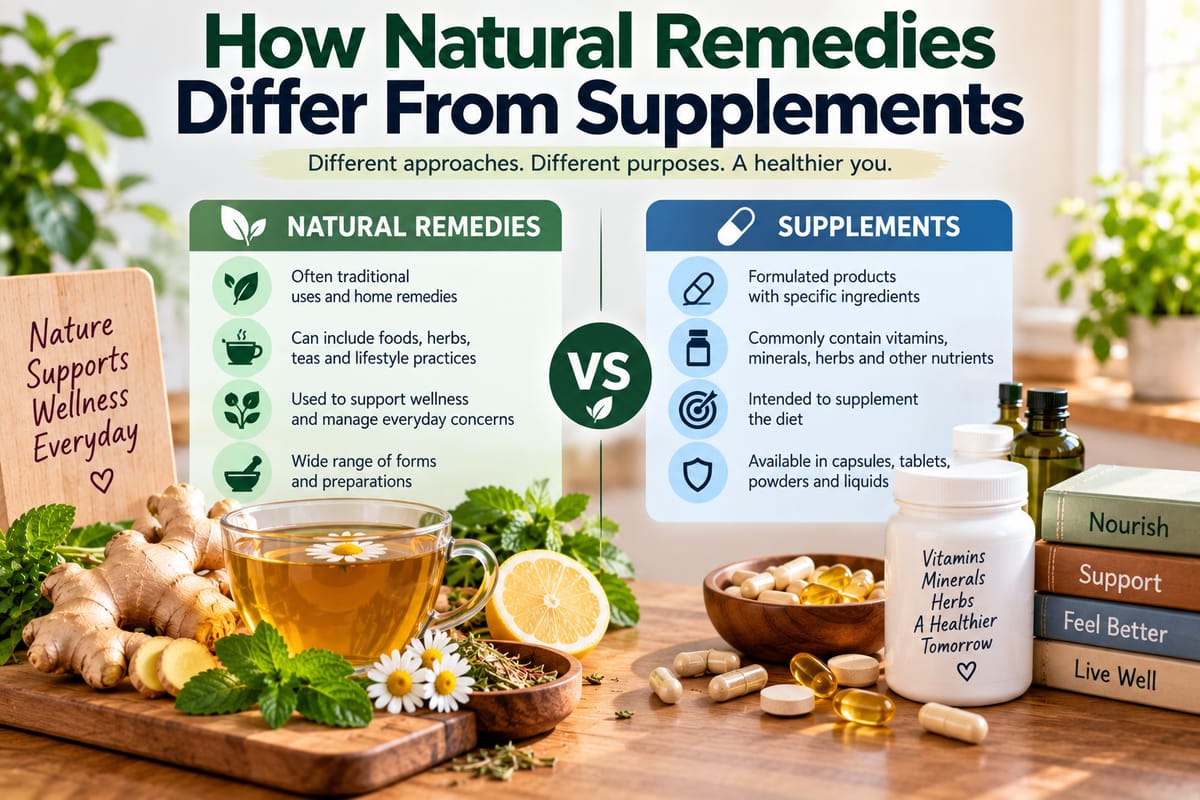
A natural remedy generally refers to a traditional, complementary, or self-care approach used to address a symptom, support everyday well-being, or promote comfort. A dietary supplement is a product intended to supplement the diet and may contain vitamins, minerals, herbs, amino acids, or other ingredients.
The difference matters because the way these products are prepared, used, marketed, studied, and regulated can vary considerably.
Understanding the distinction can help people make more informed decisions about what they use and recognize when professional medical advice may be appropriate.
What Is a Natural Remedy?
The term “natural remedy” can describe a wide range of practices and substances.
Depending on the context, natural remedies may include:
- Herbal teas
- Certain culinary herbs and spices
- Traditional plant preparations
- Warm or cold applications
- Steam or other traditional comfort measures
- Foods traditionally used for specific purposes
- Relaxation practices
- Traditional preparations made from plants or other natural materials
The term itself does not necessarily tell you how effective or safe a particular remedy is.
For example, one natural remedy may have substantial research behind a particular use, while another may primarily have a history of traditional use with limited modern evidence.
This is why it is useful to distinguish traditional use from scientific evidence.
The Complete Guide to Natural Remedies Evidence provides a broader look at how evidence can be evaluated when considering natural approaches to health and well-being.
What Is a Dietary Supplement?
A dietary supplement is a product designed to add nutrients or other dietary substances to a person’s diet.
Supplements can contain ingredients such as:
- Vitamins
- Minerals
- Herbs
- Botanical extracts
- Amino acids
- Enzymes
- Certain other dietary substances
They are commonly sold in forms such as:
- Capsules
- Tablets
- Powders
- Gummies
- Softgels
- Liquids
- Chewable products
For example, a product containing vitamin D may be considered a dietary supplement, as can a capsule containing a concentrated botanical extract.
The Complete Guide to Dietary Supplements explores the broader category, including common types of supplements, how they are used, and considerations when evaluating them.
Natural Remedies and Supplements Can Overlap
One reason the distinction can be confusing is that some products fit into both conversations.
Consider an herb traditionally prepared as a tea.
The tea itself may be described as a traditional natural remedy when used as part of a home wellness practice.
The same plant might also be processed into a concentrated capsule or extract that is sold as a dietary supplement.
The ingredient may be similar, but the preparation, concentration, intended use, and available evidence can be different.
This means that simply knowing an ingredient is “natural” does not tell you everything about a product.
The Main Difference Is Often in the Form and Purpose
A useful way to distinguish the two concepts is to consider what is being used, how it is prepared, and why it is being used.
A natural remedy may involve a simple traditional practice or preparation used for comfort or general wellness.
A supplement is generally a formulated product intended to add something to the diet.
For example:
| Natural remedy | Dietary supplement |
|---|---|
| May involve a traditional preparation or practice | Usually a manufactured product |
| Can include foods, teas, herbs, or self-care practices | Commonly contains vitamins, minerals, herbs, or other dietary ingredients |
| May be used for comfort or traditional purposes | Intended to supplement the diet |
| Preparation can vary widely | Usually has a defined formulation |
| Evidence varies substantially | Evidence varies by ingredient and intended use |
| May be prepared at home | Typically purchased as a packaged product |
These categories can overlap, but they should not automatically be treated as interchangeable.
Natural Does Not Automatically Mean Safe
One of the most important misconceptions surrounding natural remedies and supplements is the idea that anything natural must be harmless.
Natural substances can have biological effects.
Some herbs contain active compounds that can affect the body, while concentrated extracts can deliver substantially more of certain compounds than someone would normally consume through food.
Potential concerns can include:
- Allergic reactions
- Side effects
- Interactions with medications
- Excessive intake of certain nutrients
- Contamination
- Incorrect identification of plants
- Problems caused by concentrated extracts
- Risks during pregnancy or breastfeeding
- Risks associated with certain medical conditions
The Natural Remedies Safety Guide provides more information about these considerations.
Safety is therefore determined by the specific substance, preparation, dose, individual circumstances, and method of use—not simply by whether something is described as natural.
Preparation Can Change the Product
The same plant can exist in several forms.
For example, an herb could be consumed as:
- A fresh food ingredient
- A dried herb
- A tea
- A powdered ingredient
- A tincture
- A standardized extract
- A capsule
These forms are not necessarily equivalent.
The amount of active compounds can differ substantially between them.
A cup of a relatively dilute herbal infusion may expose someone to a different concentration of plant compounds than a concentrated extract in capsule form.
This is one reason people should avoid assuming that different products containing the same plant have identical effects.
Traditional Use and Scientific Evidence Are Different
Many natural remedies have histories that extend across generations.
Traditional use can provide useful information about how a plant, food, or practice has historically been used.
However, traditional use does not automatically establish that a remedy is effective for a particular medical condition.
Scientific research asks different questions.
Researchers may investigate:
- Whether a substance has a measurable effect
- How large that effect is
- Which dose was used
- Which population was studied
- How the substance compares with a placebo or another treatment
- Whether the benefits outweigh potential risks
- Whether findings can be reproduced
Evidence can therefore range from traditional experience and preliminary laboratory research to human clinical studies and systematic reviews.
The quality of evidence matters just as much as the existence of research.
Supplements Can Also Have Different Levels of Evidence
Supplements should not be treated as one uniform category.
The evidence for one supplement can be very different from the evidence for another.
For example, researchers may have extensively studied a particular vitamin for a specific deficiency, while another botanical product may have much less evidence for the health claim associated with it.
Even when research exists, its findings may depend on:
- The population studied
- The dose
- The formulation
- The duration of use
- The health outcome being measured
A study of one formulation should not automatically be used to make assumptions about every product containing the same general ingredient.
Food, Remedy, and Supplement Are Not Always the Same Thing
Some substances can exist across several categories.
Garlic, ginger, turmeric, peppermint, and other familiar foods or plants can be consumed as ordinary foods, incorporated into traditional preparations, or used in concentrated supplement products.
The context changes how the substance is being used.
Eating an herb as part of a normal meal is different from consuming a concentrated extract in a supplement.
This distinction is particularly important when considering dose.
The body may respond differently to amounts consumed as ordinary food compared with highly concentrated preparations.
Why Concentration Matters
Many supplements use extracts that concentrate particular compounds from plants.
Concentration can be useful when a specific amount of an ingredient is desired, but it can also change the risk profile.
A plant consumed occasionally as food may expose someone to relatively small amounts of its active compounds.
A concentrated supplement may provide considerably more.
This does not mean concentrated products are automatically harmful. It means they should be evaluated according to their actual ingredients and amounts rather than being assumed to be equivalent to the original food or plant.
Natural Remedies May Include Practices, Not Just Products
Another important distinction is that “natural remedy” can refer to something that is not a supplement at all.
For example, a person might use:
- A warm compress
- A cool compress
- A relaxing bath
- Herbal tea
- Gentle stretching
- A traditional food preparation
- Breathing or relaxation techniques
These approaches do not necessarily involve taking a manufactured product.
This broader meaning makes the phrase “natural remedy” considerably wider than the term “dietary supplement.”
How Natural Remedies Compare With Conventional Medicine
Natural remedies and supplements are sometimes discussed as alternatives to conventional medicine, but the relationship is more complicated than simply choosing one category over another.
Some people use natural approaches alongside conventional healthcare.
Others use them for everyday comfort or general wellness rather than as treatments for diagnosed conditions.
The Natural Remedies vs Conventional Medicine provides broader context for understanding the differences between these approaches.
For serious, persistent, or worsening symptoms, relying on a natural remedy or supplement without appropriate medical evaluation can delay diagnosis or treatment.
The appropriate approach depends on the specific health issue and the evidence available for the intervention being considered.
How Supplements Are Different From Prescription Medicines
Supplements are also different from prescription medicines.
A prescription medicine is developed and evaluated specifically as a medical treatment and is prescribed or dispensed under a healthcare system.
A dietary supplement is intended to supplement the diet and occupies a different category.
This distinction affects how people should think about claims made about products.
A supplement should not automatically be treated as though it has the same evidence, purpose, dosing framework, or clinical role as a prescription medicine.
Reading Supplement Labels Carefully
When considering a supplement, the label can provide important information.
People may want to look for:
- The names of active ingredients
- Amounts per serving
- Serving size
- Recommended use
- Other ingredients
- Allergen information
- Manufacturer information
- Expiration information
- Warnings and precautions
A product containing an herbal ingredient may also list an extract ratio, standardized compound, or other information about its formulation.
Understanding what is actually in the product can be more useful than relying on broad descriptions such as “natural,” “herbal,” or “wellness.”
Why Dosage Matters
The amount consumed can influence both potential effects and potential risks.
A substance can behave differently at different doses, and more is not necessarily better.
Taking multiple products can also unintentionally increase total intake of the same ingredient.
For example, someone might take a multivitamin, an individual mineral supplement, and another product containing the same mineral without realizing that the ingredients overlap.
Checking labels and discussing supplement use with a qualified healthcare professional can help reduce this type of problem.
Interactions Are an Important Consideration
Some natural substances and supplements can interact with medicines.
An interaction may change how a medicine works, increase or decrease its effects, or increase the likelihood of side effects.
This is especially important for people who take medications regularly.
It can also matter for individuals preparing for surgery or managing ongoing medical conditions.
A healthcare professional or pharmacist can help assess whether a particular supplement or natural product is appropriate alongside existing medications.
Who Should Be Especially Careful?
Some groups may need additional caution when considering supplements or concentrated natural products.
These can include:
- Pregnant people
- People who are breastfeeding
- Children
- Older adults taking multiple medications
- People with chronic medical conditions
- People with allergies
- People preparing for surgery
- People taking prescription medicines
The appropriate level of caution depends on the specific product and individual circumstances.
Common Misunderstandings About Natural Remedies
Several misconceptions can make it harder to evaluate natural products objectively.
“Natural Means Safe”
Safety depends on the specific substance and circumstances.
“Traditional Means Proven”
Traditional use can be meaningful, but it does not automatically establish effectiveness for a particular health condition.
“A Supplement Is Just Food in a Capsule”
Some supplements contain concentrated ingredients that are quite different from consuming the original food in an ordinary diet.
“More Is Better”
Higher doses can increase risks and do not necessarily provide greater benefits.
“Natural Remedies Cannot Interact With Medicines”
Some can.
“All Supplements Are Basically the Same”
Different ingredients, formulations, doses, and manufacturers can produce very different products.
How to Evaluate a Natural Remedy
A practical evaluation can begin with several questions.
What Exactly Is It?
Identify the plant, nutrient, preparation, or practice rather than relying on a broad label such as “natural.”
What Is It Supposed to Do?
Separate general wellness claims from specific claims about treating a health condition.
What Evidence Exists?
Consider whether the claim is supported by human research, preliminary research, traditional use, or little evidence.
What Is the Dose or Method?
A tea, food ingredient, powder, and concentrated extract should not automatically be considered equivalent.
Could It Interact With Anything?
Consider medications, supplements, medical conditions, allergies, pregnancy, and other relevant factors.
How Long Is It Intended to Be Used?
Short-term traditional use and long-term daily supplementation may involve different considerations.
How to Evaluate a Supplement
The same careful approach can be applied to supplements.
Start by identifying the exact ingredients and amounts.
Then consider:
- What is the intended purpose?
- What evidence supports that purpose?
- Is the amount appropriate?
- Are there potential side effects?
- Could it interact with medication?
- Are multiple products providing the same ingredient?
- Is there a reason to discuss its use with a healthcare professional?
This approach is more useful than choosing a product solely because it is described as natural, organic, herbal, or plant-based.
Natural Remedies and Supplements Can Have a Place in Self-Care
Self-care encompasses many different behaviors, and natural remedies or supplements may be part of a person’s broader approach to wellness.
However, they work best when viewed realistically.
A natural remedy may provide comfort without treating the underlying cause of a medical problem.
A supplement may help address a nutritional deficiency without being appropriate for every person.
Neither category should automatically be viewed as superior to every other form of healthcare.
The most useful question is often whether a particular approach is appropriate for a particular purpose, person, and situation.
When Professional Advice Matters
Some symptoms require more than self-care.
People should consider professional medical evaluation when symptoms are severe, persistent, worsening, unusual, or associated with potentially serious warning signs.
Professional guidance is also particularly valuable when someone is considering a new supplement while taking medication or managing an existing health condition.
A healthcare professional can help distinguish between a situation appropriate for self-care and one that requires further evaluation.
Making the Distinction Clear
Natural remedies and supplements overlap, but they are not interchangeable terms.
A natural remedy is a broad concept that can include traditional preparations, foods, plants, and non-product approaches to comfort or wellness.
A dietary supplement is generally a formulated product intended to supplement the diet and may contain vitamins, minerals, herbs, botanicals, amino acids, or other dietary ingredients.
The most important distinction is not whether something is labeled “natural.” Instead, it is useful to examine what the product or practice is, how it is prepared, what evidence supports its use, how much is being used, and what risks or interactions may exist.
Understanding those differences makes it easier to approach natural remedies and supplements with realistic expectations. Rather than assuming that one category is automatically safe, effective, or preferable, people can evaluate individual products and practices according to their evidence, purpose, preparation, and personal circumstances.
Continue Reading
Similar Posts

What Foods Are Considered Anti-Inflammatory?
Certain foods are commonly described as **anti-inflammatory foods** because they contain nutrients and plant compounds associated with healthier inflammatory responses.
Read article
When Natural Self Care Is Not Appropriate
Knowing when to stop relying on self-care and seek appropriate medical attention is an important part of using natural approaches responsibly.
Read article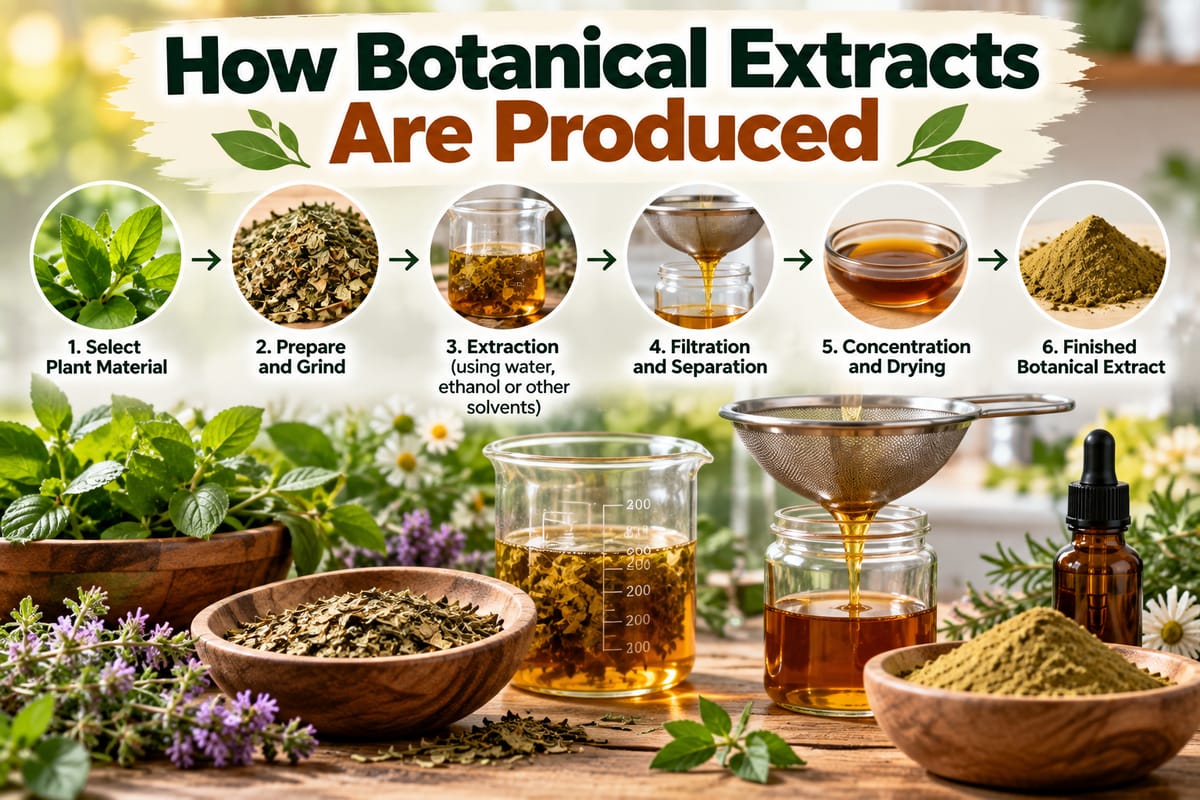
How Botanical Extracts Are Produced
Understanding how botanical extracts are produced also helps explain why an extract is not necessarily equivalent to simply consuming the original plant.
Read article

Join 10,000+ Readers Building Healthier Habits
Get actionable wellness tips every week plus our newest articles delivered straight to your inbox.