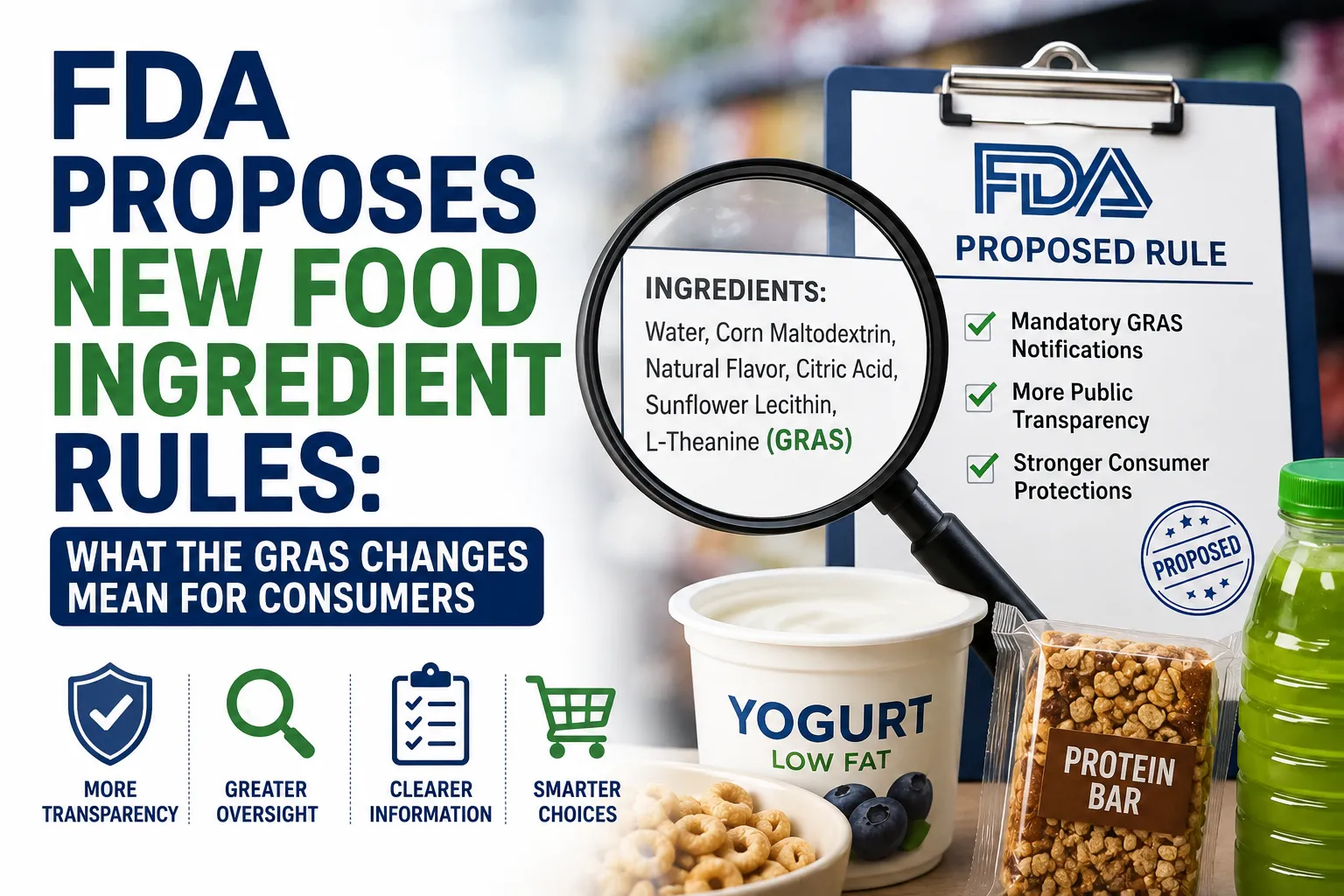

FDA Proposes New Food Ingredient Rules: What the GRAS Changes Mean for Consumers
The U.S. Food and Drug Administration is proposing a significant change to how companies disclose food ingredients classified as “Generally Recognized as Safe,” or GRAS.
Under the proposed approach, food manufacturers would have to notify the FDA when they determine that a substance qualifies for GRAS status. The agency says the change is intended to improve transparency and give regulators more information about substances entering the food supply.
The proposal could eventually give consumers a clearer picture of which ingredients companies are introducing through the GRAS pathway. But it is important to understand what the proposal does—and what it does not do.
It would not mean that every food ingredient suddenly requires FDA approval before reaching store shelves.
What Does GRAS Mean?
GRAS stands for Generally Recognized as Safe.
Under U.S. food law, substances intentionally added to food are generally considered food additives subject to FDA premarket approval unless they qualify for an exemption, including the GRAS provision.
For a substance to qualify as GRAS, qualified experts must generally recognize that it is adequately shown to be safe under its intended conditions of use. FDA says that GRAS status can be based on scientific procedures or, for certain substances used in food before 1958, a history of common use in food.
That distinction is important because GRAS does not simply mean that the FDA has tested and approved an ingredient.
The current system has allowed companies to reach GRAS conclusions independently in certain circumstances. FDA’s existing voluntary notification program gives companies an opportunity to submit their conclusions to the agency, but notification has not been mandatory for every independent GRAS determination.
Why Is the FDA Changing the GRAS System?
The proposed rule is largely about transparency and regulatory visibility.
The FDA’s 2026 Human Foods Program priorities specifically identified GRAS reform as a major food-chemical-safety initiative. The agency said the existing voluntary notification system allows companies to introduce substances they consider GRAS without necessarily notifying or receiving a review from FDA.
That creates an information gap.
If a company makes an independent GRAS determination and does not submit a notice, the FDA may have less information about the substance and its intended use.
The proposed mandatory notification system would give the agency a more comprehensive view of substances being introduced through the GRAS pathway.
For consumers, that could eventually mean more publicly available information about ingredients that previously received little regulatory attention.
This broader emphasis on ingredient transparency also connects with other developments in food regulation, including FDA food additive reviews and their renewed focus on ingredient safety.
What Would Change Under the Proposal?
The central change is straightforward: companies would be required to submit GRAS notices to the FDA rather than relying entirely on voluntary notification.
The notices would include scientific information supporting the company’s conclusion that the substance is safe for its intended use. The agency would then have an opportunity to evaluate the submitted information.
Current reporting indicates that FDA’s proposed process would give the agency up to 180 days for its review, with the possibility of additional time in certain circumstances. The proposal also calls for greater public visibility into submitted GRAS ingredients.
That could make it easier for regulators, researchers, journalists, and consumers to identify substances entering the food supply through the GRAS pathway.
However, there is an important limitation.
A GRAS Notice Would Not Mean FDA Approval
Consumers should not interpret the proposed notification system as a new FDA approval program.
The FDA’s existing framework makes an important distinction between food additives that require premarket approval and substances that qualify for the GRAS exemption.
Under the proposed system, submitting a GRAS notice would provide FDA with information about the company’s safety determination.
It would not necessarily mean:
“The FDA has independently tested this ingredient and declared it safe.”
That distinction matters when reading future ingredient databases or public notices.
A substance appearing in an FDA GRAS inventory should not automatically be interpreted as an FDA endorsement of the ingredient’s safety.
Why Consumers Should Care
Most people do not research the regulatory history of every ingredient listed on a food package.
And they shouldn’t necessarily have to.
The average grocery shopper is more likely to look at calories, sugar, protein, allergens, serving size, or other familiar information than investigate whether a particular ingredient entered the food supply through a GRAS determination.
Greater regulatory transparency could nevertheless make that information easier to investigate.
For example, researchers could potentially use public information to examine:
- Which substances are being introduced into foods
- How companies justify their safety conclusions
- What conditions of use are proposed
- What scientific evidence supports those conclusions
- Whether similar substances are already used in food
- What questions regulators or researchers may want to investigate
That information could become particularly valuable when scientists conduct broader assessments of food chemicals.
Consumers are also facing growing questions about how food ingredients and processing are evaluated, including debates surrounding how the FDA’s proposed approach to ultra-processed foods could reshape the way Americans think about healthy eating.
Does GRAS Mean an Ingredient Is Dangerous?
No.
The existence of the GRAS pathway does not mean that GRAS ingredients are inherently unsafe.
The FDA states that a substance qualifying as GRAS must meet the applicable safety standard for its intended use. In fact, the agency says that when GRAS status is established through scientific procedures, the quantity and quality of scientific evidence must be comparable to what would be required for a food-additive approval.
The controversy is more about how safety determinations are made, documented, disclosed, and reviewed.
An ingredient can therefore be considered GRAS without there being evidence that it poses a health risk.
The proposed changes are intended to address information and oversight gaps—not to establish that the entire GRAS category is unsafe.
What About Existing Ingredients?
One of the more important questions surrounding the proposal is how the new notification framework would interact with substances that are already in use.
Current reporting indicates that the administration intends the reform to address GRAS substances beyond simply brand-new ingredients, potentially increasing visibility into substances already being used under independent GRAS determinations.
That could make the proposal more significant than a simple requirement for companies to report future ingredients.
However, because this is a proposed rule, consumers should avoid assuming that every proposed requirement will ultimately take effect exactly as announced.
The final requirements could change following public comments, legal review, or other regulatory steps.
What Happens Next?
The FDA’s proposal is now part of the federal rulemaking process.
The agency plans to accept public comments for 120 days, giving industry groups, scientists, consumer advocates, and members of the public an opportunity to respond.
After reviewing comments, the FDA could modify the proposal before deciding whether to issue a final rule.
That means the proposal is not yet the same thing as a new binding requirement for every food manufacturer.
For consumers, the most important development to watch is therefore whether the notification requirement survives the rulemaking process and what the final version ultimately requires.
How the GRAS System Already Works
The current GRAS framework has existed for decades, although FDA’s formal notification process is much newer.
The underlying GRAS provision comes from federal food law, while FDA established its voluntary GRAS notification procedure through regulatory action finalized in 2016.
The basic concept is that certain substances do not need to go through the same premarket approval process as conventional food additives if their safety is generally recognized by qualified experts under the conditions of intended use.
There are therefore several concepts consumers should keep separate:
| Term | What It Generally Means |
|---|---|
| Food additive | A substance subject to FDA regulation and generally requiring premarket approval unless an exemption applies |
| GRAS | A substance whose safety is generally recognized by qualified experts under its intended conditions of use |
| GRAS notice | Information submitted to FDA describing a company’s GRAS conclusion |
| FDA review | An agency assessment of information submitted or otherwise available to FDA |
| FDA approval | Formal regulatory authorization that is distinct from simply appearing in a GRAS notification system |
Understanding these distinctions can prevent a lot of confusion when the new proposal is discussed online.
What Consumers Should Watch For
The biggest practical change may not appear immediately on supermarket shelves.
Instead, consumers should watch for improvements in public ingredient information.
If the proposal becomes final, publicly accessible GRAS information could become a more useful resource for people who want to understand unfamiliar food ingredients.
That could also benefit independent researchers and consumer organizations by making it easier to identify patterns across food ingredients and manufacturers.
At the same time, consumers should be cautious about interpreting regulatory information without context.
A chemical-sounding ingredient is not automatically dangerous, and an ingredient with a familiar or natural-sounding name is not automatically safe.
Safety depends on factors such as the substance, dose, exposure, intended use, available evidence, and characteristics of the population consuming it.
The Bigger Question Behind the GRAS Debate
The FDA’s proposal highlights a broader issue in modern food regulation: how much information should consumers have about the scientific and regulatory decisions behind the foods they buy?
The existing GRAS framework was designed to distinguish substances that meet the legal safety standard from food additives requiring premarket approval.
The new proposal would place greater emphasis on making companies’ GRAS determinations visible to the FDA.
Whether that ultimately leads to stronger consumer confidence will depend on what happens after the rule is finalized—and how effectively the resulting information is made accessible and understandable.
What the Proposed GRAS Changes Could Mean at the Grocery Store
For now, consumers do not need to panic about GRAS-labeled ingredients or assume that foods currently on supermarket shelves are suddenly unsafe.
The more immediate significance of the proposal is greater regulatory transparency.
If finalized, mandatory GRAS notifications could give the FDA a much clearer picture of substances companies are introducing through the GRAS pathway while creating a larger public record for researchers and consumers to examine.
The proposal is still moving through the rulemaking process, so its final form remains uncertain. For shoppers, the most useful approach is to distinguish between a proposed regulatory change, a GRAS safety determination, and formal FDA approval rather than treating them as interchangeable terms.
As the FDA reviews public comments and decides what comes next, those distinctions will be essential to understanding what actually changes in the American food supply.
For a broader foundation on nutrition, food choices, and the factors that shape a balanced diet, readers can also explore the complete guide to healthy eating and balanced nutrition.
Continue Reading
Similar Posts

Broccoli Sprouts Linked to Multistate Salmonella Outbreak: What Consumers Need to Know
For consumers, the most important step is to determine whether recalled broccoli sprouts are in the refrigerator, freezer, or kitchen and to avoid eating, serving, or selling them.
Read article
Fibermaxxing Is Taking Over Social Media: How Much Fiber Is Actually Too Much
More is not automatically better. Increasing fiber too rapidly or consuming very large amounts can cause bloating, gas, abdominal discomfort, constipation, or changes in bowel habits.
Read article
Salmonella Outbreak Linked to Broccoli Sprouts: What Consumers Need to Know
For consumers, the most important issue right now is knowing what products are affected, what symptoms to watch for, and how to reduce the risk of foodborne illness.
Read article

Join 10,000+ Readers Building Healthier Habits
Get actionable wellness tips every week plus our newest articles delivered straight to your inbox.