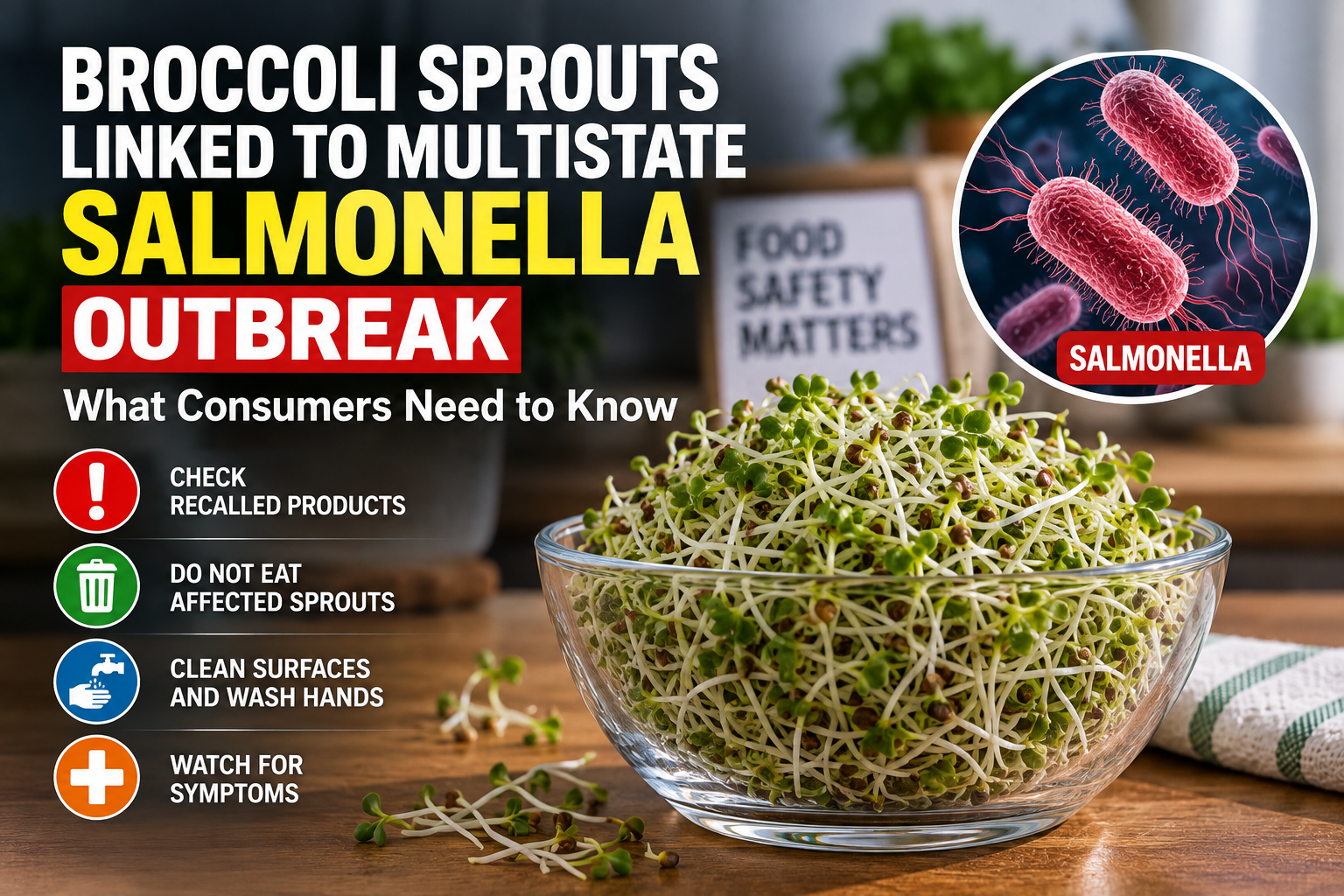

Broccoli Sprouts Linked to Multistate Salmonella Outbreak: What Consumers Need to Know
A multistate Salmonella outbreak linked to recalled broccoli sprouts has prompted health and food-safety officials to warn consumers not to eat certain products from Evergreen Fresh Sprouts, LLC.
As of September 9, 2026, investigators had identified 22 illnesses across four states, with two people hospitalized and no reported deaths. The outbreak involves Salmonella Bovismorbificans, and investigators have identified recalled broccoli sprouts grown by Evergreen Fresh Sprouts in Moyie Springs, Idaho, as the common source associated with illnesses.
For consumers, the most important step is to determine whether recalled broccoli sprouts are in the refrigerator, freezer, or kitchen and to avoid eating, serving, or selling them.
What Happened With the Broccoli Sprouts?
The FDA and CDC, working with state and local health authorities, began investigating illnesses associated with contaminated sprouts in September.
According to the FDA, interviews found that all 19 of the 19 ill people interviewed reported eating sprouts before becoming sick, while 17 specifically reported eating broccoli sprouts. Laboratory testing also identified the outbreak strain of Salmonella in a sample of broccoli sprouts collected by Montana officials.
Evergreen Fresh Sprouts initiated a recall on September 4 after a broccoli sprout sample tested positive for Salmonella. The company subsequently reported that it had stopped production and distribution of its broccoli sprouts.
Consumers looking for additional background can also read Salmonella Outbreak Linked to Broccoli Sprouts: What Consumers Need to Know.
Which Broccoli Sprouts Are Recalled?
The recalled product consists of broccoli sprouts produced by Evergreen Fresh Sprouts, LLC and packaged in clear plastic 4-ounce bags.
The affected products have use-by dates of:
- September 7, 2026
- September 9, 2026
- September 11, 2026
- September 14, 2026
- September 16, 2026
The recalled sprouts were distributed to grocery stores, restaurants, and food-service customers. Confirmed distribution includes Idaho, Montana, and Washington, although investigators have warned that products may have traveled farther.
Consumers should check both household purchases and prepared foods that may have contained the recalled sprouts.
What Should Consumers Do With Recalled Sprouts?
The FDA’s advice is straightforward: do not eat, serve, or sell the recalled broccoli sprouts.
If you have affected products, discard them or follow the appropriate recall instructions rather than tasting them to determine whether they are safe.
It is also important to consider surfaces and containers that may have come into contact with the sprouts. The FDA recommends carefully cleaning and sanitizing potentially contaminated surfaces to reduce the risk of cross-contamination.
This is particularly important because foodborne bacteria can spread from contaminated food to refrigerators, countertops, cutting boards, utensils, containers, and other foods.
Why Are Sprouts Associated With Food-Safety Risks?
Sprouts can be particularly challenging from a food-safety perspective because they are grown under warm and humid conditions that can also support bacterial growth.
Seeds may become contaminated before or during the sprouting process. Once bacteria are present, the conditions used to grow sprouts can allow them to multiply.
That does not mean every package of sprouts is contaminated, but it helps explain why sprouts have periodically been involved in foodborne illness investigations.
Consumers can learn more about reducing exposure to foodborne pathogens in the Guide to Infectious Disease Prevention.
What Is Salmonella?
Salmonella is a group of bacteria that can cause an infection known as salmonellosis.
Common symptoms include:
- Diarrhea
- Fever
- Abdominal cramps
- Nausea
- Vomiting
According to the FDA, symptoms of Salmonella infection usually begin 12 to 72 hours after consuming contaminated food and generally last four to seven days.
Most people recover without serious complications, but Salmonella infection can become severe in some cases.
Young children, older adults, and people with weakened immune systems are more likely to experience serious illness.
What Should You Do If You Ate the Recalled Sprouts?
Eating a recalled product does not necessarily mean that someone will become sick. However, consumers should pay attention to symptoms following possible exposure.
Anyone who develops symptoms consistent with Salmonella infection after eating the recalled broccoli sprouts should contact a healthcare professional. The FDA specifically advises people with symptoms to contact their healthcare provider for evaluation and care.
People should also tell their healthcare provider about the recalled food exposure because that information may be useful when determining the appropriate evaluation.
How Salmonella Can Spread Around the Kitchen
One concern during a food recall is that throwing away the original product may not eliminate every potential source of contamination.
If contaminated sprouts have touched a refrigerator shelf, cutting board, countertop, storage container, knife, or other surface, bacteria can potentially be transferred elsewhere.
Basic kitchen hygiene therefore becomes particularly important.
Wash hands thoroughly after handling recalled food or contaminated packaging, clean surfaces that may have been exposed, and avoid preparing other foods with utensils or containers that have not been properly washed and sanitized.
These everyday measures are part of a broader approach to disease prevention, including the practices discussed in How Personal Hygiene Helps Prevent Illness.
Who Faces the Greatest Risk From Salmonella?
Anyone can develop Salmonella infection, but certain groups have a greater risk of serious complications.
These include:
- Children younger than five
- Older adults
- People with weakened immune systems
- People with certain underlying medical conditions
The risk is not necessarily determined by how much contaminated food someone consumed. A seemingly small exposure can still result in illness.
That is why official recalls should be taken seriously even when the recalled product looks, smells, and tastes normal.
Can You Tell if Sprouts Contain Salmonella?
No.
Contaminated food does not necessarily have an unusual smell, appearance, or taste.
Consumers should therefore avoid relying on sensory inspection to determine whether recalled sprouts are safe.
When a specific product has been officially recalled because of potential contamination, the safest approach is to follow the recall instructions rather than trying to determine whether the individual package appears normal.
Does Washing Sprouts Make Them Safe?
Washing produce can help remove some surface contamination, but washing is not a reliable way to make recalled food safe.
Once a product has been specifically identified as part of a food-safety investigation or recall, consumers should follow the official recommendation not to eat it.
In the case of the recalled Evergreen Fresh Sprouts broccoli sprouts, the FDA says consumers should not eat, serve, or sell the affected products.
What About Cooking Broccoli Sprouts?
Cooking can reduce or eliminate many foodborne pathogens when food reaches appropriate temperatures, but consumers should not attempt to make a recalled product safe through cooking.
A recall means the product should not be consumed.
This is especially important because consumers may not know the exact extent of contamination or whether the food has contaminated other surfaces.
Are All Broccoli Sprouts Being Recalled?
No.
The current FDA advisory specifically concerns recalled broccoli sprouts grown by Evergreen Fresh Sprouts, LLC with the affected dates and distribution described by the agency.
Consumers should therefore check the product information rather than assuming every broccoli sprout product currently available is part of the recall.
At the same time, the investigation remains ongoing, and the FDA has said its advisory may be updated as additional information becomes available.
Why the Investigation Matters
Foodborne illness investigations often involve several stages.
Public health officials first identify patterns among people who became sick. Investigators then collect information about what those people ate, conduct laboratory testing, trace products through the supply chain, and compare bacterial strains.
In this case, epidemiological information pointed investigators toward sprouts, while traceback work identified Evergreen Fresh Sprouts as the common grower associated with broccoli sprouts consumed by patients. Laboratory analysis subsequently found the outbreak strain in a broccoli sprout sample.
That combination of evidence helped support the recall.
What Consumers Can Learn From the Outbreak
The broccoli sprout outbreak is another reminder that food safety does not stop when groceries reach the home.
Consumers play an important role in reducing the risk of foodborne illness by following recalls, washing hands, keeping food-preparation areas clean, preventing cross-contamination, and storing food appropriately.
It is also important to pay attention to official public health notices rather than relying on social-media rumors or informal reports.
For broader information about preventing infectious diseases, How Vaccines Help Prevent Infectious Diseases provides additional context on another major part of public health prevention.
What Happens Next?
The FDA’s investigation into the broccoli sprout outbreak remains ongoing. As of the latest September 9 update, 22 people in Idaho, Montana, Utah, and Washington had been identified as having infections with the outbreak strain, and two had been hospitalized. No deaths had been reported.
The investigation could lead to additional information about how contamination occurred, whether more products were affected, or whether distribution extended beyond the areas already confirmed.
For now, consumers should focus on the practical steps: check for recalled Evergreen Fresh Sprouts broccoli sprouts, do not eat affected products, clean surfaces that may have been exposed, and seek medical advice if symptoms develop after possible exposure.
Food recalls can be inconvenient, but taking them seriously can help prevent a contaminated product from becoming a preventable illness in another household.
Continue Reading
Similar Posts
Fibermaxxing Is Taking Over Social Media: How Much Fiber Is Actually Too Much
More is not automatically better. Increasing fiber too rapidly or consuming very large amounts can cause bloating, gas, abdominal discomfort, constipation, or changes in bowel habits.
Read article
Salmonella Outbreak Linked to Broccoli Sprouts: What Consumers Need to Know
For consumers, the most important issue right now is knowing what products are affected, what symptoms to watch for, and how to reduce the risk of foodborne illness.
Read article
New Research Raises Questions About Food Preservatives and Heart Health
The results are particularly notable because researchers attempted to measure exposure to individual additives rather than simply classifying foods as 'healthy' or 'unhealthy'.
Read article

Join 10,000+ Readers Building Healthier Habits
Get actionable wellness tips every week plus our newest articles delivered straight to your inbox.