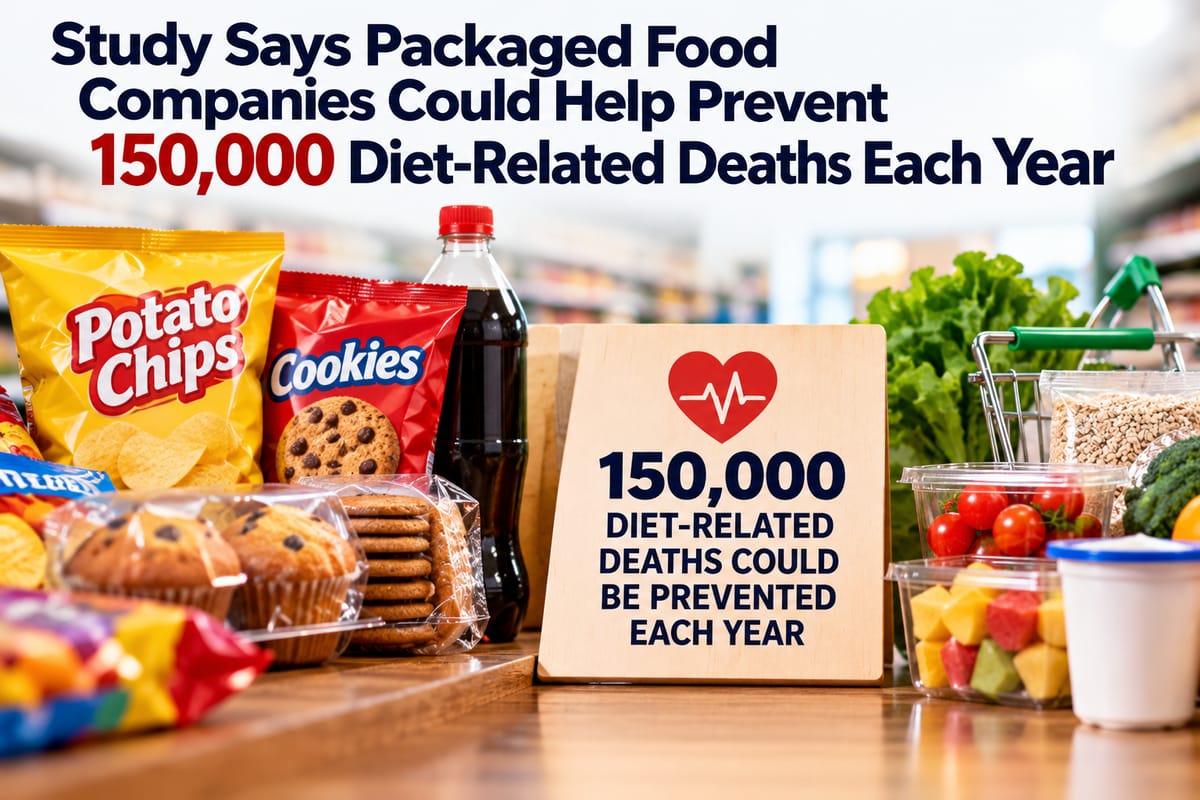

Study Says Packaged Food Companies Could Help Prevent 150,000 Diet-Related Deaths Each Year
A new nutrition study is putting packaged food companies at the center of the debate over diet-related disease, suggesting that changes in what manufacturers sell could have a substantial effect on population health.
Research from the Access to Nutrition initiative and ShareAction, with technical support from Nesta, analyzed nearly 10,000 packaged food and beverage products from 24 major companies operating in the United States. Together, those companies represent an estimated 37% of the U.S. packaged food and beverage market by sales value.
The researchers modeled what could happen if sales shifted toward healthier products already available within the same food categories. Under the scenario reported this week, roughly 150,000 deaths associated with diet-related diseases could potentially be delayed in a single year.
The analysis also estimated that such a shift could prevent about $11.6 billion in lost earnings linked to diet-related ill health.
The findings do not mean that 150,000 deaths would automatically disappear if companies changed their product portfolios. They represent an estimate from a population-health model based on hypothetical changes in food sales.
That distinction is important, but the study nevertheless raises a significant question: How much responsibility for improving diets should fall on consumers, and how much can come from the food environment surrounding them?
What the Researchers Actually Studied
The project focused on packaged foods and beverages sold in the United States rather than attempting to measure the entire American food supply.
Researchers assessed around 10,000 products across a range of categories and evaluated their nutritional quality using the Health Star Rating system. They then modeled hypothetical shifts in sales toward the healthiest 50% of products available within those categories.
The model considered changes in several nutritional characteristics, including:
- Energy content
- Saturated fat
- Salt
- Fiber
Those changes were then incorporated into population-health modeling to estimate potential effects on diet-related noncommunicable diseases.
The study used the Preventable Risk Integrated ModEl, or PRIME, to estimate potential changes in deaths and the economic value of productive working years.
In other words, researchers were not simply comparing one snack against another. They were attempting to connect changes in the nutritional quality of products sold with changes in population dietary intake and, ultimately, health outcomes.
The 150,000 Figure Is a Model, Not a Forecast
The most striking number from the research is the estimated 150,000 diet-related deaths that could potentially be delayed in one year.
That number needs context.
The study did not follow consumers for a year after companies changed their products. Instead, researchers constructed a hypothetical scenario in which consumers shifted their purchases toward healthier products already available in the U.S. market.
The resulting health effects were then estimated using established population-health modeling methods.
This means the figure should be interpreted as an estimate of potential impact under the modeled scenario, rather than evidence that manufacturers can immediately prevent 150,000 deaths through a single reformulation program.
The distinction is particularly important when interpreting nutrition research because dietary behavior, disease risk and mortality are influenced by many factors.
Which Foods Could Make the Biggest Difference?
The analysis identified several categories where shifting sales toward healthier products could provide particularly large potential benefits.
These included baked goods, sauces, dips and condiments, confectionery, carbonated drinks and savory snacks.
These categories are significant because they are widely consumed and can contribute substantial amounts of calories, saturated fat, salt or added sugars depending on the products selected.
A relatively small nutritional difference between individual products can become more important when multiplied across millions of purchases.
For example, if a lower-sodium version of a commonly purchased product becomes the more frequently purchased option, the population-level effect could be considerably larger than the effect on any individual consumer.
That is the basic logic behind the study’s modeling approach.
Healthier Products Already Exist
One of the more notable aspects of the research is that it does not assume companies need to invent an entirely new generation of foods.
The researchers specifically modeled shifts toward healthier products that are already available in the market.
That creates several potential pathways for change.
Companies could reformulate existing products to reduce nutrients of concern. They could expand the number of healthier products in their portfolios. Retailers could give healthier options more prominent placement. Marketing could emphasize products with stronger nutritional profiles.
Consumers could also shift their purchasing decisions when healthier alternatives are affordable, available and appealing.
The potential impact therefore extends beyond the ingredients inside a package.
It also involves which products companies develop, promote, distribute and make easy for shoppers to find.
Why Nutrient Density Matters
The findings also reinforce a broader nutrition principle: healthy eating is about more than avoiding one particular ingredient.
A food’s nutritional value depends on the overall package of nutrients it provides.
A product with fewer calories is not automatically more nutritious. Likewise, reducing one nutrient does not necessarily make a food healthy if the product remains low in essential nutrients.
Understanding what nutrient density means and how to choose nutrient-dense foods can help consumers look beyond isolated claims on packaging.
Nutrient density encourages people to consider what a food contributes to the overall diet, including vitamins, minerals, fiber, protein and other beneficial components.
That perspective is particularly relevant as food companies compete to market products using individual claims such as “high protein,” “low fat,” “natural” or “reduced sugar.”
A single marketing claim rarely tells the complete nutritional story.
The Food Environment Can Shape Consumer Choices
People do not make food decisions in isolation.
Price, convenience, availability, advertising, packaging, product placement and time constraints can all affect what ends up in a shopping basket.
This is one reason the researchers focused on the food environment as well as individual products.
If healthier choices are difficult to find or substantially more expensive, consumers may have fewer practical opportunities to choose them.
On the other hand, if healthier alternatives are widely available, competitively priced and presented alongside familiar products, switching may become easier.
The study’s findings therefore raise questions about how much responsibility should be placed on individual consumers when the available choices are shaped by commercial decisions.
Affordability Remains a Major Part of the Equation
Nutrition advice can be difficult to follow when healthier foods are perceived as more expensive.
Households managing tight budgets may prioritize foods that provide calories at a lower immediate cost, particularly when food prices are rising.
That makes healthy eating on a limited budget an important part of the broader discussion.
For food companies, affordability can also influence whether a healthier product actually changes population diets.
A reformulated product may have a better nutritional profile, but if it becomes significantly more expensive, its potential reach could be limited.
The healthiest product on a shelf cannot have much population-level impact if large numbers of consumers cannot afford it.
Reformulation Could Be One Route to Change
Food reformulation involves changing a product’s ingredients or composition while maintaining its basic identity.
Manufacturers have used reformulation for decades to alter levels of salt, sugar, fat and other components.
The new modeling study suggests that reformulation could be part of a broader strategy for improving the nutritional quality of packaged foods.
Potential changes could include:
- Reducing sodium in savory products
- Lowering added sugar in beverages and confectionery
- Reducing saturated fat
- Increasing fiber
- Improving the balance of nutrients
- Offering healthier alternatives within major product categories
The scale of the potential impact depends on how extensively such changes are adopted and whether consumers purchase the healthier versions.
Product Portfolios Could Matter as Much as Individual Products
A company can improve its nutritional impact without completely abandoning popular product categories.
Instead, it could increase the share of healthier products within those categories.
For example, a manufacturer might sell multiple varieties of a snack, beverage or baked product while gradually expanding the proportion of products that meet stronger nutritional standards.
This is broadly consistent with the study’s modeled scenario, which examined shifts toward the healthier half of products available in each category rather than assuming that consumers would stop purchasing packaged foods altogether.
That distinction makes the scenario more closely connected to how consumers actually shop.
People may continue buying packaged foods while changing which versions they choose.
Consumers Still Have an Important Role
The study’s focus on manufacturers does not mean individual food choices are irrelevant.
Consumers ultimately determine which products are purchased, and personal dietary patterns remain important to health.
A balanced eating pattern can include packaged foods alongside fresh and minimally processed foods.
The challenge is that consumers must often compare products using limited information while shopping quickly.
Nutrition labels can help, but interpreting them requires time and familiarity.
A broader complete guide to healthy eating and balanced nutrition can provide useful context because individual food choices make more sense when considered as part of an overall dietary pattern.
Labels Can Influence What Shoppers See
Nutrition labeling is another potential mechanism for changing consumer behavior.
Front-of-package labels, nutrient warnings and simplified nutrition information are designed to make important characteristics easier to recognize while shopping.
Separate U.S. research has modeled the potential impact of mandatory front-of-package nutrient disclosures and estimated that such a policy could avert or delay tens of thousands of diet-related noncommunicable disease deaths under modeled scenarios. That research similarly relies on assumptions about how consumers and manufacturers would respond to changes in labeling.
These findings point toward a broader idea: relatively small changes in consumer behavior can potentially produce large population effects when applied across millions of people.
However, the actual effect depends on how consumers respond in real-world settings.
The Way We Judge “Healthy” Foods Is Also Changing
Nutrition science continues to evolve, and researchers increasingly question whether simple classifications are sufficient for evaluating foods.
A product’s nutrient profile, processing level, ingredients, portion size and role within the overall diet can all influence its nutritional significance.
This is why new research challenging how we judge healthy diets is part of a wider shift in nutrition conversations.
Rather than asking whether an individual food is simply “good” or “bad,” researchers increasingly examine dietary patterns and the combination of foods people consume over time.
The same principle applies to packaged food companies.
A manufacturer can produce some highly nutritious products and some products that contribute more nutrients of concern. Looking at the overall portfolio can therefore provide more information than focusing on one item.
There Is a Difference Between Availability and Consumption
Making healthier products available does not guarantee that people will buy them.
Taste, price, familiarity, convenience and marketing all influence purchasing decisions.
A healthier product that does not appeal to consumers may have little effect on population diets.
This is why companies seeking to improve nutritional outcomes may need to consider more than formulation.
They may also need to make healthier products competitive on:
- Price
- Taste
- Convenience
- Packaging
- Availability
- Marketing
- Portion size
The study’s model assumes that sales shift toward healthier products. Achieving that shift in reality would require consumers to change purchasing behavior as well as companies to change what they offer.
Economic Benefits Could Extend Beyond Healthcare
The study also examined the economic consequences of diet-related ill health.
Researchers estimated that shifting sales toward healthier products could prevent approximately $11.6 billion in lost pay associated with diet-related ill health.
This reflects the fact that poor health can affect more than medical spending.
Illness can result in missed work, reduced productivity, early retirement or people leaving the workforce.
Improving dietary health at a population level could therefore have implications for employers and the wider economy in addition to healthcare systems.
The economic estimates, like the mortality estimates, are modeled outcomes rather than observed savings.
The U.S. Focus Limits How Far the Findings Can Be Applied
The research specifically examines packaged foods sold in the United States.
That means its 150,000-death estimate should not be interpreted as a global figure.
Food markets differ substantially between countries. Product formulations, diets, prices, labeling requirements and patterns of packaged-food consumption can vary widely.
Research from Kenya, for example, has found significant gaps in nutrition labeling and assessed the nutritional quality of thousands of packaged foods available in the Kenyan market. A 2026 UNICEF Kenya report also highlighted challenges involving nutrition information and the food environment affecting children.
These differences demonstrate why interventions need to account for local food systems rather than simply applying one country’s model everywhere.
What the Research Could Mean for Food Companies
The study gives manufacturers several potential areas to consider.
One is reformulation: making existing products nutritionally healthier.
Another is portfolio management: increasing the proportion of products with stronger nutritional profiles.
Companies could also examine pricing, product placement, marketing and distribution.
Investors and policymakers may likewise use nutritional assessments to examine how companies are responding to public-health concerns.
ATNi says the project’s purpose includes providing insights for food and beverage companies, investors, policymakers and civil society organizations.
The research therefore frames nutrition as a market issue as well as an individual health issue.
A Large Number With an Important Caveat
The estimated 150,000 deaths is attention-grabbing, but its meaning depends on the assumptions behind the model.
Researchers had to estimate how sales would change, how those sales changes would affect nutrient intake and how altered nutrient intake would influence disease and mortality.
Each stage introduces uncertainty.
The study is therefore most useful as an indication of the potential scale of the opportunity, rather than as a guarantee of a particular number of lives saved.
It also does not prove that changing packaged foods alone would solve the problem of diet-related disease.
Physical activity, healthcare access, income, education, genetics, smoking, alcohol use and many other factors can influence health outcomes.
Why the Food Industry Is Becoming Part of the Nutrition Conversation
For decades, nutrition advice has often focused on what individuals should eat.
The new research adds another layer to that discussion.
Consumers make choices, but those choices take place within an environment shaped by manufacturers, retailers, advertising, pricing and regulation.
If healthier products become more available, affordable and appealing, consumers may have more opportunities to make healthier choices without completely changing the way they shop.
That is the central idea behind the new modeling study.
Its estimate of approximately 150,000 potentially delayed deaths should not be read as a guaranteed outcome. Instead, it illustrates how relatively modest changes in the nutritional quality and sales mix of widely consumed packaged foods could potentially have effects far beyond individual households.
As researchers continue to examine diet-related disease, the conversation is increasingly moving from “What should consumers eat?” to a broader question: “What kind of food environment makes healthier eating easier to achieve?”
The answer may involve consumers, manufacturers, retailers, policymakers and public-health organizations working on different parts of the same problem.
Continue Reading
Similar Posts

Bettergoods Pasta Recalled Over Listeria Risk: What Consumers Need to Know
The recall originally covered two specific lots, but consumers should now treat the broader recall as applying to the product regardless of lot number.
Read article
GLP-1 Drugs and Nutritional Deficiencies: What New Research Says About Children
The findings do not prove that GLP-1 drugs directly caused the deficiencies. The study used administrative insurance claims rather than laboratory measurements or detailed clinical records, and the researchers themselves describe nutritional deficiencies as an under-recognized concern rather than establishing a direct causal relationship.
Read article
New Micronutrient Research Could Reshape How Experts Fight Vitamin and Mineral Deficiencies
The findings could influence how governments, nutrition organizations and food producers approach one of the world's most persistent nutrition problems.
Read article

Join 10,000+ Readers Building Healthier Habits
Get actionable wellness tips every week plus our newest articles delivered straight to your inbox.