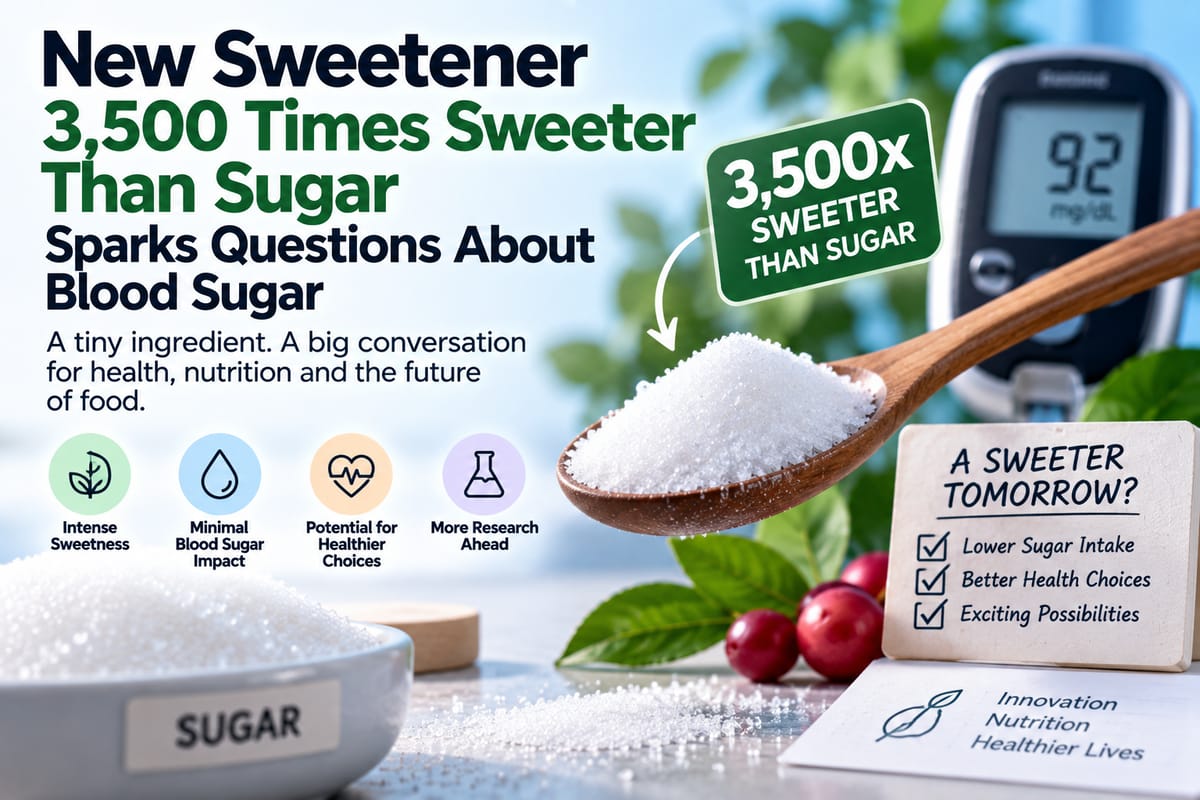

**New Sweetener 3,500 Times Sweeter Than Sugar Sparks Questions About Blood Sugar
A new sweetener that is roughly 3,500 times sweeter than table sugar is drawing attention from the food industry and nutrition researchers after a small human study found that it produced very little change in blood glucose and insulin levels.
The ingredient, known as sweelin, is a re-engineered sweet protein based on monellin, a naturally occurring protein originally identified in the serendipity berry of West Africa. Its extraordinary sweetness means that only a tiny amount is needed to provide the same perceived sweetness as a much larger quantity of sugar.
The early findings are intriguing, particularly as manufacturers continue looking for ways to reduce added sugar without sacrificing taste. But the size and design of the available human research mean there is still plenty to learn about how the sweetener behaves in different populations and over longer periods.
What Is Sweelin?
Sweelin is not simply another version of conventional table sugar or a traditional artificial sweetener.
It is based on a sweet-tasting protein called monellin. Natural monellin has an important limitation: it can lose its structure when exposed to the temperatures commonly used during food processing. Researchers working with Amai Proteins redesigned the protein to improve its stability under heat and different acidity conditions.
The resulting ingredient can be used in applications where manufacturers need sweetness while substantially reducing the amount of conventional sugar.
Research on the ingredient has reported sweetness roughly 3,500 times greater than sucrose by weight under the testing conditions used. That figure does not mean a food would literally taste 3,500 times sweeter in every situation. Sweetness comparisons can vary according to concentration, formulation and the reference solution used.
The extreme potency is nevertheless important because it means very small quantities can deliver a noticeable sweet taste.
Why Blood Sugar Is Part of the Conversation
The biggest nutritional question surrounding any sugar replacement is not simply whether it tastes sweet. Researchers also want to understand what happens after it is consumed.
Table sugar contains carbohydrates that are broken down and absorbed, contributing to a rise in blood glucose. The body responds by releasing insulin, which helps move glucose from the bloodstream into cells and assists with maintaining blood glucose within an appropriate range.
Understanding how blood sugar regulation works is therefore important when evaluating new sweeteners. A substance can taste intensely sweet without necessarily providing the same amount of carbohydrate as sugar.
That distinction is one reason high-intensity sweeteners have attracted interest among people trying to reduce their intake of added sugars.
What Did the Small Human Study Find?
A 2026 study published in Food Chemistry examined sweelin in a randomized, double-blind crossover trial involving 19 healthy adults.
Participants consumed drinks containing different sweetening treatments on separate occasions. The researchers compared the responses with those produced by dextrose, a form of glucose, as well as stevia.
The study found that sweelin produced glucose and insulin responses that were much lower than those associated with dextrose. Its overall response was similar to the response observed with stevia during the two-hour testing period.
That is an interesting result because it suggests that the sweet protein can provide an intense sweet taste without producing the same immediate blood glucose response associated with a glucose-containing drink.
However, the study was small, and its participants were healthy adults. That means the findings cannot automatically be extended to people with diabetes, prediabetes, insulin resistance or other metabolic conditions.
The study was also funded by the company developing the ingredient, another reason independent research will be important.
Does 3,500 Times Sweeter Mean It Has 3,500 Times More Sugar?
No.
The sweetness measurement describes sweetness potency, not sugar content.
If an ingredient is thousands of times sweeter than sucrose by weight, manufacturers can theoretically use dramatically less of it to achieve a similar level of sweetness.
That is very different from adding thousands of times more sugar.
This distinction matters because consumers can easily interpret an unusually large sweetness number as meaning that the ingredient is somehow delivering an enormous amount of sugar. In reality, the opposite is the point: extremely small quantities can produce substantial sweetness.
The potential nutritional advantage therefore comes from replacing some of the bulk sugar in a food or beverage rather than making the sweetener itself equivalent to thousands of grams of sugar.
Could It Help Reduce Added Sugar?
Potentially, but the answer depends on how food manufacturers use it.
A sweetener this potent could allow companies to reformulate beverages, desserts, dairy products, condiments and other foods while reducing the amount of conventional sugar required.
That could become relevant for people trying to follow a complete guide to healthy eating and balanced nutrition, where reducing excessive added sugar can be one component of an overall dietary pattern.
But replacing sugar does not automatically make a food nutritious.
A cookie, dessert or sweetened drink can still contain substantial amounts of fat, refined starch, sodium or other ingredients even if some of its sugar has been removed.
The nutritional value of the finished product will ultimately depend on the entire formulation.
What About People Concerned About Diabetes?
This is where caution becomes especially important.
The early sweelin study provides information about short-term glucose and insulin responses in a small group of healthy adults. It does not establish that the ingredient prevents diabetes or improves diabetes management.
Diabetes is influenced by numerous factors, including genetics, body composition, physical activity, dietary patterns and overall metabolic health.
For anyone interested in the broader relationship between lifestyle and metabolic disease, a complete guide to diabetes prevention and risk provides a more useful framework than focusing on a single sweetener.
People who already have diabetes should also avoid assuming that a new sweetener is automatically appropriate for their individual diet or medication plan. A product’s effect on blood glucose is only one part of evaluating how it fits into a person’s overall nutritional needs.
Natural Origin Does Not Answer Every Safety Question
Sweelin’s connection to a naturally occurring protein may sound reassuring, but “natural” and “safe” are not interchangeable terms.
The ingredient is a redesigned protein produced through precision fermentation. Researchers have conducted toxicological testing as part of its safety evaluation, and regulatory review has also taken place.
Still, food safety and long-term nutritional effects are different questions.
A new ingredient can undergo safety testing while researchers continue studying how it behaves when consumed by larger and more diverse populations. Long-term dietary exposure, interactions with different foods and responses among people with metabolic conditions may require additional research.
That is particularly relevant for an ingredient that could eventually be incorporated into a large number of everyday foods.
Could Sweelin Change the Sweetener Market?
The technology points toward a broader trend in food science: finding ways to deliver familiar sensory experiences while using fewer conventional ingredients.
Sugar performs several jobs in food beyond sweetness. It can affect texture, browning, preservation, moisture and mouthfeel. Removing it therefore cannot always be solved simply by replacing its sweetness.
A highly potent protein could nevertheless become useful in formulations where sweetness is the primary function that needs to be replicated.
For manufacturers, the challenge will be determining whether the ingredient can deliver a consistent taste, work reliably during processing and remain practical at commercial scale.
For consumers, the more important question may be what happens to the rest of the recipe after sugar is reduced.
What Consumers Should Watch For
Sweelin is still at an early stage of consumer adoption. Although it has cleared an important U.S. regulatory hurdle, products containing it are not yet widely available.
If foods and drinks containing the ingredient reach supermarkets, consumers will still need to read the entire nutrition label rather than focusing exclusively on the sweetener.
Important details can include total carbohydrates, added sugars, calories, fiber, protein, saturated fat and serving size.
It is also worth remembering that replacing sugar does not eliminate the importance of an overall healthy lifestyle. Nutrition, movement, sleep, stress management and other daily habits work together, which is why broader resources such as what healthy living is and what it includes remain relevant when evaluating individual food ingredients.
The Bigger Question Behind the Sweetener
The most interesting part of sweelin may not be its headline-making sweetness ratio. It is the possibility of designing food ingredients that can reproduce sweetness while substantially reducing the amount of conventional sugar required.
The initial human findings provide a reason for researchers to keep studying the ingredient, but they do not settle the question of its long-term effects on blood sugar, insulin or overall health.
Larger independent studies involving people with different metabolic profiles will be important before broad conclusions can be drawn.
For now, sweelin represents an intriguing development in food science: an exceptionally potent sweet protein with promising short-term metabolic findings, but with a research story that is still being written.
Continue Reading
Similar Posts

Bettergoods Pasta Recalled Over Listeria Risk: What Consumers Need to Know
The recall originally covered two specific lots, but consumers should now treat the broader recall as applying to the product regardless of lot number.
Read article
GLP-1 Drugs and Nutritional Deficiencies: What New Research Says About Children
The findings do not prove that GLP-1 drugs directly caused the deficiencies. The study used administrative insurance claims rather than laboratory measurements or detailed clinical records, and the researchers themselves describe nutritional deficiencies as an under-recognized concern rather than establishing a direct causal relationship.
Read article
New Micronutrient Research Could Reshape How Experts Fight Vitamin and Mineral Deficiencies
The findings could influence how governments, nutrition organizations and food producers approach one of the world's most persistent nutrition problems.
Read article

Join 10,000+ Readers Building Healthier Habits
Get actionable wellness tips every week plus our newest articles delivered straight to your inbox.