
New Study Questions the Environmental Impact of the Latest U.S. Dietary Guidelines
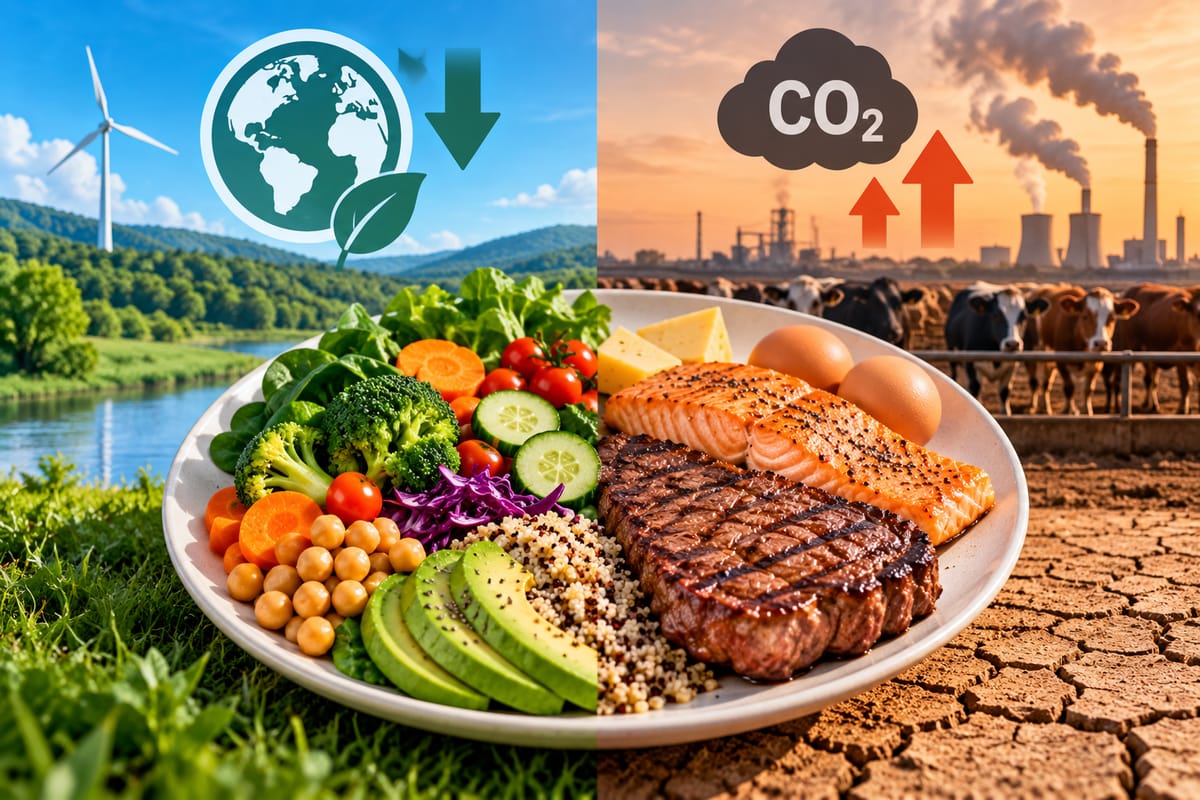
The latest U.S. Dietary Guidelines are facing new questions over their environmental impact after researchers estimated that following the 2025–2030 recommendations could produce substantially higher diet-related greenhouse gas emissions than previous versions.
The study, published September 23 in Nature Food, estimated that a diet following the newest guidelines would generate 5.46 kilograms of carbon dioxide equivalent per 2,000 calories. That represents a 32.8% increase compared with dietary patterns associated with the 2015–2020 and 2020–2025 guidelines.
The researchers linked dietary data from the National Health and Nutrition Examination Survey with life-cycle greenhouse-gas estimates for foods. Their analysis points primarily to one change as the driver of the increase: the higher protein intake encouraged by the newest guidelines.
The finding does not mean that Americans following the guidelines will automatically produce exactly 32.8% more emissions. It is a modeling estimate based on dietary scenarios and environmental-impact databases. But it raises a significant question about whether nutritional recommendations and environmental sustainability are always moving in the same direction.
What the New Dietary Guidelines Recommend
The Dietary Guidelines for Americans, 2025–2030 are the current federal dietary recommendations and are designed to promote health, help prevent diet-related chronic disease and meet nutrient needs. The guidelines emphasize whole and nutrient-dense foods while encouraging Americans to limit highly processed foods, added sugars and refined carbohydrates.
One of the notable changes is the stronger emphasis on protein.
The guidelines recommend prioritizing protein foods at every meal and include both animal and plant sources. Recommended protein foods include eggs, poultry, seafood and red meat, along with beans, peas, lentils, legumes, nuts, seeds and soy.
The guidelines also establish a protein target of roughly 1.2 to 1.6 grams per kilogram of body weight per day, adjusted according to individual energy needs.
That recommendation is central to the environmental debate because different protein sources can have dramatically different environmental footprints.
Why Protein Is at the Center of the Debate
Protein is an essential nutrient, and the new guidelines place greater emphasis on obtaining high-quality protein throughout the day.
The environmental question is not simply whether people eat more protein. It is where that protein comes from.
Animal-based foods and plant-based foods can differ substantially in greenhouse-gas emissions, land requirements, water use and other environmental impacts.
The Nature Food study found that the increase in dietary emissions associated with the new guidelines was primarily driven by the higher recommended protein intake.
A separate 2026 analysis reached a similar broad conclusion. Researchers modeled diets based on the new guidelines while removing highly processed foods and varying protein intake and protein sources. They found that the environmental benefits associated with eliminating highly processed foods could be outweighed by the impact of higher protein intake on greenhouse gases, land use and nitrogen fertilizer use.
That does not mean protein itself is environmentally harmful. Rather, the environmental consequences depend heavily on the foods used to supply it.
The Study’s 32.8% Figure Needs Context
The headline figure is striking, but it needs to be interpreted carefully.
Researchers did not follow millions of Americans for years and measure their actual emissions after the new guidelines were introduced.
Instead, they used dietary information from NHANES and linked food consumption with life-cycle greenhouse-gas estimates. They then modeled the environmental footprint associated with following different generations of the Dietary Guidelines.
The resulting estimate was 5.46 kilograms of CO₂ equivalent per 2,000 calories for the 2025–2030 guideline pattern, compared with about 4.11 kilograms for the earlier guideline periods. Researchers calculated the difference as a 32.8% increase.
This makes the result a projection rather than a measurement of future national emissions.
The study is therefore best understood as an assessment of the environmental implications embedded in the recommended dietary pattern.
Eliminating Highly Processed Foods Could Have Environmental Benefits
The environmental picture is more complicated than simply saying the new guidelines are worse for the planet.
The latest guidelines strongly emphasize reducing highly processed foods.
That could have environmental benefits because some highly processed foods contain animal-derived ingredients and can account for substantial energy intake in the current American diet.
Another 2026 study examining the new guidelines found that removing highly processed foods from modeled versions of the current American diet could reduce some environmental impacts. However, those benefits were offset in several scenarios by the higher protein intake recommended under the new guidelines.
This creates an important tradeoff.
A dietary change can be beneficial in one environmental category while creating greater pressure in another.
Plant Protein Produces a Different Environmental Picture
The source of protein becomes especially important when comparing animal and plant-based diets.
The additional modeling study found that a diet providing the same higher protein target primarily through plant foods had substantially lower environmental impacts than one emphasizing animal-based protein.
Researchers behind the Nature Food study likewise noted that the environmental footprint of the dietary pattern is influenced by the composition of the protein foods.
This is one reason the environmental question cannot be reduced to a simple comparison between “high protein” and “low protein.”
Two people could consume similar amounts of protein while having very different environmental footprints depending on whether that protein comes primarily from beef, poultry, dairy, eggs, fish, beans, lentils, nuts or soy.
Health and Sustainability Are Not Always the Same Thing
The new findings also highlight a broader issue in nutrition science: a diet can be nutritionally desirable without automatically having the lowest environmental footprint.
That relationship is more complicated than the idea that every healthy dietary pattern is inherently sustainable.
A June 2026 perspective published in the American Journal of Clinical Nutrition examined the long-running debate over whether sustainability should be included in the Dietary Guidelines. The author argued that the relationship between nutrition and sustainability involves significant tradeoffs and that evidence can vary across countries, food systems and environmental measures.
The issue is therefore not simply whether sustainability should matter.
It is also about how sustainability should be measured and how environmental considerations should be balanced against nutritional adequacy, affordability, cultural preferences and health outcomes.
A Healthy Diet Can Still Have Environmental Tradeoffs
Consider two diets that both contain vegetables, fruits, whole grains and adequate protein.
One might rely more heavily on beans, lentils and other plant proteins. Another might obtain much of its protein from beef, dairy, poultry and eggs.
Both could potentially satisfy many nutritional recommendations.
Their environmental footprints, however, could differ considerably.
The same is true within individual food categories.
Production methods, transportation, land use, farming practices, processing and food waste can all influence environmental impact.
This makes broad claims about “healthy” or “sustainable” diets difficult without specifying exactly what foods are being consumed and how they are produced.
Nutrient Density Adds Another Layer
The new guidelines place substantial emphasis on nutrient-dense foods.
That concept focuses on the amount of beneficial nutrients a food provides relative to its calories.
For consumers trying to understand the nutritional side of the debate, What Nutrient Density Means and How to Choose Nutrient-Dense Foods provides useful context.
Nutrient density and environmental sustainability, however, are different measurements.
A food can be highly nutrient-dense without having the smallest environmental footprint. Conversely, a food with a relatively low environmental footprint is not automatically nutritionally complete.
A balanced assessment therefore requires looking at both dimensions rather than assuming that one can substitute for the other.
The Guidelines Were Designed Primarily Around Health
The federal Dietary Guidelines are fundamentally a public-health tool.
USDA describes the guidelines as the foundation for federal nutrition programs and policies, with recommendations intended to meet nutrient needs, promote health and help prevent diet-related chronic diseases.
That mission helps explain why environmental sustainability was not the primary organizing principle of the 2025–2030 edition.
The question raised by the new research is whether environmental consequences should play a larger role in future updates.
That would introduce another layer of complexity into a process already balancing nutrition science, chronic disease prevention, food access, cultural preferences and practical dietary advice.
The Sustainability Debate Is Not New
Environmental sustainability has been debated as part of U.S. dietary guidance for decades.
The American Journal of Clinical Nutrition perspective notes that the idea of incorporating sustainability into the Dietary Guidelines dates back to the 1980s. The issue became especially contentious around the 2015 Dietary Guidelines Advisory Committee process, after sustainability considerations were included in the committee’s report but ultimately did not become part of the final federal guidelines.
Since then, researchers have continued studying the relationship between food choices and environmental outcomes.
The latest Nature Food study adds another piece of evidence by specifically examining the environmental footprint associated with the newest U.S. recommendations.
Why the Environmental Question Matters Beyond Climate Change
Greenhouse-gas emissions are only one part of the environmental footprint of food.
Agriculture can affect:
- Land use
- Freshwater consumption
- Nitrogen fertilizer use
- Biodiversity
- Soil health
- Water pollution
- Energy consumption
The separate 2026 modeling study examined several of these measures and found that the environmental effects of following the new dietary pattern varied by category. It reported higher impacts for greenhouse gases, land use and nitrogen fertilizer in some modeled scenarios, while water use could be lower than the current American diet.
This demonstrates why the phrase “environmentally friendly diet” can be misleading without specifying the environmental measure being considered.
A diet could perform better on water use but worse on greenhouse gases, for example.
Food Production Also Depends on Where You Live
Environmental impacts are not identical across countries.
Farming systems, climate, soil, water availability, livestock production, crop yields and transportation networks all vary by region.
The American Journal of Clinical Nutrition perspective highlighted substantial differences between countries in the relationship between dietary patterns and environmental impacts. It cautioned against assuming that findings from one country can automatically be transferred to another.
That is particularly important when discussing U.S. dietary guidance.
A recommendation developed around American food production and consumption patterns cannot necessarily be evaluated using environmental assumptions from Europe, Africa or another region.
Affordability and Access Still Matter
A sustainable dietary recommendation also needs to be realistic for the people expected to follow it.
Food prices, availability, cooking facilities, transportation and cultural preferences all influence what people actually eat.
The environmental footprint of a theoretically ideal diet means little if large portions of the population cannot afford or access the foods it requires.
This is why nutrition guidance increasingly has to address more than nutrient targets.
A useful Complete Guide to Healthy Eating and Balanced Nutrition can help put individual food choices into the broader context of balanced dietary patterns.
The Study Does Not Mean the Dietary Guidelines Are Unhealthy
The new research should not be interpreted as proof that the 2025–2030 Dietary Guidelines are nutritionally harmful.
The study examined greenhouse-gas emissions, not whether following the guidelines improves or worsens individual health outcomes.
The guidelines themselves are intended to support healthy eating patterns, and they emphasize vegetables, fruits, whole grains, nutrient-dense foods and limits on highly processed foods.
The new study instead raises a separate question:
Can a dietary pattern designed to improve health also be designed to reduce environmental impacts?
That question remains open to debate.
Researchers Are Challenging How “Healthy” Should Be Defined
The latest environmental findings fit into a larger reassessment of how dietary quality should be measured.
Nutrition research has increasingly examined food quality, nutrient density, processing, dietary patterns and environmental impact together rather than treating each as an isolated issue.
That shift is reflected in the broader discussion captured by New Research Challenges How We Judge Healthy Diets.
A food’s health value can depend on the overall dietary pattern in which it is consumed. Its environmental impact can likewise depend on production methods, quantity and what it replaces.
That makes simple food rankings difficult to apply universally.
The Environment Can Also Influence Health
The relationship works in both directions.
Diet affects the environment, but environmental conditions can also affect people’s health and ability to maintain a healthy diet.
Climate change, air pollution, water quality, food availability and neighborhood conditions can all influence health outcomes.
For consumers interested in that broader relationship, How Your Environment Affects Everyday Health provides additional context.
This means nutrition policy increasingly sits at the intersection of public health and environmental policy.
What Could Change in Future Dietary Guidelines?
The latest research does not automatically mean the federal government will change the current guidelines.
The 2025–2030 edition is already the official framework, and dietary guidelines are updated on a five-year cycle.
But studies like the new Nature Food analysis can influence future scientific discussions.
Researchers may increasingly evaluate proposed dietary patterns using multiple criteria at once:
- Nutritional adequacy
- Chronic disease risk
- Greenhouse-gas emissions
- Water use
- Land use
- Fertilizer requirements
- Food affordability
- Cultural acceptability
- Food availability
Such an approach could make future dietary recommendations more comprehensive, although it could also make them more complicated for consumers to follow.
What Consumers Should Take From the Findings
The research does not require consumers to abandon the new Dietary Guidelines or make drastic dietary changes based on a single modeling study.
Instead, it highlights the importance of considering food choices from more than one perspective.
Protein can come from many sources. Vegetables, fruits, whole grains, legumes, nuts and seeds can contribute important nutrients while also offering different environmental profiles from many animal-based foods.
The environmental footprint of a diet is shaped by the overall pattern rather than by one meal or one ingredient.
For individuals, that means there is room for healthy eating patterns that also take environmental considerations into account without treating nutrition and sustainability as identical concepts.
A More Complicated Picture of “Eating Healthy”
The latest study adds an important complication to the conversation surrounding America’s newest dietary guidance.
The 2025–2030 guidelines place greater emphasis on protein, including animal-based protein foods, while also encouraging Americans to reduce highly processed foods and prioritize nutrient-dense whole foods.
Researchers now estimate that following the recommended pattern could produce about 32.8% more diet-related greenhouse-gas emissions than dietary patterns associated with the previous two guideline cycles.
That figure is a model, not a prediction that national emissions will rise by exactly that amount.
But it highlights a genuine policy challenge: health, nutrition and environmental sustainability do not always point toward the same dietary choices.
Future research will need to determine how dietary recommendations can meet nutritional needs while accounting more explicitly for the environmental costs of different food choices. For now, the new evidence suggests that defining a truly healthy diet may require looking beyond nutrients and disease prevention to the wider food system that makes those diets possible.
Continue Reading
Similar Posts

Bettergoods Pasta Recalled Over Listeria Risk: What Consumers Need to Know
The recall originally covered two specific lots, but consumers should now treat the broader recall as applying to the product regardless of lot number.
Read article
GLP-1 Drugs and Nutritional Deficiencies: What New Research Says About Children
The findings do not prove that GLP-1 drugs directly caused the deficiencies. The study used administrative insurance claims rather than laboratory measurements or detailed clinical records, and the researchers themselves describe nutritional deficiencies as an under-recognized concern rather than establishing a direct causal relationship.
Read article
New Micronutrient Research Could Reshape How Experts Fight Vitamin and Mineral Deficiencies
The findings could influence how governments, nutrition organizations and food producers approach one of the world's most persistent nutrition problems.
Read article
Join 10,000+ Readers Building Healthier Habits
Get actionable wellness tips every week plus our newest articles delivered straight to your inbox.