
How to Reduce Sedentary Behavior and Add More Movement to Everyday Life
Modern life makes sitting remarkably easy.
People sit while commuting, working at a desk, watching television, using smartphones, eating meals, attending meetings and browsing the internet. Even people who exercise regularly can spend much of the rest of their day sitting.
That matters because exercise and sedentary behavior are not exactly the same thing. Someone can complete a workout in the morning and still spend most of the remaining day inactive.
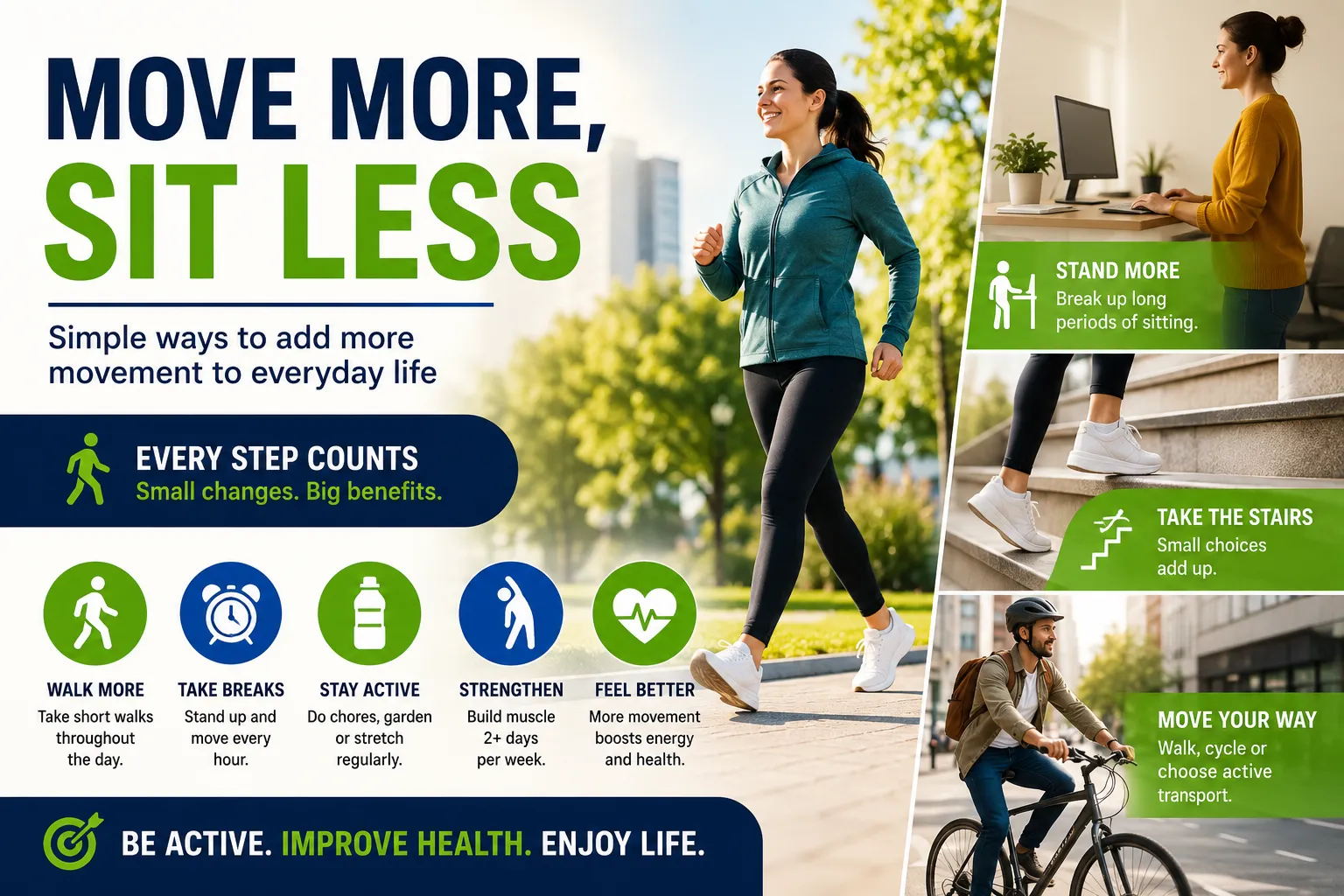
The good news is that becoming more active does not necessarily require spending hours in a gym. Walking more, standing periodically, taking the stairs, doing household tasks, moving during breaks and choosing active transportation can all add meaningful physical activity to the day.
The World Health Organization recommends that adults get at least 150–300 minutes of moderate-intensity aerobic activity per week, or 75–150 minutes of vigorous activity, along with muscle-strengthening activities on at least two days per week. At the same time, WHO recommends limiting sedentary time and replacing sitting with physical activity of any intensity, including light movement.
The goal is not to turn every moment into a workout.
It is to make movement a normal part of everyday life.
For a broader overview of exercise and movement, see the complete guide to physical activity and exercise.
What Is Sedentary Behavior?
Sedentary behavior refers to activities performed while awake that involve very little physical movement, usually while sitting, reclining or lying down.
Common examples include:
- Sitting at a desk
- Watching television
- Playing video games
- Browsing social media
- Reading while seated
- Sitting during long meetings
- Commuting by car or bus
- Spending extended periods on a computer
- Sitting while using a smartphone
Sedentary behavior is different from simply being physically inactive.
A person can meet recommended exercise targets and still spend many hours sitting during the rest of the day.
That is why a healthy lifestyle involves both getting enough physical activity and reducing unnecessary sedentary time.
Why Moving More Matters
Physical activity supports cardiovascular fitness, muscular function, mobility and overall well-being.
Regular movement is also associated with important health benefits. WHO notes that physical activity can help prevent and manage conditions including cardiovascular disease and type 2 diabetes, while also supporting mental health and cognitive well-being.
The CDC similarly emphasizes that adults who sit less and engage in any amount of moderate-to-vigorous physical activity can gain health benefits.
This does not mean every movement needs to be intense.
A walk around the neighborhood, climbing stairs or doing household chores may not feel like a formal workout, but these activities still contribute to overall movement.
You Do Not Have to Exercise All at Once
One common misconception is that physical activity only counts if it happens during a dedicated workout.
In reality, movement can be accumulated throughout the day.
A 30-minute walk is one option, but so are several shorter periods of activity.
For example, someone might:
- Walk for 10 minutes in the morning
- Take a 10-minute walking break at lunch
- Walk for another 15 minutes in the evening
- Take the stairs during the day
- Do household chores
Those activities can add up.
The CDC notes that adults can spread physical activity throughout the week and break it into smaller chunks rather than completing everything in one session.
Short bouts can also make exercise more approachable for people with demanding schedules, as discussed in how you may not need a long workout.
Start by Identifying How Much You Sit
Before changing your habits, pay attention to where sedentary time comes from.
For one or two days, consider tracking periods when you are sitting.
Look at:
- Work hours
- Commute time
- Meal times
- Television
- Gaming
- Social media
- Computer use
- Evening relaxation
- Long meetings
The purpose is not to criticize yourself.
It is to identify opportunities.
If you discover that you spend three hours watching television every evening, for example, you may be able to stand or walk during part of that time.
If your workday involves four hours of uninterrupted computer use, short movement breaks may be easier to introduce.
Break Up Long Periods of Sitting
One of the simplest changes is to avoid remaining seated for very long uninterrupted periods.
You can create natural opportunities to move by:
- Standing during phone calls
- Walking while listening to audio
- Getting up to refill your water
- Walking to speak with a nearby colleague
- Taking brief movement breaks
- Stretching between tasks
- Standing during some meetings
These small interruptions can make a sedentary day more active.
The objective is not necessarily to eliminate sitting.
It is to break up unnecessary stretches of inactivity.
Turn Walking Into a Daily Habit
Walking is one of the easiest ways to increase daily movement because it requires little equipment and can fit into many lifestyles.
You can walk:
- Before work
- After meals
- During lunch breaks
- While making phone calls
- To nearby shops
- Around your neighborhood
- With friends or family
- While listening to music or podcasts
Walking can also become transportation.
Instead of driving to a destination that is reasonably close, walking may allow you to combine an everyday task with physical activity.
For people unsure about how much walking they actually need, the evidence on whether you really need 10,000 steps a day offers useful context.
Use the Stairs When Practical
Stairs provide a simple opportunity to add movement to your day.
If you regularly use elevators for short distances, taking the stairs can increase your activity without requiring a separate workout.
Start with manageable situations.
You do not need to climb ten floors immediately.
Choosing stairs for one or two floors and gradually increasing the amount can make the habit easier to maintain.
People with mobility limitations or medical concerns should adapt activities to their abilities and seek professional advice when appropriate.
Make Your Commute More Active
Transportation can be a major source of sedentary time.
Depending on where you live and what is practical, consider:
- Walking part of the journey
- Cycling
- Getting off public transport one stop earlier
- Parking farther away
- Walking between nearby destinations
- Combining errands into a walking route
Even partial changes can increase movement.
For people who cannot walk or cycle to work, simply adding a short walk before or after public transportation can make a difference.
Move During Work Breaks
Desk-based work can make movement difficult because sitting becomes the default.
Instead of spending every break at your desk, try using some breaks for movement.
A short break could involve:
- Walking around the building
- Going outside
- Stretching
- Climbing a few stairs
- Refilling water
- Walking to another department
These activities can also provide a mental reset.
A movement break does not have to be long to be useful.
Create Movement Triggers
One effective way to develop a movement habit is to connect it to something you already do.
For example:
Every time the phone rings → stand up.
After finishing a meeting → walk for five minutes.
After lunch → take a short walk.
After every hour of computer work → get up and move.
These are sometimes called behavioral cues.
Instead of relying entirely on motivation, you attach movement to an existing routine.
Use Technology as a Reminder
Phones, smartwatches and fitness trackers can remind people when they have been inactive for a long period.
These reminders can be useful because people often lose awareness of how long they have been sitting.
A reminder might simply prompt you to:
- Stand up
- Walk around
- Stretch
- Refill your water
- Take a short break
The technology itself is not the solution.
The important part is responding to the reminder.
Avoid Turning Step Counts Into a Competition
Step counters can encourage movement, but a specific number should not become an obsession.
There is nothing magical about reaching a particular daily step count.
Your appropriate activity level depends on your age, fitness, health, mobility and circumstances.
A person who normally takes 2,000 steps a day may benefit from gradually increasing movement without immediately trying to reach 10,000.
The most useful target is often more movement than your current baseline, progressing gradually.
Make Household Chores Count
Everyday tasks can provide opportunities for physical activity.
Consider:
- Sweeping
- Mopping
- Gardening
- Washing a car
- Cleaning
- Carrying groceries
- Doing laundry
- Organizing rooms
- Walking while completing errands
WHO specifically recognizes household tasks, transportation and other everyday activities as forms of physical activity.
This can change the way people think about exercise.
Physical activity does not always require gym clothes and specialized equipment.
Sometimes it looks like cleaning the house.
Spend Less Time Sitting During Entertainment
Leisure time can become one of the biggest sources of sedentary behavior.
Watching television, streaming movies, gaming and scrolling through social media can consume several hours.
You do not necessarily need to give up these activities.
Instead, consider changing how you use some of that time.
You could:
- Stand during part of a program
- Walk during advertisements or breaks
- Stretch while watching television
- Do light household tasks
- Take a short walk between episodes
- Use an exercise bike while watching certain programs
The idea is to combine entertainment with movement where practical.
Make Social Activities More Active
Socializing does not have to mean sitting at a restaurant or coffee shop.
You can meet friends for:
- Walks
- Hiking
- Recreational sports
- Dancing
- Cycling
- Swimming
- Outdoor games
- Exploring a new neighborhood
Family activities can also become more active.
A weekend walk or outdoor game can provide movement while strengthening social connections.
Choose Active Hobbies
Hobbies can make physical activity feel less like exercise.
Consider activities such as:
- Gardening
- Dancing
- Hiking
- Cycling
- Swimming
- Recreational sports
- Walking photography
- Exploring nature
- Home improvement
- Active games
Enjoyment matters because an activity you genuinely like is easier to repeat.
Add Movement to Your Morning
A morning routine can establish an active tone for the day.
You could begin with:
- A short walk
- Gentle mobility exercises
- Stretching
- Bodyweight movements
- Household chores
- Walking while preparing for the day
It does not need to be a demanding workout.
Even a few minutes of movement can help break up an otherwise sedentary morning.
Take a Walk After Meals
A short walk after eating can be an easy way to introduce movement into the day.
Rather than remaining seated immediately after a meal, consider walking around the neighborhood, workplace or home.
The walk does not need to be fast or long.
The main objective is to turn a sedentary transition into an active one.
People managing medical conditions that affect activity or blood sugar should follow advice from their healthcare professionals when deciding how to structure activity around meals.
Stand More When Possible
Standing is not a replacement for physical activity, but it can help reduce uninterrupted sitting.
Possible opportunities include:
- Standing while making phone calls
- Standing during short tasks
- Using a standing desk for part of the workday
- Standing while reading messages
- Standing during breaks
If you use a standing desk, remember that standing motionless for long periods is not the same as being physically active.
The broader goal is to alternate positions and move regularly.
Add Simple Strength Exercises
Movement throughout the day is important, but adults should also include muscle-strengthening activities.
WHO recommends muscle-strengthening activities involving major muscle groups on at least two days per week.
Strength exercises can include:
- Squats
- Lunges
- Push-ups
- Resistance-band exercises
- Bodyweight rows
- Step-ups
- Carrying appropriate loads
- Weight training
A strength session does not necessarily require a full gym.
However, technique and appropriate progression matter, particularly when using weights.
For a deeper comparison of resistance and aerobic exercise, see strength training vs cardio for long-term health.
Use Short Activity Sessions
You do not always need a full hour to become more active.
Short sessions can fit into busy schedules.
For example:
Five minutes: Walk around the building.
Ten minutes: Take a brisk walk.
Fifteen minutes: Complete a short bodyweight routine.
Twenty minutes: Cycle, walk briskly or perform a structured workout.
Several short periods can make a meaningful contribution to total daily activity.
WHO’s guidance emphasizes that some physical activity is better than none and that replacing sedentary time with physical activity of any intensity can provide benefits.
Make Your Environment Encourage Movement
Your surroundings influence your behavior.
If everything you need is within arm’s reach, you have fewer reasons to move.
Small environmental changes can create additional opportunities.
For example:
- Keep your water bottle away from your desk.
- Place frequently used items somewhere that requires standing.
- Use stairs when practical.
- Put the television remote farther away.
- Arrange your workspace so that you occasionally need to stand.
- Keep walking shoes easily accessible.
These changes create movement opportunities without requiring constant willpower.
Do Not Depend Entirely on Motivation
Motivation changes.
Some days you will feel energetic.
Other days you will not.
A movement-friendly routine should therefore rely on habits and environmental cues rather than motivation alone.
Instead of thinking:
“I need to feel motivated to exercise today,”
try:
“After lunch, I always walk for ten minutes.”
The second approach turns movement into part of the routine.
Build Movement Into Your Workday
People with desk jobs can create a simple movement schedule.
For example:
Start of work: Walk for five minutes.
Every hour: Stand and move briefly.
Mid-morning: Walk while taking a phone call.
Lunch: Walk for 10–20 minutes.
Afternoon: Take another short movement break.
End of work: Walk before beginning the next part of the evening.
The exact schedule does not matter as much as finding a pattern that fits your responsibilities.
Use Walking Meetings When Appropriate
Not every meeting needs to happen around a conference table.
For informal conversations that do not require a computer, documents or presentations, a walking meeting can provide an opportunity to move.
This can work particularly well for:
- One-on-one conversations
- Brainstorming
- Informal check-ins
- Phone discussions
It is not suitable for every workplace situation, but it is an easy option when circumstances allow.
Set Realistic Goals
Trying to transform a highly sedentary lifestyle overnight can be overwhelming.
A better strategy is to establish small goals.
For example:
Week 1: Take a five-minute walk after lunch.
Week 2: Add another short walk.
Week 3: Start taking the stairs for one or two floors.
Week 4: Add two strength sessions.
Gradual progress can make the new behavior feel normal rather than temporary.
WHO recommends that adults who are not currently meeting activity targets start with smaller amounts and gradually increase frequency, intensity and duration.
Track Progress Without Becoming Obsessed
Tracking can help identify patterns.
You might monitor:
- Daily steps
- Walking time
- Workout sessions
- Sitting periods
- Strength sessions
- Active transportation
- Weekly activity minutes
The purpose is to learn what works.
If tracking becomes stressful, simplify it.
A simple calendar with check marks for active days may be enough.
What If You Have a Very Busy Schedule?
A busy schedule does not necessarily mean there is no opportunity to move.
Look for small gaps rather than waiting for a large block of free time.
Five minutes before work.
Ten minutes at lunch.
A short walk after dinner.
Stairs instead of an elevator.
Walking while making a phone call.
These moments can accumulate.
The goal is to stop thinking of physical activity as something that can happen only when you have an uninterrupted hour available.
Movement Can Be More Important Than Perfection
Some days will be more active than others.
You may miss a workout.
You may spend an entire afternoon sitting in meetings.
You may have a long commute.
That does not mean the day is a failure.
The next opportunity to move is simply the next opportunity to move.
A sustainable lifestyle is built over weeks and months, not judged by a single day.
A Simple Daily Movement Plan
For someone looking for a straightforward starting point, a day could look like this:
Morning
- Walk for 5–10 minutes.
- Take the stairs when practical.
- Stand and move while preparing for the day.
During Work
- Break up long sitting periods.
- Walk during suitable phone calls.
- Take short movement breaks.
- Walk during lunch.
Afternoon
- Stand up and move between tasks.
- Take another brief walk.
Evening
- Walk after dinner.
- Do household chores.
- Spend some leisure time standing or moving.
Several Times Per Week
- Add structured aerobic exercise.
- Perform muscle-strengthening activities on at least two days.
This does not need to be followed exactly.
It is simply an example of how movement can become distributed throughout everyday life.
How to Make Walking More Interesting
Walking can become repetitive if it is always done the same way.
You can make it more enjoyable by:
- Exploring different routes
- Listening to podcasts
- Walking with friends
- Taking photographs
- Listening to music
- Walking in parks
- Setting small exploration goals
- Combining walks with errands
The more enjoyable the activity, the easier it may be to maintain.
Why “Move More, Sit Less” Is a Useful Principle
It is easy to think about physical activity as a binary choice:
Exercise or don’t exercise.
Everyday movement creates a third option.
You can exercise and still move more throughout the day.
You can also move more even when you do not have time for a formal workout.
The CDC summarizes this idea simply: adults should move more and sit less, and some physical activity is better than none.
That makes movement a more achievable goal for people with different schedules, abilities and fitness levels.
Avoid Comparing Your Routine With Someone Else’s
Fitness advice often becomes confusing because people compare their activity levels with athletes, fitness influencers or highly active friends.
That is unnecessary.
Your starting point matters more than someone else’s routine.
If you currently spend most of the day sitting, adding a 10-minute walk may be a meaningful improvement.
If you already walk regularly, you may be ready to add strength training or longer aerobic sessions.
The right next step depends on where you are starting.
When to Be More Careful With Exercise
Most people can benefit from becoming more physically active, but exercise should be appropriate for individual circumstances.
People with significant medical conditions, major mobility limitations, symptoms triggered by exertion, or other concerns should discuss appropriate activity with a healthcare professional.
Older adults and people with limited mobility may also need activities adapted to their abilities. WHO specifically recommends balance-focused activity for older adults with poor mobility to help maintain function and reduce fall risk.
The goal is not to push through symptoms.
It is to find safe, sustainable ways to move more.
Small Changes Can Become a More Active Lifestyle
Reducing sedentary behavior does not require completely redesigning your life.
It can begin with surprisingly ordinary choices:
Take a walk instead of sitting.
Take the stairs when practical.
Stand during a phone call.
Walk after dinner.
Move during work breaks.
Do household chores.
Cycle or walk for short trips.
Spend time outdoors.
Play actively with family.
Add strength training a couple of times each week.
These actions may seem insignificant individually, but together they can change how much movement is built into an ordinary day.
Making Movement the Default
The most sustainable approach to reducing sedentary behavior is to stop treating movement as something that only happens during a workout.
Build it into transportation.
Build it into work.
Build it into household tasks.
Build it into social time.
Build it into leisure.
Build it into daily routines.
Formal exercise remains valuable, and adults should work toward recommended levels of aerobic and muscle-strengthening activity. But everyday movement can help close the gap between a short workout and an otherwise sedentary lifestyle.
The objective is not to make every part of the day physically demanding.
It is simply to create more opportunities to move and fewer opportunities to remain still for hours at a time.
For many people, that small shift can be one of the most practical steps toward a more active and healthier everyday life.
Continue Reading
Similar Posts

What Nutrient Density Means and How to Choose Nutrient-Dense Foods
Understanding nutrient density can make everyday food choices easier without requiring complicated diets or strict rules. Instead of focusing only on calories, nutrient density encourages people to consider what nutrients a food contributes to the overall diet.
Read article
How to Recover After Breaking Healthy Habits
Breaking a healthy routine is usually a temporary interruption rather than a permanent failure. The important part is learning how to return to healthier behaviors without turning a short setback into a long-term pattern.
Read article
How Your Environment Affects Everyday Health
Understanding these connections can help people make practical changes that support healthier daily living.
Read article

Join 10,000+ Readers Building Healthier Habits
Get actionable wellness tips every week plus our newest articles delivered straight to your inbox.