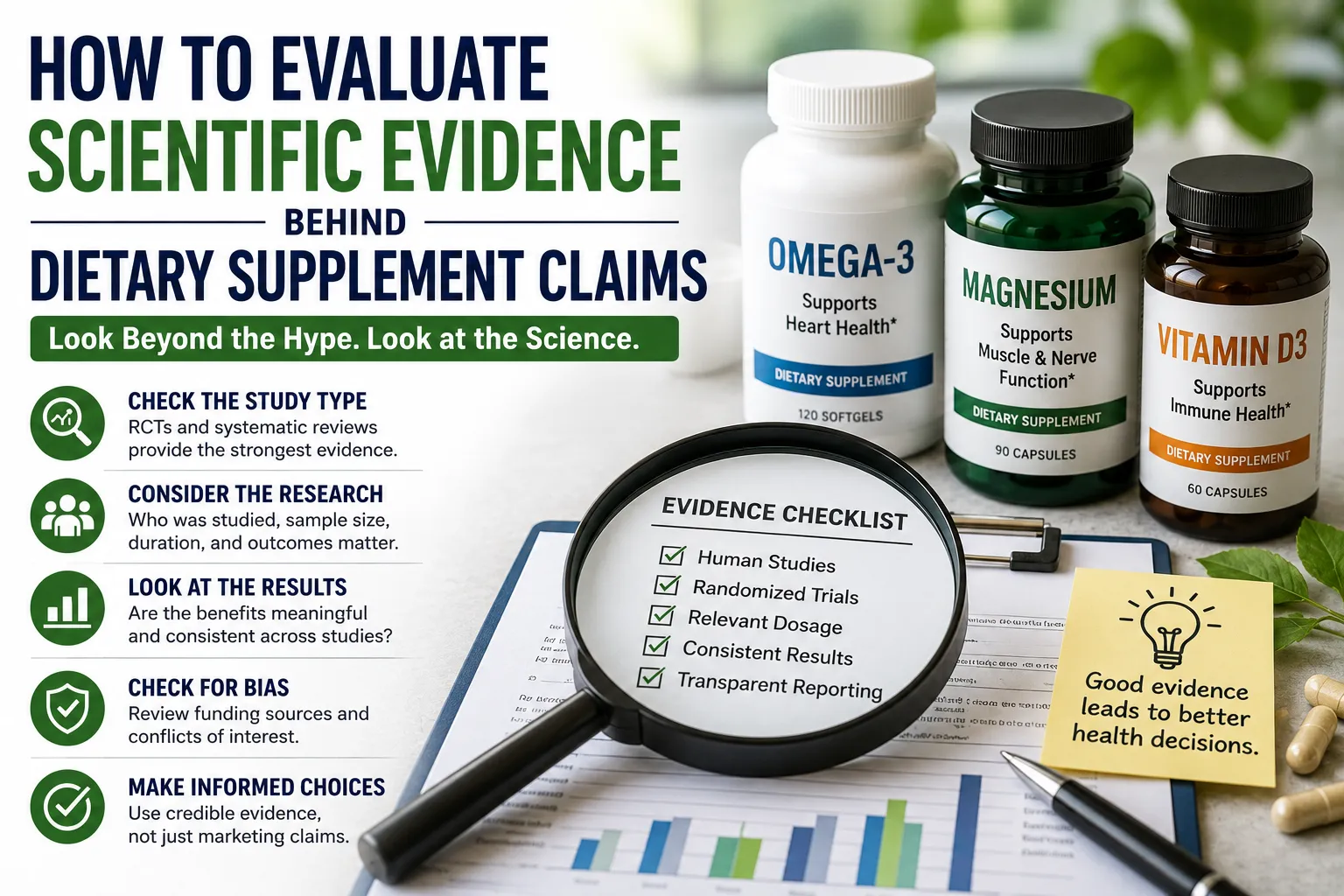

How to Evaluate Scientific Evidence Behind Dietary Supplement Claims
Dietary supplements are surrounded by impressive promises. A capsule may claim to support memory, improve energy, strengthen immunity, promote better sleep, protect heart health or help with weight management. Advertisements and product labels often use phrases such as “clinically studied,” “scientifically proven” and “natural formula.”
But a scientific-sounding claim does not necessarily mean that a supplement has been proven to work.
The evidence behind dietary supplements varies considerably. Some ingredients have been extensively studied in well-designed clinical trials, while others have only limited laboratory research or anecdotal support. Even when a study produces encouraging results, it may not mean that the specific product being sold provides the same benefit.
Learning how to evaluate the evidence can help consumers distinguish genuine scientific findings from exaggerated marketing claims.
For broader context on how evidence, safety, quality, and other considerations fit together, see the complete guide to dietary supplements.
Start by Asking What the Claim Actually Says
Before looking at a study, identify exactly what the supplement is claiming to do.
There is a major difference between claims such as:
- “Supports normal immune function”
- “May help maintain healthy cholesterol levels”
- “Reduces the risk of heart disease”
- “Prevents cardiovascular disease”
The first claims are relatively broad. The latter claims suggest a specific health outcome that requires much stronger evidence.
Marketing language can sometimes make a modest scientific finding sound much more significant than it really is.
A supplement may have been shown to influence a biological marker without being shown to prevent or treat a disease.
Not All Scientific Studies Provide the Same Evidence
One of the most important skills in evaluating supplement claims is understanding the differences between types of research.
Laboratory Studies
Laboratory experiments can examine how an ingredient behaves at the cellular or molecular level.
They can help scientists develop hypotheses about how a substance might work.
However, results observed in isolated cells do not automatically occur in the human body.
An ingredient might affect a particular biological pathway in a laboratory while having little meaningful effect when consumed as a supplement.
Animal Studies
Animal research can provide valuable information about biological mechanisms, toxicity and potential effects.
But animals and humans do not always respond to substances in the same way.
A supplement that appears promising in mice, for example, still needs appropriate human research before claims about human health can be justified.
Observational Studies
Observational studies examine relationships between behaviors, exposures and health outcomes.
Researchers might find that people who consume more of a particular nutrient have lower rates of a certain condition.
Such findings can be useful, but they do not necessarily demonstrate cause and effect.
People who consume more of a nutrient may also exercise more, eat healthier diets or have other characteristics that influence the outcome.
Randomized Controlled Trials
Randomized controlled trials are generally considered much stronger evidence for determining whether an intervention actually causes a health effect.
Participants are typically assigned to different groups, with one group receiving the intervention and another receiving a comparison treatment or placebo.
Randomization helps reduce the influence of factors that could otherwise distort the results.
For supplement claims, well-designed human randomized controlled trials are often far more informative than laboratory studies or testimonials.
Systematic Reviews and Meta-Analyses
A systematic review collects and evaluates research addressing a specific question.
A meta-analysis may statistically combine results from multiple studies.
When conducted properly, these approaches can provide a broader picture than relying on one individual experiment.
However, combining several weak studies does not automatically produce strong evidence. The quality, consistency and relevance of the underlying research still matter.
Look at the People Who Were Studied
A study’s participants are just as important as its results.
Research involving healthy young adults may not apply to older adults or people with particular health conditions.
Likewise, research involving people with a diagnosed nutrient deficiency may not tell us whether the same supplement benefits people who already receive enough of that nutrient.
When evaluating evidence, ask:
- Who participated in the study?
- How old were they?
- Were they healthy or already experiencing a health condition?
- How many people participated?
- Were the participants similar to the people who are being targeted by the supplement claim?
A study is much more useful when its participants resemble the people who are considering the product.
Pay Attention to the Dose
The amount of an ingredient used in a study matters.
A supplement company might cite research showing that a particular compound produced an effect at a specific dose, but its product may contain a substantially different amount.
The form of the ingredient can matter as well.
Different chemical forms, extracts or formulations may be absorbed differently or have different biological effects.
Therefore, finding a study involving an ingredient does not necessarily prove that every supplement containing that ingredient provides the same result.
Check How Long the Study Lasted
The duration of a study can also affect how meaningful its findings are.
Some effects may appear relatively quickly, while other health outcomes develop over years.
A short study might demonstrate that a supplement changes a particular biomarker without establishing whether that change translates into better long-term health.
For example, lowering a laboratory measurement does not automatically mean that a person will live longer or have fewer serious health problems.
The study should therefore measure outcomes that are relevant to the claim being made.
Distinguish Biomarkers From Real Health Outcomes
This is an important distinction that can easily be overlooked.
A biomarker is a measurable biological characteristic, such as blood pressure, cholesterol, blood glucose or a particular hormone level.
A change in a biomarker can be useful evidence, but it is not always equivalent to a meaningful improvement in health.
Suppose a supplement lowers a particular laboratory measurement. That may sound impressive, but researchers still need to determine whether the change actually improves a person’s health or reduces the risk of disease.
When reading supplement research, ask whether the study measured a meaningful health outcome or simply a biological marker.
Sample Size Matters
A study involving 10 or 20 participants may produce an interesting result, but small studies are often less reliable than larger trials.
Small sample sizes can make results more vulnerable to random variation.
They may also make it difficult to detect uncommon side effects or determine whether the observed benefit applies broadly to the population.
This does not mean that every small study is worthless. Early research often begins with relatively small groups.
The important point is to avoid treating a preliminary finding as definitive proof.
Statistical Significance Is Not the Same as Practical Importance
Scientific papers frequently discuss statistical significance.
A result can be statistically significant while producing a relatively small real-world effect.
For example, a treatment might produce a measurable difference between two groups, but the actual improvement may be too small to have much practical importance for most people.
When evaluating a supplement claim, consider both questions:
Is the difference statistically meaningful?
and
Is the difference large enough to matter in everyday life?
Both are important.
Look for Consistency Across Studies
One positive study is rarely enough to settle an important health question.
Scientific confidence generally increases when multiple well-designed studies produce similar results.
If ten independent studies investigate the same supplement and most reach similar conclusions, the evidence is more persuasive than a situation in which one study reports a benefit and several others find little or no effect.
This is why systematic reviews and evidence summaries can be useful.
They help place individual studies within the broader research landscape.
Examine Who Funded the Research
Funding does not automatically invalidate a study.
Companies have legitimate reasons to fund research into their own products and ingredients.
However, financial relationships can introduce potential conflicts of interest, so they are worth considering.
When evaluating a study, look for information about:
- Who funded the research
- Whether researchers disclosed financial relationships
- Whether the study was independently replicated
- Whether the methods and data appear transparent
- Whether other researchers have reached similar conclusions
The strongest evidence does not depend entirely on one company-sponsored study.
Be Careful With “Clinically Proven”
The phrase “clinically proven” can sound stronger than it actually is.
Ask what the company means by it.
Was the actual product tested in humans?
Was the research published in a reputable scientific journal?
How many participants were involved?
Was there a placebo or comparison group?
Was the study independently conducted?
Did it measure the specific benefit advertised on the label?
A product can have an ingredient that has been studied clinically without the finished product itself having been demonstrated to produce the advertised result.
Testimonials Are Not Scientific Evidence
Personal stories can be compelling.
Someone may say that a supplement dramatically improved their energy, sleep or concentration.
That experience may be genuine, but it does not establish that the supplement caused the improvement.
People naturally experience changes in symptoms over time. Expectations can influence how effects are perceived, and other lifestyle changes may occur simultaneously.
Testimonials can be useful for understanding consumer experiences, but they should not replace controlled scientific research.
Watch for Overly Broad Claims
Some supplement advertisements promise benefits that would require extraordinarily strong evidence.
Be skeptical of language suggesting that a single product can:
- Cure multiple unrelated diseases
- Guarantee weight loss
- Reverse aging
- Detoxify the entire body
- Replace medical treatment
- Produce dramatic results for everyone
Health outcomes are usually influenced by many factors.
Claims that a single supplement can solve a wide range of complex problems should therefore receive particularly careful scrutiny.
“Natural” Does Not Mean Automatically Safe
The word “natural” is frequently used as a marketing advantage.
But natural substances can have powerful biological effects.
Some supplements can interact with prescription medications, affect blood clotting, alter blood pressure or cause other adverse effects.
A substance being derived from a plant or another natural source does not establish that it is safe at every dose or for every person.
Safety and effectiveness are separate questions.
A supplement can be ineffective but relatively safe, effective for a particular purpose but inappropriate for certain people, or potentially harmful despite having a natural origin.
Consider the Quality of the Product
Scientific evidence about an ingredient does not guarantee that every product containing it is identical.
Supplements can differ in:
- Ingredient concentration
- Chemical form
- Purity
- Manufacturing quality
- Additional ingredients
- Contamination risk
- Storage conditions
Third-party testing and reputable manufacturing practices can provide additional information about product quality. Consumers should also be cautious about products making unusually dramatic claims, particularly when the manufacturer provides little information about testing or ingredients.
Understanding how supplement quality and testing work can help put these product-quality considerations into perspective.
Check Whether the Evidence Applies to the Specific Product
This is one of the easiest details to overlook.
Imagine that a study finds a particular botanical extract produces a benefit at a certain standardized dose.
A commercial supplement might contain a different extract, a different concentration or a different combination of ingredients.
The research cannot automatically be transferred to that product.
Ideally, consumers should ask whether the formulation, dose and population studied are sufficiently similar to the product and intended user.
Consider the Size of the Claimed Benefit
A supplement may produce a small measurable effect while its advertising implies a dramatic transformation.
Look beyond whether a study found “an effect.”
Find out how large the effect was.
A small change may be scientifically real without being particularly important to a healthy person.
This is one reason absolute numbers and effect sizes can be more informative than phrases such as “significantly improved.”
Separate Prevention Claims From Treatment Claims
Preventing a disease and treating an existing disease are different scientific questions.
Evidence that a nutrient helps maintain normal physiological function does not necessarily establish that it can treat a diagnosed condition.
People with medical conditions should be especially careful about using supplements as alternatives to established treatment.
Replacing prescribed treatment with an unproven supplement can carry serious risks.
Look for Independent Evidence
Independent replication is one of the strongest protections against misleading conclusions.
If a supplement company funds a study showing a large benefit, it is useful to see whether researchers without financial ties have obtained similar results.
Independent research can help determine whether a finding is robust or whether it might depend on a particular study design, population or methodology.
The broader the agreement among independent studies, the more confidence consumers can generally place in the evidence.
Use Reliable Sources to Check the Research
Consumers do not have to read every scientific paper from beginning to end.
Evidence summaries from reputable medical and scientific organizations can provide useful starting points.
When researching a supplement, look for information from organizations such as:
- Government health agencies
- Academic medical centers
- Major research institutions
- Peer-reviewed scientific journals
- Professional medical organizations
Be more cautious when the only evidence presented comes from a supplement company’s own website, influencer posts or anonymous online reviews.
Ask What Happens When the Evidence Is Uncertain
Science does not always produce a simple “yes” or “no.”
Research may show that a supplement might help a particular group but that the evidence remains limited.
In other cases, studies may produce conflicting results.
This uncertainty is not a failure of science. It is part of the scientific process.
A responsible assessment should acknowledge what is known, what is uncertain and what remains to be investigated.
Marketing material, by contrast, may have an incentive to present uncertainty as confidence.
A Simple Evidence-Checking Framework
Before believing a supplement claim, consider these questions:
- What exactly is the product claiming?
- Has the specific ingredient been studied in humans?
- Were the studies randomized and controlled?
- Were the participants similar to me?
- Was the dose comparable to the product’s dose?
- Was the study long enough to measure the claimed outcome?
- Did researchers measure a meaningful health outcome?
- Have multiple studies produced similar findings?
- Who funded the research?
- Are there credible independent sources supporting the claim?
- What are the potential risks and interactions?
- Is the product being presented as a replacement for established medical care?
The more questions a claim can answer convincingly, the stronger the case becomes.
Why Scientific Skepticism Is Useful
Being skeptical does not mean assuming every supplement is ineffective.
It means matching confidence to the quality of the evidence.
Some supplements and individual nutrients have well-established uses in particular circumstances. Others have promising but incomplete evidence. Some claims remain poorly supported.
The challenge is separating these categories.
A useful habit is to ask not simply “Does this supplement work?” but:
“For whom, for what outcome, at what dose, compared with what, and how strong is the evidence?”
That question is much harder for misleading marketing to answer.
Making Smarter Decisions About Supplements
Dietary supplements can be useful in appropriate circumstances, but their claims should be evaluated with the same critical thinking applied to other health products.
Start with the specific claim. Look for high-quality human research. Check the study population, dose, duration and measured outcomes. Look beyond individual studies and consider the broader research consensus. Pay attention to potential conflicts of interest and remember that “natural” does not automatically mean safe or effective.
It is also important to understand what the product label itself can and cannot tell you. Learning how to read supplement labels correctly can complement the process of evaluating the scientific evidence behind the claims.
Most importantly, distinguish evidence that an ingredient has biological effects from evidence that a particular supplement meaningfully improves health.
A convincing label, impressive testimonial or single positive study may generate interest, but reliable scientific evidence is built through careful research, replication and consistency. The better consumers become at asking what the evidence actually shows, the less likely they are to mistake persuasive supplement marketing for established science.
Continue Reading
Similar Posts
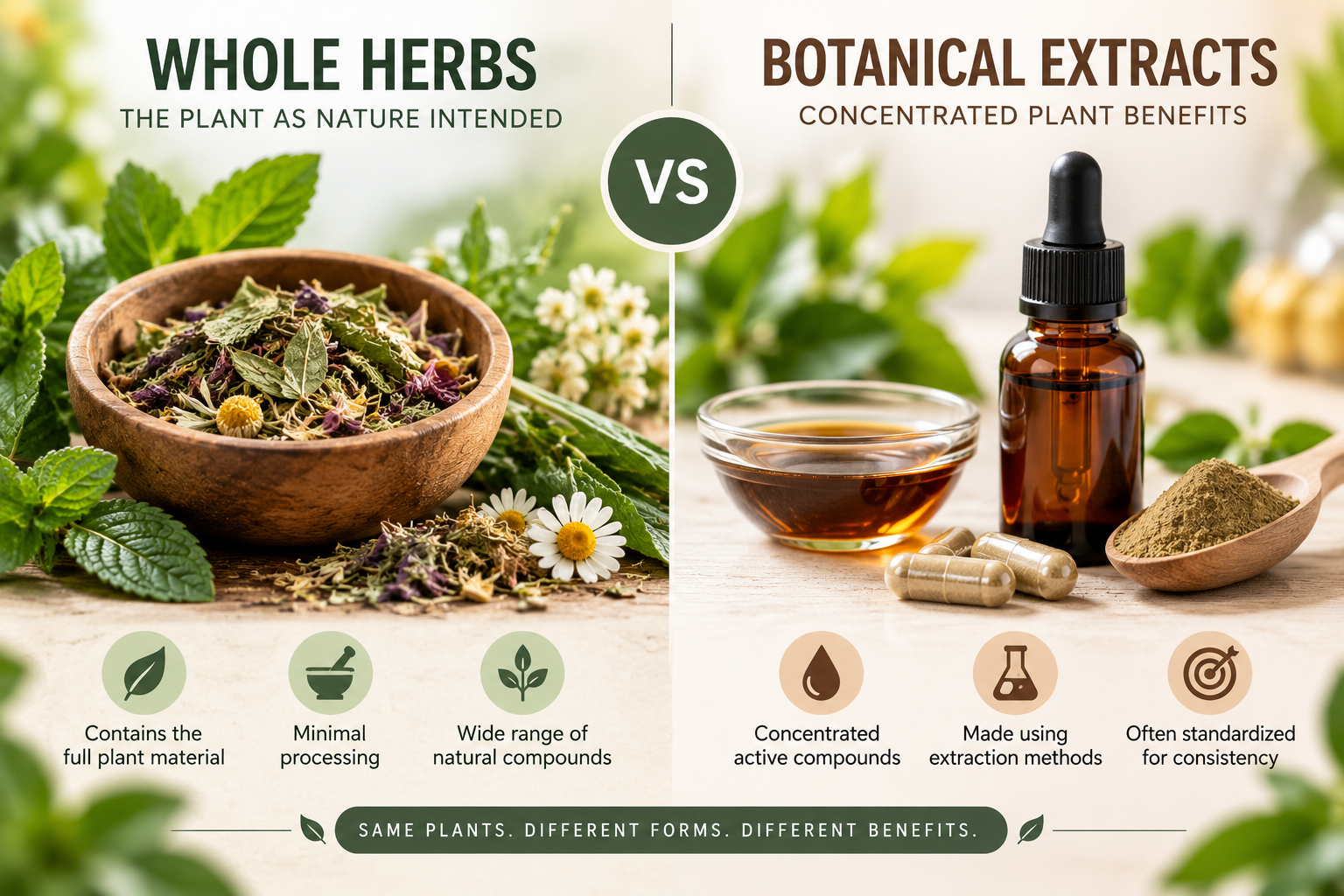
How Botanical Extracts Differ From Whole Herbs
Understanding how extracts differ from whole herbs can make it easier to interpret supplement labels, compare products, and evaluate claims about herbal ingredients.
Read article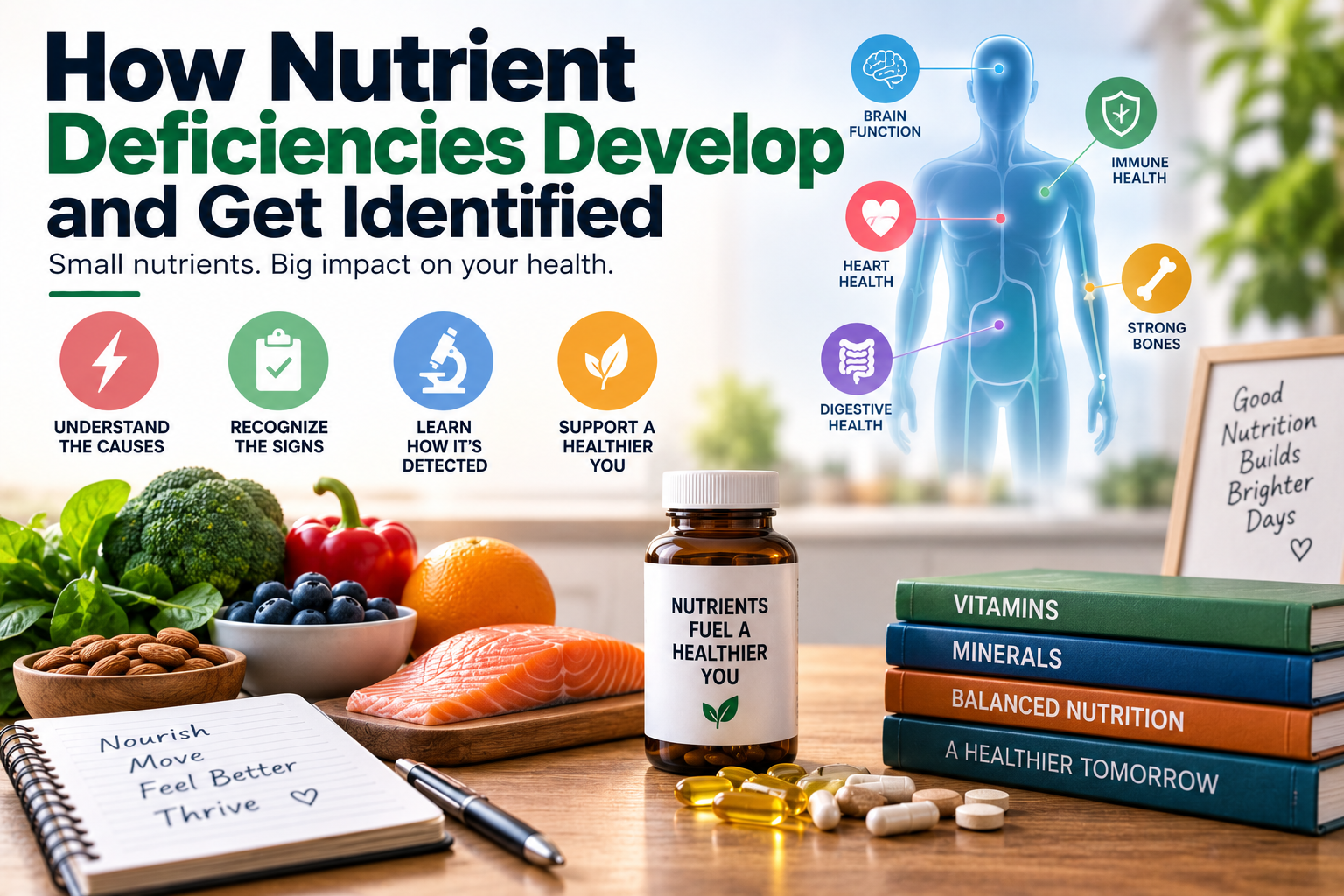
How Nutrient Deficiencies Develop and Get Identified
Understanding how nutrient deficiencies develop—and how healthcare professionals identify them—can make it easier to recognize potential problems before they become more serious.
Read article
What Is the Difference Between Water-Soluble and Fat-Soluble Vitamins
Understanding this basic distinction can make it easier to interpret nutrition information, evaluate supplements, and make informed decisions about dietary intake.
Read article

Join 10,000+ Readers Building Healthier Habits
Get actionable wellness tips every week plus our newest articles delivered straight to your inbox.