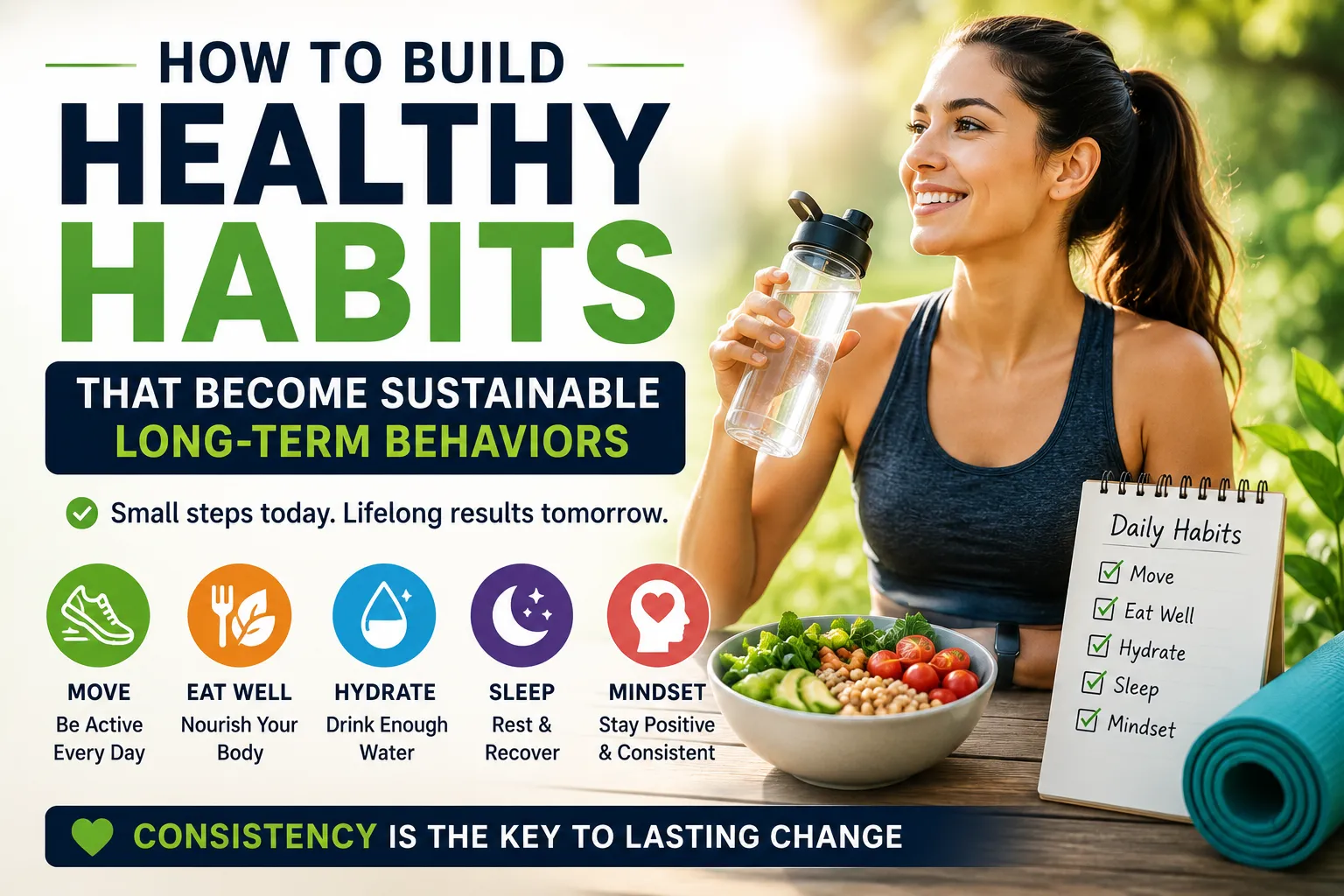

How to Build Healthy Habits That Become Sustainable Long-Term Behaviors
Healthy habits are often easier to start than they are to maintain.
A new diet, exercise routine, sleep schedule or morning ritual can feel exciting during the first few days. Motivation is high, goals feel achievable and every small improvement can seem rewarding. But after the novelty disappears, everyday responsibilities return, routines become unpredictable and the habit can begin to feel like another obligation.
The problem is often not a lack of discipline.
Many habits fail because they are designed around short-term motivation rather than the realities of everyday life.
Building lasting healthy behaviors requires a different approach. Instead of trying to completely transform your lifestyle overnight, the goal is to create small, practical behaviors that can survive busy schedules, setbacks and changes in motivation.
What Makes a Healthy Habit Sustainable?
A sustainable habit is one that can realistically be repeated over a long period without requiring extraordinary levels of effort.
That does not mean it has to be effortless.
Rather, the behavior should fit reasonably well into your existing life.
For example, someone who wants to become more active might initially decide to exercise for an hour every day. While that may work temporarily, it could become difficult when work, family responsibilities or travel interfere.
A more sustainable starting point might be a 20-minute walk several days a week.
The smaller behavior may appear less impressive, but consistency can make it more valuable over time.
Start With One Change
One of the most common mistakes people make when trying to improve their health is attempting to change everything simultaneously.
They may decide to:
- Exercise every morning
- Completely change their diet
- Drink significantly more water
- Go to bed earlier
- Stop eating certain foods
- Meditate daily
- Reduce screen time
- Start meal planning
Each goal may be reasonable on its own.
Together, however, they can create an overwhelming routine.
Starting with one or two behaviors allows you to focus on consistency before adding more.
Once a habit becomes relatively automatic, another behavior can be introduced.
Make the Habit Specific
“Eat healthier” is a goal, but it is not a clearly defined behavior.
“Eat a serving of vegetables with lunch” is much more specific.
Similarly:
- “Exercise more” can become “walk for 20 minutes after work.”
- “Sleep better” can become “start getting ready for bed at 10 p.m.”
- “Drink more water” can become “drink a glass of water when I wake up.”
- “Reduce screen time” can become “leave my phone outside the bedroom at night.”
Specific habits are easier to understand and easier to measure.
When you know exactly what you are supposed to do, there is less room for uncertainty.
Connect New Habits to Existing Routines
One effective way to establish a new behavior is to attach it to something you already do.
This is sometimes called habit stacking.
For example:
After I brush my teeth in the morning, I will stretch for five minutes.
Or:
After I finish lunch, I will take a short walk.
Existing routines act as reminders for the new behavior.
The more consistently the behaviors are connected, the easier it can become to remember the new habit without relying entirely on willpower.
Make Healthy Choices Easier
The environment around you can influence behavior more than motivation does.
If you want to eat more fruit, keeping fruit visible and easily accessible can make that choice simpler.
If you want to exercise in the morning, preparing your clothes and equipment the night before removes some of the friction associated with getting started.
If you want to read instead of scrolling before bed, keeping a book beside your bed and charging your phone somewhere else can make the preferred behavior easier.
The principle is simple:
Reduce the number of obstacles between yourself and the behavior you want to repeat.
Make Unhelpful Behaviors Slightly Harder
The same principle can work in reverse.
If a behavior is too convenient, it may be repeated automatically.
Someone trying to reduce unnecessary snacking might avoid keeping large quantities of highly tempting foods within easy reach.
Someone trying to reduce late-night social media use might remove distracting apps from the home screen or set device limits.
The goal is not to create an environment where unhealthy choices are impossible.
It is simply to introduce enough friction to create a moment in which you can make a more deliberate decision.
Focus on Consistency Rather Than Perfection
One missed workout does not erase weeks of progress.
One unhealthy meal does not invalidate an otherwise balanced eating pattern.
One late night does not destroy a sleep routine.
Sustainable behavior depends partly on learning how to recover from disruptions.
Instead of thinking:
“I failed, so I need to start again.”
Try thinking:
“That was one interruption. What can I do next?”
This approach prevents small setbacks from becoming long periods of inactivity.
Use the Smallest Useful Version of the Habit
On difficult days, maintaining a reduced version of a habit can help preserve continuity.
A person who normally takes a 30-minute walk might take a 10-minute walk when time is limited.
Someone who usually completes a full workout might perform a shorter session.
Someone who normally cooks a complete meal might prepare something simple rather than abandoning their intention to eat at home.
The reduced version does not need to replace the full routine permanently.
Its purpose is to keep the behavior connected to everyday life even when circumstances are less than ideal.
Motivation Is Unreliable
Motivation can be useful when starting a habit, but it is unlikely to remain constant.
Some days you will feel enthusiastic.
Other days you will be tired, busy or distracted.
A sustainable routine therefore needs to work even when motivation is low.
This is one reason environmental design, routines and clearly defined behaviors are so useful.
You do not need to repeatedly make a dramatic decision to exercise if exercise has already been incorporated into your schedule.
Give Habits a Clear Trigger
A habit needs some form of cue that reminds you to perform it.
Triggers can include:
- A particular time
- A location
- Another routine
- An alarm
- A calendar reminder
- A meal
- Waking up
- Returning home from work
For example, deciding to “exercise sometime tomorrow” is vague.
Deciding to “walk for 20 minutes immediately after dinner” creates a much clearer trigger.
The more predictable the cue, the easier the behavior can become to repeat.
Build Around Your Real Schedule
A healthy habit should fit your actual life, not an imaginary version of it.
If mornings are consistently chaotic, designing a demanding morning workout routine may not be sustainable.
If evenings are unpredictable, a lunchtime walk might work better.
If cooking every meal from scratch is unrealistic, preparing a few simple meals in advance may be more practical.
There is no universal schedule for healthy living.
The best routine is one that can survive your ordinary responsibilities.
Choose Behaviors You Can Actually Enjoy
Health does not require choosing the most unpleasant option.
If you dislike running, there are many other ways to improve cardiovascular fitness.
You might prefer:
- Walking
- Cycling
- Swimming
- Dancing
- Hiking
- Team sports
- Group fitness
- Recreational activities
The same principle applies to food.
Healthy eating does not have to mean eating meals you dislike.
Finding nutritious foods and recipes that you genuinely enjoy makes it easier to maintain a balanced eating pattern over time.
Enjoyment can turn a behavior from a chore into something you look forward to.
Avoid Making Every Habit About Weight
Health encompasses far more than body weight.
Healthy behaviors can support:
- Cardiovascular fitness
- Strength
- Mobility
- Sleep
- Energy
- Mental well-being
- Bone health
- Metabolic health
- Social connection
- Daily functioning
When every healthy behavior is judged solely by its effect on the scale, progress can feel discouraging when weight does not change as expected.
A broader definition of health allows you to recognize improvements that may not be immediately visible.
Create Habits Around Identity
Long-term behavior can become easier to maintain when it becomes part of how you see yourself.
Instead of thinking:
“I am trying to exercise.”
You might begin thinking:
“I am someone who takes care of my physical health.”
Instead of:
“I am trying to eat better.”
Think:
“I am someone who regularly chooses foods that support my health.”
This shift does not magically create discipline.
But it can change how individual decisions fit into your broader sense of identity.
A single workout becomes part of being an active person rather than an isolated task.
Track Progress Without Becoming Obsessed With It
Tracking can provide useful feedback.
Depending on the habit, you might record:
- Workout sessions
- Walking time
- Sleep duration
- Fruit and vegetable intake
- Water consumption
- Meditation sessions
- Days without smoking
- Time spent outdoors
The purpose of tracking is not to create another source of pressure.
It is to make patterns visible.
If a habit repeatedly disappears during busy weeks, that information can help you redesign it.
Use Milestones Instead of Constant Self-Judgment
Progress does not always happen in a straight line.
Instead of evaluating yourself every day, consider looking at longer periods.
Ask:
- What has improved over the past month?
- Which habits are becoming easier?
- What situations consistently disrupt my routine?
- Which strategies have worked?
- What should I change?
This turns health improvement into an ongoing learning process rather than a daily test of whether you were “good” or “bad.”
Prepare for Difficult Weeks
Sustainable habits are not tested when everything is going well.
They are tested when life becomes complicated.
Travel, deadlines, illness, family responsibilities, holidays and unexpected events can disrupt even well-established routines.
Preparing for these situations can make recovery easier.
For example, you might decide in advance:
- What exercise can I do when I cannot access a gym?
- What simple meals can I prepare when I am busy?
- How can I maintain a reasonable sleep schedule while traveling?
- What is the minimum version of my routine?
Having alternatives prevents one disruption from becoming a complete abandonment of the habit.
Sleep Should Be Part of the Strategy
Healthy habits can become significantly harder to maintain when sleep is consistently inadequate.
Poor sleep can affect energy, concentration, mood, appetite and motivation.
Building a sustainable health routine therefore includes creating conditions that support regular sleep.
Helpful practices can include maintaining a reasonably consistent bedtime, creating a relaxing pre-sleep routine and limiting activities that make it difficult to wind down.
The exact amount of sleep people need can vary, but consistently getting enough sleep should be treated as a fundamental part of overall health rather than an optional extra.
Build a Balanced Approach to Food
Long-term healthy eating is generally more sustainable when it focuses on overall patterns rather than perfection.
A balanced eating pattern can include a variety of:
- Vegetables
- Fruits
- Whole grains
- Protein-rich foods
- Healthy fats
- Dairy or suitable alternatives
The right balance depends on individual needs, preferences and circumstances.
Extremely restrictive approaches can be difficult to maintain because they may turn everyday eating into a constant exercise in avoiding foods.
For many people, a more sustainable approach is to focus on adding nutritious foods while allowing flexibility.
Exercise Should Develop Gradually
Starting an exercise program at an intensity far beyond your current fitness level can make injury, excessive fatigue or burnout more likely.
A gradual approach gives your body time to adapt.
Someone who has been inactive might begin with regular walks before adding more demanding activity.
Someone returning to strength training might start with manageable resistance rather than immediately attempting maximum loads.
Progress can then be increased over time based on ability and recovery.
For people with medical conditions, significant physical limitations or concerns about beginning exercise, professional guidance can help determine an appropriate approach.
Social Support Can Strengthen Habits
Healthy behaviors can become easier when other people support them.
You might:
- Walk with a friend
- Join a recreational sports group
- Exercise with a partner
- Cook healthy meals with family
- Share progress with a supportive community
- Work with a qualified coach
Social commitments can provide accountability, but they can also make healthy activities more enjoyable.
The strongest support systems do not rely on shame or pressure.
They make it easier to continue.
Don’t Confuse Intensity With Progress
A common misconception is that a harder routine must produce better results.
That is not always true.
An exercise routine that leaves you exhausted but that you abandon after two weeks is unlikely to be more useful than a moderate routine you can maintain for years.
Similarly, an extremely restrictive diet may produce rapid short-term changes but prove difficult to sustain.
Long-term health is often built through repeated moderate actions.
Small improvements accumulate.
Review Your Habits Regularly
A routine that works today may not work six months from now.
Your schedule may change. Your responsibilities may increase. Your interests may evolve.
Regularly reviewing your habits gives you an opportunity to adjust.
Every few weeks or months, consider asking:
Is this habit still useful?
Is it still realistic?
What is making it difficult?
Can I make it easier?
Do I need to change the trigger or timing?
Adaptation is not failure.
It is part of building a routine that can survive different stages of life.
What to Do When a Habit Keeps Failing
Repeated failure is often a sign that the strategy needs to change.
Instead of immediately blaming motivation or discipline, examine the behavior.
Perhaps the habit is too large.
Perhaps the timing is inconvenient.
Perhaps the trigger is unclear.
Perhaps the environment makes the behavior difficult.
Perhaps the goal does not actually fit your priorities.
For example, if you repeatedly fail to exercise at 6 a.m., the solution may not be to become more disciplined at 6 a.m.
It may be to exercise after work instead.
The objective is to solve the system rather than continually criticize yourself.
Healthy Habits Should Support Your Life
The purpose of healthy habits is not to turn every day into a perfectly optimized schedule.
Health should support your ability to live your life, not consume it.
There should be room for celebrations, rest, social occasions, travel, hobbies and unexpected events.
A sustainable routine is flexible enough to accommodate normal life.
That flexibility is one of the differences between a temporary lifestyle challenge and a long-term behavior change.
Think in Years, Not Weeks
Many health goals are framed around short periods.
“Get fit in 30 days.”
“Lose weight in six weeks.”
“Transform your lifestyle this month.”
Short-term goals can provide motivation, but lasting health improvements require a longer perspective.
Ask what you would realistically be willing to continue for one year.
Then ask whether you could continue it for five years.
That question can change the decisions you make today.
A routine that seems less dramatic may ultimately produce greater results because it can be repeated consistently.
Sustainable Health Is Built Through Repetition
Building healthy habits that last is less about finding the perfect routine and more about creating behaviors that fit naturally into everyday life.
Start small.
Make the behavior specific.
Connect it to an existing routine.
Make healthy choices easier.
Expect setbacks.
Adjust when necessary.
Most importantly, avoid treating one imperfect day as evidence that the entire effort has failed.
The strongest habits are not necessarily the most ambitious ones. They are the behaviors that remain possible when motivation disappears, schedules become busy and life refuses to follow the plan.
Over time, repeated choices can become familiar routines, and familiar routines can become part of everyday life.
Long-term health is rarely created by one dramatic decision. It is built through thousands of ordinary decisions repeated often enough to become sustainable.
Continue Reading
Similar Posts

What Nutrient Density Means and How to Choose Nutrient-Dense Foods
Understanding nutrient density can make everyday food choices easier without requiring complicated diets or strict rules. Instead of focusing only on calories, nutrient density encourages people to consider what nutrients a food contributes to the overall diet.
Read article
How to Recover After Breaking Healthy Habits
Breaking a healthy routine is usually a temporary interruption rather than a permanent failure. The important part is learning how to return to healthier behaviors without turning a short setback into a long-term pattern.
Read article
How Your Environment Affects Everyday Health
Understanding these connections can help people make practical changes that support healthier daily living.
Read article

Join 10,000+ Readers Building Healthier Habits
Get actionable wellness tips every week plus our newest articles delivered straight to your inbox.