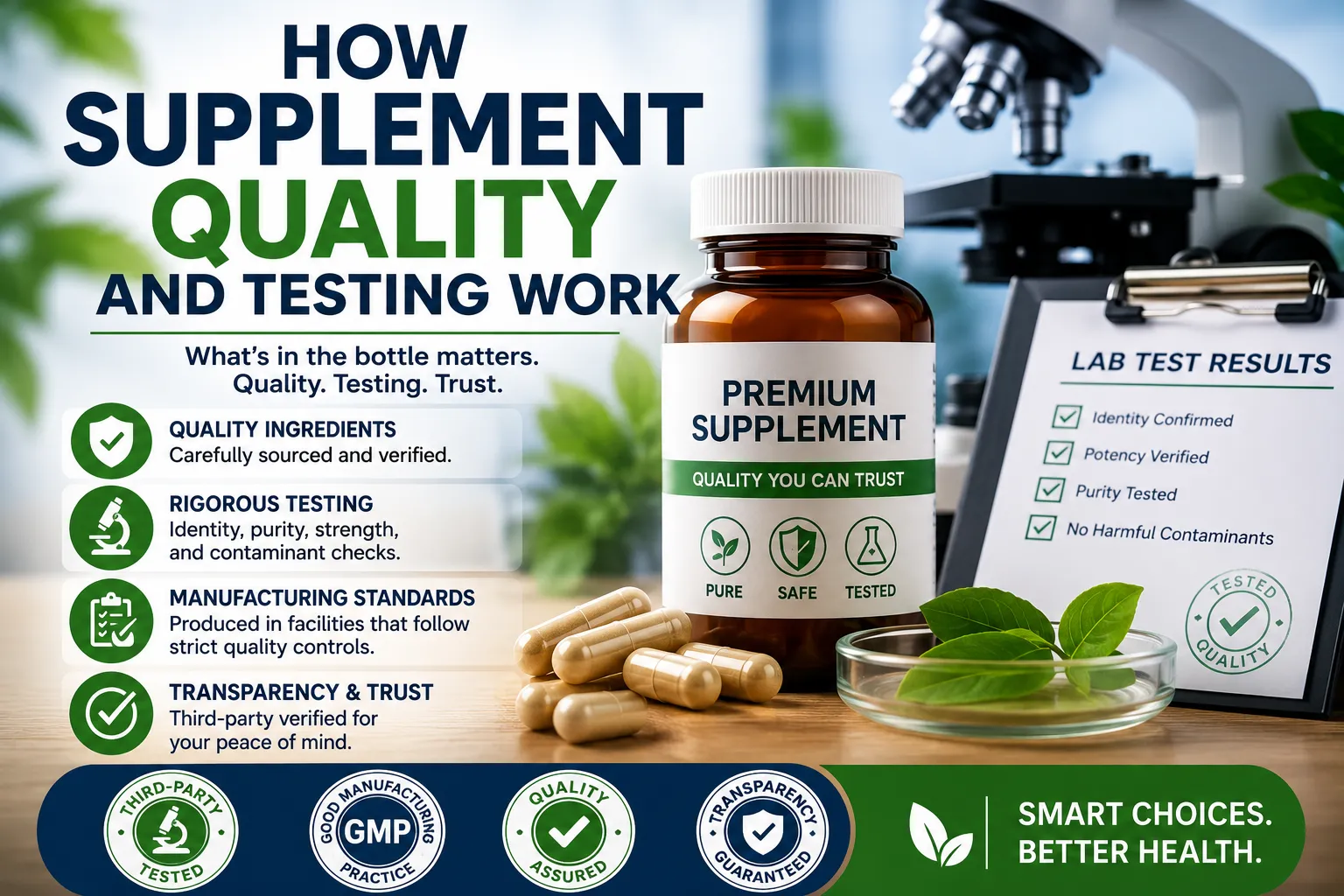

How Supplement Quality And Testing Work
Dietary supplements are often marketed with words such as pure, tested, high quality, standardized, or third-party tested. But those phrases do not always tell consumers exactly what has been tested, who performed the testing, or whether a product contains the amount of an ingredient shown on its label.
Understanding how supplement quality and testing work can make it easier to evaluate products and distinguish meaningful quality controls from marketing language.
Quality begins long before a capsule reaches a bottle. It can involve selecting raw-material suppliers, confirming ingredient identity, controlling manufacturing processes, testing for contaminants, checking the finished product, maintaining records, and ensuring that the label accurately represents what is inside.
Important: This article explains supplement quality and testing in general. It is not a recommendation to use any particular supplement or a substitute for advice from a qualified healthcare professional.
What Does Supplement Quality Mean?
Supplement quality generally refers to whether a product consistently meets established specifications for its identity, purity, strength, composition, and acceptable limits for contaminants.
In the United States, the Food and Drug Administration (FDA) requires dietary supplement manufacturers to follow current good manufacturing practices, commonly called CGMPs. These requirements are intended to help ensure that supplements are manufactured and packaged consistently and meet established quality specifications.
For a broader look at how these quality considerations fit into supplement selection and use, see the complete guide to dietary supplements.
Quality therefore involves more than simply asking whether laboratory testing was performed.
A high-quality manufacturing system may include:
- Verification of incoming ingredients
- Supplier qualification
- Testing or examination of raw materials
- Manufacturing controls
- Appropriate sanitation and contamination controls
- Accurate weighing and formulation
- Finished-product testing
- Packaging and labeling controls
- Batch records
- Complaint and quality-control procedures
This distinction is important because testing a finished bottle is only one part of a broader quality-control system.
How Supplement Testing Works
Supplement testing can take place at several stages of production.
1. Raw Ingredients Are Evaluated
Before an ingredient is incorporated into a supplement, manufacturers need to establish that it is the ingredient they claim it is and that it meets applicable specifications.
Depending on the ingredient, testing may involve chemical analysis, microscopic or macroscopic examination, or other scientifically valid methods. FDA’s dietary supplement CGMP requirements address procedures for verifying ingredient identity and other component specifications.
For example, a manufacturer receiving an herbal ingredient needs controls that help prevent the wrong plant material from entering production.
2. Ingredients Can Be Checked for Contamination
Raw materials and finished supplements may require testing for potential contaminants.
Depending on the product, this can include concerns such as:
- Heavy metals
- Microorganisms
- Pesticide residues
- Undeclared ingredients
- Other substances that could affect product safety or quality
The appropriate tests depend on the nature of the ingredient and the risks associated with the manufacturing process.
FDA’s CGMP framework specifically addresses testing and controls intended to prevent contaminated components from being used and requires appropriate specifications for contaminants.
3. Manufacturing Processes Are Controlled
Quality cannot be created entirely through testing at the end of production.
Manufacturers also need controls over the production process itself. These can include specifications for manufacturing steps, equipment, sanitation, ingredient quantities, processing conditions, packaging, and labeling.
This matters because a supplement can potentially pass a limited finished-product test while problems elsewhere in the manufacturing process remain undetected.
FDA guidance notes that finished-product sampling and testing alone may not demonstrate that appropriate controls were established and followed throughout the manufacturing process.
4. Finished Batches Are Evaluated
Finished products can be tested or examined to determine whether they meet established specifications.
These specifications can address characteristics such as:
- Identity
- Purity
- Strength
- Composition
- Contaminant limits
Under FDA’s dietary supplement CGMP rules, manufacturers must verify that selected finished-batch specifications are being met through appropriate testing or examination, with certain provisions and exceptions described in the regulations.
What Does “Third-Party Tested” Mean?
The phrase third-party tested generally means that an organization independent of the manufacturer performed some form of testing.
That can provide useful additional information, but consumers should not automatically assume that every product carrying a “third-party tested” claim has undergone the same testing.
The important questions are:
- Who performed the testing?
- What exactly was tested?
- Which batches were tested?
- What analytical methods were used?
- What specifications were applied?
- Were contaminants included?
- Were the results independently reviewed?
- Is the testing organization actually independent of the manufacturer?
A laboratory report can be useful evidence, but the words third-party tested by themselves do not describe the complete quality system behind a supplement.
Testing Is Different From Certification
Testing and certification are related but different concepts.
Testing generally involves analyzing a sample to determine whether it meets particular specifications.
Certification can involve a broader assessment against defined standards, potentially including audits of manufacturing practices, documentation, quality systems, and testing procedures.
Consumers should therefore pay attention to what a certification actually covers rather than treating every certification mark as evidence that a product has been comprehensively evaluated.
This distinction is particularly important because dietary supplements are not “FDA approved” before they are marketed in the way that prescription drugs are. The FDA explains that its oversight of supplements differs from its regulation of drugs and that manufacturers are responsible for ensuring their products meet applicable requirements.
What Is a Certificate of Analysis?
A Certificate of Analysis, commonly abbreviated as COA, is a document containing analytical results for a material or product.
A COA may include information such as:
- Product or ingredient identification
- Batch or lot number
- Tests performed
- Analytical methods
- Specifications or acceptance limits
- Actual test results
- Date of testing
- Laboratory or supplier information
However, simply having a document labeled “COA” does not automatically prove that a supplement is high quality.
The reliability of the information depends on factors such as who performed the analysis, whether the laboratory is competent, whether the sample corresponds to the product being sold, and whether the testing methods are appropriate.
FDA’s CGMP requirements also address circumstances in which manufacturers rely on supplier certificates of analysis, including requirements concerning supplier qualification and periodic reconfirmation.
Why Batch Testing Matters
Supplements are manufactured in batches, and quality can potentially vary between batches if manufacturing controls are inadequate.
Batch identification makes it possible to connect a finished product to its production records and testing information.
A strong quality system can therefore maintain records showing:
- Which ingredients were used
- Where those ingredients came from
- Which manufacturing process was followed
- Which equipment was used
- Which batch was produced
- What tests were performed
- Whether specifications were met
- Whether the batch was released or rejected
FDA’s CGMP requirements include extensive recordkeeping covering manufacturing, testing, packaging, labeling, and quality-control decisions.
Does “Standardized” Mean Better Quality?
Not necessarily.
Standardized can sound like a strong quality guarantee, but the term can have different meanings in the supplement industry.
The National Institutes of Health Office of Dietary Supplements notes that dietary supplements are not required to be standardized in the United States and that there is no single legal definition of “standardization” for dietary supplements.
For some botanical products, manufacturers may use particular chemical markers to help achieve consistency between batches.
But seeing the word standardized on a label does not, by itself, establish that a product is superior.
Consumers should look at the specific standard being claimed and the evidence supporting it.
Does More Testing Always Mean Better Quality?
Not necessarily.
Testing is valuable when it answers a meaningful quality question using an appropriate analytical method.
For example, testing may be useful for confirming:
- Whether an ingredient is actually present
- Whether its quantity falls within an established specification
- Whether a contaminant is below a defined limit
- Whether a product meets a particular identity requirement
But no single laboratory test can answer every question about a supplement.
A test for one contaminant does not automatically demonstrate that other contaminants are absent. Likewise, testing the quantity of one ingredient does not establish that every ingredient in the product is present at the labeled amount.
Quality is therefore better understood as a system of controls, rather than a single laboratory result.
Quality Testing Does Not Prove Health Benefits
This is one of the most important distinctions consumers should understand.
A supplement can be manufactured correctly and contain the ingredients stated on its label without necessarily providing the health benefit claimed by advertising.
Product quality and scientific effectiveness are separate questions.
The NIH Office of Dietary Supplements explains that dietary supplements are not generally required by federal law to be tested for safety and effectiveness before marketing, and that the amount of scientific evidence varies substantially among ingredients.
In simple terms:
Quality testing asks:
“Is the product what it claims to be and does it meet its specifications?”
Clinical research asks:
“Does this ingredient or product actually produce the claimed effect in people, and under what conditions?”
Those questions require different kinds of evidence.
What Consumers Should Look For
When evaluating a supplement, consumers can look beyond the front of the bottle.
Useful questions include:
Is the Manufacturer Transparent?
A manufacturer that provides meaningful information about its quality practices can make it easier for consumers to evaluate a product.
Look for clear information about:
- Manufacturing location
- Quality standards
- Testing practices
- Ingredient sourcing
- Lot or batch identification
- Contact information
Is There Independent Verification?
Independent certification or testing can provide an additional layer of information.
However, check what the program actually evaluates rather than relying solely on a logo or marketing phrase.
Can Testing Claims Be Verified?
If a company says its product has been tested, determine whether it provides meaningful details about the testing.
A vague statement such as “laboratory tested” provides much less information than a clearly documented testing program.
For another practical way to evaluate what a supplement label actually tells you, see how to read supplement labels correctly.
Does the Label Make Unrealistic Claims?
Consumers should be cautious of supplements marketed as treatments or cures for serious diseases.
The FDA notes that products marketed to treat, diagnose, cure, or prevent diseases may fall under the regulatory framework for drugs rather than ordinary dietary supplements.
Common Supplement Quality Mistakes
Assuming an Expensive Product Is Better
Price does not automatically indicate quality.
A more expensive supplement may have useful quality controls, but consumers should evaluate evidence rather than assuming higher cost equals better manufacturing.
Treating a Certification Logo as Proof of Everything
A certification may cover particular aspects of production or testing. It should not automatically be interpreted as proof of clinical effectiveness or universal safety.
Confusing Testing With Research
Laboratory testing can establish characteristics of a product. It does not necessarily demonstrate that taking the product produces a particular health outcome.
Assuming “Natural” Means Pure
Natural ingredients can still be contaminated, incorrectly identified, adulterated, or poorly processed.
The source of an ingredient does not eliminate the need for quality controls.
Ignoring the Manufacturer
The quality of a supplement depends heavily on the systems used to source, manufacture, test, package, and store it.
Looking only at the ingredient list provides an incomplete picture.
A Simple Way to Think About Supplement Quality
A useful framework is to think about supplement quality as a chain:
Raw materials → identity testing → supplier controls → manufacturing controls → contamination controls → finished-product testing → packaging → labeling → recordkeeping
A weakness at any point can potentially affect the final product.
This is why reputable quality systems rely on multiple controls instead of expecting one final laboratory test to solve every problem.
The way a supplement is formulated also matters, particularly when multiple ingredients are combined. Understanding how supplement blends are formulated and designed can provide additional context for why ingredient selection, quantities, processing, and manufacturing controls matter.
What Quality Testing Can and Cannot Tell You
| Question | Quality testing may help answer it? |
|---|---|
| Is the ingredient what it claims to be? | Yes |
| Does the product meet specified strength requirements? | Yes |
| Are certain contaminants within specified limits? | Yes |
| Was the product manufactured under appropriate controls? | Partly; broader audits and records matter |
| Will the supplement improve a health condition? | Not by itself |
| Is the supplement appropriate for a particular person? | No |
| Can the supplement interact with medication? | Not from quality testing alone |
| Does a certification prove effectiveness? | No |
The Bigger Picture Behind Supplement Quality
Supplement quality is not determined by one word on a label, one laboratory report, or one certification logo.
It is the result of a broader system involving ingredient controls, manufacturing practices, testing, documentation, supplier oversight, packaging, labeling, and quality assurance.
For consumers, the most useful approach is to separate three questions:
What is in the product?
Quality testing and manufacturing controls can help answer this.
Is the product safe and appropriate for me?
This requires consideration of the ingredient, dose, health circumstances, medications, and other factors.
Does the product actually work for the intended purpose?
That requires appropriate scientific evidence, including human research where available.
Understanding those differences can make supplement claims easier to evaluate—and can help consumers make more informed decisions about the products they choose.
Continue Reading
Similar Posts
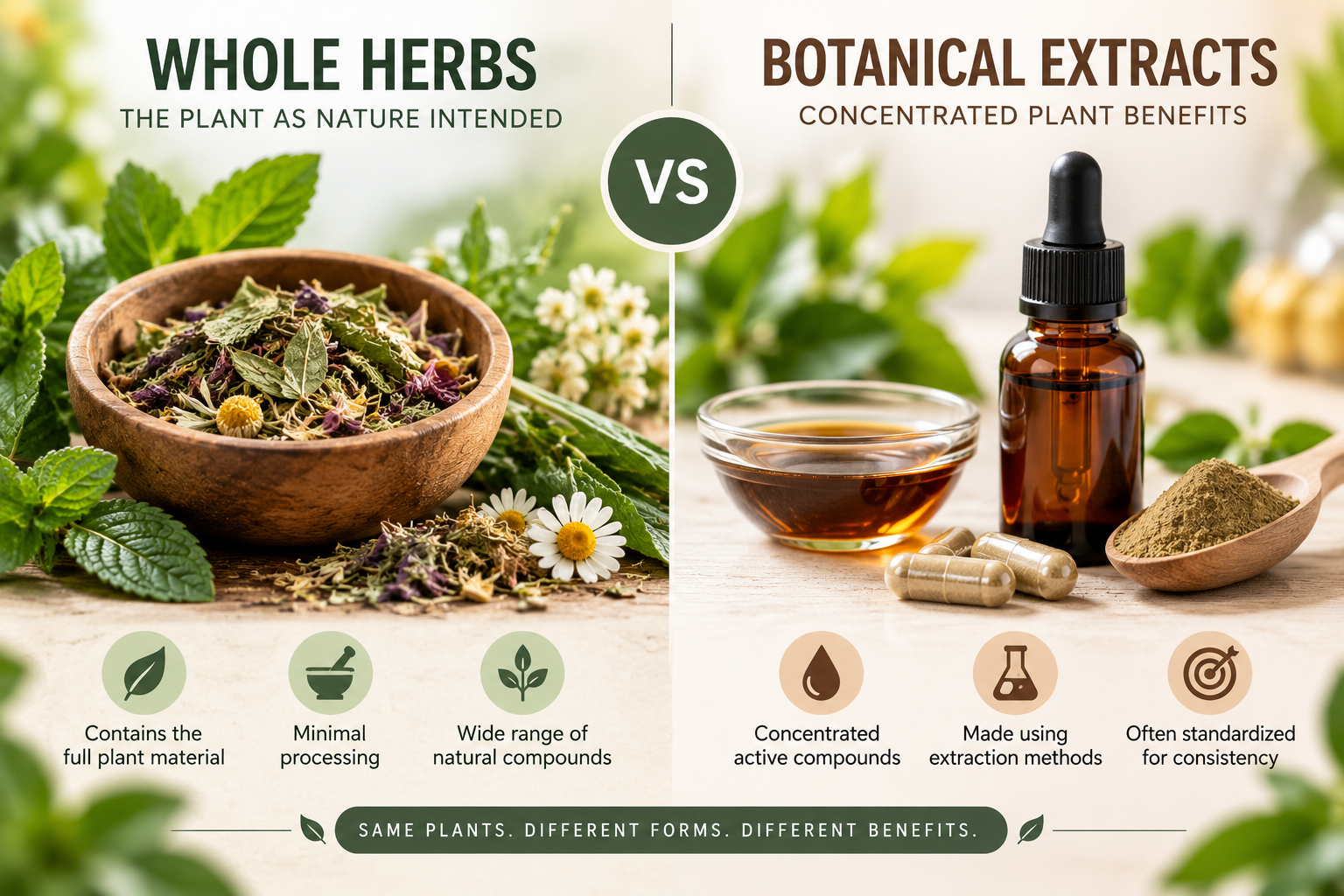
How Botanical Extracts Differ From Whole Herbs
Understanding how extracts differ from whole herbs can make it easier to interpret supplement labels, compare products, and evaluate claims about herbal ingredients.
Read article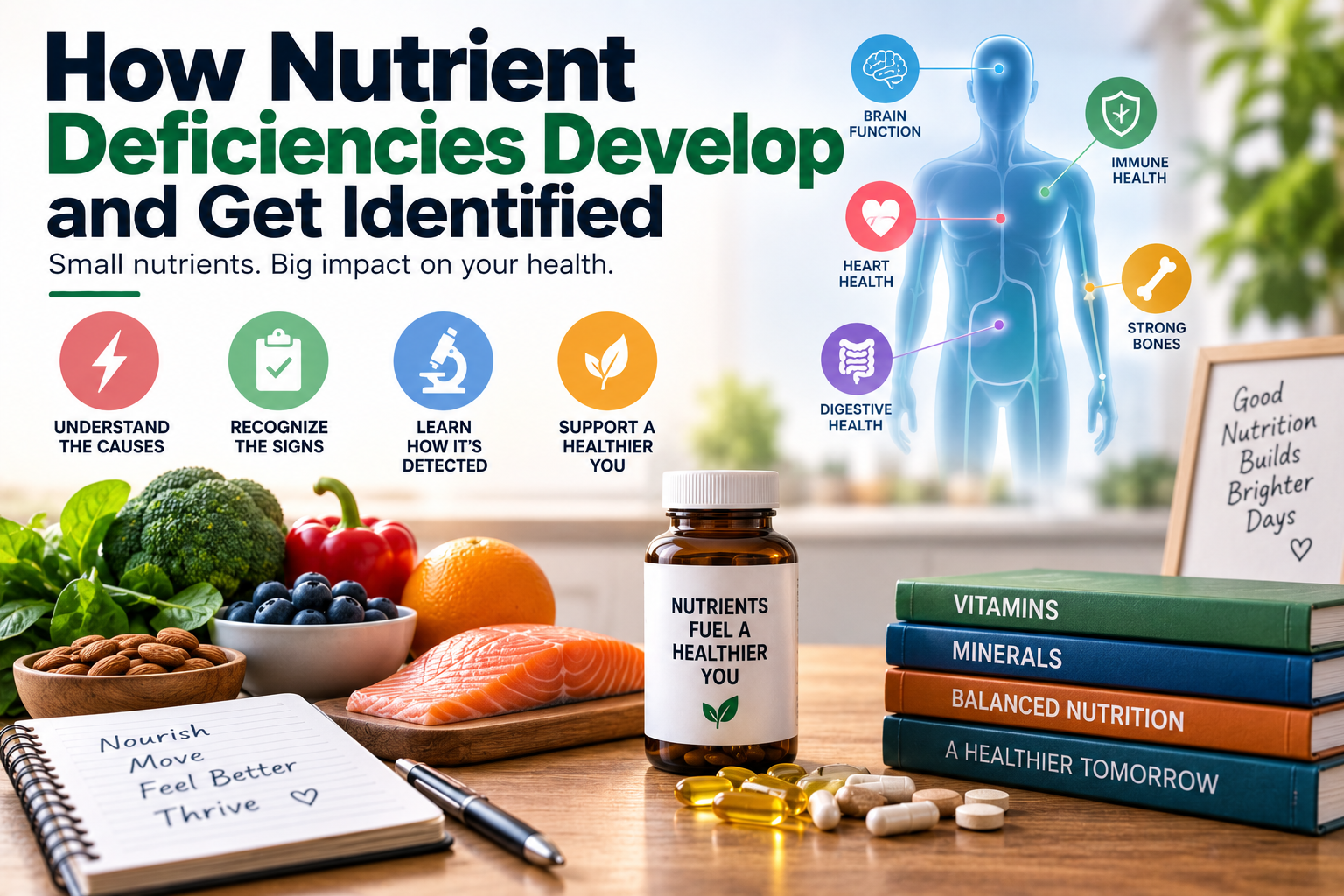
How Nutrient Deficiencies Develop and Get Identified
Understanding how nutrient deficiencies develop—and how healthcare professionals identify them—can make it easier to recognize potential problems before they become more serious.
Read article
What Is the Difference Between Water-Soluble and Fat-Soluble Vitamins
Understanding this basic distinction can make it easier to interpret nutrition information, evaluate supplements, and make informed decisions about dietary intake.
Read article

Join 10,000+ Readers Building Healthier Habits
Get actionable wellness tips every week plus our newest articles delivered straight to your inbox.