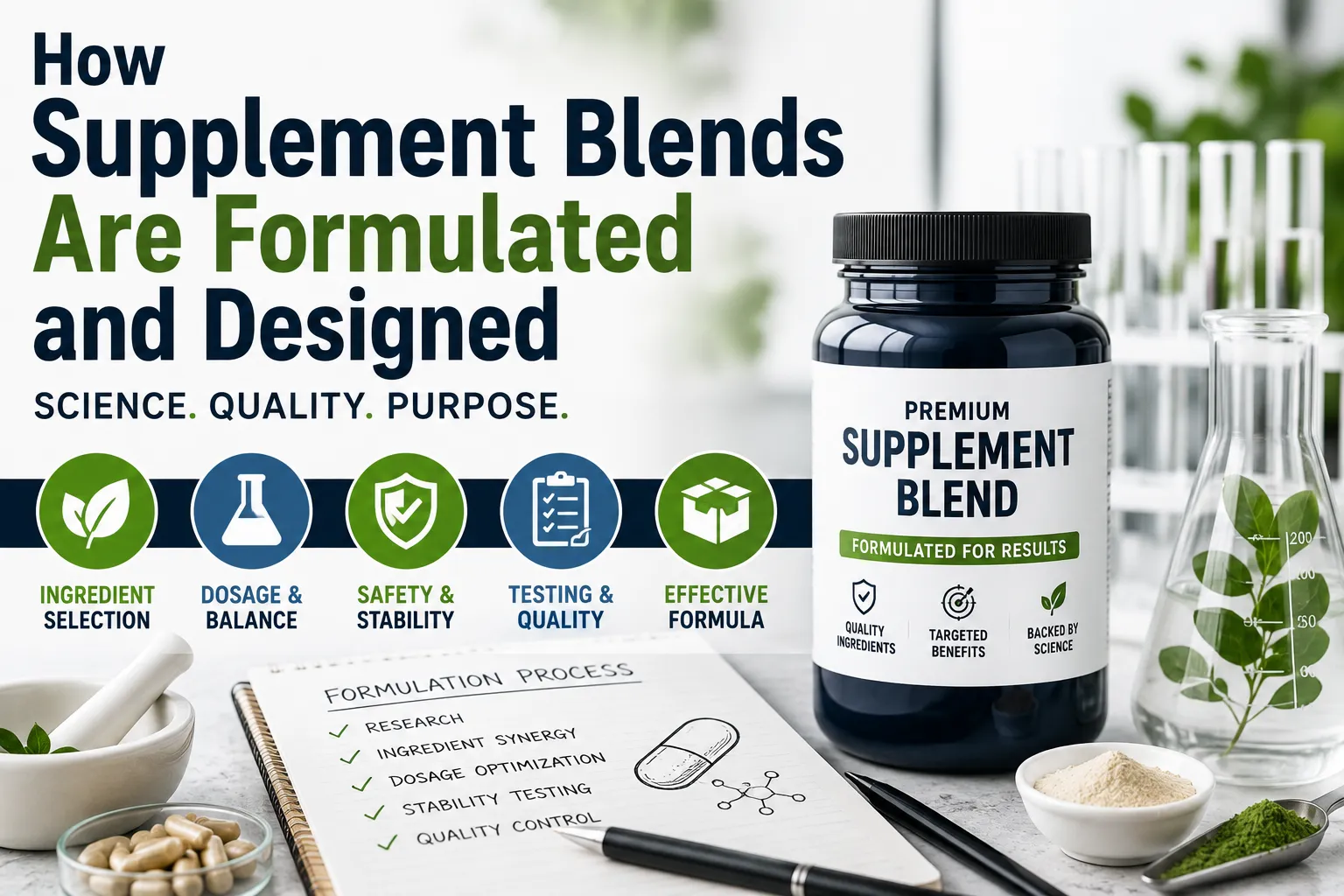

How Supplement Blends Are Formulated and Designed
Walk into a health store or browse an online supplement retailer and it is easy to find products containing a long list of vitamins, minerals, herbs, amino acids, extracts and other ingredients.
These products are often marketed as carefully engineered formulas designed to support specific goals, from general nutrition and exercise performance to sleep, energy or digestive health.
But creating a supplement blend involves considerably more than putting several ingredients into the same capsule or powder.
Formulators have to consider ingredient selection, dosage, compatibility, stability, manufacturing constraints, safety, labeling and the intended use of the finished product. The result is a balancing act between science, practicality, quality control and consumer expectations.
For a broader look at how these considerations fit into the supplement landscape, see the complete guide to dietary supplements.
What Is a Supplement Blend?
A supplement blend is a product that combines multiple ingredients into a single formulation.
The ingredients may belong to the same nutritional category or serve different purposes within the formula.
A blend could contain combinations of:
- Vitamins
- Minerals
- Amino acids
- Botanical ingredients
- Plant extracts
- Fatty acids
- Enzymes
- Fiber
- Protein ingredients
- Other specialized nutritional compounds
The purpose of combining ingredients is usually convenience or to create a product aimed at a particular nutritional objective.
For example, instead of taking several separate products, a consumer might prefer one formulation containing multiple nutrients.
However, combining ingredients does not automatically make a product more effective. The quality of the formulation depends on what is included, how much is included and whether the combination makes sense for the intended consumer.
Formulation Starts With a Specific Purpose
The first step in designing a supplement blend is generally defining what the product is supposed to do.
A manufacturer might be developing a product intended to complement a diet with certain nutrients, for example, or a product designed for people with a particular lifestyle or dietary pattern.
The intended purpose influences virtually every later decision.
A formulation designed around general nutritional support may look very different from one designed for athletes or people seeking additional protein.
The formulation team must determine which ingredients are relevant and which are unnecessary.
This prevents the product from becoming simply a long list of ingredients chosen for marketing appeal.
Ingredient Selection Is a Major Part of the Process
Once the purpose is established, formulators evaluate potential ingredients.
This can involve reviewing scientific literature, regulatory requirements, supplier specifications, safety information and the characteristics of the ingredient itself.
Important questions may include:
- What is the ingredient?
- What form should be used?
- What amount is appropriate?
- Is there evidence supporting its intended use?
- Is it suitable for the target population?
- How stable is it?
- Does it interact with other ingredients?
- Is the ingredient available at consistent quality?
- Does it work with the planned delivery format?
The answers can significantly affect the final formula.
The Form of an Ingredient Matters
The same nutrient can sometimes be available in different chemical forms.
Minerals are a familiar example. A mineral may be supplied in different compounds or salts, and those forms can have different characteristics, including differences in how much of the compound consists of the actual mineral.
The choice of form can also influence stability, taste, solubility and manufacturing.
This means that simply seeing a nutrient’s name on a label does not tell the entire formulation story.
The specific form and amount can matter.
Dosage Is More Important Than the Number of Ingredients
A supplement containing 25 ingredients is not necessarily better than one containing five.
The amount of each ingredient is critical.
If a formula contains many ingredients but only very small quantities of each, consumers should not assume that the product provides meaningful amounts simply because the ingredient names appear on the label.
Formulators therefore have to balance the desired amounts of individual ingredients with the physical limitations of the product.
This is particularly challenging when manufacturers attempt to include numerous active ingredients in a relatively small capsule or serving.
More Is Not Always Better
The idea that a larger dose produces a better result can be misleading.
Some nutrients are essential at appropriate levels but can cause problems when consumed excessively. Others may have limited evidence for benefits at higher doses.
Formulators therefore need to distinguish between an ingredient being biologically important and a particular dose being useful.
Safety considerations are especially important for products containing concentrated botanical extracts or ingredients that can interact with medications.
A responsible formulation should be designed around an appropriate intended use rather than simply maximizing ingredient quantities.
Different Ingredients Can Affect One Another
Combining ingredients introduces another challenge: compatibility.
Ingredients can interact physically or chemically.
For example, one ingredient might affect the stability of another, while a particular combination could influence moisture levels, texture, solubility or taste.
Some ingredients may also compete for space in a formulation or make manufacturing more difficult.
This means that a formula that looks sensible on paper may require considerable testing before it can become a stable commercial product.
Bioavailability Can Influence Formulation Decisions
Bioavailability refers broadly to how much of a substance becomes available to the body after it is consumed.
The body does not necessarily absorb every nutrient or compound in a supplement at the same rate.
Factors such as the chemical form of an ingredient, food consumption, digestive conditions and interactions with other substances can influence absorption.
For a deeper look at this issue, see the guide to how supplement absorption and bioavailability affect nutrient availability.
Formulators may therefore consider the delivery form and timing of ingredients when designing a product.
However, claims about improved absorption should be supported by appropriate evidence rather than based solely on a marketing description.
Capsules and Tablets Have Physical Limits
A supplement formula must fit into its chosen delivery format.
Capsules and tablets have limited capacity.
If a product requires a large amount of powder, the manufacturer may need multiple capsules or a larger serving size.
This is one reason some formulations are sold as powders, liquids or chewables instead.
The choice of format can depend on:
- Total ingredient weight
- Stability
- Taste
- Solubility
- Consumer convenience
- Manufacturing requirements
- Intended serving size
A powder can accommodate substantially more material than a small capsule, but it may introduce taste and mixing challenges.
Powders Have Their Own Challenges
Powdered supplements can contain relatively large amounts of ingredients, but creating a pleasant and stable powder is not always simple.
Some ingredients have strong flavors or odors.
Others may not dissolve easily in water.
Some powders can absorb moisture from the surrounding environment, potentially affecting texture and stability.
Manufacturers may use appropriate excipients or processing techniques to improve properties such as flow, mixing and consistency.
These decisions can affect how the finished product looks, tastes and behaves when consumers use it.
Flavor Is Part of Formulation
For products intended to be mixed with water or consumed directly, flavor can be just as important as the ingredient list.
Botanical extracts, minerals, amino acids and other compounds can have bitter, sour, earthy or otherwise unpleasant flavors.
Formulators may therefore use flavoring systems, sweeteners or other ingredients to create a more acceptable product.
The challenge is to achieve a pleasant taste without compromising the intended formulation.
A supplement that consumers dislike may have limited practical value because people are less likely to use it consistently.
Excipients Help Build the Finished Product
Not every ingredient in a supplement is an active nutritional ingredient.
Products can also contain excipients, which are substances used to help manufacture, stabilize or deliver the product.
Depending on the formulation, excipients can assist with:
- Tablet formation
- Powder flow
- Moisture control
- Stability
- Capsule production
- Taste
- Texture
- Consistency
Their presence does not necessarily mean that an ingredient is intended to provide the primary nutritional effect.
They are often part of the engineering required to turn raw materials into a usable product.
Stability Testing Helps Determine Shelf Life
A supplement is expected to remain within its specifications throughout its shelf life.
That creates a major formulation challenge.
Vitamins and other compounds can degrade over time under certain conditions.
Heat, oxygen, moisture and light can all affect the stability of some ingredients.
Manufacturers may conduct stability testing under controlled conditions to understand how a formulation changes over time.
The results can help inform packaging, storage recommendations and expiration dates.
Packaging Can Protect the Formula
Packaging is not simply about appearance.
It can play an important role in maintaining product quality.
Some formulations may require protection from moisture, oxygen or light.
Manufacturers can choose packaging materials and designs based on the characteristics of the product.
For example, a moisture-sensitive powder may require packaging designed to limit exposure to humidity.
A well-designed formulation therefore extends beyond the ingredients themselves. The container becomes part of the product’s stability system.
Manufacturing Requires Consistency
Once a formula has been developed, it must be manufactured consistently.
Every batch should contain ingredients within appropriate specifications and meet established quality standards.
This can involve controls over:
- Raw materials
- Ingredient identity
- Ingredient quantity
- Mixing
- Temperature
- Moisture
- Production equipment
- Packaging
- Finished-product testing
Consistency is particularly important for products containing multiple active ingredients because variations in one ingredient can affect the overall formulation.
Raw Material Quality Matters
A finished supplement is only as reliable as the raw materials used to make it.
Manufacturers may establish specifications for ingredients covering characteristics such as identity, purity, potency and contamination limits.
Supplier qualification and testing can help ensure that materials meet those requirements.
Depending on the ingredient and product, testing may address concerns such as microbial contamination, heavy metals or other unwanted substances.
Quality control is therefore not something that happens only after manufacturing. It begins with the materials entering the production process.
Third-Party Testing Can Add Another Layer of Verification
Some supplement companies use independent laboratories or certification programs to verify aspects of product quality.
Testing can potentially provide additional information about whether a product meets stated specifications.
However, consumers should understand exactly what a certification covers.
A quality certification does not necessarily mean that a supplement is proven to provide every health benefit claimed in its marketing.
Quality verification and evidence of effectiveness are related but distinct questions.
For more on this issue, see the guide to supplement quality and testing.
Formulators Also Have to Consider Regulations
Supplement regulation varies significantly between countries and regions.
Manufacturers must consider the rules governing ingredients, manufacturing practices, labeling, health claims and advertising in the markets where a product is sold.
The distinction between a permitted nutritional claim and an unsupported disease-treatment claim can be particularly important.
A product may legally contain an ingredient without being allowed to make unlimited claims about what that ingredient can accomplish.
Regulatory compliance is therefore an important part of product development rather than an afterthought.
Labels Tell Only Part of the Story
Supplement labels can provide useful information about serving sizes, ingredients and amounts, but consumers still need to interpret them carefully.
A label may list a proprietary blend or use a combined category for multiple ingredients, depending on applicable labeling requirements.
When individual quantities are not clearly disclosed, it can be more difficult for consumers to determine exactly how much of each ingredient they are receiving.
Clear labeling generally makes it easier to compare products and understand total intake.
For a practical guide to interpreting this information, see how to read supplement labels correctly.
Proprietary Blends Can Make Comparison Difficult
A proprietary blend typically groups several ingredients under a single combined amount rather than providing the exact quantity of every ingredient.
Manufacturers may argue that this protects their formulation from competitors.
From a consumer perspective, however, it can make comparisons more difficult.
If a label says a blend contains several ingredients but does not disclose the individual amounts, a buyer may not know whether the formula contains substantial quantities of each ingredient or only small amounts of some components.
Transparent labeling can make informed purchasing easier.
Interactions Are an Important Consideration
Combining several supplements can increase the risk of unintentionally consuming excessive amounts of certain nutrients.
For example, a person might take a multivitamin, an energy product and a separate mineral supplement without realizing that the products contain overlapping ingredients.
Some supplements can also interact with medications or medical conditions.
This is especially relevant for concentrated botanical products and high-dose nutrients.
People taking prescription medicines, preparing for surgery, pregnant or breastfeeding individuals, and those managing specific health conditions should consider discussing supplement use with an appropriate healthcare professional.
Formulation Is a Balance Between Science and Practicality
A theoretically excellent formula may not be commercially practical.
If it requires an enormous serving size, tastes unpleasant, becomes unstable quickly or costs too much to manufacture, consumers may not use it consistently.
Formulators therefore have to balance multiple objectives:
Evidence + safety + stability + manufacturability + usability + cost
Changing one part of the equation can affect the others.
Increasing the amount of an ingredient, for example, might require a larger capsule or different delivery format.
Adding more ingredients might create compatibility or stability problems.
The final product is therefore usually the result of numerous trade-offs.
Why the Intended Consumer Matters
A supplement designed for the general population may have very different formulation requirements from one intended for athletes or another specific group.
Age, dietary patterns, activity levels and typical nutrient intake can all influence the design considerations.
A product should also have clearly defined directions for use and appropriate warnings where necessary.
Good formulation begins with understanding who is expected to use the product and under what circumstances.
Evidence Should Guide the Formula
One of the most important principles in supplement development is distinguishing between an interesting ingredient and a well-supported ingredient.
Scientific evidence can vary considerably.
Some nutrients have well-established physiological roles. Other compounds may have promising preliminary research but limited evidence from high-quality human studies.
A responsible formulation process should take the strength and limitations of available evidence into account.
The existence of a study does not automatically prove that an ingredient will produce a meaningful effect in every person, particularly at every dose or formulation.
Why Marketing and Formulation Are Different
A supplement’s marketing may emphasize a handful of attractive ingredients, but the formulation process involves many less visible decisions.
The marketing department may focus on the consumer benefit and product positioning.
Formulators have to think about chemistry, stability, dosage, manufacturing, quality and safety.
The strongest products bring those considerations together without allowing marketing claims to outrun the evidence.
Consumers can help by looking beyond front-of-package claims and examining the full ingredient list, serving size and available evidence.
How Consumers Can Evaluate a Supplement Blend
When considering a multi-ingredient supplement, several questions can help.
What is the product intended to provide?
A clear purpose makes it easier to evaluate whether the ingredients are relevant.
Are the individual ingredients disclosed?
Transparent labeling makes comparison easier.
How much of each ingredient is provided?
The presence of an ingredient tells you less than its actual amount.
Does the formula contain unnecessary duplicates?
Check other supplements being used to avoid unintentionally overlapping ingredients.
Does the product come from a reputable manufacturer?
Manufacturing quality matters as much as the ingredient list.
Are the claims supported by credible evidence?
Be cautious about promises that sound dramatically better than the available research.
Are there potential medication or health-condition interactions?
When in doubt, seek professional advice.
The Best Formula Is Not Necessarily the Longest One
Supplement formulation is ultimately an exercise in solving a complex design problem.
Developers must select appropriate ingredients, determine sensible amounts, ensure that the components remain stable, make the product practical to consume and manufacture it consistently. They must also account for regulatory requirements, labeling and safety.
That is why the number of ingredients on a bottle is a poor measure of quality.
A thoughtfully designed formula may contain only a handful of ingredients selected for a specific purpose, while a product with a much longer list may offer little additional value.
For consumers, the most useful approach is to look past impressive ingredient counts and ask a simpler set of questions: What is in the product, how much is there, why is it included, and how strong is the evidence for its intended use?
Understanding how supplement blends are actually formulated makes those questions easier to answer—and can turn an increasingly crowded supplement market into a more informed purchasing decision.
Continue Reading
Similar Posts
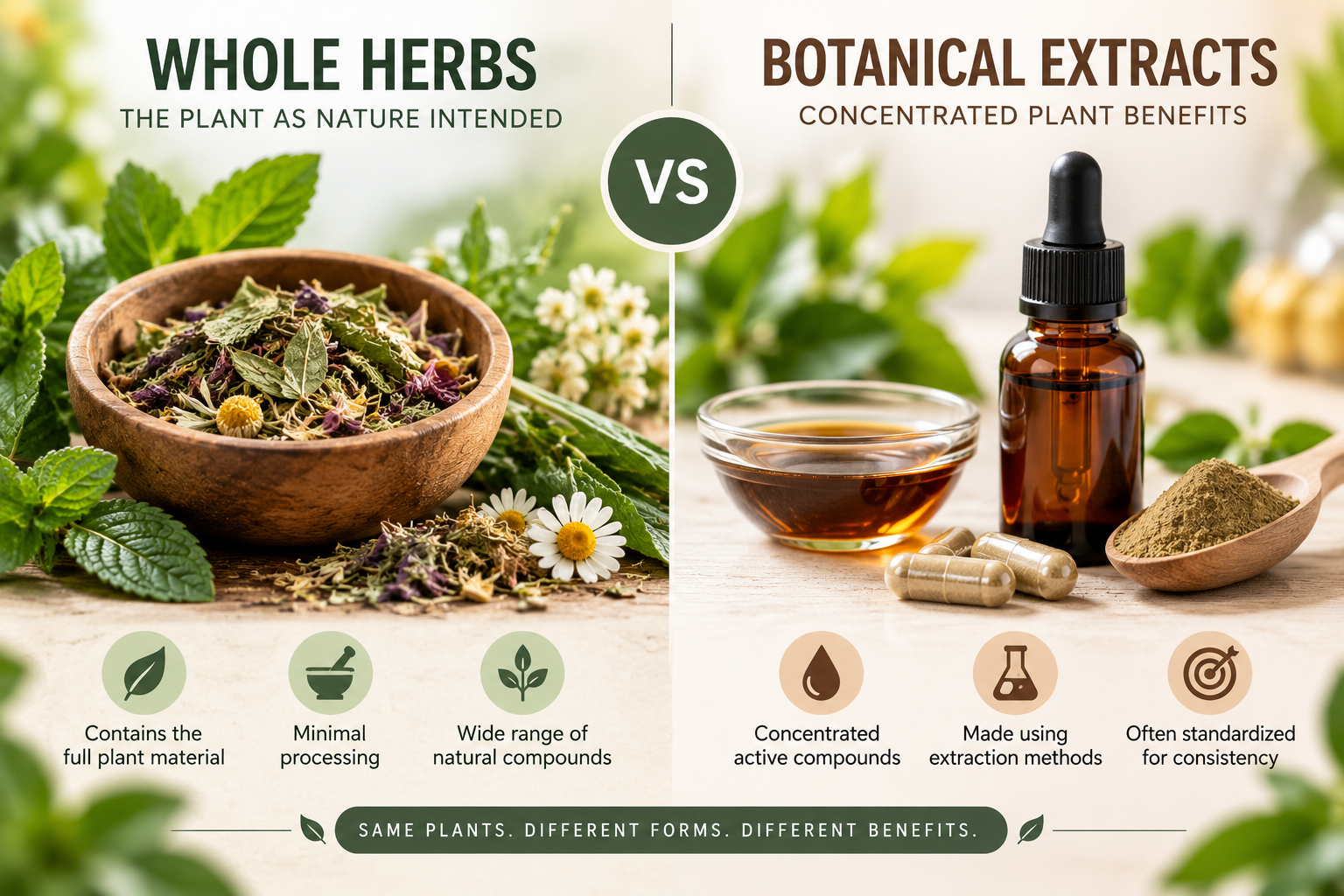
How Botanical Extracts Differ From Whole Herbs
Understanding how extracts differ from whole herbs can make it easier to interpret supplement labels, compare products, and evaluate claims about herbal ingredients.
Read article
How Nutrient Deficiencies Develop and Get Identified
Understanding how nutrient deficiencies develop—and how healthcare professionals identify them—can make it easier to recognize potential problems before they become more serious.
Read article
What Is the Difference Between Water-Soluble and Fat-Soluble Vitamins
Understanding this basic distinction can make it easier to interpret nutrition information, evaluate supplements, and make informed decisions about dietary intake.
Read article

Join 10,000+ Readers Building Healthier Habits
Get actionable wellness tips every week plus our newest articles delivered straight to your inbox.