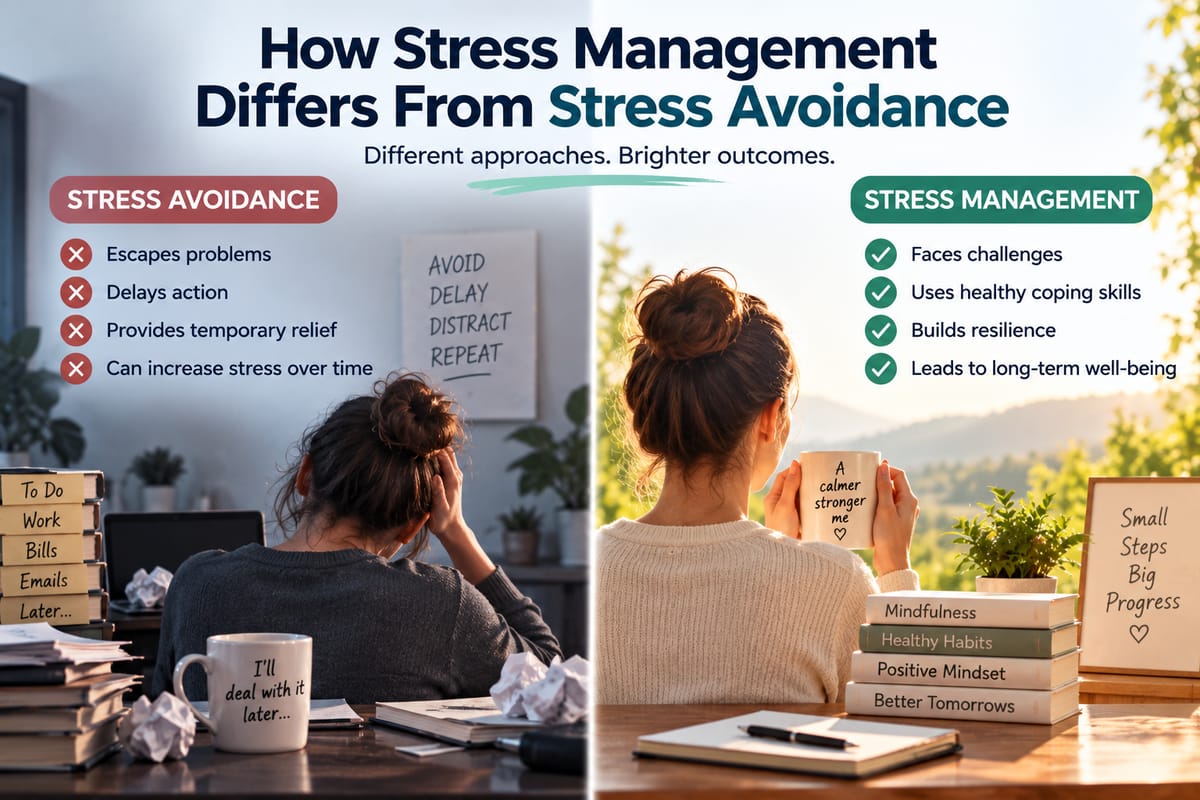

How Stress Management Differs From Stress Avoidance
Stress is a normal part of life. Work deadlines, financial responsibilities, relationships, health concerns, major changes, and everyday demands can all create pressure. Because stress can feel uncomfortable, it is understandable to want to get away from it as quickly as possible.
However, there is an important difference between managing stress and avoiding stress.
Stress management involves recognizing stress, understanding how it affects you, and developing practical ways to respond to it. Stress avoidance, on the other hand, generally involves trying to prevent stressful situations or escape uncomfortable feelings whenever possible.
Avoiding unnecessary sources of stress can sometimes be sensible. But attempting to eliminate every stressful experience is rarely realistic. Learning to respond to manageable stressors can create a more sustainable approach to everyday well-being.
What Is Stress Management?
Stress management refers to the collection of strategies and behaviors people use to recognize, respond to, and reduce the impact of stress.
It can involve several areas of life, including:
- Sleep
- Physical activity
- Time management
- Relaxation
- Social connection
- Problem-solving
- Emotional awareness
- Healthy eating patterns
- Setting boundaries
- Mindfulness
- Seeking professional support when appropriate
The goal is not necessarily to eliminate all stress.
Instead, stress management focuses on improving how a person responds when stressful situations arise.
For a broader overview, The Complete Guide to Stress Management explores different strategies for recognizing and responding to stress in everyday life.
What Is Stress Avoidance?
Stress avoidance involves deliberately trying to stay away from situations, environments, thoughts, or experiences that create stress or discomfort.
Some avoidance can be useful.
For example, if a particular situation presents an unnecessary and preventable source of danger, avoiding it may be an appropriate response. Similarly, setting boundaries with consistently stressful circumstances can be part of healthy self-care.
The difficulty arises when avoidance becomes the primary way of dealing with stress.
Someone might repeatedly:
- Ignore an important problem
- Delay a necessary conversation
- Avoid responsibilities
- Refuse to address financial concerns
- Withdraw from social situations because they feel uncomfortable
- Avoid making decisions
- Suppress difficult emotions
- Put off medical or professional appointments because they create anxiety
These behaviors may provide temporary relief while leaving the underlying issue unresolved.
The Difference Between Avoiding a Stressor and Managing Stress
The distinction becomes clearer when looking at how each approach responds to a stressful situation.
Imagine that someone has an increasingly demanding workload.
A stress-avoidance response might involve ignoring emails, postponing difficult tasks, or repeatedly distracting themselves from the problem.
A stress-management response might involve identifying the most urgent tasks, discussing workload expectations, taking appropriate breaks, improving time management, and seeking support when necessary.
Both approaches may provide some immediate relief, but they address the situation differently.
| Stress Management | Stress Avoidance |
|---|---|
| Identifies the source of stress | Attempts to escape the source |
| Focuses on practical responses | May postpone the problem |
| Accepts that some stress is unavoidable | Attempts to eliminate discomfort |
| Builds coping skills | Can rely heavily on distraction or withdrawal |
| Encourages problem-solving | May leave problems unresolved |
| Develops resilience over time | Can provide short-term relief |
The distinction is not absolute. Healthy stress management can include avoiding unnecessary stressors, while avoidance can sometimes be appropriate.
The important question is whether avoidance helps solve a problem or simply postpones it.
Why Avoiding Every Stressful Situation Is Difficult
Stress is unavoidable in many areas of life.
People encounter:
- Unexpected changes
- Difficult conversations
- Deadlines
- Disagreements
- Financial decisions
- Workplace demands
- Family responsibilities
- Health concerns
- Uncertainty
- Disappointment
Trying to create a life completely free from stress can therefore become another source of pressure.
A more realistic goal is learning which stressors can be changed, which can be reduced, which require acceptance, and which may require outside support.
This approach gives people more options than simply trying to escape every uncomfortable situation.
Short-Term Relief Does Not Always Solve the Problem
Avoidance can feel effective because it often reduces discomfort immediately.
For example, someone who is worried about an upcoming task may feel temporarily calmer after deciding not to think about it.
The problem may still exist, however.
If the task becomes more urgent, the eventual stress can become greater than it was initially.
This can create a cycle:
Stress → avoidance → temporary relief → unresolved problem → increased pressure → more stress
Breaking that cycle often requires addressing the underlying issue while also developing healthier ways to manage the emotional response.
Stress Management Starts With Awareness
It is difficult to manage stress without recognizing it.
Stress can affect people differently. Some may notice irritability or difficulty concentrating, while others experience muscle tension, fatigue, changes in sleep, or changes in appetite.
People may also develop behavioral signs such as:
- Withdrawing from others
- Procrastinating
- Working excessively
- Using distractions constantly
- Becoming unusually impatient
- Finding it difficult to relax
- Losing interest in normal activities
Learning to recognize personal stress signals can make it easier to respond before stress becomes overwhelming.
Understanding the Effects of Chronic Stress
Not all stress is experienced in the same way. Persistent or repeated stress can affect both physical and mental well-being.
How Chronic Stress Affects Your Body and Mind provides a broader look at how prolonged stress can influence different aspects of health.
This is one reason stress management matters.
The goal is not to react to every minor inconvenience as though it were a crisis. Instead, it is to recognize when ongoing demands are taking a significant toll and consider what changes or support may be appropriate.
Healthy Stress Management Includes Problem-Solving
Some sources of stress can be reduced by taking practical action.
For example, if someone feels overwhelmed by too many responsibilities, possible steps might include:
- Listing the current demands.
- Identifying which tasks are most urgent.
- Breaking large tasks into smaller steps.
- Removing unnecessary commitments.
- Asking for help where appropriate.
- Creating a realistic schedule.
- Reviewing what can be changed.
This approach addresses the source of stress rather than only attempting to make the feeling disappear.
Healthy Coping Skills Can Make a Difference
Not every stressful situation can be solved immediately.
Some circumstances involve uncertainty, loss, change, or events outside a person’s control. In these situations, coping skills can help someone manage the emotional and physical response while navigating the situation.
Healthy coping strategies can include:
- Talking with someone trusted
- Physical activity
- Relaxation exercises
- Journaling
- Spending time outdoors
- Maintaining social connections
- Practicing mindfulness
- Taking appropriate breaks
- Establishing healthy routines
- Seeking professional support when needed
Complete Guide to Healthy Coping Skills provides additional information about developing constructive ways to handle difficult experiences.
Mindfulness Can Reduce the Urge to Escape Every Feeling
Mindfulness involves deliberately paying attention to the present moment.
Rather than immediately trying to suppress an uncomfortable thought or feeling, mindfulness encourages people to notice what is happening without automatically reacting to it.
For example, someone experiencing work-related stress might notice:
- Their breathing has become faster.
- Their shoulders feel tense.
- Their thoughts are moving quickly.
- They are worried about an upcoming deadline.
Recognizing these experiences does not require accepting the situation as permanent. It simply creates a moment of awareness before deciding what to do next.
For a broader explanation, Complete Guide to Mindfulness and Present-Moment Awareness explores how present-moment awareness can become part of everyday life.
Setting Boundaries Is Not the Same as Avoidance
Healthy boundaries can sometimes look like avoidance from the outside, but the underlying purpose can be very different.
For example, deciding not to respond to work messages during designated personal time may be a reasonable boundary.
Similarly, limiting unnecessary interactions with someone who repeatedly creates conflict can be an appropriate way to protect personal well-being.
The distinction lies partly in whether the decision is intentional and constructive.
A boundary might communicate:
“I am choosing a healthier limit around this situation.”
Avoidance may instead look like:
“I cannot deal with this, so I will pretend it does not exist.”
Healthy boundaries can therefore be an important part of stress management.
When Avoidance May Be Appropriate
Stress management does not mean forcing yourself to remain in every stressful situation.
There are circumstances where leaving, limiting exposure, or avoiding a particular situation is appropriate.
Examples might include:
- Removing yourself from an unsafe environment
- Avoiding unnecessary conflict
- Limiting exposure to harmful behaviors
- Reducing unreasonable commitments
- Taking a break from an overwhelming situation
- Establishing boundaries around work or personal time
The goal is not to endure every stressor.
Instead, it is to distinguish between healthy protection and avoidance that prevents necessary problem-solving.
Stress Management Can Include Changing the Environment
Sometimes the best way to manage stress is to change the conditions creating it.
For example, someone experiencing constant workplace pressure might need more than relaxation exercises. They may need to discuss workload, clarify responsibilities, change schedules, or consider whether the current situation is sustainable.
Similarly, someone overwhelmed by an overly crowded schedule may benefit more from removing commitments than from simply learning another relaxation technique.
Stress management should therefore include both internal and external strategies.
Emotional Acceptance Does Not Mean Giving Up
Accepting that a situation is stressful does not mean deciding that nothing can be done.
Acceptance can simply mean acknowledging the current reality rather than spending all of your energy denying it.
For example:
Avoidance:
“I should not be feeling stressed, and I don’t want to think about it.”
Acceptance:
“This situation is stressful. What part of it can I influence right now?”
The second approach creates room for action.
It can also make it easier to identify which aspects of a situation are outside your control.
Build Stress-Management Habits Before You Need Them
Stress-management strategies are often easier to use when they are already familiar.
Rather than waiting until a stressful period becomes overwhelming, people can establish supportive routines during calmer periods.
These might include:
- Regular physical activity
- Consistent sleep habits
- Time for relaxation
- Social connection
- Healthy meals
- Short mindfulness sessions
- Organized schedules
- Regular breaks
- Time outdoors
These habits do not guarantee that stressful situations will become easy, but they can create a stronger foundation for responding to everyday challenges.
Watch for All-or-Nothing Thinking
Another problem with stress avoidance is the belief that feeling stressed means something has gone wrong.
Stress is not always evidence that a person has failed to manage life properly.
Someone can have strong coping skills and still experience:
- Anxiety before an important event
- Frustration during a difficult conversation
- Nervousness about uncertainty
- Disappointment after a setback
- Pressure during a demanding period
The goal is not to eliminate every uncomfortable feeling.
It is to respond to those feelings in ways that support healthy functioning.
When Professional Support May Be Appropriate
Everyday stress is common, but persistent or overwhelming distress may require more than self-help strategies.
Consider seeking appropriate professional support when stress is significantly interfering with daily life, relationships, work, sleep, or the ability to function.
Professional support can provide personalized strategies for dealing with circumstances that are difficult to manage alone.
There is no requirement to wait until stress becomes extreme before asking for help.
Creating a More Sustainable Relationship With Stress
Stress management and stress avoidance are not completely opposite concepts. Avoiding unnecessary stress can sometimes be a healthy choice, while learning to face manageable challenges can strengthen problem-solving and coping skills.
The key difference is what happens after the immediate discomfort appears.
Avoidance can provide temporary relief while leaving an important problem unresolved. Stress management focuses on recognizing the stressor, deciding what can be changed, using healthy coping strategies, and accepting what cannot immediately be controlled.
A sustainable approach therefore does not require creating a life without stress. It means developing enough awareness and flexibility to respond to stressful experiences without allowing every difficult moment to dictate what happens next.
Continue Reading
Similar Posts

How Meal Planning Supports Healthy Eating
Meal planning does not require complicated recipes, strict diets, or preparing every meal days in advance. It can be as simple as deciding on several meals, creating a shopping list, and making sure the kitchen has the ingredients needed to prepare balanced options.
Read article
How Dehydration Affects the Body
Understanding how dehydration affects the body can make it easier to recognize early signs, understand when fluid needs increase, and take practical steps to maintain adequate hydration.
Read article
How Heat and Climate Affect Hydration
Understanding these relationships can make it easier to adapt fluid intake to changing conditions rather than relying on the same hydration habits throughout the year.
Read article

Join 10,000+ Readers Building Healthier Habits
Get actionable wellness tips every week plus our newest articles delivered straight to your inbox.