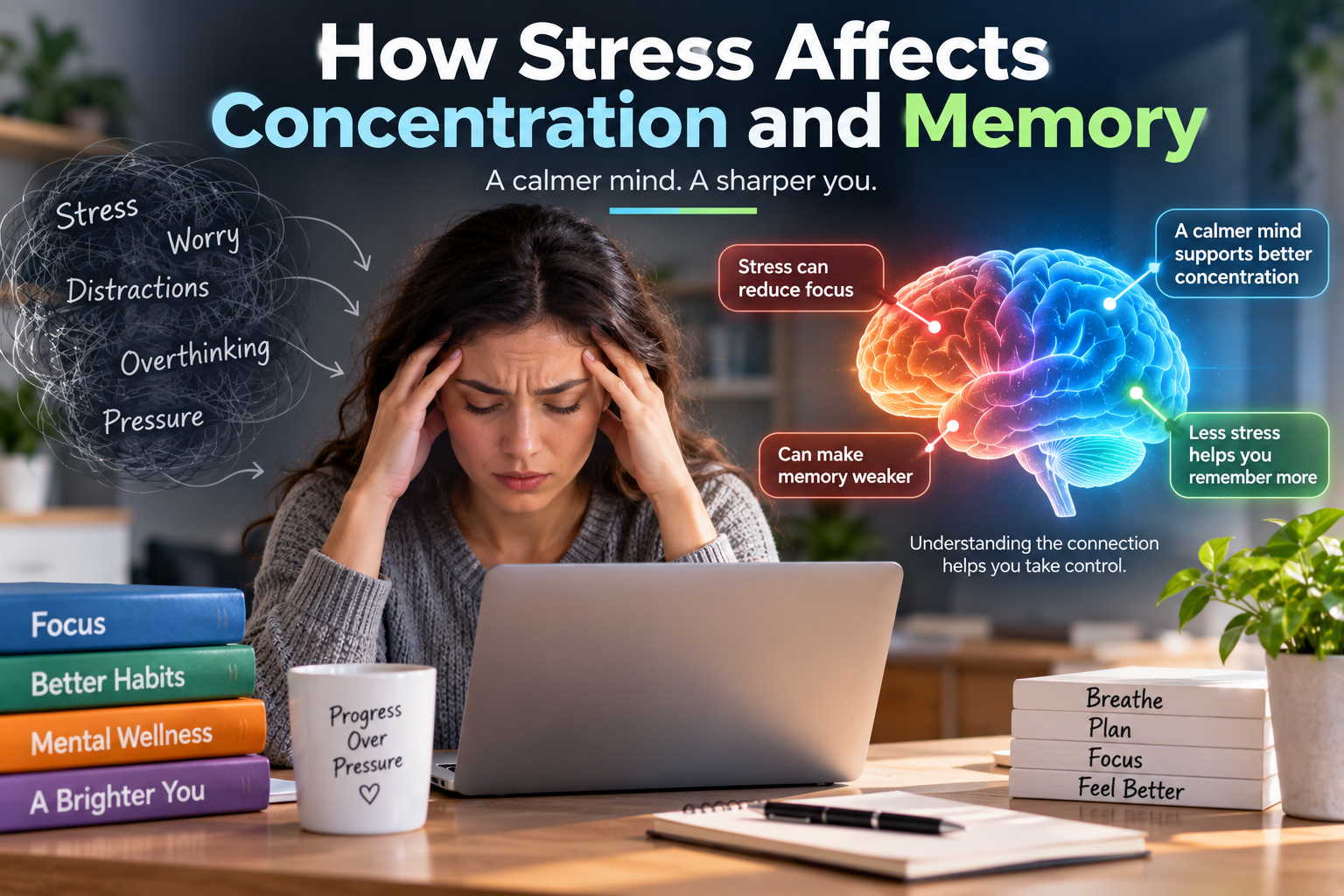

How Stress Affects Concentration and Memory
Stress is a normal part of life. A looming deadline, an important meeting, a difficult conversation or an unexpected problem can trigger a temporary stress response that helps a person pay attention and respond quickly.
But when stress becomes intense, frequent or prolonged, it can interfere with two mental abilities people rely on every day: concentration and memory.
Someone under significant stress may find it harder to focus on a conversation, remember why they walked into a room, complete a task without distraction or recall information they recently learned. These experiences can be frustrating, particularly when they appear during work, school or other situations that demand sustained attention.
Understanding the connection between stress, concentration and memory can help explain why the mind sometimes feels less efficient during stressful periods—and why managing stress can be an important part of maintaining overall mental well-being.
What Happens to the Brain During Stress?
When the brain detects a threat or significant challenge, the body activates a stress response. Hormones and other chemical signals help prepare the body to respond.
Heart rate can increase, muscles become more alert and attention may shift toward what the brain considers important for immediate action.
This response can be useful in short bursts. If someone needs to react quickly to a dangerous situation, heightened alertness can be beneficial.
The problem can arise when the stress response remains activated for long periods or occurs repeatedly.
Instead of helping a person concentrate on a single task, persistent stress can contribute to mental distraction, fatigue and difficulty managing competing demands.
Why Stress Can Make It Harder to Concentrate
Concentration requires the brain to direct attention toward relevant information while filtering out distractions.
Stress can make that process more difficult.
When someone is worried about an unresolved problem, part of their attention may remain focused on that concern even while they are attempting to perform another task.
For example, an employee preparing a report may repeatedly think about an upcoming deadline. A student studying for an examination may find themselves worrying about the exam rather than absorbing the material.
The person may still be physically present and trying to work, but mental resources are being divided.
This can make ordinary tasks feel more difficult and time-consuming.
Stress Can Encourage Mental Distraction
Stress often produces repetitive thoughts about problems, uncertainties or possible outcomes.
This kind of mental preoccupation can compete with the attention required for other activities.
A person might read the same paragraph several times without remembering what it said. Someone listening during a meeting may suddenly realize that they have missed part of the conversation.
These experiences do not necessarily indicate a permanent memory or concentration problem. Temporary difficulties can occur when the mind is heavily occupied by stress.
Reducing the source of stress, taking breaks and allowing the mind to recover can sometimes improve concentration.
How Stress Affects Short-Term Memory
Short-term or working memory allows people to temporarily hold and manipulate information.
It is involved in activities such as remembering a phone number long enough to enter it, following several instructions or keeping track of information while solving a problem.
Stress can interfere with this process.
When attention is divided between a task and stressful thoughts, there may be fewer mental resources available for holding new information in mind.
This can lead to experiences such as forgetting instructions, losing track of a task or struggling to remember information that was just presented.
Stress Can Also Affect Learning
Learning requires more than simply encountering information. The brain needs to pay attention to new material, process it and eventually store it in a form that can be retrieved later.
If stress consistently interferes with attention, the initial stages of learning can become more difficult.
Someone may study for an hour but retain less information because they were distracted throughout the session.
This is one reason creating a calmer learning environment can be useful for students and anyone trying to acquire new skills.
Why You Might Forget Things During a Stressful Period
People experiencing stress sometimes describe themselves as unusually forgetful.
They may forget appointments, misplace objects, overlook details or struggle to retrieve familiar information.
In many cases, the problem may involve attention and encoding rather than the complete loss of a memory.
If information was never fully processed because the person’s attention was elsewhere, there may be less information available to retrieve later.
For example, someone distracted by an intense worry may put their keys down without consciously registering where they placed them. Later, they may feel as though they have forgotten where the keys are, when the information was never properly encoded in the first place.
Chronic Stress Can Have Broader Effects
Short periods of stress and persistent stress are not the same.
When stressful experiences continue for weeks, months or longer, they can be associated with broader effects on sleep, mood, energy, physical health and cognitive functioning.
The relationship between prolonged stress and overall health is explored in how chronic stress affects your body and mind.
Persistent stress can create a cycle in which worry affects sleep, poor sleep makes concentration harder, reduced concentration creates mistakes and those mistakes produce additional stress.
Breaking that cycle can require attention to several areas of daily life rather than focusing on concentration alone.
Sleep Plays an Important Role
Stress and sleep are closely connected.
Worrying thoughts can make it difficult to fall asleep or stay asleep. At the same time, insufficient or disrupted sleep can make concentration and memory more difficult the following day.
Sleep is important for many aspects of cognitive functioning, including attention and memory processes.
Someone experiencing a stressful period may therefore notice that their concentration is particularly poor after several nights of inadequate sleep.
Addressing sleep habits can be an important part of supporting cognitive performance, although persistent sleep problems may require professional attention.
Stress Can Affect Decision-Making Too
Concentration and memory are not the only cognitive abilities influenced by stress.
Under pressure, people may become more focused on immediate concerns and have difficulty considering information carefully.
This can affect planning, problem-solving and decision-making.
A person facing a stressful deadline, for instance, might rush through a task and overlook information they would normally notice.
This does not mean that stress always produces poor decisions. In some situations, moderate alertness can encourage faster responses. The effects depend on factors such as the intensity and duration of stress and the nature of the task.
Not All Stress Is Harmful
It is important to distinguish between manageable short-term stress and persistent overwhelming stress.
A certain amount of pressure can motivate people to prepare for an exam, complete an assignment or meet an important deadline.
The difficulty arises when stress becomes excessive or remains present without adequate opportunities for recovery.
People also respond to stress differently. A situation that feels manageable to one person may feel overwhelming to another.
This makes stress management a personal process rather than a one-size-fits-all formula.
Everyday Habits Can Support Concentration
When stress is affecting concentration, basic habits can provide a useful foundation.
These may include:
- Taking regular breaks during demanding tasks
- Maintaining a consistent sleep schedule
- Getting regular physical activity
- Eating regular, balanced meals
- Staying adequately hydrated
- Spending time outdoors when possible
- Breaking large tasks into smaller steps
- Limiting unnecessary multitasking
- Practicing relaxation or breathing exercises
- Maintaining supportive social connections
These habits cannot eliminate every source of stress, but they can help create conditions that support mental functioning.
For a broader look at practical approaches, the complete guide to stress management explores strategies for recognizing and managing everyday stress.
Taking Breaks Can Help the Mind Reset
Trying to work continuously for long periods is not always the most effective approach, particularly when someone is already stressed.
Short breaks can provide an opportunity to step away from a demanding task and return with renewed attention.
A break might involve walking, stretching, getting some fresh air or simply changing activities for a few minutes.
The goal is not necessarily to avoid work but to prevent prolonged mental overload.
Exercise and Mental Well-Being
Physical activity is another habit commonly associated with overall mental well-being.
Walking, cycling, running, swimming, strength training and other forms of movement can provide a break from stressful thoughts while supporting general physical health.
Exercise may also be incorporated into a broader routine for managing stress and maintaining emotional well-being.
It should not be viewed as a cure for serious mental health difficulties, but regular movement can be one useful component of a healthy lifestyle.
Digital Habits Can Add to Mental Overload
Digital devices provide enormous convenience, but constant notifications, social media feeds, messages and rapid switching between applications can make it harder to maintain sustained attention.
Frequent interruptions can fragment concentration, particularly when someone is already stressed.
People who notice this pattern may benefit from reducing unnecessary notifications, creating periods without interruptions and establishing boundaries around device use.
The relationship between technology and mental well-being is explored further in how digital habits and screen time affect mental wellness.
Organizing Tasks Can Reduce Mental Pressure
A long list of unfinished tasks can make stress feel worse.
Writing down responsibilities and dividing them into manageable steps can reduce the need to keep every task in working memory.
Instead of trying to remember everything simultaneously, a person can identify what needs attention first and work through the list one step at a time.
This approach can be particularly useful when stress makes everything feel urgent.
Mindfulness and Relaxation Techniques
Some people find mindfulness, meditation, controlled breathing or other relaxation practices helpful when dealing with stress.
These approaches generally encourage people to focus attention on the present moment rather than becoming consumed by worries about the past or future.
A few minutes of slow, deliberate breathing may also provide an opportunity to pause during a stressful day.
Different techniques work for different people, so individuals may need to experiment to find an approach they can use consistently.
Social Support Can Make Stress Easier to Manage
Stress does not always need to be handled alone.
Talking with a trusted friend, family member, colleague or professional can provide emotional support and sometimes a different perspective on a difficult situation.
Healthy relationships are an important part of broader emotional well-being.
The complete guide to emotional well-being provides additional context on the factors that can contribute to a healthier emotional life.
When Concentration Problems Should Not Be Ignored
Occasional forgetfulness or difficulty concentrating during a stressful period is relatively common, but persistent or severe cognitive difficulties deserve attention.
A person should consider speaking with a qualified healthcare professional if concentration or memory problems:
- Continue for a prolonged period
- Interfere significantly with work, school or daily activities
- Appear suddenly or become rapidly worse
- Occur alongside other concerning symptoms
- Make it difficult to manage ordinary responsibilities
Memory and concentration problems can have many possible causes, including sleep problems, medications, substance use, mood difficulties and other health conditions. Stress may be one contributing factor, but it should not automatically be assumed to be the only explanation.
Building a More Supportive Mental Environment
Stress is unavoidable for most people, but its effects do not have to dominate everyday life.
Understanding how stress can compete with attention and interfere with memory provides an important starting point. From there, practical changes such as improving sleep, taking breaks, organizing responsibilities, staying physically active and creating healthier digital boundaries may help support concentration.
The larger goal is not to eliminate every stressful experience. Instead, it is to develop healthier ways of responding to pressure and create enough opportunities for the brain and body to recover.
When stress is persistent, overwhelming or significantly affecting daily life, seeking professional support can be an important step rather than something to postpone.
Giving the Brain Room to Recover
Concentration and memory depend on many factors, and stress is only one piece of the picture. Yet when the mind is repeatedly occupied by worry and pressure, even familiar tasks can suddenly feel much harder.
Recognizing that connection can help people respond with practical changes rather than simply blaming themselves for being distracted or forgetful.
A healthier balance of rest, focused activity, physical movement, social connection and stress-management strategies can create better conditions for mental performance.
And when stress becomes too difficult to manage alone, reaching out for appropriate support can be just as important as any productivity technique.
Continue Reading
Similar Posts

How to Provide Emotional Support to Others
Good emotional support is also about respecting boundaries. People need different kinds of help at different times. Some may want to talk, while others may need practical assistance, quiet companionship, or simply reassurance that someone cares.
Read article
When Should Someone Seek Professional Mental Health Support
Understanding **what mental wellness means** is a useful starting point. Mental wellness involves more than simply being happy or avoiding mental illness. It includes the ability to manage emotions, handle challenges, maintain relationships, make decisions, and function in everyday life.
Read article
How Major Life Transitions Affect Mental Wellbeing and Emotional Health
Understanding how transitions affect mental wellbeing can make it easier to recognize normal adjustment difficulties, develop healthier coping strategies and know when additional support may be useful.
Read article

Join 10,000+ Readers Building Healthier Habits
Get actionable wellness tips every week plus our newest articles delivered straight to your inbox.