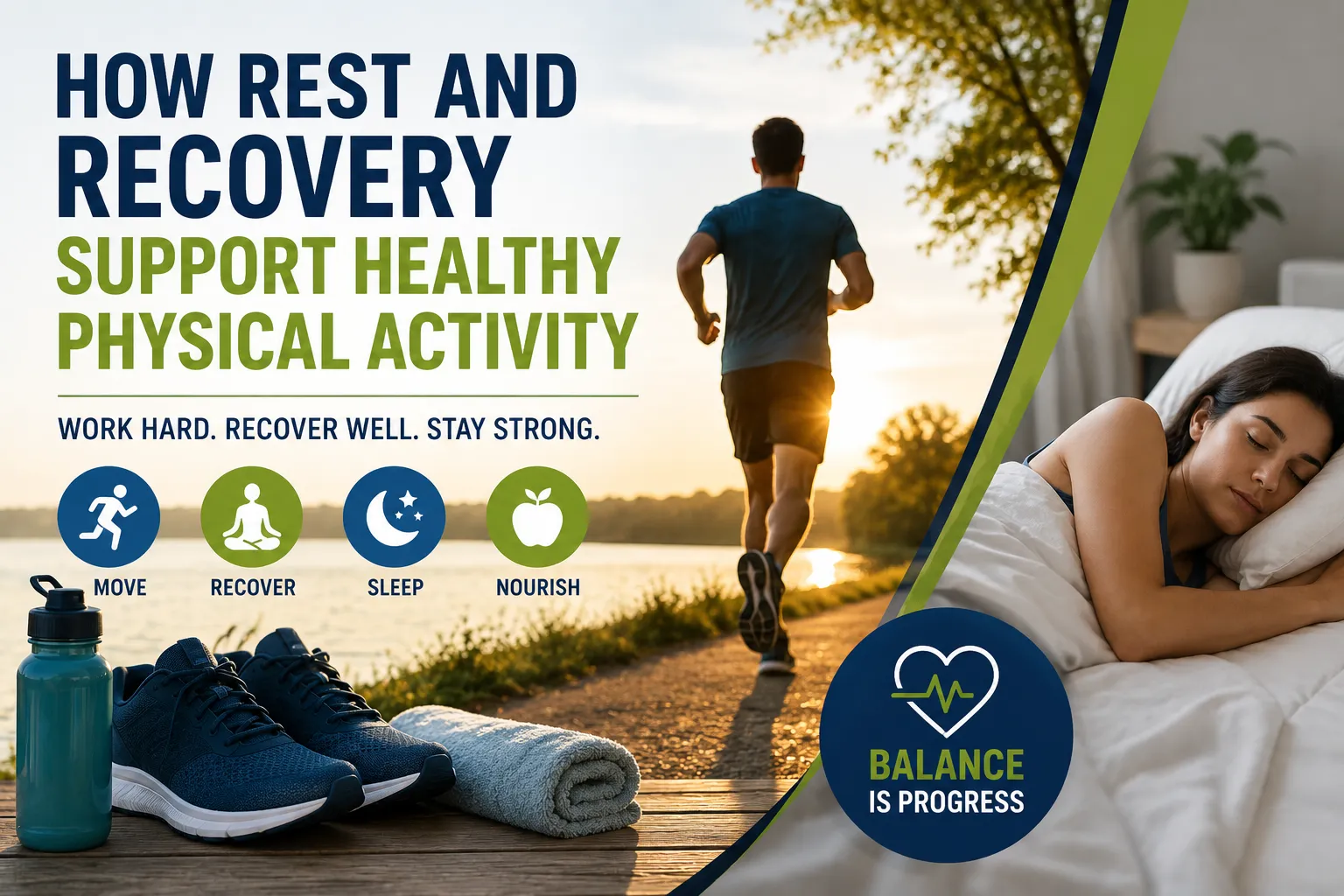

How Rest and Recovery Support Healthy Physical Activity
Physical activity is one of the foundations of a healthy lifestyle. Regular movement can support cardiovascular fitness, muscular strength, mobility, balance and overall well-being. But exercise is only one part of the equation.
Rest and recovery are equally important.
When people focus heavily on workouts, it can be tempting to believe that exercising more frequently or intensely will always produce better results. In reality, the body needs time between demanding activities to repair tissues, replenish energy stores and adapt to training.
Understanding the role of recovery can help people build exercise routines that are more sustainable, enjoyable and effective over time.
For a broader overview of exercise and physical activity, see the complete guide to physical activity and exercise.
Why the Body Needs Recovery
Physical activity places stress on the body.
During exercise, muscles work harder than they do during ordinary daily activities. Heart rate and breathing increase, energy is consumed and the body has to respond to physical demands.
This stress is not necessarily harmful. In appropriate amounts, it is part of how the body becomes more capable.
The recovery period is when many of the processes associated with adaptation take place.
Rest gives the body an opportunity to repair and rebuild after physical exertion rather than immediately placing it under another significant load.
Without sufficient recovery, repeated strenuous activity can eventually make a person feel persistently tired and reduce their ability to perform well.
Exercise and Recovery Work Together
A useful way to think about physical activity is as a cycle:
Exercise → stress → recovery → adaptation
Exercise provides the stimulus.
Recovery gives the body time to respond to that stimulus.
Over time, this process can contribute to improvements in endurance, strength, coordination and physical capacity.
If exercise is consistently demanding but recovery is inadequate, the cycle can become less productive.
This is why a well-designed fitness routine includes both activity and periods of lower demand.
Rest Helps Muscles Recover
Strength training and other demanding activities place stress on muscle tissue.
The body responds by repairing and adapting to that stress.
Recovery does not necessarily mean lying completely still. It means giving the muscles enough time and appropriate conditions to recover before repeatedly exposing them to substantial workloads.
For example, someone who performs demanding resistance training may alternate muscle groups or schedule easier days between challenging sessions.
This approach can allow training to continue while reducing the risk of repeatedly overloading the same tissues.
Sleep Is a Major Part of Recovery
Sleep is one of the most important forms of recovery.
During sleep, the body carries out numerous processes involved in physical restoration, brain function and regulation of physiological systems.
Poor sleep can make exercise feel more difficult and may affect concentration, mood, reaction time and motivation.
For people who exercise regularly, consistent sleep can therefore be just as important to a sustainable routine as the workout itself.
Rather than viewing sleep as time taken away from exercise, it is more useful to see it as part of the overall training and health process.
Recovery Is Not the Same for Everyone
There is no universal recovery schedule that works for every person.
Recovery needs can vary according to:
- Age
- Fitness level
- Exercise intensity
- Exercise duration
- Training frequency
- Sleep quality
- Nutrition
- Stress levels
- Work demands
- Previous injuries
- Overall health
A beginner who has recently started exercising may need more recovery between challenging sessions than someone who has gradually developed greater fitness.
Similarly, a long, demanding workout may require more recovery than a gentle walk.
Listening to the body’s response can help people determine whether their exercise schedule is appropriate.
Active Recovery Can Keep the Body Moving
Rest does not always have to mean complete inactivity.
Active recovery involves performing low-intensity movement instead of another demanding workout.
Examples can include:
- Easy walking
- Gentle cycling
- Light swimming
- Comfortable mobility exercises
- Gentle stretching
The goal is not to create another challenging training session.
Active recovery can provide movement while allowing the body to operate at a lower intensity.
For someone who enjoys being active every day, this can be a useful alternative to performing hard workouts on consecutive days.
Light movement can also help people stay active between formal workouts. Reducing sedentary behavior and adding more movement to everyday life provides practical examples of how to incorporate easier movement throughout the day.
Rest Days Can Prevent Training From Becoming Excessive
Rest days provide a deliberate break from demanding physical activity.
They can be particularly useful when a person follows a regular strength-training, running or high-intensity exercise program.
A rest day does not mean someone has failed to maintain discipline.
It is part of the structure of a sustainable routine.
For some people, rest may involve normal daily activities and no formal workout. Others may choose light movement such as walking.
The appropriate approach depends on the individual’s training demands and recovery needs.
Recovery Supports Performance
People sometimes associate recovery only with avoiding fatigue.
It can also support better performance.
When the body has had adequate time to recover, a person may be able to exercise with better energy, concentration and technique.
This can be particularly important for activities that require coordination and precision.
A tired athlete may struggle to maintain proper form during strength training or may have difficulty maintaining technique during a long run.
Training while excessively fatigued can therefore reduce the quality of a workout.
More exercise is not automatically better if the quality of that exercise continues to decline.
Nutrition Helps the Recovery Process
Recovery also depends on adequate nutrition.
Food provides energy and nutrients that the body needs for normal functioning and physical activity.
A balanced diet can include a combination of:
- Protein-rich foods
- Whole grains and other carbohydrate sources
- Fruits and vegetables
- Healthy fats
- Adequate fluids
Protein is particularly important for maintaining and repairing muscle tissue, while carbohydrates provide an important source of energy for many forms of exercise.
The specific nutritional needs of an individual depend on factors such as activity level, goals and overall dietary pattern.
A balanced approach is generally more useful than focusing on a single nutrient or supplement.
Hydration Matters After Exercise
Physical activity can increase fluid losses, particularly in hot or humid conditions or during prolonged exercise.
Replacing fluids helps support normal physiological function.
Water is sufficient for many everyday workouts, although people participating in prolonged or particularly strenuous activities may have different hydration and electrolyte needs.
The important point is to avoid treating hydration as something that only matters during exercise.
Regular fluid intake throughout the day contributes to overall hydration.
Stretching Has a Role, But It Is Not a Cure-All
Stretching is often associated with recovery, but its role is more nuanced than some fitness advice suggests.
Gentle stretching can help people maintain flexibility and may feel comfortable after physical activity.
However, stretching should not be viewed as a universal solution for soreness, injury prevention or recovery.
Different types of exercise call for different approaches, and mobility work can be incorporated according to an individual’s needs.
The most important recovery factors remain adequate rest, appropriate training loads, sleep, nutrition and sensible progression.
Warm-Ups and Cool-Downs Can Support a Balanced Routine
Recovery begins before a workout is finished.
A gradual warm-up can prepare the body for more demanding movement by increasing activity progressively.
Similarly, ending a workout with a period of lower-intensity movement can provide a gradual transition from vigorous exercise to normal daily activity.
A warm-up and cool-down do not eliminate the need for recovery, but they can help make exercise sessions more structured.
Soreness Does Not Always Mean a Better Workout
Muscle soreness can occur after unfamiliar or demanding exercise.
It is sometimes treated as proof that a workout was effective.
That is misleading.
A workout can be productive without causing significant soreness, and severe or persistent soreness may indicate that the exercise load was too demanding for the individual’s current level of conditioning.
Fitness progress should be measured through meaningful improvements such as strength, endurance, mobility, technique or consistency rather than simply by how sore someone feels afterward.
Learn to Distinguish Normal Fatigue From Warning Signs
Some tiredness after exercise is normal.
However, persistent or unusual symptoms should not simply be ignored.
Warning signs that deserve attention can include:
- Persistent or worsening pain
- Significant swelling
- Repeated dizziness
- Unusual shortness of breath
- Chest pain
- Extreme or persistent fatigue
- A noticeable decline in exercise performance
- Pain that changes normal movement
These symptoms can have many possible causes. Anyone experiencing concerning or persistent symptoms should seek appropriate medical advice rather than attempting to exercise through them.
Rest Can Support Mental Well-Being Too
Recovery is not only physical.
Exercise can support mental well-being, but a demanding exercise routine can become another source of pressure if people feel they must constantly train.
Taking breaks can reduce the psychological burden of feeling that every day needs to involve a hard workout.
Rest can also create time for other activities, including social interaction, hobbies, work and relaxation.
A healthy relationship with exercise allows physical activity to contribute positively to life rather than dominating it.
Stress Outside the Gym Also Affects Recovery
Recovery needs are influenced by more than exercise.
Work, family responsibilities, financial concerns, travel and other sources of stress can affect sleep, energy and motivation.
Someone may follow exactly the same workout schedule for months but suddenly find it much harder to recover during a particularly stressful period.
Recognizing this can help people adjust their exercise routine without viewing reduced performance as a personal failure.
Sometimes the healthiest choice is to reduce workout intensity temporarily and prioritize recovery.
Gradual Progression Is Safer and More Sustainable
The body adapts to physical activity over time.
Increasing exercise gradually gives it an opportunity to adjust.
Problems can arise when people suddenly increase workout duration, intensity or frequency.
For example, someone who normally runs a few kilometers may not be ready to immediately run several times that distance.
A gradual approach allows fitness to develop while giving the body time to adapt.
Progress does not have to happen quickly to be meaningful.
Consistency over months and years is often more important than short periods of extreme effort.
Recovery Looks Different Across Activities
Different forms of exercise place different demands on the body.
A long-distance runner may need to pay particular attention to endurance training, lower-body recovery and energy availability.
A strength athlete may structure recovery around specific muscle groups.
Someone participating in recreational swimming may be able to perform frequent sessions because the activity places different stresses on the body.
This is why recovery recommendations should be considered in the context of the activity rather than treated as universal rules.
Fitness Technology Can Help Track Recovery
Modern fitness watches and activity trackers increasingly provide information about sleep, heart rate, training load and recovery.
These tools can help users identify patterns.
For example, someone might notice that demanding workouts consistently feel harder after nights of poor sleep.
However, wearable data should be treated as information rather than a diagnosis.
A device cannot perfectly determine how recovered a person is.
How someone feels, performs and responds to exercise remains important.
Technology can be particularly useful when combined with broader approaches to exercise planning and monitoring, including wearable fitness technology.
A Sustainable Routine Is Better Than an Extreme One
One of the biggest benefits of recovery is that it makes regular exercise easier to maintain.
A routine built around constant high-intensity workouts may be difficult to sustain.
A more balanced program can include:
- Challenging workouts
- Easier sessions
- Rest days
- Adequate sleep
- Balanced nutrition
- Gradual progression
- Flexibility when circumstances change
This approach allows people to continue being active without constantly pushing themselves to their limits.
Making Recovery Part of the Fitness Plan
Recovery should not be something added only when exhaustion appears.
It can be planned from the beginning.
A weekly exercise schedule might deliberately alternate harder and easier sessions. Someone can also monitor sleep, energy levels and performance to determine whether adjustments are needed.
The goal is not to find the maximum amount of exercise the body can tolerate.
The goal is to find a level of activity that provides meaningful benefits while remaining manageable over the long term.
Rest Is Part of Getting Stronger
Physical activity challenges the body, but recovery gives the body an opportunity to adapt.
That makes rest more than a break from fitness. It is an essential component of fitness itself.
Adequate sleep, appropriate nutrition, hydration, lighter activity and scheduled rest can all help support a balanced approach to exercise.
The most effective fitness routine is rarely the one that pushes hardest every single day. It is the one that allows a person to train consistently, recover adequately and keep moving toward their goals without turning exercise into a cycle of exhaustion.
Healthy physical activity is ultimately a balance between challenge and recovery. Knowing when to work hard—and when to give the body time to recover—can make exercise more sustainable and support an active lifestyle for years to come.
Continue Reading
Similar Posts

How Your Environment Affects Everyday Health
Understanding these connections can help people make practical changes that support healthier daily living.
Read article
How Aerobic Exercise Supports Cardiovascular Health
Understanding how aerobic exercise affects cardiovascular health can make it easier to choose activities that are enjoyable, sustainable, and appropriate for your fitness level.
Read article
What Is the Gut Microbiome and Why Does It Matter
Understanding how this ecosystem works can make it easier to understand why diet, lifestyle, medications, and other factors can influence digestive health.
Read article

Join 10,000+ Readers Building Healthier Habits
Get actionable wellness tips every week plus our newest articles delivered straight to your inbox.