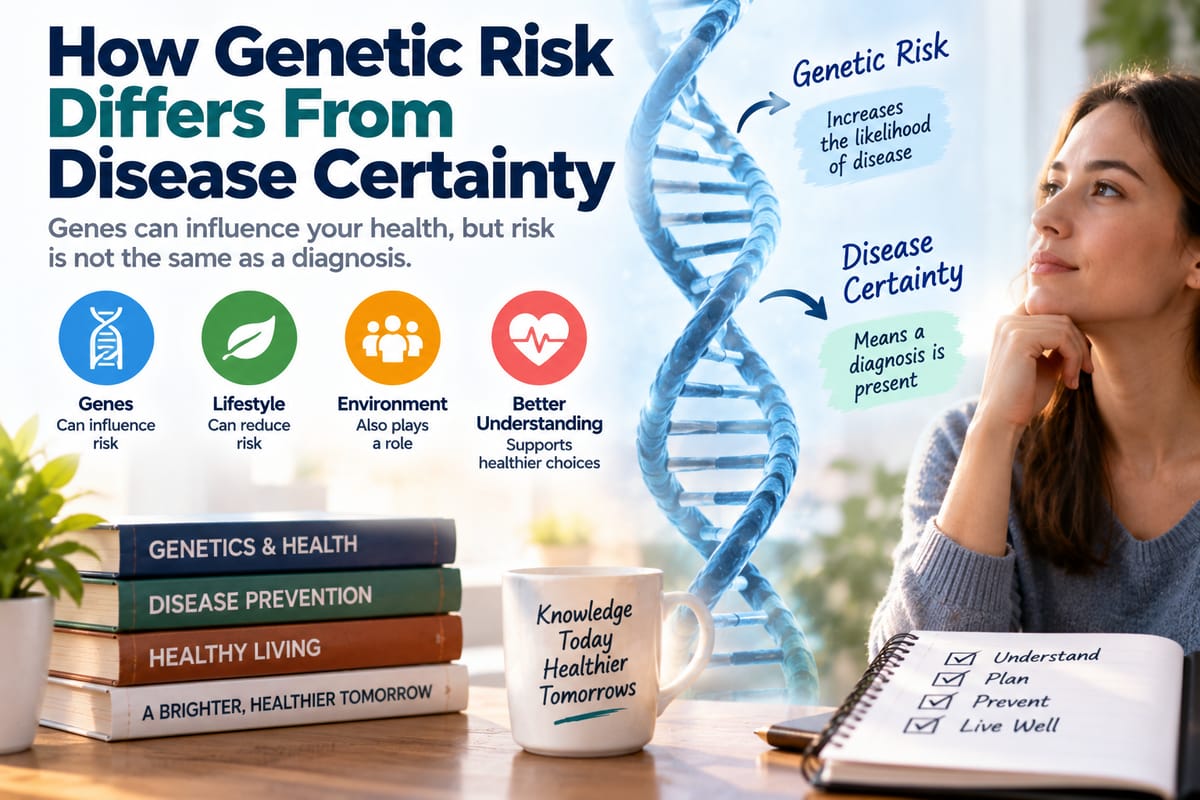

How Genetic Risk Differs From Disease Certainty
Genetic information can reveal important clues about a person’s likelihood of developing certain health conditions. But having a genetic risk factor does not necessarily mean that a disease will develop.
This distinction is important because genetics is only one part of the picture. Many diseases result from interactions between genes, environmental exposures, lifestyle factors, age, existing health conditions, and other biological influences.
A genetic variant may increase susceptibility without making a particular outcome inevitable. Understanding the difference between genetic risk and disease certainty can help people interpret genetic information more accurately and avoid assuming that a risk factor is the same thing as a diagnosis.
What Is Genetic Risk?
Genetic risk refers to the possibility that inherited or acquired genetic characteristics may influence a person’s likelihood of developing a particular condition.
Some genetic variants have relatively strong associations with specific diseases, while others have much smaller effects. In many cases, genetic risk represents one factor among many that can influence whether a disease develops.
For example, a person may inherit a variant associated with an increased likelihood of a particular condition without ever developing that condition.
This is because genes operate within a broader biological and environmental context.
The relationship is explored further in How Genes and Disease Risk Relate, which examines how genetic factors can contribute to differences in disease susceptibility.
What Does Disease Certainty Mean?
Disease certainty refers to a much stronger claim: that a person actually has a disease or that a particular outcome will occur.
A genetic risk factor by itself generally does not establish that a person currently has a disease.
A diagnosis may require a combination of factors, such as:
- Symptoms
- Physical examination
- Medical history
- Laboratory testing
- Imaging
- Genetic testing
- Other diagnostic assessments
The appropriate evidence depends on the specific condition.
This distinction matters because a risk indicator and a diagnosis answer two different questions.
Risk asks: How likely might this condition be?
Diagnosis asks: Does this person currently have the condition?
Why a Genetic Variant Does Not Always Cause Disease
Genes influence biological processes, but their effects can vary.
A particular genetic variant may increase susceptibility to a disease without being sufficient to cause it on its own. Other biological pathways may compensate, environmental factors may influence the outcome, or additional genetic factors may alter the effect.
Some conditions are strongly influenced by a single genetic change, while others involve many genetic variants, each contributing a relatively small amount of risk.
The result is that genetic information can range from highly informative to only one piece of a much larger puzzle.
Genetics Is Only One Risk Factor
Disease risk can be influenced by many factors.
Depending on the condition, these may include:
- Age
- Family history
- Environmental exposures
- Diet
- Physical activity
- Tobacco exposure
- Alcohol consumption
- Infections
- Existing health conditions
- Medication use
- Hormonal factors
- Social and occupational circumstances
- Genetic characteristics
Understanding Major Risk Factors for Disease provides broader context on how multiple factors can contribute to the development of disease.
A person with a genetic risk factor may have a different overall risk depending on the presence or absence of other factors.
Family History Is Not the Same as Genetic Certainty
A family history of a disease can sometimes suggest that genetic factors may be involved, but family history alone does not prove that a person inherited a specific disease-causing variant.
Families share more than genes. They may also share environments, lifestyles, dietary patterns, cultural practices, and other exposures.
For this reason, having relatives with a particular condition can be an important part of a health history without establishing that the same condition will occur in every family member.
Genetic Risk Can Vary Between Conditions
Not all genetic risks work in the same way.
Some genetic conditions are caused primarily by changes in a specific gene. In other conditions, many genes can contribute to susceptibility.
There are also situations where genetic variants influence risk without determining whether the condition will develop.
This means people should avoid treating the phrase “genetic risk” as though it has one universal meaning.
The strength and significance of a genetic finding depend on the specific gene, variant, condition, population, and available scientific evidence.
Risk Is About Probability, Not Destiny
One of the most important concepts in genetics is probability.
If a genetic factor is associated with increased risk, that does not necessarily mean that everyone carrying the factor will develop the condition.
Likewise, someone without a known genetic risk factor may still develop a disease through other biological or environmental pathways.
This is why genetic information should generally be interpreted in context rather than viewed as a prediction of an individual’s future health.
Genetic Testing Does Not Always Provide a Simple Answer
People sometimes expect genetic testing to produce a straightforward result such as “you will develop this disease” or “you will never develop this disease.”
In reality, test results can be more complicated.
A result might indicate:
- A clearly established disease-causing variant
- An increased susceptibility
- A variant with uncertain significance
- No identified relevant variant
- A finding whose significance depends on additional information
The meaning of a result depends heavily on what the test was designed to examine and how the findings are interpreted.
Positive Does Not Always Mean Diseased
The word “positive” can easily be misunderstood in the context of genetic testing.
A positive genetic result may indicate that a particular variant was detected. It does not automatically mean that a person currently has a disease.
For some conditions, a particular genetic finding can be strongly associated with disease. For others, the finding may indicate increased susceptibility rather than certainty.
The terminology used in a test report therefore needs to be interpreted in the context of the specific condition and test.
Negative Does Not Always Mean Zero Risk
The opposite misunderstanding can also occur.
A negative genetic test does not necessarily mean that a person has no possibility of developing the condition being investigated.
A test may only examine particular genes or variants. Scientists may also not yet understand every genetic factor associated with a disease.
In addition, many diseases have important non-genetic risk factors.
Consequently, a negative result can reduce concern about certain genetic findings without eliminating every possible pathway to disease.
How Genetics Can Influence Individual Health Risks
Genetic differences can affect people in many ways.
They may influence how the body processes certain substances, responds to environmental factors, regulates biological processes, or becomes susceptible to particular diseases.
However, the size of that influence varies.
How Genetics Can Influence Individual Health Risks explores why genetic information can contribute to differences in health risk between individuals.
Understanding these differences is important because genetics is neither irrelevant nor an absolute prediction of health outcomes.
Genetic Risk Can Interact With Environment
Genes and environmental factors can interact in complex ways.
For example, a genetic characteristic may influence how strongly someone responds to a particular exposure. In another situation, environmental conditions may affect whether a genetic susceptibility becomes clinically important.
This interaction helps explain why two people with similar genetic characteristics can have different health outcomes.
It also demonstrates why health risk is often more complicated than identifying a single cause.
Genetic Risk and Prevention
Knowing about an elevated genetic risk can sometimes provide an opportunity for more informed health planning.
Depending on the condition, healthcare professionals may recommend appropriate monitoring, screening, lifestyle measures, or other interventions.
The appropriate response depends on the specific risk and the individual’s overall circumstances.
Genetic information should therefore be viewed as potentially useful information for health management rather than as a predetermined outcome.
Genetic Risk Does Not Replace Medical Diagnosis
A genetic test is not necessarily a substitute for a medical evaluation.
A person experiencing symptoms may need diagnostic testing even if genetic testing does not identify an increased genetic risk.
Likewise, someone with an inherited risk factor may need appropriate clinical assessment even if they currently have no symptoms.
Different types of medical information answer different questions.
Genetic testing can provide information about genetic characteristics, while diagnostic testing and clinical evaluation help determine whether a disease is present.
How Genetic Risk Fits Into Overall Health Assessment
A useful way to think about disease risk is as a collection of contributing factors rather than a single prediction.
Genetic information can be one piece of that assessment alongside:
- Family history
- Age
- Personal medical history
- Environmental exposures
- Lifestyle factors
- Symptoms and clinical findings
- Laboratory results
- Other relevant medical information
This broader perspective helps prevent genetic information from being interpreted in isolation.
Common Misunderstandings About Genetic Risk
Several misconceptions can make genetic information harder to understand.
“If I Have the Variant, I Will Get the Disease”
Not necessarily. Some variants increase susceptibility without guaranteeing that the disease will develop.
“If I Do Not Have the Variant, I Cannot Get the Disease”
Not necessarily. Diseases can have multiple genetic and non-genetic pathways.
“Genetic Risk Means I Already Have the Disease”
Risk and diagnosis are different concepts. A risk factor does not automatically establish the presence of disease.
“Family History Proves I Inherited the Condition”
Family history can provide valuable information, but it does not by itself establish the presence of a specific genetic variant.
“Genetic Testing Always Gives a Definite Answer”
Genetic testing can produce results that require interpretation and may not explain every aspect of disease risk.
Putting Genetic Information Into Perspective
Genetic information can be valuable because it may reveal risks that would otherwise be difficult to identify. But its meaning depends on the condition, the specific genetic finding, and the broader health context.
The Complete Guide to Common Health Conditions provides broader background on how different conditions can affect the body and why understanding their causes and risk factors matters.
The key distinction is simple: genetic risk describes a possibility, while disease certainty describes an established condition or outcome.
Recognizing that difference allows genetic information to be used more thoughtfully. Instead of viewing a genetic result as a fixed prediction, it can be understood as one piece of evidence that may contribute to a larger picture of individual health risk.
Continue Reading
Similar Posts

How Vector Control Prevents Infectious Diseases
Vector control includes a wide range of measures designed to reduce contact between people and disease-carrying organisms.
Read article
How Sun Exposure Affects Skin Cancer Risk
Understanding how sun exposure affects the skin can make prevention more practical. Protection is not about avoiding daylight altogether. Instead, it involves reducing unnecessary ultraviolet exposure and recognizing situations when the skin is particularly vulnerable.
Read article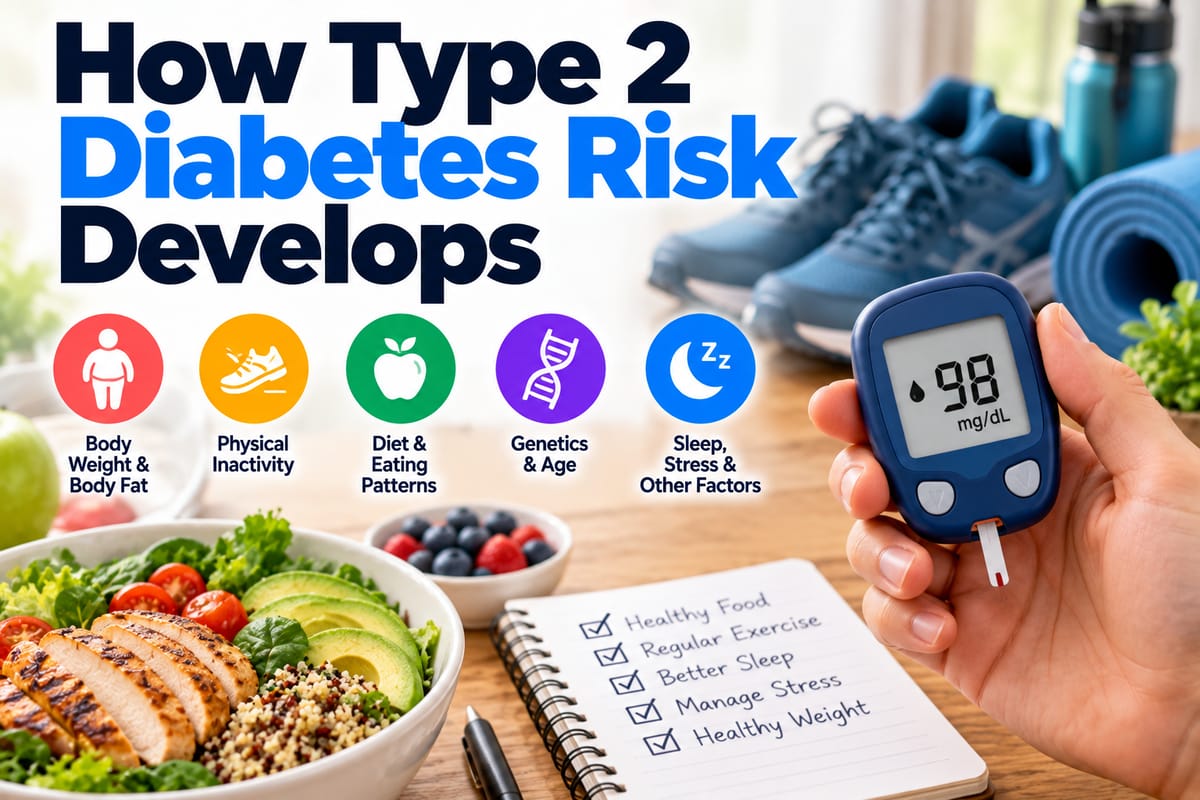
How Type 2 Diabetes Risk Develops
Understanding how type 2 diabetes risk develops can make the condition easier to prevent or manage. Risk factors do not guarantee that someone will develop diabetes, and some people develop the condition without having an obvious single cause. Instead, risk tends to emerge from the interaction of several factors over time.
Read article

Join 10,000+ Readers Building Healthier Habits
Get actionable wellness tips every week plus our newest articles delivered straight to your inbox.