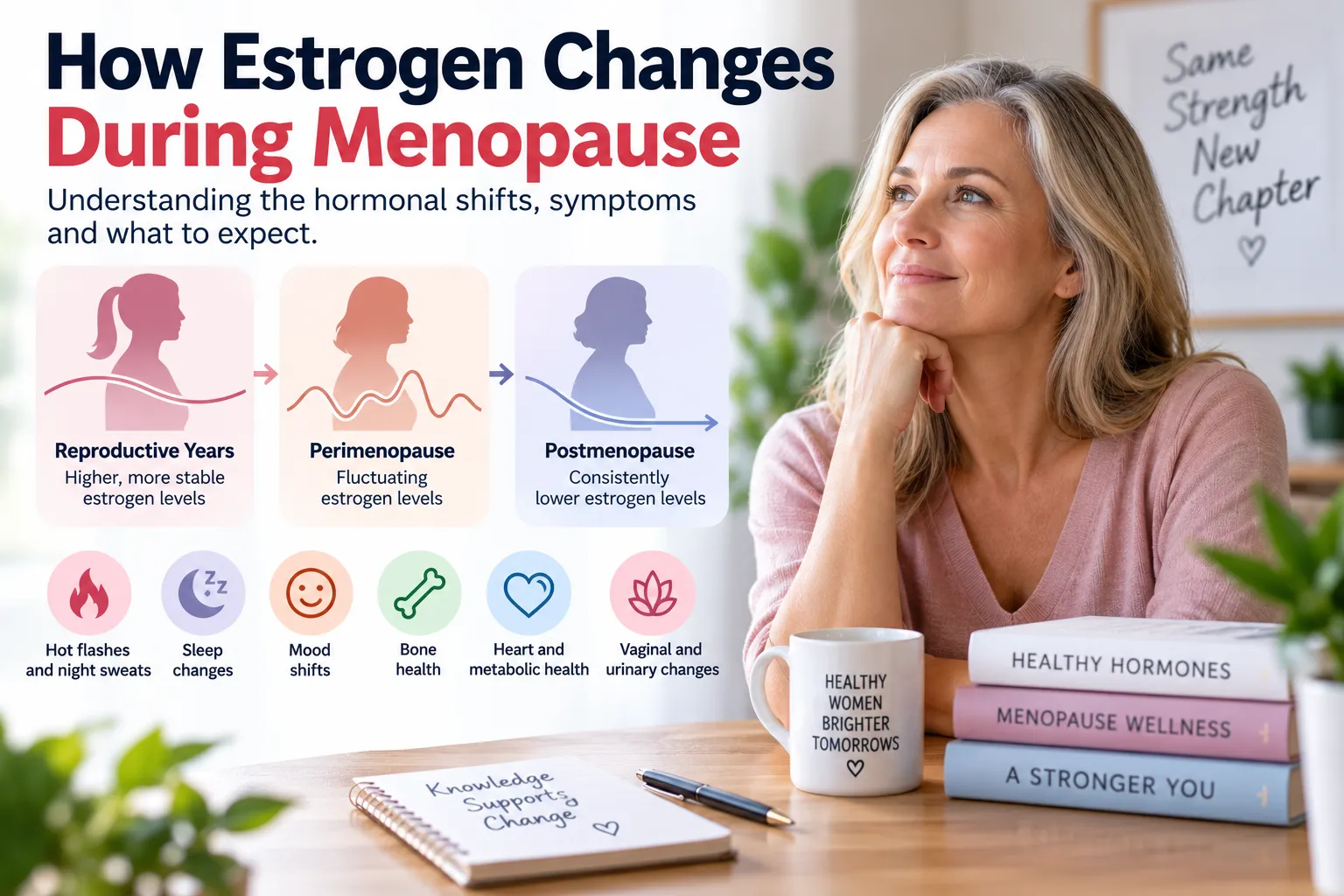

How Estrogen Changes During Menopause
Estrogen is one of the hormones most closely associated with the menstrual cycle, fertility, bone health, and many other functions throughout a woman’s life. During menopause, estrogen levels change substantially, and those changes can affect the body in ways that range from hot flashes and sleep disruption to vaginal symptoms and changes in menstrual patterns.
The process does not usually happen overnight. Estrogen levels begin changing during perimenopause, the transitional stage leading up to menopause. They can fluctuate considerably before eventually settling at much lower levels after menopause.
Understanding how estrogen changes can make many of the physical and emotional changes associated with this stage of life easier to recognize and discuss with a healthcare professional.
For a broader overview of the transition itself, see our Complete Guide to Menopause and Perimenopause.
What Is Estrogen?
Estrogen is actually a group of hormones rather than a single substance.
The three major forms are:
- Estradiol
- Estrone
- Estriol
Estradiol is the predominant form of estrogen during the reproductive years. After menopause, estrone becomes the main circulating estrogen, although estrogen levels overall are considerably lower.
Estrogen is produced primarily by the ovaries before menopause. Smaller amounts can also come from other tissues, including fat tissue and the adrenal glands.
Although estrogen is strongly associated with reproductive health, its effects extend well beyond the reproductive system.
It influences tissues throughout the body, including the:
- Brain
- Bones
- Cardiovascular system
- Reproductive organs
- Urinary tract
- Skin
- Muscles and connective tissues
This helps explain why declining estrogen can produce such a wide range of changes during menopause.
When Does Estrogen Start Changing?
Estrogen does not suddenly disappear when menopause begins.
The major hormonal changes generally begin during perimenopause, which can last for several years.
During this stage, ovarian hormone production becomes less predictable. Estrogen levels can rise and fall significantly from one cycle to another.
This means a woman may experience symptoms one month and feel relatively normal the next. Menstrual cycles can also become shorter, longer, heavier, lighter, or increasingly irregular.
Eventually, ovarian estrogen production declines substantially.
Menopause is defined retrospectively after a person has gone 12 consecutive months without a menstrual period, assuming there is no other explanation for the absence of menstruation.
How Estrogen Changes During Perimenopause
Perimenopause is often the stage when women first notice that their hormones are changing.
Rather than following a simple downward line, estrogen levels can fluctuate dramatically.
At times, estrogen may remain relatively high. At other times, levels can drop considerably.
These fluctuations can contribute to symptoms such as:
- Hot flashes
- Night sweats
- Breast tenderness
- Irregular periods
- Sleep disturbances
- Mood changes
- Changes in menstrual flow
- Vaginal or urinary symptoms
- Changes in sexual function
The experience varies considerably from person to person.
Some women have relatively mild symptoms, while others experience symptoms that substantially affect sleep, work, relationships, and everyday activities.
What Happens to Estrogen Around the Final Menstrual Period?
As the menopause transition progresses, the ovaries gradually produce less estrogen.
Eventually, ovulation becomes increasingly uncommon and ovarian estrogen production falls to a much lower level.
After the final menstrual period, estrogen levels generally remain much lower than they were during the reproductive years.
This lower-estrogen state is not an illness. It is a normal biological stage of aging.
However, the symptoms associated with the transition can be significant and may require treatment or management when they interfere with quality of life.
Why Do Estrogen Levels Fluctuate So Much?
During the reproductive years, the menstrual cycle involves coordinated changes in several hormones.
As ovarian function becomes less predictable during perimenopause, this hormonal coordination also becomes less predictable.
Ovulation may occur less consistently, and estrogen production can become irregular.
This helps explain why menopause symptoms can seem unpredictable.
A woman might experience a period of intense hot flashes followed by several weeks with fewer symptoms. Menstrual bleeding can also change from one cycle to another.
The transition is therefore better understood as a period of hormonal fluctuation followed by a sustained decline, rather than a sudden loss of estrogen.
Estrogen and Menstrual Changes
Estrogen plays a central role in the menstrual cycle.
One of its important functions is stimulating the growth of the uterine lining during the first part of the cycle.
When estrogen patterns change during perimenopause, menstrual cycles can become less predictable.
Possible changes include:
- Periods occurring closer together
- Periods occurring farther apart
- Heavier bleeding
- Lighter bleeding
- Longer periods
- Shorter periods
- Skipped periods
These changes are common during the menopause transition, but not every type of bleeding should automatically be attributed to menopause.
Unusually heavy bleeding, bleeding between periods, or bleeding after menopause should be discussed with a healthcare professional.
For a broader look at the menstrual cycle and menstrual health, see our Complete Guide to Menstrual Health and Cycles.
Why Lower Estrogen Can Cause Hot Flashes
Hot flashes are among the most recognizable symptoms of menopause.
The exact mechanisms are complex, but declining and fluctuating estrogen appear to affect the brain’s temperature-regulation system.
Changes in the hypothalamus can make the body more sensitive to small changes in core temperature.
When the brain incorrectly interprets the body as being too warm, it can trigger responses designed to release heat.
These may include:
- Sudden sweating
- Flushing
- Increased heart rate
- A sensation of intense warmth
- Chills afterward
Hot flashes can occur during the day or at night. Night sweats can disrupt sleep and contribute to daytime fatigue.
The frequency and intensity of hot flashes vary widely between individuals.
Estrogen and Sleep
Menopause-related sleep problems can have several causes.
Hormonal changes may contribute directly, while night sweats can repeatedly wake someone from sleep.
Other factors can also become more common during midlife, including stress, changes in health, medications, lifestyle changes, and sleep disorders.
Poor sleep can then affect mood, concentration, memory, and energy during the day.
This can create a frustrating cycle in which menopause symptoms interfere with sleep and inadequate sleep makes those symptoms feel more difficult to manage.
Estrogen and Emotional Changes
Mood changes during the menopause transition are also influenced by multiple factors.
Estrogen interacts with systems in the brain involved in mood regulation, and hormonal fluctuations may contribute to changes in emotional well-being.
Women may experience:
- Irritability
- Mood swings
- Increased anxiety
- Low mood
- Emotional sensitivity
- Difficulty concentrating
- Mental fatigue
However, not every emotional change during midlife is caused by estrogen.
Relationships, work, caregiving responsibilities, financial stress, sleep disruption, health conditions, and other life circumstances can all influence mental health.
Recent research continues to investigate how hormone therapy may affect mood symptoms during the menopause transition, but treatment decisions should be individualized rather than based on hormone levels alone.
Estrogen and Brain Function
Many women describe experiencing “brain fog” during perimenopause and menopause.
This can include:
- Forgetfulness
- Difficulty concentrating
- Losing track of words
- Trouble multitasking
- Feeling mentally slower
- Difficulty maintaining attention
These experiences can be unsettling, but occasional changes in memory or concentration do not automatically indicate dementia.
Sleep disruption, stress, anxiety, depression, medications, and other health conditions can also affect cognitive performance.
Hormonal changes may be one factor among several.
Persistent or worsening cognitive problems should be discussed with a healthcare professional rather than automatically being attributed to menopause.
Estrogen and Bone Health
Estrogen plays an important role in maintaining bone tissue.
When estrogen levels decline substantially after menopause, the rate at which bone is broken down can increase.
Over time, this can contribute to reduced bone density and a higher risk of osteoporosis and fractures.
This is one reason bone health becomes increasingly important during and after menopause.
Factors that support bone health include:
- Adequate calcium intake
- Adequate vitamin D
- Weight-bearing physical activity
- Resistance exercise
- Avoiding tobacco
- Moderating alcohol consumption
- Maintaining an appropriate body weight
- Addressing other osteoporosis risk factors
Some women may need bone-density testing or additional treatment depending on their age and individual risk factors.
Estrogen and Vaginal and Urinary Changes
Lower estrogen can affect tissues of the vagina, vulva, and urinary tract.
Some women develop symptoms such as:
- Vaginal dryness
- Burning or irritation
- Pain during sexual activity
- Reduced vaginal lubrication
- Urinary urgency
- Increased urinary discomfort
- Recurrent urinary tract infections in some cases
These symptoms are sometimes grouped under the term genitourinary syndrome of menopause.
They can persist or become more noticeable after menopause rather than disappearing once hot flashes improve.
Treatment options are available, and women do not necessarily have to simply tolerate persistent discomfort.
Estrogen and Sexual Health
Changes in estrogen can affect sexual health in several ways.
Reduced vaginal lubrication and changes in vaginal tissues can make sexual activity uncomfortable or painful.
Changes in sleep, mood, stress, body image, relationships, medications, and other hormones can also influence sexual desire.
It is therefore important to approach changes in sexual function from a broader perspective rather than assuming estrogen is the only factor involved.
Persistent pain, bleeding, or other concerning symptoms during sexual activity should be evaluated by a healthcare professional.
For a broader perspective on reproductive and sexual health across different stages of life, see our Complete Guide to Reproductive Health.
What Happens to Estrogen After Menopause?
After menopause, estrogen levels generally remain much lower than during the reproductive years.
The ovaries continue to have hormonal activity, but the primary source of estrogen changes.
Small amounts of estrogen can still be produced through the conversion of other hormones in tissues such as body fat and the adrenal glands.
Postmenopausal estrogen is therefore not zero.
Instead, the body operates at a different hormonal level than it did during the reproductive years.
This lower-estrogen environment can continue to influence bones, vaginal and urinary tissues, cardiovascular health, and other systems.
Does Every Woman Experience the Same Estrogen Decline?
No.
The timing and experience of menopause vary substantially.
Some women experience gradual changes over several years, while others have a more abrupt transition, particularly after surgical removal of the ovaries or certain medical treatments.
Symptoms also differ.
One woman may experience frequent hot flashes and significant sleep disruption, while another may notice primarily menstrual changes or vaginal symptoms.
The intensity of symptoms does not necessarily correspond perfectly to a particular estrogen measurement.
This is one reason menopause care is generally based on a person’s symptoms, health history, age, reproductive history, and individual circumstances rather than trying to identify one “normal” estrogen number.
Can Estrogen Levels Be Tested?
Hormone testing can sometimes be useful in specific clinical circumstances, but routine estrogen testing is generally not necessary to diagnose typical menopause in women in the expected age range.
Estrogen levels fluctuate substantially during perimenopause, which means a single blood test may not accurately represent what is happening over the course of the transition.
Healthcare professionals often use a combination of:
- Age
- Menstrual history
- Symptoms
- Medical history
- Physical examination when appropriate
- Other tests when another condition needs to be ruled out
Testing may be more useful in certain situations, such as suspected early menopause or other conditions that make the diagnosis less straightforward.
What Is Hormone Therapy?
Menopausal hormone therapy uses estrogen, with or without a progestogen depending on a person’s circumstances, to treat certain menopause symptoms.
Systemic hormone therapy can be delivered through forms such as:
- Pills
- Patches
- Gels
- Sprays
- Other systemic preparations
Low-dose vaginal estrogen is another option used primarily for genitourinary symptoms.
Hormone therapy remains one of the most effective treatments for bothersome hot flashes and night sweats. The Menopause Society notes that the benefits and risks depend heavily on factors such as age, timing, type of therapy, route of administration, medical history, and individual risk factors.
Does Everyone Need Estrogen Therapy?
No.
Menopause itself does not mean that every woman needs estrogen treatment.
Some women have symptoms that are mild enough to manage without hormone therapy. Others experience symptoms that significantly interfere with daily life and may benefit from treatment.
The decision depends on the individual’s symptoms, health history, preferences, risk factors, and treatment goals.
Hormone therapy is not recommended simply because estrogen levels have declined.
The goal is to determine whether the potential benefits of treatment outweigh its risks for that particular person.
What About Women Who Still Have a Uterus?
This is an important consideration when systemic estrogen therapy is being discussed.
For women who still have a uterus, systemic estrogen is generally combined with a progestogen to protect the uterine lining.
Taking systemic estrogen without adequate endometrial protection can increase the risk of endometrial hyperplasia and cancer.
Women who have had a hysterectomy may have different treatment options, depending on their medical circumstances.
This is one of several reasons hormone therapy should be prescribed and monitored individually.
Is Hormone Therapy Safe?
There is no single answer that applies to every woman.
Hormone therapy has benefits and risks, and those risks can vary according to the person’s age, medical history, type of therapy, dose, route, and whether estrogen is used alone or with a progestogen.
For many healthy women who are younger than 60 or within about 10 years of menopause onset, the balance of benefits and risks can be favorable when hormone therapy is used for appropriate indications.
However, hormone therapy is not appropriate for everyone.
Women with certain conditions, including some hormone-sensitive cancers, unexplained vaginal bleeding, a history of certain blood clots, liver disease, or cardiovascular disease, may need to avoid systemic hormone therapy or consider alternatives.
A healthcare professional can assess the individual’s circumstances.
Why the Route of Estrogen Matters
Estrogen can enter the body in different ways, and the route can influence its effects.
Oral estrogen passes through the digestive system and liver before entering general circulation.
Transdermal estrogen, such as patches, gels, or sprays, enters the bloodstream through the skin.
Low-dose vaginal estrogen is primarily intended to act locally on vaginal and urinary tissues, with relatively little entering the bloodstream.
These differences matter when clinicians evaluate the potential benefits and risks of treatment.
The Menopause Society notes that some risks, including blood-clot risk, can vary depending on how estrogen is administered.
Estrogen Is Only One Part of Menopause
It can be tempting to attribute every menopause symptom to falling estrogen.
The reality is more complicated.
Menopause occurs during a major stage of life that can involve changes in:
- Other reproductive hormones
- Sleep
- Metabolism
- Body composition
- Bone health
- Cardiovascular risk factors
- Mental health
- Relationships
- Lifestyle
- Work and caregiving responsibilities
This broader perspective is important when thinking about treatment.
Understanding hormonal changes is valuable, but it should not overshadow other health factors.
For a broader look at hormones and their role throughout the body, explore our Complete Guide to Hormonal Health.
When Should Menopause Symptoms Be Evaluated?
Women should consider speaking with a healthcare professional when menopause symptoms are persistent, severe, unusual, or interfering with daily life.
Medical evaluation is particularly important for symptoms such as:
- Very heavy or prolonged bleeding
- Bleeding after menopause
- Unexplained pelvic pain
- New or severe symptoms
- Persistent depression or anxiety
- Significant sleep problems
- Pain during sex
- Recurrent urinary symptoms
- Symptoms occurring unusually early
- Symptoms that may have another medical explanation
Not every symptom that occurs around menopause is necessarily caused by hormonal changes.
Medical evaluation can help identify other possible causes and ensure that appropriate treatment is considered.
The Bigger Picture of Estrogen Changes
Estrogen does not simply “drop” when menopause begins.
The process usually starts years earlier during perimenopause, when estrogen levels can fluctuate considerably before declining to a consistently lower level after the final menstrual period.
These changes can affect menstrual cycles, temperature regulation, sleep, mood, vaginal and urinary tissues, bones, and other parts of the body.
For many women, understanding that these changes are part of a broader transition can make menopause easier to navigate. At the same time, significant or unusual symptoms should not simply be dismissed as something a woman has to endure.
Menopause is a normal stage of life, but that does not mean its symptoms have to be ignored. With accurate information, appropriate preventive care, and individualized treatment when necessary, women can make informed decisions about their health during the transition and well beyond it.
Continue Reading
Similar Posts

How Communication Supports Sexual Health
Whether people are discussing contraception, sexual preferences, STI testing, fertility, consent, or changes in their health, clear communication can play an important role in making sexual relationships safer and healthier.
Read article
Why Health History Matters for Women
For women, keeping an accurate health history can be especially valuable because health needs can change significantly throughout different stages of life.
Read article
How Preconception Health Can Support Reproductive Health
Although preconception care cannot guarantee conception or prevent every pregnancy complication, addressing modifiable health factors beforehand can give prospective parents an opportunity to improve their health and identify potential concerns early.
Read article

Join 10,000+ Readers Building Healthier Habits
Get actionable wellness tips every week plus our newest articles delivered straight to your inbox.