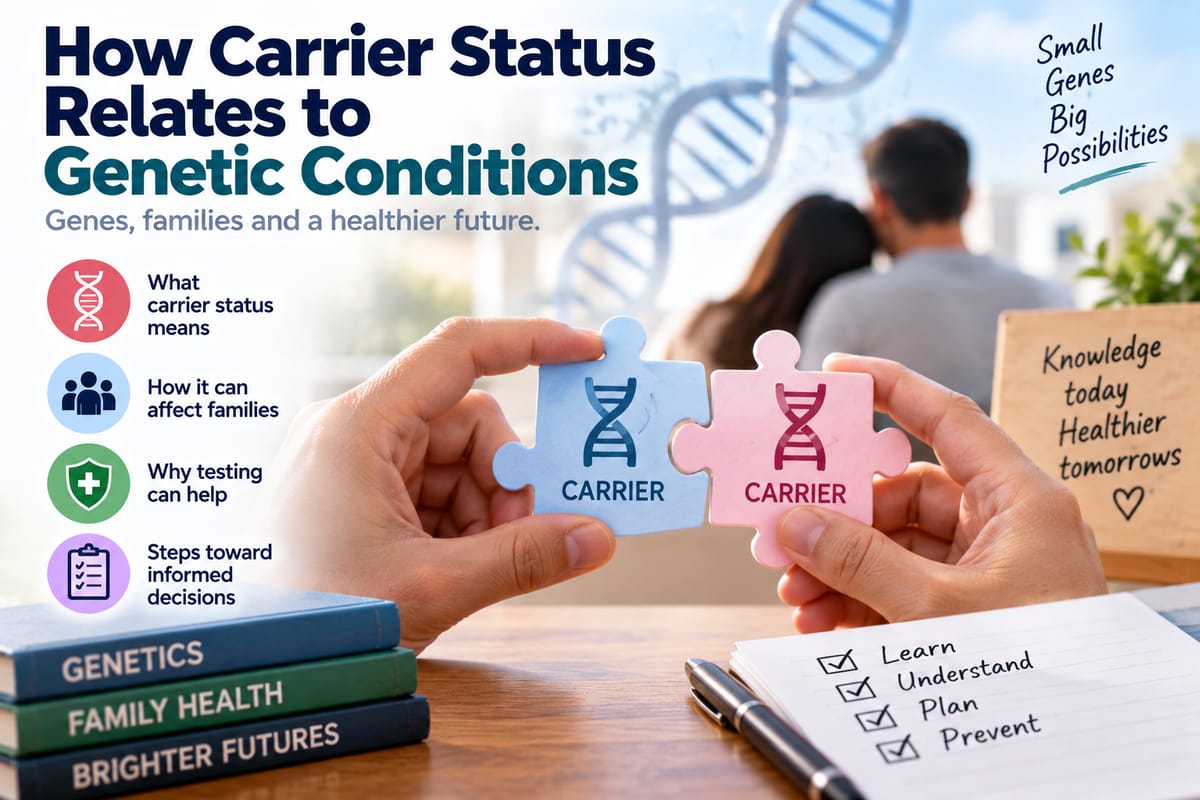

How Carrier Status Relates to Genetic Conditions
Genetic conditions can be inherited in different ways, and some people can carry a disease-associated genetic variant without having the condition themselves. These individuals are often described as carriers.
Carrier status can become particularly important when people are planning a family, investigating a family history of a genetic condition, or undergoing genetic testing. Understanding what it means to be a carrier can help explain why some inherited conditions appear unexpectedly in families and why a person’s own health may not always be affected by a genetic variant they carry.
Carrier status is not the same as having a genetic disease. Its significance depends on the specific condition, the gene involved, the inheritance pattern, and whether other genetic factors are present.
What Does It Mean to Be a Genetic Carrier?
A genetic carrier is generally a person who has a genetic variant associated with a particular inherited condition but does not typically have the condition itself.
Carrier status is especially common with autosomal recessive conditions. In these conditions, a person usually needs two disease-associated copies of a particular gene, one inherited from each biological parent, for the condition to develop.
A person with one altered copy and one functioning copy may be a carrier.
Carriers can often live healthy lives without symptoms related to the condition they carry. However, they may be able to pass the genetic variant to their biological children.
How Recessive Inheritance Works
Genes are inherited in pairs for many parts of the genome, with one copy generally coming from each biological parent.
For an autosomal recessive condition, a simplified inheritance pattern can look like this:
- One parent carries a disease-associated variant.
- The other parent also carries a disease-associated variant.
- Each parent can pass either their altered or functioning copy to a child.
- A child who inherits altered copies from both parents may develop the condition.
- A child who inherits one altered copy may be a carrier.
- A child who inherits functioning copies may not carry the particular variant.
The exact probabilities depend on the specific inheritance pattern and genetic variants involved.
Carrier Status Does Not Usually Mean the Person Is Sick
One of the most important distinctions is between being a carrier and having the genetic condition.
A carrier of an autosomal recessive condition often has enough functioning gene activity to avoid developing the associated disease.
This does not mean that every carrier is completely unaffected. Some genetic conditions can have more complicated inheritance patterns, and certain variants may produce mild or variable effects.
Therefore, carrier status should always be interpreted in relation to the specific gene and condition involved.
Why Carrier Status Can Matter for Families
Carrier status can become particularly relevant when two biological parents carry variants associated with the same recessive condition.
If both parents carry a disease-associated variant in the same gene, their children may have different possible genetic outcomes.
For each pregnancy, there may be a chance that a child:
- Inherits the relevant variant from both parents
- Inherits the variant from one parent
- Does not inherit the variant from either parent
The precise inheritance probabilities depend on the condition and the genetic variants involved.
This is one reason carrier screening and genetic counseling can be useful for people with relevant family histories or specific reproductive concerns.
Family History Can Provide Important Clues
A family history of an inherited condition can sometimes indicate that carrier status or another genetic factor may be present.
However, the absence of a known family history does not necessarily mean that a person cannot be a carrier.
There are several reasons a genetic condition may not be obvious in a family. Carriers may have no symptoms, relatives may not have been genetically tested, and some conditions may be uncommon or diagnosed only after several generations.
Genetic risk is therefore influenced by more than what is immediately visible in a family tree.
The broader relationship between inherited characteristics and health is explored in How Genetics Can Influence Individual Health Risks.
Carrier Status and Different Inheritance Patterns
Not all genetic conditions follow an autosomal recessive pattern.
Other inheritance patterns include:
- Autosomal dominant inheritance
- X-linked inheritance
- Mitochondrial inheritance
- Other more complex patterns
The term “carrier” is most commonly associated with recessive conditions, particularly when someone has one disease-associated variant without developing the condition.
For other inheritance patterns, the meaning of carrying a genetic variant can be different.
This is why a genetic result should be interpreted according to the specific condition rather than applying one general rule to every genetic disorder.
Autosomal Recessive Conditions
Autosomal recessive conditions occur when disease-associated variants affect both copies of a particular gene.
A carrier typically has one altered copy and one copy that provides sufficient function to prevent the usual disease presentation.
Examples of conditions that can follow autosomal recessive inheritance include certain metabolic disorders, blood disorders, and inherited enzyme deficiencies.
The characteristics and severity of these conditions vary considerably.
A broad overview of different diseases and health conditions can be found in the Complete Guide to Common Health Conditions.
X-Linked Conditions Are Different
Some genetic conditions are associated with genes located on the X chromosome.
Because people typically have different combinations of sex chromosomes, X-linked conditions can have different inheritance patterns from autosomal conditions.
A person with an X-linked variant may have different symptoms or risks depending on their genetic makeup.
For this reason, someone who receives an X-linked genetic result should not assume that the usual autosomal recessive carrier explanation applies.
Carrier Screening
Carrier screening involves genetic testing designed to determine whether a person carries certain variants associated with inherited conditions.
Screening can focus on specific conditions or examine a broader collection of genes, depending on the test.
Testing may be considered in situations such as:
- A known family history of a genetic condition
- A partner who is known to be a carrier
- A population with increased prevalence of a particular inherited condition
- Before or during family planning
- When recommended as part of a healthcare assessment
The appropriate testing strategy depends on the person’s circumstances and the conditions being considered.
What a Carrier Screening Result Can Show
A carrier screening result may indicate that a person:
- Is a carrier for one or more tested conditions
- Was not found to be a carrier for the variants examined
- Has a genetic finding requiring further interpretation
- Has an uncertain result that cannot yet be clearly classified
A negative result generally means that the test did not identify the variants it was designed to detect. It does not necessarily eliminate every possible genetic risk.
Tests differ in what they examine, and not every possible disease-associated variant can necessarily be detected.
What Happens When Both Partners Are Carriers?
When two biological parents are found to carry variants associated with the same autosomal recessive condition, they may have an increased chance of having a child affected by that condition.
At that point, healthcare professionals or genetic counselors may explain the available reproductive and testing options.
These discussions can include:
- Understanding the inheritance pattern
- Reviewing the specific genetic variants
- Discussing testing during pregnancy
- Considering reproductive options
- Understanding available medical care
- Reviewing the family’s medical history
The appropriate choices vary from person to person, and genetic counseling can help families understand the information without reducing a complex situation to a single test result.
Carrier Status and Genetic Testing
Genetic testing does not always produce a simple yes-or-no answer.
A test may identify a variant whose significance is well established, while another finding may require additional evidence.
Testing methods also differ in their ability to identify particular variants.
For these reasons, the meaning of a carrier result depends on:
- The gene tested
- The specific variant identified
- The condition associated with the gene
- The type of test performed
- The strength of available scientific evidence
- The individual’s family history
Professional interpretation can be especially important when results are unexpected or potentially significant for family planning.
Can Carriers Develop Symptoms?
For many classic autosomal recessive conditions, carriers do not develop the full condition associated with having two disease-associated variants.
However, genetics is not always simple.
Some carriers can experience mild or condition-specific effects, while certain variants can have different consequences depending on the individual.
This means that the word “carrier” should not be treated as a universal guarantee that a person has no symptoms.
The specific condition and variant matter.
Carrier Status Is Only One Part of Disease Risk
A person’s overall health risk is influenced by many factors.
These can include:
- Genetics
- Age
- Family history
- Lifestyle
- Environmental exposures
- Infections
- Existing health conditions
- Medications
- Social and environmental circumstances
Carrier status describes a particular genetic relationship with a specific inherited condition. It does not provide a complete picture of a person’s overall health.
A broader examination of these influences is available in Understanding Major Risk Factors for Disease.
Carrier Status and Prevention
Carrier testing does not prevent a genetic variant from being inherited, but it can provide information that may help people make informed healthcare and family-planning decisions.
Depending on the condition, knowing carrier status may also help families understand whether relatives could potentially carry the same variant.
Some inherited conditions can also be identified through screening or diagnostic testing, allowing appropriate medical care to begin earlier when necessary.
Prevention strategies differ substantially between diseases. General principles are discussed in How Disease Prevention Works and How to Reduce Health Risks.
Why Ethnicity and Ancestry Can Sometimes Matter
Certain inherited conditions are more common in particular populations because genetic variants can become more prevalent within groups over generations.
This historical pattern can sometimes influence which carrier screening panels are recommended.
However, genetic ancestry is complex, and relying only on a person’s stated ethnicity may not identify every potential carrier.
Modern screening approaches may therefore consider a broader range of conditions rather than focusing exclusively on a person’s reported background.
Carrier Status and Newborn Screening
Carrier screening and newborn screening are different processes.
Carrier screening generally looks for whether an individual carries certain genetic variants that could be passed to children.
Newborn screening is performed after birth to identify certain conditions in infants, often before symptoms become apparent.
The two approaches serve different purposes, although both can contribute to earlier recognition of inherited health conditions.
Why Genetic Counseling Can Be Helpful
Genetic information can be complicated, particularly when it involves family planning or an inherited disease.
Genetic counselors and other qualified healthcare professionals can help explain:
- What a test actually examined
- What a result means
- What the result does not mean
- How a condition is inherited
- Whether relatives may be relevant
- What additional testing might be appropriate
- What options may be available
This can help prevent genetic information from being misunderstood or interpreted more broadly than the evidence supports.
What a Negative Carrier Test Means
A negative carrier screening result can be reassuring, but it does not mean that every possible inherited condition has been ruled out.
A test may examine a defined set of genes or variants, and some genetic changes may not be detectable with the particular testing method.
Therefore, a negative result should be understood as “no relevant variant was identified by this test” rather than a guarantee of zero genetic risk.
The details of the test and the person’s family history remain important.
What a Positive Carrier Result Means
A positive carrier result generally means that a genetic variant associated with a particular inherited condition was identified.
It does not automatically mean that the person has the disease.
The next step may involve confirming the finding, understanding the inheritance pattern, and considering whether testing of a biological partner or other family members is appropriate.
The significance depends on the particular condition and variant.
Carrier Status Can Be Passed Through Generations
A carrier can pass a disease-associated genetic variant to a child.
This means a variant can move through several generations without anyone developing the associated recessive condition.
For example, a person may inherit a variant from a parent, remain healthy as a carrier, and later pass that variant to their own child.
This can make a recessive genetic condition appear unexpectedly in a family even when there is no obvious history of affected relatives.
Genetic Information Should Be Interpreted Carefully
Carrier status is useful information, but it should not be viewed as a prediction of someone’s entire health future.
A genetic result describes a specific finding. Its significance depends on the gene, variant, inheritance pattern, family history, and scientific evidence available.
Understanding these distinctions can help people avoid two common misunderstandings: assuming that being a carrier means having the disease, or assuming that a negative result eliminates all inherited health risks.
Understanding What Carrier Status Really Tells You
Carrier status provides a window into how certain genetic conditions can move through families. For many recessive conditions, carriers have one disease-associated gene variant without developing the full condition, but they may be able to pass that variant to their children.
The information becomes particularly relevant when both biological parents carry variants associated with the same condition. In those circumstances, understanding the inheritance pattern can help families and healthcare professionals discuss testing and available options.
Genetics is only one part of health, however. Carrier status should be considered alongside family history, environmental factors, lifestyle, existing conditions, and other relevant information. A clear understanding of what a genetic test can and cannot show makes it easier to use carrier information appropriately.
Continue Reading
Similar Posts

How Vector Control Prevents Infectious Diseases
Vector control includes a wide range of measures designed to reduce contact between people and disease-carrying organisms.
Read article
How Sun Exposure Affects Skin Cancer Risk
Understanding how sun exposure affects the skin can make prevention more practical. Protection is not about avoiding daylight altogether. Instead, it involves reducing unnecessary ultraviolet exposure and recognizing situations when the skin is particularly vulnerable.
Read article
How Type 2 Diabetes Risk Develops
Understanding how type 2 diabetes risk develops can make the condition easier to prevent or manage. Risk factors do not guarantee that someone will develop diabetes, and some people develop the condition without having an obvious single cause. Instead, risk tends to emerge from the interaction of several factors over time.
Read article

Join 10,000+ Readers Building Healthier Habits
Get actionable wellness tips every week plus our newest articles delivered straight to your inbox.