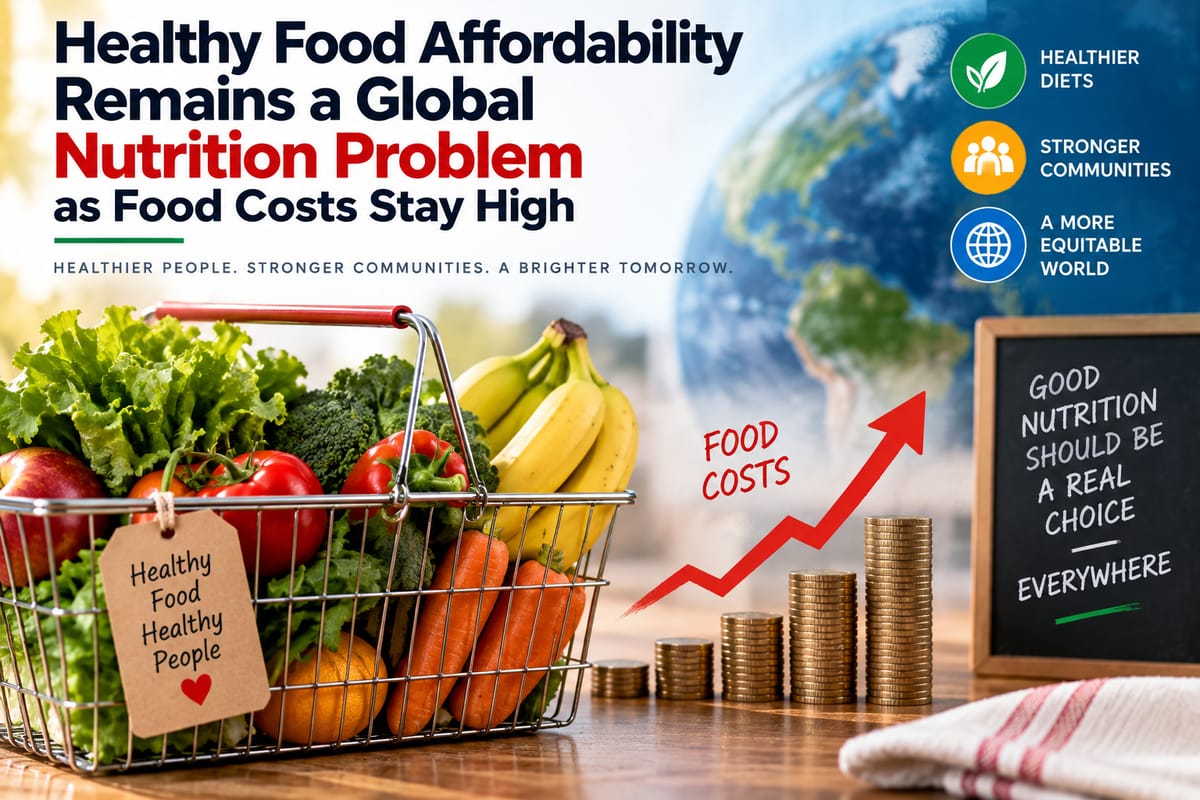

Healthy Food Affordability Remains a Global Nutrition Problem as Food Costs Stay High
The global food system produces enough food to feed the world, yet millions of households continue to struggle with a more basic question: Can they afford to eat well?
The latest global nutrition data show that the affordability of healthy food remains a major barrier to better nutrition. The 2026 State of Food Security and Nutrition in the World estimates that about 2.7 billion people worldwide cannot afford a healthy diet, even as global hunger has declined for a third consecutive year.
The problem is not simply about whether food is available. For many families, it is about the price of nutritious foods compared with household income and the cost of other necessities.
At the same time, international food commodity prices have started rising again. The FAO Food Price Index averaged 133.3 points in August 2026, up 1.9% from July and 2.5% from a year earlier. The index remains well below its record reached in March 2022, but the latest increases highlight continued pressure from weather risks, supply concerns and disruptions to global trade.
The Cost of a Healthy Diet Is More Than the Price of Calories
One of the most important distinctions in the global nutrition debate is the difference between getting enough calories and being able to afford a healthy diet.
Staple foods such as grains, roots and tubers can provide large amounts of energy at relatively low prices. But a nutritionally balanced diet also requires fruits, vegetables, legumes, nuts, seeds and animal-source foods.
According to FAO’s 2026 analysis, a healthy diet costs about $4.28 per person per day when measured using purchasing-power-parity dollars, roughly 25% more than five years earlier. The measure is based on the least expensive locally available foods needed to meet defined nutritional requirements rather than the amount a particular household actually spends.
That distinction matters because a household may technically have enough money to purchase food while still being unable to consistently afford the variety and nutritional quality associated with a healthy diet.
For consumers trying to understand the fundamentals, a Complete Guide to Healthy Eating and Balanced Nutrition can help explain why dietary variety, adequate nutrients and overall balance matter beyond simply counting calories.
Fruits and Vegetables Often Carry a Higher Price
The affordability problem becomes particularly visible when comparing inexpensive sources of calories with foods that supply a wider range of vitamins, minerals, fiber and other nutrients.
FAO’s analysis finds that starchy staples are generally among the least expensive ways to obtain calories. Fruits, vegetables and animal-source foods tend to account for a larger share of the cost of a healthy diet because they provide nutrients that cannot be obtained adequately from cheap calories alone.
This creates a difficult trade-off for households operating with limited budgets.
When food prices rise, consumers may respond by purchasing foods that provide more calories for less money. That strategy can help stretch a food budget, but it may reduce dietary diversity.
The result is a nutrition problem that cannot be solved simply by telling people to eat more nutritious foods. If healthier choices consistently cost more, household purchasing power becomes a central part of the equation.
Food Inflation Adds Another Layer of Pressure
Global food prices are influenced by much more than what happens on farms.
Weather conditions, energy costs, transportation, storage, processing, trade policies and exchange rates can all affect the final price consumers see in stores and markets.
The latest FAO Food Price Index illustrates how quickly international commodity markets can change. In August 2026, every major commodity group tracked by the index recorded an increase from the previous month, although the size of those increases varied significantly. Cereal prices reached their highest level since May 2024, while vegetable oil prices reached their highest level since June 2022.
These international benchmarks do not translate directly into identical retail prices in every country. Local transportation costs, taxes, currency movements, production conditions and market structures can make the impact very different from one place to another.
Nevertheless, prolonged food-price pressure can make it harder for households to maintain dietary quality.
Why Healthy Food Can Be Expensive
The price of nutritious food is shaped by the entire journey from producer to consumer.
Fresh produce, for example, can require careful handling, refrigeration, transportation and rapid distribution. If roads are poor or cold-storage capacity is limited, food losses can increase and the cost of getting usable products to consumers can rise.
FAO says post-farmgate activities account for a substantial part of what consumers ultimately pay. Storage, transportation, processing, market information and food-loss reduction therefore have an important role in making nutritious foods more affordable.
Energy infrastructure also matters. Refrigeration and other forms of cold-chain infrastructure can be particularly important for perishable foods.
In regions where these systems are less developed, the final cost of nutritious foods can reflect not only production expenses but also the cost of moving and preserving them.
Affordability Looks Different Around the World
There is no single global price for a healthy diet.
FAO’s 2026 analysis shows substantial regional differences. Latin America and the Caribbean recorded the highest average cost of a healthy diet in 2025, while Northern America, Europe and Oceania had the lowest overall costs among the regions examined. Landlocked developing countries also face additional transportation and logistics challenges because goods may need to cross other countries before reaching their markets.
Africa faces its own combination of challenges. Animal-source foods tend to place a relatively large burden on healthy-diet budgets, while fruits are comparatively less expensive in Africa than in other regions, according to FAO’s analysis.
These differences demonstrate why a single global solution is unlikely to solve the affordability problem.
A strategy that works for a country with strong domestic agricultural production, efficient transportation and extensive cold-storage infrastructure may not work in a landlocked or import-dependent economy.
Household Budgets Still Matter
While governments and food systems influence prices, individual households still have to make purchasing decisions within the money available to them.
Families facing higher rent, transportation costs, energy bills or medical expenses may have less money left for food. When budgets become tighter, food choices can shift toward products that are cheaper, longer-lasting or easier to prepare.
This is why Healthy Eating on a Limited Budget is closely connected to the broader affordability debate. Budget-conscious eating is not simply about finding the cheapest food available. It can involve comparing prices, reducing unnecessary waste, using affordable staple foods as a foundation and finding ways to include nutritious ingredients without overspending.
For some households, planning meals around foods that are locally available and in season can also help reduce costs.
Nutrient Density Becomes Especially Important
When money is limited, the nutritional value of each purchase becomes increasingly important.
Nutrient-dense foods provide substantial amounts of vitamins, minerals and other beneficial nutrients relative to their calories. Understanding what nutrient density means and how to choose nutrient-dense foods can help consumers think about food quality rather than relying solely on price.
However, nutrition education has limits.
Knowing which foods are nutrient-dense does not automatically make those foods affordable. A household may understand the nutritional value of fresh produce, fish, dairy products or other nutrient-rich foods while still finding them difficult to purchase regularly.
That is why affordability is fundamentally both a nutrition issue and an economic issue.
Social Life Can Also Affect Food Choices
Food is not purchased only for nutritional purposes. It is part of family life, cultural traditions, celebrations and social events.
People may eat differently when attending parties, traveling, dining with friends or participating in cultural celebrations. These situations can make maintaining dietary habits more complicated, particularly when healthier choices are more expensive or less available.
Practical strategies for maintaining healthy eating habits while enjoying social events can help people balance nutrition with the social role that food plays in everyday life.
The broader affordability problem, however, extends far beyond individual choices. It concerns whether healthy options are consistently available at prices households can realistically manage.
Why Food-System Changes Matter
FAO’s latest analysis argues that reducing the cost of healthy diets requires changes throughout the food system rather than relying exclusively on consumer behavior.
Improved roads, storage facilities, irrigation, cold chains and market infrastructure can help reduce costs and food losses. Research and development can also improve agricultural productivity and resilience.
Trade policies and competition rules can influence how efficiently food moves between producers, processors, wholesalers and retailers.
Targeted social protection can also help vulnerable households maintain access to nutritious food when prices rise or incomes fall.
The goal is not simply to produce more food. It is to make nutritious food easier and less expensive to produce, transport, store and purchase.
Food Prices Could Remain a Nutrition Issue
The latest food-price data suggest that affordability will remain an important nutrition issue even if global hunger continues to decline.
The world has made progress in reducing hunger, but hunger and healthy-diet affordability are not identical problems. A person can have access to enough calories while still lacking affordable access to the variety of foods needed for a nutritious diet.
That distinction is becoming increasingly important as governments, food producers and consumers respond to higher costs, climate-related risks and changes in global food markets.
Making healthy diets affordable will ultimately require progress at several levels: stronger food systems, more efficient supply chains, appropriate agricultural policies, targeted support for vulnerable households and practical strategies that help families make nutritious choices within their budgets.
For millions of people, the question is no longer simply whether food is available. It is whether the food that supports good health is affordable enough to make healthy eating a realistic everyday choice.
Continue Reading
Similar Posts

Bettergoods Pasta Recalled Over Listeria Risk: What Consumers Need to Know
The recall originally covered two specific lots, but consumers should now treat the broader recall as applying to the product regardless of lot number.
Read article
GLP-1 Drugs and Nutritional Deficiencies: What New Research Says About Children
The findings do not prove that GLP-1 drugs directly caused the deficiencies. The study used administrative insurance claims rather than laboratory measurements or detailed clinical records, and the researchers themselves describe nutritional deficiencies as an under-recognized concern rather than establishing a direct causal relationship.
Read article
New Micronutrient Research Could Reshape How Experts Fight Vitamin and Mineral Deficiencies
The findings could influence how governments, nutrition organizations and food producers approach one of the world's most persistent nutrition problems.
Read article

Join 10,000+ Readers Building Healthier Habits
Get actionable wellness tips every week plus our newest articles delivered straight to your inbox.