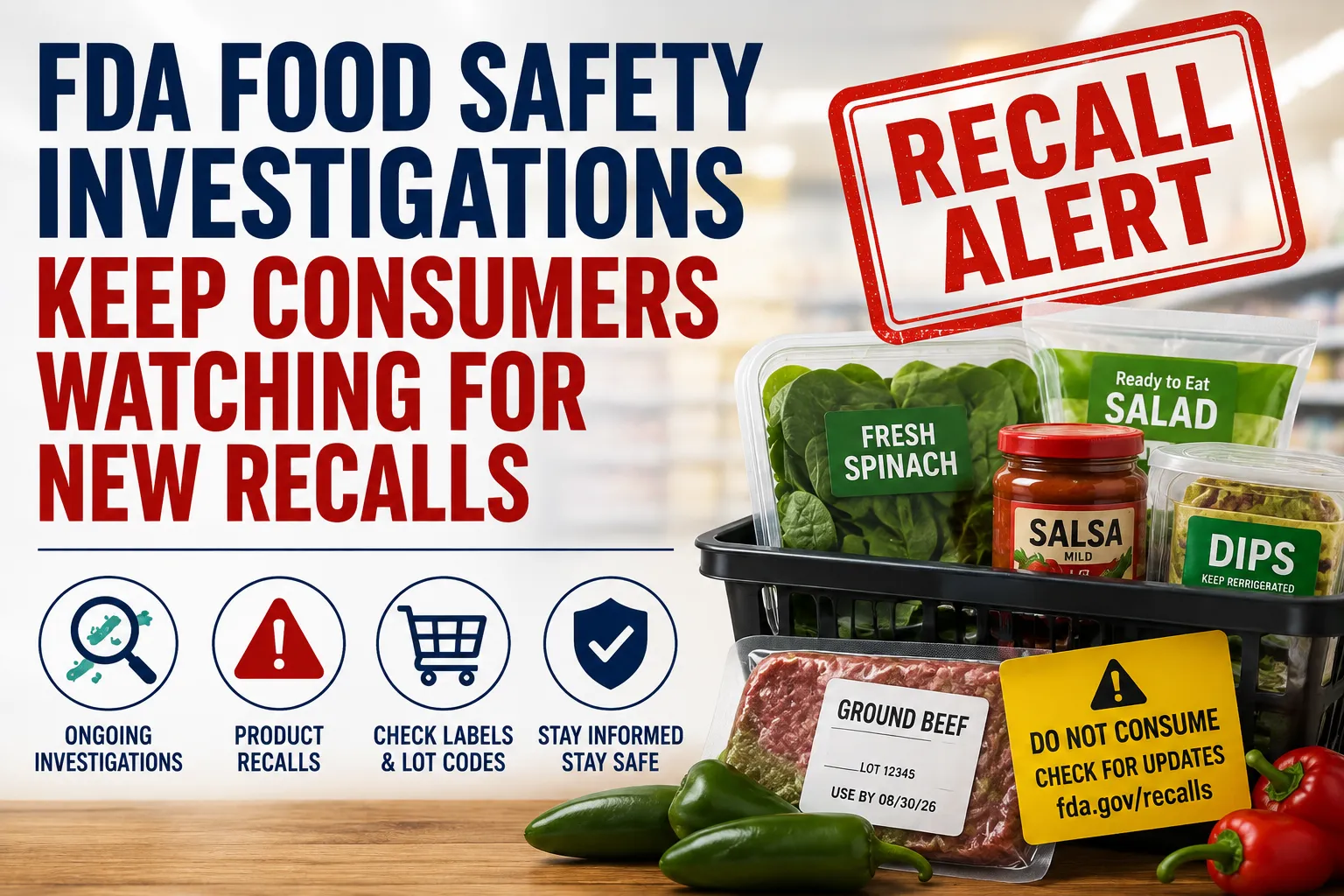

FDA Food Safety Investigations Keep Consumers Watching for New Recalls
Food safety investigations can move quickly from an initial illness report to product testing, recalls and warnings reaching stores and consumers across the country. For shoppers, that means a product sitting in a refrigerator or pantry can sometimes become the subject of a safety alert days or weeks after it was purchased.
That concern has been especially visible in August 2026, as the U.S. Food and Drug Administration continues investigating several foodborne illness events while companies issue recalls involving products ranging from fresh produce to packaged foods.
The developments highlight why consumers are being encouraged to pay attention not only to individual recall announcements but also to ongoing FDA investigations that can lead to additional products being identified.
Why FDA Food Safety Investigations Matter
The FDA works with the Centers for Disease Control and Prevention, state health departments and other agencies when foodborne illnesses are reported.
An investigation can involve several stages. Officials may interview people who became sick, compare what they ate, collect food samples, inspect facilities and trace products through the supply chain.
If investigators identify a likely source, companies may recall products that could pose a health risk.
That process can continue even after the first recall.
A contaminated ingredient, for example, may have been sold to another manufacturer that used it in salsa, prepared meals or other products. Those downstream products can then become subject to additional recalls.
That is exactly the type of situation currently playing out in an FDA investigation involving jalapeño peppers. The developments are examined in greater detail in Jalapeño Recall Expands as Salmonella Outbreak Sickens 345 People.
Jalapeño Investigation Shows How Recalls Can Expand
One of the most significant current food safety investigations involves a multistate outbreak of Salmonella Javiana linked to fresh jalapeños from Sinaloa, Mexico, distributed by Coast Citrus Distributors.
As of the FDA’s August 21 update, 431 illnesses and 57 hospitalizations had been reported across 32 states, with no deaths reported. The agency says its investigation remains ongoing.
The initial problem with the peppers has led to additional recalls involving products made with or containing the recalled jalapeños.
That illustrates an important point about modern food distribution: consumers do not necessarily encounter a recalled ingredient in the same form in which it originally entered the supply chain.
A contaminated pepper can become an ingredient in another product, creating additional points at which consumers could be exposed.
Prepared Foods Can Become Part of a Recall
When a company recalls a raw ingredient, other manufacturers and food-service businesses may need to determine whether they used that ingredient.
In the jalapeño investigation, downstream recalls have included prepared foods and other products containing the recalled peppers. FDA records show recalls involving products such as dips, salsa, guacamole and other finished foods.
This makes recall notices more complicated than simply checking whether a particular brand of fresh produce is in the refrigerator.
Consumers may need to look at the ingredients and lot information of prepared foods as well.
New Investigations Are Also Drawing Attention
The jalapeño outbreak is not the only food safety investigation currently active.
The FDA’s active investigation list includes an outbreak involving alfalfa sprouts associated with E. coli and Salmonella, as well as several investigations involving Salmonella and Cyclospora where the source has not yet been identified.
The agency recently identified alfalfa sprouts distributed by Everything Sprouts, LLC, as a source of illness in one investigation. The company subsequently recalled certain lots because they could be contaminated with Shiga toxin-producing E. coli or Salmonella.
These investigations demonstrate why food safety alerts can change over time.
A product may initially be listed as an unknown source while investigators gather evidence. Once a likely connection is established, a recall or public health advisory may follow.
Consumers can also benefit from understanding the broader precautions involved in FDA Issues New Produce Safety Guidance, particularly when fresh produce is involved in food safety investigations.
Recalls Can Involve More Than Bacteria
Food recalls are not limited to outbreaks of foodborne illness.
The FDA’s recall database also lists products affected by undeclared allergens, foreign materials and other potential hazards.
Recent August listings, for example, include products recalled because of undeclared milk, wheat or sesame, as well as products potentially contaminated with foreign materials such as metal or glass.
This matters particularly for people with food allergies.
An undeclared allergen can pose a serious risk even when the product itself is not contaminated with a pathogen.
Why Undeclared Allergens Trigger Recalls
Food manufacturers are required to provide accurate information about ingredients and allergens on labels.
If an allergen is accidentally omitted from a label, a product can become unsafe for consumers who need to avoid that ingredient.
Recent FDA recall listings include examples involving undeclared eggs, milk and wheat.
For consumers with food allergies, checking recall information can therefore be just as important as following traditional food-handling precautions.
What Consumers Should Do When a Recall Is Announced
A recall notice should not be treated as a suggestion to simply be more careful with the product.
If a specific product, lot number or expiration date is included in a recall, consumers should follow the instructions provided by the manufacturer and FDA.
Depending on the circumstances, that may mean throwing the product away or returning it to the place of purchase.
Consumers should also avoid tasting a product to determine whether it is safe. Food contaminated with bacteria or other hazards may look, smell and taste normal.
For recalls associated with an outbreak, the FDA may provide additional instructions about cleaning surfaces and preventing cross-contamination.
Checking the Product Details Is Essential
Many recalls apply only to specific products, package sizes, lot codes or date ranges.
That means consumers should not automatically assume that every product from a particular brand has been recalled.
Recall notices typically provide identifying information that allows shoppers to determine whether their specific item is affected.
Important details can include:
- Product name
- Brand
- Package size
- Lot or batch number
- UPC or product code
- Best-by or use-by date
- Distribution locations
- Recall date
Checking those details can prevent consumers from unnecessarily discarding unaffected products while ensuring that recalled items are removed from the household.
Why Food Recalls Sometimes Keep Growing
One of the reasons consumers can see multiple recall announcements connected to the same investigation is the complexity of the food supply chain.
A single ingredient can travel through several businesses before reaching a consumer.
For example:
Farm → distributor → processor → manufacturer → retailer → consumer
If an ingredient is identified as potentially contaminated, investigators may need to determine which companies received it and what products were made using it.
That can lead to a series of recalls rather than one announcement.
The FDA’s current jalapeño investigation is an example of how downstream recalls can emerge after the original ingredient is identified.
Restaurants Can Also Be Affected
Food safety investigations do not stop at supermarkets.
Restaurants, wholesalers and food-service companies can receive the same ingredients that eventually appear in retail products.
In the current jalapeño investigation, FDA and CDC information indicated that many people who became ill reported eating at Mexican-style restaurants before becoming sick. The investigation identified the implicated jalapeños as having been distributed to distributors, restaurants and food-service companies.
Restaurants that received recalled ingredients are instructed not to sell or serve affected products.
That can result in temporary menu changes or additional recalls involving prepared foods.
What Foodborne Illness Can Look Like
Symptoms depend on the contaminant involved, but foodborne illnesses can cause gastrointestinal symptoms such as diarrhea, abdominal cramps, nausea and vomiting.
In the current Salmonella investigation, the FDA says illness generally occurs 12 to 72 hours after eating contaminated food and commonly includes diarrhea, fever and abdominal cramps.
Some people are at greater risk of serious complications from foodborne infections, including young children, older adults and people with weakened immune systems.
Anyone who becomes seriously ill after a suspected food exposure should seek appropriate medical attention.
Food Safety Begins Before a Recall
Recalls are an important safety mechanism, but consumers can also reduce foodborne illness risks through everyday food-handling practices.
Basic precautions include washing hands, keeping raw foods separate from ready-to-eat foods, cooking foods to appropriate temperatures and refrigerating perishable products promptly.
Consumers should also pay attention to damaged packaging, unusual product conditions and instructions provided by food manufacturers.
These measures cannot eliminate every risk, but they can reduce opportunities for contamination.
The FDA’s Recall Database Is an Important Resource
The FDA maintains a public database of recalls, market withdrawals and safety alerts.
The database allows consumers to search for recent announcements and see why products were recalled. The agency’s current listings include food recalls involving allergens, foodborne pathogens and foreign-material contamination.
For consumers who regularly purchase products that have been subject to recalls, checking official FDA information can be more reliable than relying solely on social media posts or messages shared by friends.
Official recall notices contain the specific product information needed to determine whether an item is affected.
Investigations Can Change the Picture
One of the most important lessons from ongoing food safety investigations is that the information available today may not be the final picture.
Investigators can identify additional illnesses, discover new products linked to an outbreak or determine that a previously suspected source was not responsible.
The FDA’s active investigation page currently shows several cases where case counts have changed or additional testing and inspections are underway.
That is why consumers may see updates days after an initial recall.
A recall can be expanded, additional products can be added or a public health advisory can be updated as investigators learn more.
Staying Informed Without Becoming Alarmed
The steady flow of food safety announcements can make grocery shopping feel more complicated, but recalls are also evidence that the food safety system is identifying potential problems and communicating them to the public.
The goal is not for consumers to become suspicious of every food product they purchase.
Instead, consumers can develop a simple habit: pay attention to official safety alerts and check whether products already in the home are affected.
That approach is particularly useful when an investigation is still developing.
What the Latest Recall Activity Means for Consumers
The current wave of FDA investigations illustrates how modern food safety monitoring works.
An illness cluster can trigger an investigation. Investigators can trace a possible source. A company can issue a recall. Then additional businesses may discover that they used the same ingredient and issue their own recalls.
That chain can continue until investigators have a clearer understanding of where contamination occurred and which products may have reached consumers.
For shoppers, the most useful response is not panic but attention.
Keeping track of official recall notices, checking product details and following instructions when an affected item is identified can help households respond quickly. With several foodborne illness investigations still active, the FDA’s updates remain an important source of information for consumers who want to know what has been recalled, why it was recalled and whether something in their kitchen could be affected.
Continue Reading
Similar Posts
Broccoli Sprouts Linked to Multistate Salmonella Outbreak: What Consumers Need to Know
For consumers, the most important step is to determine whether recalled broccoli sprouts are in the refrigerator, freezer, or kitchen and to avoid eating, serving, or selling them.
Read article
Fibermaxxing Is Taking Over Social Media: How Much Fiber Is Actually Too Much
More is not automatically better. Increasing fiber too rapidly or consuming very large amounts can cause bloating, gas, abdominal discomfort, constipation, or changes in bowel habits.
Read article
Salmonella Outbreak Linked to Broccoli Sprouts: What Consumers Need to Know
For consumers, the most important issue right now is knowing what products are affected, what symptoms to watch for, and how to reduce the risk of foodborne illness.
Read article

Join 10,000+ Readers Building Healthier Habits
Get actionable wellness tips every week plus our newest articles delivered straight to your inbox.