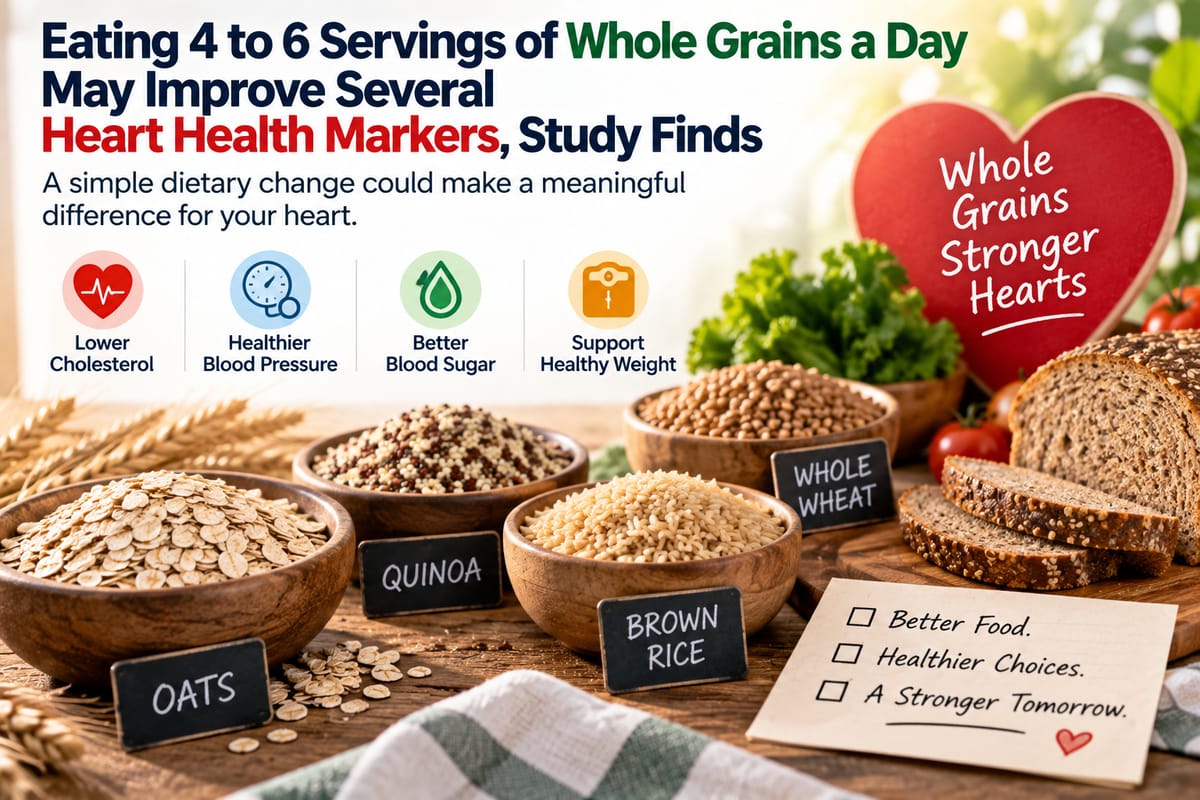

Eating 4 to 6 Servings of Whole Grains a Day May Improve Several Heart Health Markers, Study Finds
Eating more whole grains could offer measurable benefits for several factors linked to heart and metabolic health, according to a new analysis of randomized dietary trials.
Researchers who examined 87 clinical trials found that higher whole-grain consumption was associated with improvements in several cardiovascular risk markers, including cholesterol, blood pressure, blood sugar, body weight and waist circumference. The analysis suggests that the largest benefits for many of these measures were generally seen at around 60 to 100 grams of whole grains per day, equivalent to roughly four to six servings depending on how servings are measured.
The findings add to a growing body of evidence that the type of carbohydrate people eat can matter for long-term cardiometabolic health.
What the New Study Found
The study, published in the European Heart Journal in September 2026, was a systematic review and dose-response meta-analysis of randomized controlled trials. Researchers included 87 trials representing 101 publications and examined how different amounts of whole-grain consumption affected cardiovascular and metabolic risk factors in adults.
Rather than simply comparing people who ate whole grains with those who did not, the researchers also examined how outcomes changed as whole-grain intake increased.
For every additional 48 grams of whole grains consumed per day, the analysis found average reductions in several measurements. These included body weight, waist circumference, total cholesterol and the inflammatory marker interleukin-6. Moderate-certainty evidence also supported improvements in LDL cholesterol, triglycerides, fasting blood glucose and systolic blood pressure.
The researchers found that the relationship was not necessarily unlimited. For many of the outcomes studied, the strongest effects appeared around 60 to 100 grams of whole grains per day, although some outcomes showed potential benefits at higher intakes as well.
Why Whole Grains May Matter for Heart Health
Whole grains contain the three main components of the grain kernel: the bran, germ and endosperm. This distinguishes them from refined grains, which have had parts of the kernel removed during processing.
Because of this structure, whole grains can provide fiber, vitamins, minerals and other naturally occurring compounds. Foods such as oats, barley, brown rice, whole-wheat bread and whole-grain pasta can therefore contribute more than carbohydrates alone to an overall eating pattern.
Fiber is particularly relevant to cardiovascular health. Certain types of soluble fiber can influence cholesterol metabolism, while fiber-rich foods can also contribute to fullness and help support healthier overall eating patterns.
The new analysis does not establish that one single component of whole grains is responsible for all of the observed effects. Instead, the findings are consistent with the possibility that several nutritional characteristics work together.
For people looking to understand how different food groups fit into a broader dietary pattern, the Complete Guide to Healthy Eating and Balanced Nutrition provides a wider look at the role of carbohydrates, protein, fats, fruits, vegetables and other foods.
The Heart Health Markers That Changed
One of the notable findings was the reduction in LDL cholesterol, often described as “bad” cholesterol because elevated levels are associated with cardiovascular risk.
The dose-response analysis found an average LDL reduction of about 0.07 mmol/L for each additional 48 grams of whole grains per day. Total cholesterol also fell, while triglycerides showed a smaller average reduction.
Blood pressure was another area where researchers found an association. Systolic blood pressure decreased by an average of about 0.82 mmHg for each 48-gram increase in daily whole-grain intake in the dose-response analysis.
The researchers also observed modest improvements in fasting blood glucose and measures of insulin resistance. These findings are relevant because blood pressure, cholesterol, blood glucose and insulin resistance can interact as part of a broader pattern of cardiometabolic risk.
Body measurements changed as well. The analysis found reductions in body weight and waist circumference, although the size of these changes varied across outcomes and studies.
Four to Six Servings Does Not Mean Eating the Same Food All Day
The study’s estimated 60-to-100-gram range should not necessarily be interpreted as a requirement for everyone to consume a fixed number of identical servings every day.
Whole-grain foods differ considerably in their composition, portion size and preparation. The researchers themselves noted that the conversion between dry weight, fresh weight and servings depends on how whole grains are measured. Their analysis estimated that roughly 60 to 100 grams of dry-weight whole grains corresponded to approximately four to six servings in the context of the evidence reviewed.
A practical approach can be to replace some refined-grain foods with minimally processed whole-grain alternatives.
For example, someone might choose oatmeal instead of a refined breakfast cereal, brown rice instead of white rice, or whole-wheat bread instead of white bread. The goal is not necessarily to add large quantities of grain foods on top of an existing diet, but to make whole grains part of the overall dietary pattern.
Not All Whole-Grain Foods Are Nutritionally Identical
The label “whole grain” does not automatically tell the entire nutritional story.
A minimally processed food containing intact or relatively intact whole grains can be quite different from an ultra-processed product that contains whole-grain flour alongside substantial amounts of added sugar, sodium, saturated fat or other ingredients.
This distinction matters because dietary quality depends on the overall food pattern rather than a single ingredient.
The American Heart Association’s 2026 dietary guidance similarly emphasizes choosing foods made mostly with whole grains, eating plenty of fruits and vegetables, selecting healthy protein sources and unsaturated fats, and minimizing highly processed foods and added sugars.
That broader perspective is important when considering the new findings. Increasing whole grains can be useful, but it works within a diet that also needs adequate protein, healthy fats, vegetables and other nutrient-dense foods.
For example, understanding What Is Healthy Living and What Does It Include? can help put dietary changes into the context of physical activity, sleep and other parts of a healthy lifestyle.
Whole Grains May Help Without Acting Like a Standalone Treatment
The new findings are encouraging, but they do not mean whole grains can independently prevent or treat heart disease.
The analysis measured changes in risk factors rather than directly demonstrating that eating four to six servings prevents heart attacks or strokes. Researchers also noted that the certainty of evidence differed between outcomes, and data at particularly high intake levels were limited.
This distinction is important because cardiovascular disease develops through many interacting factors. Blood pressure, cholesterol, blood sugar, smoking, physical activity, body weight, genetics and other dietary factors can all contribute to overall risk.
Previous randomized trials have also produced mixed findings. For example, the older WHOLEheart randomized trial found that increasing whole-grain intake did not significantly change a range of cardiovascular risk markers over 16 weeks, illustrating why individual trials can produce different results from larger evidence syntheses.
The new meta-analysis brings together a much larger body of randomized evidence, but it still cannot turn a dietary pattern into a guarantee of an individual health outcome.
How Whole Grains Can Fit Into Everyday Meals
Increasing whole-grain intake does not necessarily require a dramatic change in the way someone eats.
Simple substitutions can make a difference. Breakfast could include oats or another whole-grain cereal. Lunch might use whole-grain bread or a grain-based salad. Dinner could include brown rice, whole-grain pasta, barley or another minimally processed grain.
Whole grains can also be combined with vegetables, legumes and sources of protein to create more balanced meals. For readers wondering about the role of protein alongside carbohydrate-rich foods, understanding [Why Does the Body Need Protein Every Day?] can help explain how protein contributes to muscle maintenance, tissue repair and other essential functions.
The broader objective is dietary balance rather than focusing exclusively on hitting a particular number.
What the Findings Mean for Heart Disease Prevention
The study provides another piece of evidence supporting whole grains as part of a heart-conscious dietary pattern.
The researchers found improvements across multiple cardiometabolic markers rather than just one measure. The effects were generally modest individually, but cardiovascular health is influenced by several risk factors simultaneously.
That makes the findings relevant to the broader principles of Heart Disease Prevention Guide, where diet is one part of a much larger prevention strategy.
For people who currently eat mostly refined grains, gradually replacing some of those foods with minimally processed whole grains may be a practical way to improve overall diet quality. At the same time, people with medical conditions, dietary restrictions or specific nutritional needs may require individualized guidance from a qualified healthcare professional or registered dietitian.
A More Practical Way to Think About the New Evidence
The main message from the research is not that everyone must eat exactly four, five or six servings of whole grains every day.
Instead, the evidence suggests that moving toward a diet containing meaningful amounts of whole grains may improve several measurable factors associated with cardiometabolic health. The strongest dose-response relationships for many outcomes appeared around 60 to 100 grams of whole grains per day, while the researchers cautioned that evidence becomes less certain at higher intake levels.
For everyday eating, that means whole grains can be viewed as one useful building block of a balanced diet. Replacing refined grains with nutritious whole-grain foods, while also maintaining a diet rich in vegetables, fruits, healthy protein sources and unsaturated fats, may offer a more sustainable approach than focusing on any single food or nutrient.
Continue Reading
Similar Posts

Bettergoods Pasta Recalled Over Listeria Risk: What Consumers Need to Know
The recall originally covered two specific lots, but consumers should now treat the broader recall as applying to the product regardless of lot number.
Read article
GLP-1 Drugs and Nutritional Deficiencies: What New Research Says About Children
The findings do not prove that GLP-1 drugs directly caused the deficiencies. The study used administrative insurance claims rather than laboratory measurements or detailed clinical records, and the researchers themselves describe nutritional deficiencies as an under-recognized concern rather than establishing a direct causal relationship.
Read article
New Micronutrient Research Could Reshape How Experts Fight Vitamin and Mineral Deficiencies
The findings could influence how governments, nutrition organizations and food producers approach one of the world's most persistent nutrition problems.
Read article

Join 10,000+ Readers Building Healthier Habits
Get actionable wellness tips every week plus our newest articles delivered straight to your inbox.