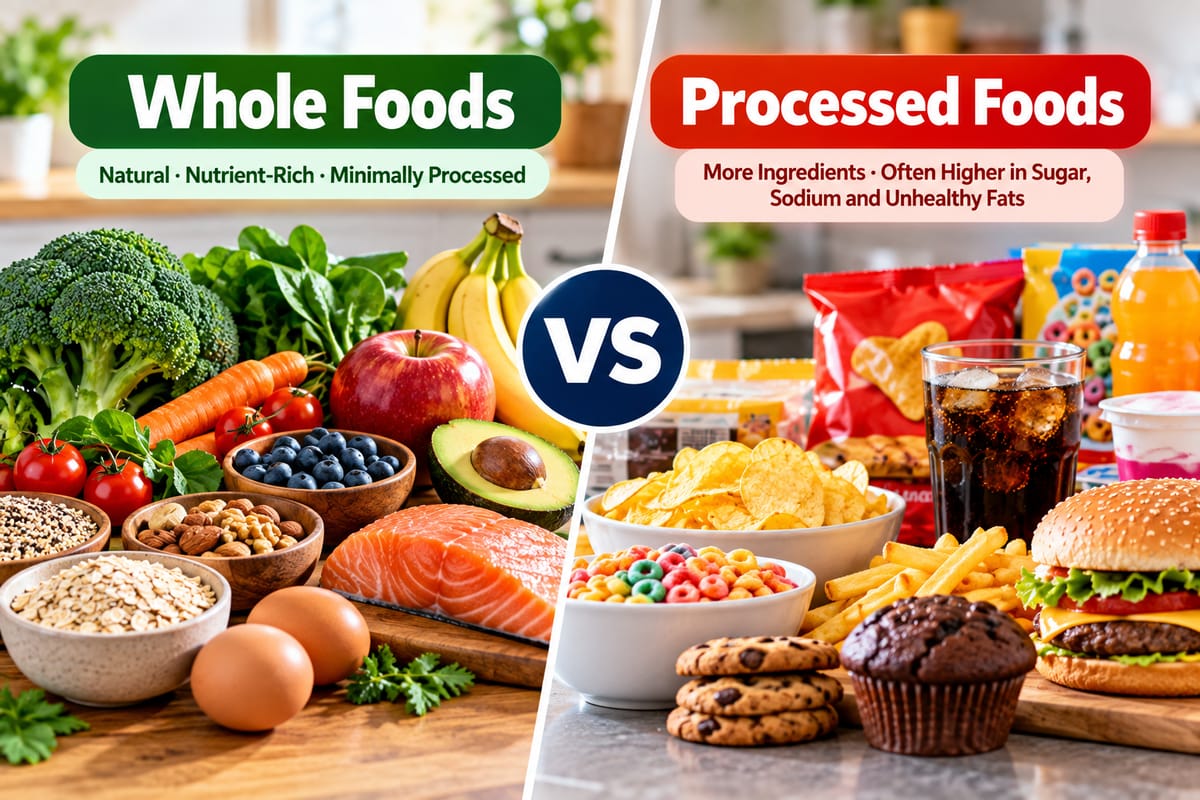

Difference Between Whole and Processed Foods
The terms whole foods and processed foods are often used as though they describe two completely separate categories. In reality, food processing exists on a spectrum. Some foods are eaten almost exactly as they occur in nature, while others are changed through cooking, grinding, drying, freezing, fermenting, canning, or more extensive industrial processing.
Understanding that difference can make everyday food choices much easier.
A frozen vegetable, for example, has been processed, but that does not automatically make it an unhealthy choice. Likewise, a packaged food can contain nutritious ingredients even though it has gone through several processing steps. The more useful question is often what happened to the food during processing, what ingredients were added, and how the final product fits into an overall eating pattern.
What Are Whole Foods?
Whole foods are foods that remain relatively close to their natural form and generally contain little or no added ingredients.
Examples include:
- Fresh fruits
- Vegetables
- Whole grains
- Beans
- Lentils
- Nuts
- Seeds
- Eggs
- Fresh fish
- Fresh meat
- Plain dairy products
Whole foods can still be cooked, chopped, frozen, dried, or otherwise prepared.
For example, steaming broccoli does not transform it into an entirely different type of food. Similarly, cooking oats or boiling beans changes their texture and digestibility without necessarily turning them into highly processed products.
What Are Processed Foods?
Processed foods are foods that have been altered from their original form in some way.
Processing can include relatively simple techniques such as:
- Washing
- Cutting
- Freezing
- Drying
- Grinding
- Pasteurizing
- Fermenting
- Cooking
- Canning
Some processed foods can be highly nutritious.
Examples include:
- Frozen vegetables
- Canned beans
- Plain yogurt
- Canned fish
- Whole-grain bread
- Unsweetened applesauce
- Pasteurized milk
- Frozen fruit
This is why describing every processed food as unhealthy is misleading.
Processing Exists on a Spectrum
Food processing is better understood as a continuum rather than a simple whole-food-versus-processed-food divide.
One end includes foods that are minimally altered.
The middle can include foods that have been processed to improve safety, convenience, storage, or preparation.
The other end includes products that may contain numerous ingredients and undergo extensive industrial processing.
This distinction is particularly important when discussing ultra-processed foods, which are a more specific category within the broader universe of processed foods.
Whole Foods and Nutrient Density
One reason whole and minimally processed foods are often emphasized in healthy eating patterns is that many provide substantial amounts of nutrients relative to their energy content.
Fruits and vegetables, for example, can provide:
- Vitamins
- Minerals
- Fiber
- Water
- Plant compounds
Beans and lentils can provide:
- Protein
- Fiber
- Minerals
- Complex carbohydrates
Nuts and seeds can provide:
- Unsaturated fats
- Protein
- Fiber
- Minerals
The concept of nutrient density is explored further in What Nutrient Density Means and How to Choose Nutrient-Dense Foods.
What Makes Some Processed Foods Different?
Processing itself is not necessarily the problem.
The nutritional characteristics of a food depend on what processing does to it and what ingredients are added.
For example, freezing vegetables can preserve them for longer while retaining many of their nutritional properties.
Canning can make beans convenient and shelf-stable.
Grinding grains can change their physical structure, while fermentation can create foods such as yogurt or certain traditional fermented products.
On the other hand, some highly formulated foods may contain combinations of refined ingredients, added sugars, sodium, fats, flavorings, and other additives.
The nutritional impact therefore depends on the specific food rather than simply whether a machine or factory was involved in producing it.
Minimally Processed Foods Can Be Convenient
Healthy eating does not require everything to be purchased fresh and prepared from scratch.
Convenient minimally processed foods can make nutritious eating more practical.
Examples include:
- Frozen vegetables
- Pre-cut vegetables
- Frozen berries
- Canned beans
- Plain canned fish
- Unsalted nuts
- Plain yogurt
- Frozen whole grains
- Dried lentils
These foods can save preparation time while still contributing valuable nutrients.
For busy households, convenience can actually make it easier to maintain a balanced eating pattern.
What Are Ultra-Processed Foods?
Ultra-processed foods are generally products made through more extensive industrial formulation and processing.
They often contain combinations of ingredients that are not commonly used in home kitchens, along with additives designed to influence characteristics such as flavor, texture, appearance, stability, or shelf life.
Examples can include some:
- Packaged snack foods
- Sugary drinks
- Confectionery products
- Instant meals
- Highly formulated breakfast products
- Processed desserts
- Packaged savory snacks
However, classification systems differ, and not every packaged food falls into the same category.
It is therefore useful to distinguish processed foods in general from ultra-processed foods specifically.
Whole Foods Can Still Contain Plenty of Calories
Whole does not automatically mean low-calorie.
Foods such as nuts, seeds, oils, avocados, and whole grains can be highly nutritious while also providing substantial amounts of energy.
Likewise, eating large quantities of a nutritious food can still contribute significant calories.
Healthy eating is therefore not simply about choosing foods labeled “whole.” Portion sizes, dietary patterns, individual nutritional needs, and overall food variety matter as well.
Processed Foods Can Also Provide Important Nutrients
Some processed foods are valuable sources of essential nutrients.
Examples include:
- Fortified cereals
- Pasteurized dairy
- Canned fish
- Frozen vegetables
- Fortified plant-based beverages
- Whole-grain breads
- Canned legumes
Fortification can also help increase the availability of particular nutrients in the diet.
This is one reason it is more useful to evaluate the nutritional characteristics of a food rather than automatically rejecting it because it comes in a package.
How Processing Can Affect Nutrients
Processing can change the nutritional composition of food in different ways.
Some nutrients may be reduced by heat, water exposure, storage, or other processing methods.
Other nutrients can become easier to absorb after certain forms of preparation.
Cooking can, for example, alter the structure of foods and influence digestibility.
Freezing can help preserve foods for long periods.
Fermentation can change the chemical and microbial characteristics of foods.
The effect therefore depends on the specific food and the processing method involved.
Fiber Is an Important Difference to Consider
Many whole or minimally processed plant foods contain substantial amounts of dietary fiber.
Fiber is found naturally in foods such as:
- Vegetables
- Fruits
- Beans
- Lentils
- Whole grains
- Nuts
- Seeds
Some forms of extensive processing can alter the physical structure of food and reduce or remove naturally occurring fiber.
However, processed foods vary considerably, and some packaged foods contain significant amounts of added or naturally occurring fiber.
Rather than assuming that all processed foods are low in fiber, check the nutrition information and ingredient list where available.
Added Sugar Can Change the Nutritional Picture
Sugar occurs naturally in foods such as fruit and milk.
Added sugars are different because they are incorporated into foods or beverages during production or preparation.
Foods containing substantial amounts of added sugar can make it easier to consume large amounts of energy without necessarily providing the same combination of fiber, protein, vitamins, and minerals found in many whole foods.
This does not mean that every food containing added sugar must be eliminated. The amount and frequency matter within the overall dietary pattern.
Sodium Is Another Consideration
Processed and packaged foods can sometimes contribute substantial amounts of sodium.
Salt and other sodium-containing ingredients are commonly used to enhance flavor, preserve foods, or support food manufacturing processes.
Foods such as canned soups, sauces, packaged snacks, processed meats, and some prepared meals can contain significant amounts.
Reading nutrition labels can help people compare products and identify lower-sodium alternatives when appropriate.
Why Protein Matters
Protein can come from both whole and processed foods.
Whole or minimally processed sources include:
- Eggs
- Fish
- Meat
- Beans
- Lentils
- Nuts
- Seeds
Processed sources can include:
- Plain yogurt
- Cheese
- Tofu
- Canned fish
- Certain fortified foods
- Some protein-rich packaged products
The presence of processing does not determine whether a food contains useful protein.
What matters is the nutritional profile of the specific product and how it fits into the overall diet.
Whole Grains Versus Refined Grains
Grain processing provides a useful example of how food structure can change.
Whole grains retain the major components of the grain kernel, including the bran, germ, and endosperm.
Refining removes some components, particularly the bran and germ, producing a different nutritional profile.
Whole-grain foods can provide more fiber and certain nutrients than comparable refined-grain products.
However, refined grains can still be part of a balanced diet, particularly when consumed alongside vegetables, legumes, protein sources, and other nutrient-rich foods.
Are Frozen Foods Healthy?
Freezing is a form of food processing, but frozen foods can absolutely be part of a healthy eating pattern.
Frozen fruits and vegetables can be especially practical because they:
- Last longer
- Reduce food waste
- Require little preparation
- Can be available outside seasonal periods
- Can provide important nutrients
The important distinction is between plain frozen foods and highly formulated frozen products.
A bag of frozen vegetables is nutritionally different from a highly processed frozen meal containing large amounts of sodium, refined ingredients, and added fats.
Are Canned Foods Healthy?
Canned foods can also be nutritious.
Canned beans, tomatoes, vegetables, and fish can provide valuable nutrients while offering long shelf lives.
For people with limited time, storage space, or access to fresh produce, canned foods can be an important part of practical meal planning.
When possible, people who are concerned about sodium can compare labels and choose lower-sodium varieties or rinse certain canned foods before eating them.
Packaged Does Not Mean Unhealthy
Packaging and processing are not the same thing.
A package can protect food from contamination, extend shelf life, provide nutritional information, and make transportation easier.
Some highly nutritious foods are routinely packaged.
Examples include:
- Plain oats
- Brown rice
- Dried beans
- Frozen vegetables
- Plain yogurt
- Unsalted nuts
- Canned fish
The better question is what is actually inside the package.
Read the Ingredient List
Ingredient lists can provide useful information about processed foods.
Ingredients are generally listed in descending order by weight.
When evaluating a packaged food, consider:
- The main ingredients
- Added sugars
- Sodium
- Type of fat
- Fiber
- Protein
- Added vitamins and minerals
- Number and type of additives
A long ingredient list does not automatically make a food unhealthy, just as a short ingredient list does not automatically make it nutritious.
The nutritional context matters.
Read the Nutrition Facts as Well
The ingredient list tells you what is in the product, while the nutrition label can help you understand quantities.
Depending on the food and labeling system, useful information may include:
- Calories
- Protein
- Carbohydrates
- Fiber
- Total fat
- Saturated fat
- Sodium
- Sugars
- Certain vitamins and minerals
Looking at both the ingredients and nutrition information can provide a more complete picture.
How Whole Foods Fit Into a Balanced Diet
Whole and minimally processed foods can form an important foundation for a balanced dietary pattern.
Meals can be built around combinations such as:
- Vegetables
- Fruits
- Whole grains
- Beans and lentils
- Nuts and seeds
- Lean proteins
- Dairy or suitable alternatives
A broader framework for combining these foods is provided in the Complete Guide to Healthy Eating and Balanced Nutrition.
The goal is not necessarily to eliminate every processed product but to create a dietary pattern that provides a broad range of nutrients.
How Ultra-Processed Foods Fit Into the Discussion
Research into ultra-processed foods has attracted considerable attention because some studies have found associations between higher consumption and various health outcomes.
However, researchers continue to investigate exactly why these associations occur and how factors such as nutritional composition, eating behavior, energy intake, and food formulation contribute.
For example, research has examined relationships between ultra-processed food consumption and body composition. The findings discussed in Ultra-Processed Foods Linked to Higher Fat Inside Thigh Muscles in New Study illustrate why this remains an active area of nutritional research.
An association observed in a study does not automatically establish that a particular food or processing method caused an outcome.
Why Diet Quality Is More Complicated Than a Food Label
A person’s diet consists of many foods eaten repeatedly over time.
Someone might eat mostly minimally processed foods while occasionally enjoying highly processed snacks. Another person might consume a mixture of packaged and fresh foods that collectively provides adequate protein, fiber, vitamins, minerals, and energy.
Diet quality therefore cannot always be determined by looking at one item.
Factors such as:
- Overall dietary pattern
- Portion sizes
- Food variety
- Nutrient intake
- Frequency of consumption
- Energy requirements
- Individual circumstances
all contribute to the bigger picture.
New Research Can Change How We Think About Healthy Eating
Nutrition science continues to evolve.
Researchers use observational studies, clinical trials, dietary assessments, metabolic measurements, and other methods to investigate how food affects health.
New findings may challenge assumptions about how individual foods or dietary patterns should be evaluated.
The ongoing nature of this research is discussed in New Research Challenges How We Judge Healthy Diets.
This does not mean established nutritional principles become irrelevant whenever a new study appears. Instead, individual findings need to be considered alongside the broader body of evidence.
Practical Ways to Eat More Whole or Minimally Processed Foods
People who want to increase whole foods do not need to completely redesign their diets overnight.
Simple changes can include:
- Add fruit to breakfast.
- Keep washed vegetables available for quick meals.
- Use beans or lentils in more dishes.
- Choose whole grains more often.
- Keep unsalted nuts or seeds available for snacks.
- Use frozen vegetables when fresh produce is inconvenient.
- Choose plain yogurt and add fruit when desired.
- Prepare simple meals in larger batches.
- Compare packaged foods using nutrition labels.
Small changes can accumulate without requiring an unrealistic level of dietary perfection.
Convenience Still Matters
A healthy diet needs to be practical enough to maintain.
Someone who works long hours, travels frequently, has limited cooking facilities, or cares for a family may not be able to prepare every meal from scratch.
Convenient foods can help bridge that gap.
Frozen vegetables, canned beans, pre-cooked grains, plain yogurt, canned fish, and other minimally processed products can make nutritious meals faster and easier.
A practical eating pattern is often more sustainable than one that depends on complicated preparation every day.
The Most Useful Distinction to Remember
The difference between whole and processed foods is not simply natural versus unnatural or healthy versus unhealthy.
Whole foods generally remain close to their original form. Processed foods have been altered in some way, but processing ranges from simple preservation and preparation to extensive industrial formulation.
A more useful approach is to look at the specific food, its nutritional composition, its ingredients, how frequently it is consumed, and how it fits into the overall diet.
Whole and minimally processed foods can provide a strong foundation for healthy eating, while selected processed foods can offer convenience, safety, affordability, and important nutrients.
The goal is not perfection. It is building an eating pattern that is varied, nutritious, practical, and sustainable over time.
Continue Reading
Similar Posts

How Meal Planning Supports Healthy Eating
Meal planning does not require complicated recipes, strict diets, or preparing every meal days in advance. It can be as simple as deciding on several meals, creating a shopping list, and making sure the kitchen has the ingredients needed to prepare balanced options.
Read article
How Dehydration Affects the Body
Understanding how dehydration affects the body can make it easier to recognize early signs, understand when fluid needs increase, and take practical steps to maintain adequate hydration.
Read article
How Heat and Climate Affect Hydration
Understanding these relationships can make it easier to adapt fluid intake to changing conditions rather than relying on the same hydration habits throughout the year.
Read article

Join 10,000+ Readers Building Healthier Habits
Get actionable wellness tips every week plus our newest articles delivered straight to your inbox.