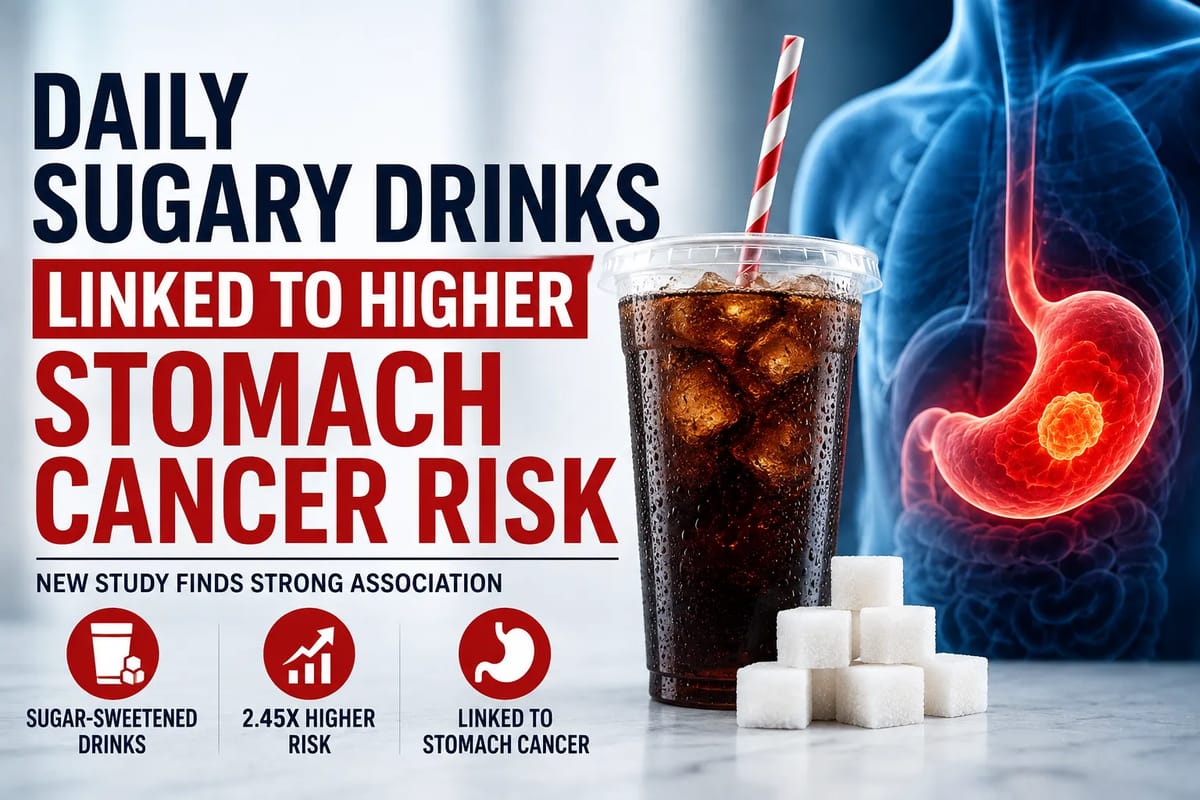

Daily Sugary Drinks Linked to Higher Stomach Cancer Risk in New Study
A new study is drawing attention to a possible connection between daily consumption of sugar-sweetened beverages and stomach cancer. Researchers analyzing long-term health data from more than 112,000 U.S. adults found that people who consumed at least one sugar-sweetened beverage per day had a substantially higher rate of gastric cancer than those who consumed these drinks less than once a month.
The findings, published in Gastro Hep Advances, add to existing research examining how dietary patterns and sugary beverages may relate to cancer risk. But the study does not prove that sugary drinks directly cause stomach cancer. Its observational design means other differences between frequent and infrequent consumers could partly explain the association. (Mirage News)
What the New Study Found
Researchers from Mass General Brigham Cancer Institute examined dietary and health information from 112,284 participants in two long-running U.S. studies: the Nurses’ Health Study and the Health Professionals Follow-Up Study.
Over the decades covered by the research, 278 participants developed gastric cancer.
After accounting for several potential risk factors, participants who reported consuming at least one sugar-sweetened beverage a day had a 2.45-times higher risk of developing gastric cancer compared with people who drank these beverages less than once a month. The association was observed in both men and women. (Mirage News)
The researchers also found an association between higher total fructose intake and greater gastric cancer incidence.
Among women in the Nurses’ Health Study, consuming more than one sugar-sweetened beverage per day was associated with roughly a threefold higher risk compared with very infrequent consumption. (Mirage News)
What Counts as a Sugary Drink?
The researchers included several types of beverages in their definition of sugar-sweetened drinks, including:
- Carbonated soft drinks
- Fruit punches
- Lemonade
- Sports drinks
- Other beverages containing added sugar
The study distinguished these beverages from artificially sweetened, low-calorie carbonated drinks.
Interestingly, higher consumption of artificially sweetened beverages was not associated with an increased incidence of gastric cancer after adjustment for other factors in this analysis. That finding does not establish that artificially sweetened beverages are healthy or cancer-protective; it simply means the study did not detect the same association. (Mirage News)
Why Stomach Cancer Is an Important Concern
Stomach cancer, also called gastric cancer, develops in the stomach and can be influenced by a variety of genetic, environmental and lifestyle factors.
The disease remains a major global health concern. Researchers behind the new study noted that gastric cancer is among the leading causes of cancer mortality worldwide, while dietary factors specific to stomach cancer have received comparatively less research than some other cancer types. (Mirage News)
Known risk factors include infection with Helicobacter pylori (H. pylori), certain dietary patterns, smoking and other factors.
That makes it particularly important to interpret a dietary association within the broader picture of stomach-cancer risk.
The Researchers Looked at H. Pylori Too
Because H. pylori infection is an established risk factor for gastric cancer, the researchers examined the relationship in a smaller subset of 940 participants for whom information about infection was available.
Just over one-third of those participants had evidence of H. pylori infection. The researchers did not find an association between sugar-sweetened beverage consumption and H. pylori infection in that analysis. (Mirage News)
However, the limited availability of H. pylori information is also one of the study’s limitations.
Does Sugar Cause Stomach Cancer?
That is not what the study proves.
The research was observational, meaning researchers analyzed patterns in people’s reported diets and subsequent health outcomes rather than assigning participants to consume particular amounts of sugary drinks.
This distinction is crucial.
An association means two things were linked statistically. It does not necessarily mean that one directly caused the other.
People who frequently consume sugary beverages may differ from infrequent consumers in many other ways, including:
- Overall dietary patterns
- Body weight
- Physical activity
- Smoking
- Alcohol consumption
- Socioeconomic factors
- Other food and beverage choices
Researchers attempted to account for a number of potential confounding factors, but observational studies cannot eliminate every possible source of bias. (Mirage News)
Why Fructose Is Being Examined
The researchers also observed an association between higher total fructose intake and gastric cancer incidence.
Fructose is a naturally occurring sugar found in fruit and is also used as part of the sweetening of many processed foods and beverages.
That distinction matters because fructose in a whole fruit is not nutritionally equivalent to drinking a sugary beverage. Whole fruit also provides fiber, water, vitamins, minerals and other compounds.
The study therefore should not be interpreted as evidence that eating fruit carries the same risk as consuming sugar-sweetened drinks.
Instead, the finding adds to questions about whether large amounts of added sugars consumed in liquid form may have particular health consequences. More research is needed to determine whether fructose itself is responsible for the observed association or whether it is a marker of broader dietary patterns.
The Findings Add to an Existing Research Picture
The new results do not appear in isolation.
Previous research has investigated associations between sugar-sweetened beverages and several cancers, although the strength and consistency of evidence vary by cancer type.
A recent review of ultra-processed foods and gastrointestinal cancers noted that sugary drinks and carbonated beverages have been investigated in relation to gastric cancer, but the available evidence has not been consistent. (DOI)
For example, a large Japanese prospective cohort study involving 74,455 adults found no overall association between sugary drink consumption and gastric cancer after adjustment for potential confounders. Researchers followed participants for an average of 16.7 years and identified 2,141 gastric cancer cases. (Nature)
That earlier finding is important because it shows why one new study should not be treated as definitive proof.
Why the New Research Still Matters
Even with its limitations, the study addresses a question for which evidence has previously been limited, particularly in U.S. populations.
The researchers used long-running prospective cohorts containing detailed information about diet and lifestyle. That allowed them to examine beverage consumption before the diagnosis of cancer rather than relying solely on people’s memories after they became ill.
The study also included both men and women, giving researchers an opportunity to examine the association across sexes. (Mirage News)
The result is therefore useful as a signal that deserves additional investigation.
Sugary Drinks Have Other Established Health Concerns
The stomach-cancer finding is only one reason nutrition experts commonly recommend limiting sugar-sweetened beverages.
Frequent consumption can substantially increase added-sugar intake without providing the same level of satiety or nutritional value associated with many whole foods.
High intake of sugary drinks has also been associated with concerns including:
- Excess calorie consumption
- Weight gain
- Obesity
- Type 2 diabetes risk
- Dental cavities
- Cardiometabolic health problems
The American Institute for Cancer Research recommends limiting sugar-sweetened drinks and choosing water or unsweetened beverages instead. It notes that frequent sugary-drink consumption can contribute to weight gain, which itself is associated with increased cancer risk. (American Institute for Cancer Research)
What About Fruit Juice?
Fruit juice requires a more careful distinction.
A glass of 100% fruit juice contains naturally occurring sugars but generally lacks much of the fiber found in whole fruit.
The new study specifically focused on sugar-sweetened beverages as defined by the researchers rather than demonstrating that eating whole fruit or drinking every type of fruit beverage carries the same gastric-cancer risk.
Previous research on sweet beverages has also produced different findings depending on whether researchers examine sugar-sweetened beverages, artificially sweetened beverages or fruit juices. (PubMed Central (PMC))
For that reason, it would be misleading to treat all sweet-tasting beverages as nutritionally identical.
What About Diet Soda?
The researchers found no significant association between artificially sweetened beverage consumption and gastric cancer incidence in their analysis.
That finding should be interpreted carefully.
The study did not establish that artificially sweetened beverages prevent stomach cancer, nor did it prove that they are risk-free.
It simply found no corresponding association with gastric cancer in the data after statistical adjustment. (Mirage News)
The broader health effects of artificial sweeteners remain a separate research question.
The Role of Weight and Overall Diet
One possible explanation for the association involves the broader metabolic effects of regularly consuming large amounts of sugary beverages.
Sugar-sweetened drinks can make it easier to consume substantial amounts of calories without feeling as full as someone might after eating an equivalent amount of energy in solid food.
Over time, excess calorie intake can contribute to weight gain.
Excess body weight is itself associated with several types of cancer, making it difficult for researchers to determine how much of an observed association is attributable to the beverage itself and how much may reflect related metabolic or lifestyle factors.
A recent European Code Against Cancer review emphasizes the importance of avoiding excess body weight and limiting sugar-sweetened beverages as part of broader cancer-prevention strategies. (FEBS Journal)
What the Study Cannot Tell Us
There are several important limitations to keep in mind.
It Cannot Establish Cause and Effect
The study identifies an association, not a proven causal relationship.
Gastric Cancer Cases Were Relatively Few
Although the overall cohort was large, only 278 participants developed gastric cancer during follow-up. That relatively small number can make statistical estimates less precise.
H. Pylori Data Were Limited
Researchers had information about H. pylori infection for only a small subset of participants, making it difficult to completely account for the role of this important risk factor.
The Participants Were Not Fully Representative of the U.S. Population
The study population was predominantly white, limiting the researchers’ ability to assess whether the association differs across racial and ethnic groups.
Dietary Information Has Limitations
Long-term dietary research often depends partly on participants accurately reporting what they consume. Eating habits can also change over time.
The researchers themselves said further studies are needed to confirm the findings and investigate potential biological mechanisms. (Mirage News)
Should People Stop Drinking Sugary Drinks?
The study does not provide a reason for panic, but it does provide another reason to reconsider frequent consumption.
Someone who drinks a sugary beverage occasionally should not interpret the findings as meaning that a single soda causes cancer.
The concern is about habitual consumption and long-term patterns.
For people who regularly consume several sugary drinks each day, reducing that intake can be a practical nutrition goal regardless of whether future research ultimately confirms a direct stomach-cancer connection.
Simple substitutions can include:
- Water
- Sparkling water without added sugar
- Unsweetened tea
- Unsweetened coffee
- Water flavored with fruit or herbs
Reducing the frequency of sugary drinks can also be easier than trying to eliminate every source of added sugar from a diet.
A Bigger Lesson About Nutrition and Cancer
The study highlights an important principle in nutrition research: individual foods and beverages rarely tell the whole story.
Cancer risk is influenced by a combination of factors, including genetics, infections, tobacco exposure, alcohol use, body weight, physical activity, environmental exposures and dietary patterns.
A healthy diet is therefore better understood as a long-term pattern rather than a list of individual “good” and “bad” foods.
Research published in European Journal of Epidemiology in 2026, for example, found associations between more plant-based dietary patterns and lower risks for several cancers, although the strength of evidence varied by cancer type. (Springer Link)
The broader evidence supports emphasizing foods such as vegetables, fruits, whole grains and legumes while limiting heavily processed foods and excess added sugars.
What Readers Should Take From the New Findings
The new study provides an important signal: daily consumption of sugar-sweetened beverages was associated with a substantially higher risk of gastric cancer in this large U.S. observational study. But the result should not be presented as proof that sugary drinks directly cause stomach cancer. (Mirage News)
For now, the practical message is relatively straightforward. Reducing sugary drinks is already consistent with established nutrition and cancer-prevention advice, and replacing them with water or other unsweetened beverages is a simple way to reduce added-sugar intake.
The more important scientific question is what future research will reveal. Studies in different populations, with better information about H. pylori, dietary patterns and other risk factors, will help determine whether the association is reproducible and whether sugary beverages themselves play a causal role in stomach-cancer development.
Continue Reading
Similar Posts

Bettergoods Pasta Recalled Over Listeria Risk: What Consumers Need to Know
The recall originally covered two specific lots, but consumers should now treat the broader recall as applying to the product regardless of lot number.
Read article
GLP-1 Drugs and Nutritional Deficiencies: What New Research Says About Children
The findings do not prove that GLP-1 drugs directly caused the deficiencies. The study used administrative insurance claims rather than laboratory measurements or detailed clinical records, and the researchers themselves describe nutritional deficiencies as an under-recognized concern rather than establishing a direct causal relationship.
Read article
New Micronutrient Research Could Reshape How Experts Fight Vitamin and Mineral Deficiencies
The findings could influence how governments, nutrition organizations and food producers approach one of the world's most persistent nutrition problems.
Read article

Join 10,000+ Readers Building Healthier Habits
Get actionable wellness tips every week plus our newest articles delivered straight to your inbox.