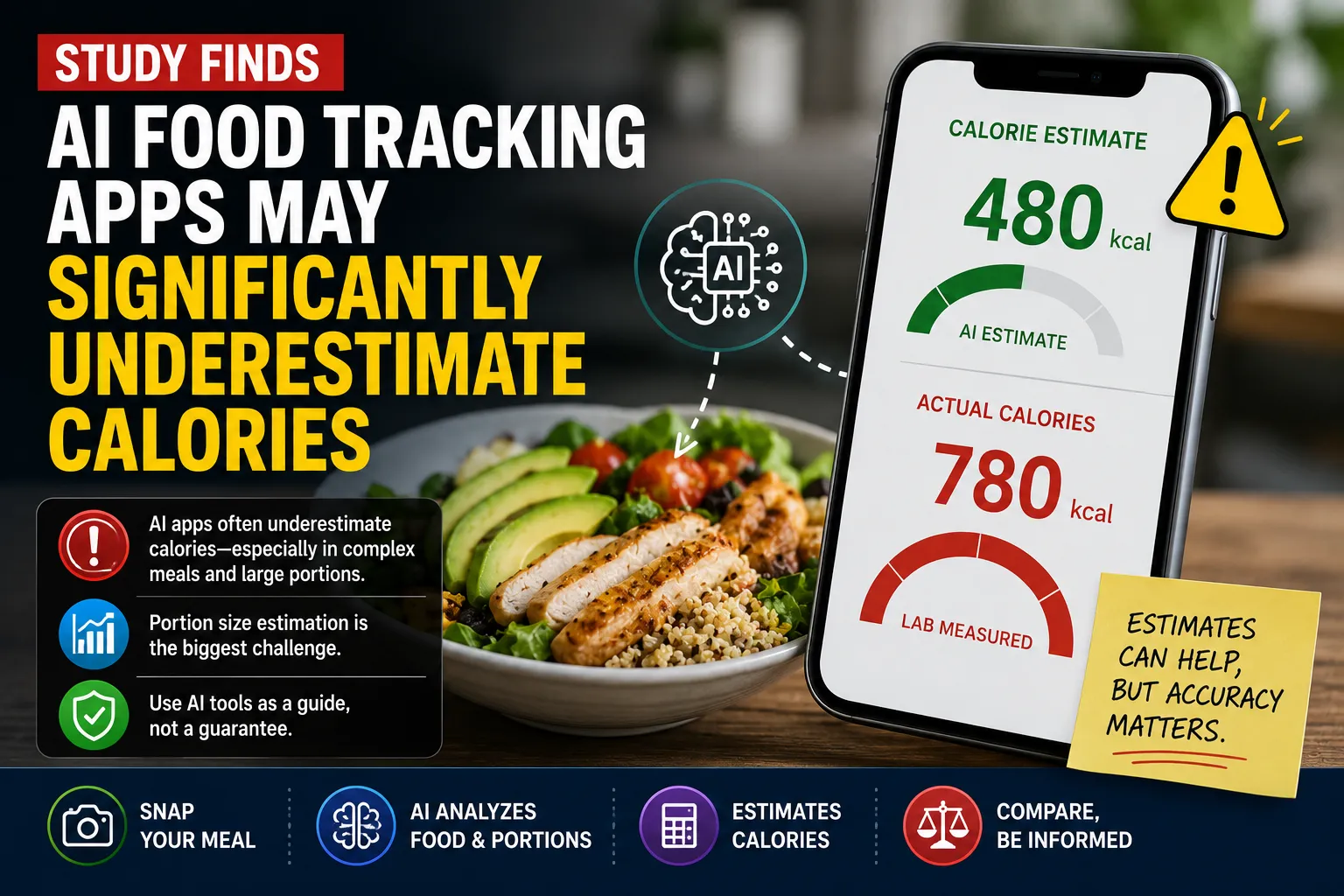

Study Finds AI Food Tracking Apps May Significantly Underestimate Calories
Artificial intelligence has rapidly transformed nutrition tracking, making it easier than ever for users to estimate calories with nothing more than a smartphone camera. However, a new study suggests that these convenient AI-powered food tracking apps may not always be as accurate as many users assume.
Researchers found that several popular AI-based nutrition apps consistently underestimated calorie content in meals, particularly those containing multiple ingredients or larger portion sizes. While the technology continues to improve, experts say consumers should understand its limitations before relying on AI estimates for health or weight management goals.
The findings highlight both the promise and the challenges of integrating artificial intelligence into everyday nutrition decisions.
For broader guidance on building a balanced eating pattern, see this complete guide to healthy eating and balanced nutrition.
AI Is Changing How People Track Food
Traditional calorie tracking often required users to manually search food databases, weigh ingredients, and enter portion sizes.
Modern AI nutrition apps simplify this process by allowing users to:
- Photograph meals
- Scan food labels
- Identify ingredients automatically
- Estimate serving sizes
- Calculate calories
- Analyze nutrients
- Generate dietary insights
These features have helped millions of people monitor eating habits with far less effort.
What the Study Found
Researchers evaluated several AI-powered food tracking applications by comparing their calorie estimates against professionally measured nutritional values.
According to the study, AI systems frequently performed well when identifying simple foods such as:
- Fruits
- Vegetables
- Packaged snacks
- Single-ingredient meals
However, accuracy declined when meals became more complex.
Foods that commonly produced underestimated calorie counts included:
- Restaurant meals
- Mixed dishes
- Pasta recipes
- Rice bowls
- Burgers
- Sandwiches
- Salads with multiple toppings
- Desserts
The largest discrepancies often involved portion size estimation rather than food recognition.
Portion Size Remains the Biggest Challenge
While AI has become increasingly capable of recognizing foods, estimating how much food is actually on a plate remains difficult.
Several factors affect calorie estimation, including:
- Camera angle
- Plate size
- Lighting
- Hidden ingredients
- Cooking methods
- Sauces and dressings
- Food stacking
- Image quality
Even small errors in estimating serving size can significantly alter total calorie calculations.
Why Accurate Calorie Tracking Matters
For many individuals, calorie tracking supports personal health goals such as:
- Weight management
- Athletic performance
- Medical nutrition therapy
- Diabetes management
- Healthy eating habits
Consistently underestimating calorie intake may make it more difficult for users to understand why expected health or weight outcomes are not being achieved.
Nutrition professionals emphasize that calorie estimates should be viewed as guides rather than exact measurements.
This broader question of how people evaluate the healthfulness of what they eat is also explored in New Research Challenges How We Judge Healthy Diets.
AI Still Offers Significant Benefits
Despite the study’s findings, researchers say AI nutrition tools continue to provide meaningful value.
Advantages include:
- Faster food logging
- Improved convenience
- Increased dietary awareness
- Better habit tracking
- Personalized insights
- Reduced manual data entry
For many users, consistently tracking eating habits—even with some estimation error—may be more beneficial than not tracking meals at all.
How AI Food Tracking Works
Most AI nutrition applications rely on a combination of technologies, including:
- Computer vision
- Machine learning
- Image recognition
- Food databases
- Nutritional analysis
- Pattern recognition
After analyzing a photo, the system attempts to identify foods, estimate quantities, and match them with nutritional information stored in large databases.
Some platforms also learn from previous user corrections, gradually improving future recommendations.
Why Restaurant Meals Are Difficult
Restaurant dishes are among the hardest meals for AI systems to evaluate accurately.
Reasons include:
- Hidden oils
- Butter
- Sauces
- Variable recipes
- Garnishes
- Portion differences
- Specialty ingredients
Unlike packaged foods with standardized nutrition labels, restaurant meals often vary from one serving to another.
Nutrition Experts Recommend a Balanced Approach
Dietitians generally encourage users to treat AI-generated calorie estimates as approximations rather than precise measurements.
Experts often recommend:
- Checking nutrition labels when available
- Measuring portions at home occasionally
- Reviewing AI suggestions before accepting them
- Focusing on long-term eating patterns instead of individual meals
- Consulting healthcare professionals for medical nutrition advice
Developing sustainable healthy habits remains more important than achieving perfect calorie accuracy.
For people using food tracking alongside weight-management strategies, nutrition needs can also become an important consideration when taking GLP-1 medications. GLP-1 Drugs and Diet explores some of those nutritional considerations in greater detail.
AI Nutrition Technology Continues Improving
Developers are actively working to improve AI food recognition systems.
Emerging innovations include:
- Better portion estimation
- 3D meal reconstruction
- Depth-sensing cameras
- Expanded food databases
- Regional cuisine recognition
- Improved restaurant meal identification
- Personalized learning models
As training data grows, future AI systems may become substantially more accurate.
Privacy Considerations
Many AI nutrition platforms process meal photographs and personal dietary information.
Users should review:
- Privacy policies
- Data sharing practices
- Account settings
- Permission requests
- Cloud storage options
Understanding how personal health information is handled helps users make informed choices.
The Future of AI in Nutrition
Artificial intelligence is expected to play an increasingly important role in digital health.
Potential future capabilities include:
- Real-time nutritional coaching
- Personalized meal recommendations
- Micronutrient analysis
- Automated grocery planning
- Integration with wearable health devices
- Predictive dietary insights
Rather than replacing nutrition professionals, AI is likely to become a complementary tool that supports healthier lifestyle decisions.
As nutrition research continues to examine the balance between individual nutrients and overall dietary quality, broader discussions about protein, fiber, and eating patterns remain important. Protein Is Popular, But Are People Eating Enough Fiber? looks at one example of that wider nutrition conversation.
Looking Ahead
AI-powered food tracking has made nutrition monitoring more accessible than ever, helping millions of people better understand their eating habits. While the latest study highlights important limitations—particularly in estimating portion sizes and complex meals—the technology continues to evolve rapidly.
For now, experts recommend using AI calorie estimates as helpful guidance rather than exact measurements. Combined with informed decision-making, balanced eating habits, and professional advice when needed, AI nutrition apps can remain valuable tools for supporting long-term health and wellness goals.
Frequently Asked Questions
Why do AI food tracking apps sometimes underestimate calories?
AI systems often struggle to estimate portion sizes accurately and may have difficulty identifying hidden ingredients, sauces, oils, or complex mixed dishes.
Are AI calorie estimates completely unreliable?
No. AI estimates can be useful for tracking general eating habits, but they should be considered approximations rather than precise nutritional measurements.
Which foods are easiest for AI to recognize?
Simple foods with clear visual characteristics, such as fruits, vegetables, and packaged products, are generally recognized more accurately than mixed meals.
Can AI replace a registered dietitian?
AI can provide helpful guidance and simplify food logging, but it does not replace personalized advice from qualified healthcare or nutrition professionals.
Will AI nutrition apps become more accurate?
Yes. Ongoing improvements in computer vision, machine learning, portion estimation, and food databases are expected to improve accuracy over time.
Key Takeaways
- A recent study found that some AI-powered food tracking apps may significantly underestimate calorie intake, particularly for complex meals.
- Portion size estimation remains one of the biggest technical challenges for AI nutrition systems.
- AI food tracking still offers valuable convenience and can encourage healthier eating habits.
- Users should treat AI calorie estimates as guides rather than exact measurements.
- Nutrition experts recommend combining AI tools with informed judgment, nutrition labels, and healthy lifestyle practices.
- Continued advances in artificial intelligence are expected to improve food recognition and nutritional accuracy in future applications.
Continue Reading
Similar Posts

Broccoli Sprouts Linked to Multistate Salmonella Outbreak: What Consumers Need to Know
For consumers, the most important step is to determine whether recalled broccoli sprouts are in the refrigerator, freezer, or kitchen and to avoid eating, serving, or selling them.
Read article
Fibermaxxing Is Taking Over Social Media: How Much Fiber Is Actually Too Much
More is not automatically better. Increasing fiber too rapidly or consuming very large amounts can cause bloating, gas, abdominal discomfort, constipation, or changes in bowel habits.
Read article
Salmonella Outbreak Linked to Broccoli Sprouts: What Consumers Need to Know
For consumers, the most important issue right now is knowing what products are affected, what symptoms to watch for, and how to reduce the risk of foodborne illness.
Read article

Join 10,000+ Readers Building Healthier Habits
Get actionable wellness tips every week plus our newest articles delivered straight to your inbox.