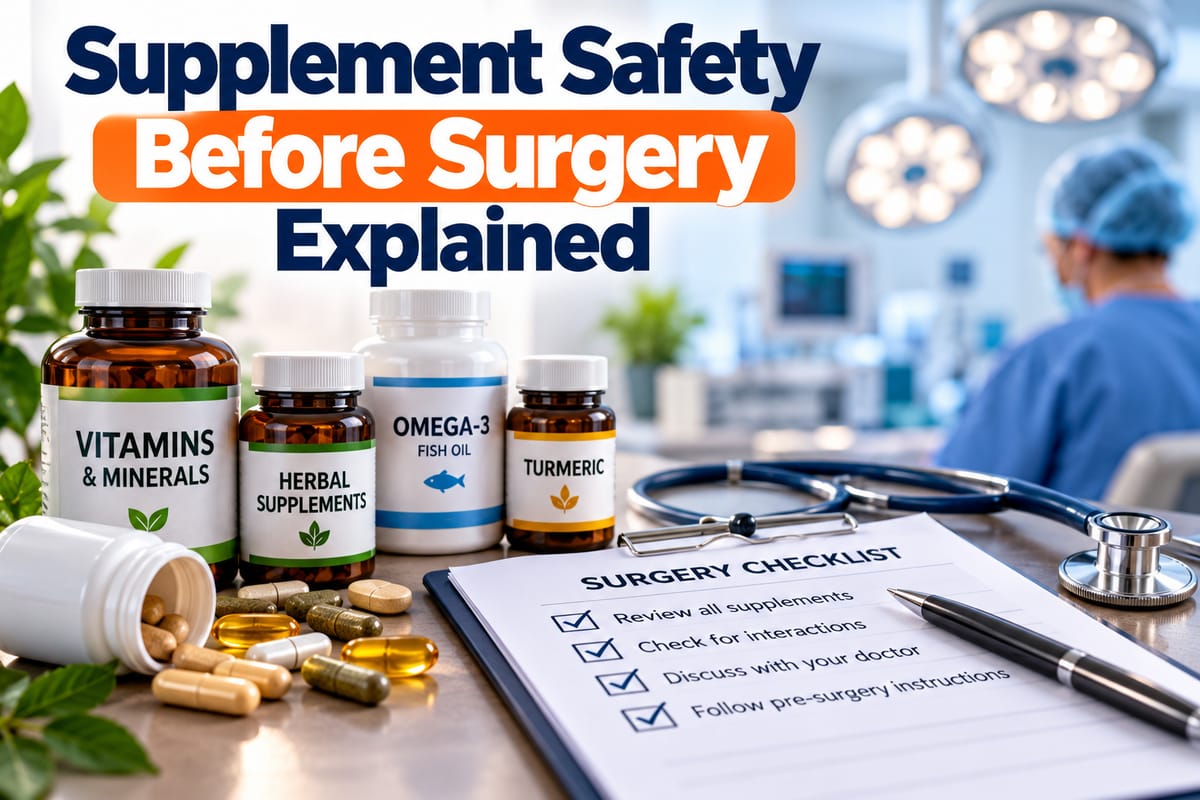

Supplement Safety Before Surgery Explained
Dietary supplements are often treated as harmless because many contain vitamins, minerals, herbs, or other naturally occurring substances. Before surgery, however, the question is not simply whether a supplement is generally safe. What matters is how that product could interact with anesthesia, medications, bleeding, blood pressure, heart function, blood sugar, or the body’s ability to recover.
Some supplements can affect how the body responds to medicines or procedures. Others may increase bleeding risk, alter blood pressure or blood sugar, or have effects that are difficult to predict because supplement products can contain multiple active ingredients.
For these reasons, supplement use should be part of the information patients provide to their surgical and anesthesia teams.
Why Supplements Matter Before Surgery
Surgery involves carefully controlled changes in the body. Anesthesia, prescription medicines, intravenous fluids, pain management, and the surgical procedure itself can all affect normal physiological processes.
A supplement that causes little noticeable effect during everyday life could become more relevant around an operation.
Potential concerns can include:
- Increased bleeding
- Changes in blood pressure
- Changes in blood sugar
- Altered heart rhythm
- Increased sedation
- Interactions with anesthetic medicines
- Changes in how prescription medicines are metabolized
- Delayed recovery in certain circumstances
- Unexpected effects when multiple products are combined
Not every supplement creates these problems, and the level of risk varies considerably between products.
The important point is that the surgical team needs to know what a patient is taking so the potential risks can be assessed.
What Counts as a Supplement?
Supplement use includes much more than a bottle labeled “vitamins.”
Products can include:
- Multivitamins
- Individual vitamins
- Minerals
- Herbal products
- Botanical extracts
- Amino acids
- Protein supplements
- Sports supplements
- Weight-management products
- Traditional or complementary remedies
- Specialty nutrition products
Some products contain numerous ingredients in a single serving.
The Complete Guide to Dietary Supplements provides broader information about the different categories of supplements and how they are used.
Patients should tell their healthcare team about all products they regularly use rather than deciding which ones are important enough to mention.
Why Herbal Supplements Deserve Attention
Herbal products can be particularly difficult to evaluate before surgery because their effects can vary according to the plant, extract, concentration, preparation, and other ingredients in the product.
Some herbal products may affect blood clotting, blood pressure, heart rate, or the central nervous system.
A product marketed as natural can therefore still have pharmacological effects.
This is one reason surgical teams should know about herbal supplements just as they need to know about prescription and over-the-counter medicines.
Supplements That May Affect Bleeding
Bleeding is one of the major concerns considered before an operation.
Some supplements may influence blood clotting or platelet activity. Depending on the procedure and the patient’s circumstances, this could be clinically important.
Examples of supplements that may require particular consideration include certain concentrated herbal products and high-dose nutrient supplements.
However, the presence of an ingredient on a general risk list does not mean that every person taking it will experience a bleeding problem.
The actual concern depends on factors such as:
- The supplement
- The dose
- How long it has been taken
- Other medications
- The type of surgery
- The patient’s health
- The expected bleeding risk of the procedure
Patients should not independently assume that a product is safe simply because it is sold without a prescription.
Supplements and Anesthesia
Anesthesia involves medicines that affect the nervous system and other bodily functions.
Some supplements may have sedating effects of their own or may influence how the body responds to sedative medicines.
This can make it important for the anesthesia team to know about supplement use before the procedure.
Potential concerns can involve:
- Excessive sedation
- Changes in blood pressure
- Changes in heart rate
- Altered responses to anesthetic medicines
- Difficulty determining the effects of multiple substances
The exact interaction depends on the product and the medications being used.
Supplements That May Affect Blood Pressure
Some supplements can influence blood pressure.
This may be particularly relevant during surgery because anesthesia and other medicines can also affect blood pressure.
A supplement that changes blood pressure could potentially add to or counteract the effects of medications used around the operation.
Patients taking supplements marketed for cardiovascular health, energy, relaxation, or other purposes should therefore disclose them before surgery.
Supplements and Blood Sugar
Blood sugar management can be important before, during, and after surgery.
Some supplements may influence blood glucose levels.
This can become more relevant when a patient is also taking diabetes medication or following instructions about fasting before an operation.
A supplement that affects blood sugar could complicate management when combined with fasting, medication, and the physiological stress associated with surgery.
Patients with diabetes or other conditions affecting blood glucose should be particularly thorough when reporting supplements.
Why Multiple Supplements Can Be a Problem
The risk of interactions can become harder to assess when someone takes several products.
For example, a person might use:
- A multivitamin
- An herbal sleep product
- A joint-health supplement
- A sports supplement
- A separate mineral product
Each product may contain several ingredients.
Some ingredients may overlap, while others may interact with prescription medicines or each other.
The Supplement Interactions resource provides additional context about why combinations of supplements and medications deserve careful consideration.
The safest approach before surgery is to provide the complete list rather than attempting to identify only the products that seem relevant.
Read the Entire Supplement Label
Patients should know exactly what is in the products they take.
A supplement label can provide information about:
- Active ingredients
- Amounts per serving
- Serving size
- Botanical ingredients
- Extract concentrations
- Proprietary blends
- Additional nutrients
- Other ingredients
Bring the actual containers to a medical appointment when practical, or provide clear photographs of the labels.
This can be more useful than relying on memory, particularly when several products are involved.
Product Quality Can Affect the Risk Assessment
Supplement products can differ in formulation, manufacturing, and quality controls.
Two products with similar names may not necessarily contain identical ingredients or concentrations.
This makes it useful to identify the specific product being used.
The How Supplement Quality and Testing Work guide explains why manufacturing and testing considerations are relevant when evaluating supplement products.
For surgery planning, accurate product information can help healthcare professionals assess potential interactions more effectively.
Do Not Hide Supplements From the Surgical Team
Some patients may mention prescription medications but forget to mention supplements.
Others may assume that doctors do not need to know about vitamins or herbal products because they are considered natural.
This can create an incomplete medication history.
Healthcare professionals need an accurate picture of substances being taken before making decisions about surgery and anesthesia.
There is no benefit to withholding supplement information because a product seems ordinary or harmless.
Should You Stop Supplements Before Surgery?
There is no single stopping schedule that applies to every supplement or every surgical procedure.
The appropriate approach can depend on:
- The specific supplement
- The dose
- The patient’s health
- Other medications
- The type of surgery
- The type of anesthesia
- The surgeon’s protocol
- The expected bleeding risk
- The timing of the procedure
Some supplements may need to be stopped before certain procedures, while others may not require discontinuation.
Patients should follow instructions from their surgical and anesthesia teams rather than creating their own stopping schedule.
Why You Should Ask Before the Day of Surgery
Waiting until the morning of surgery to mention supplement use may leave little time for the medical team to investigate potential interactions.
A better approach is to disclose supplements during the preoperative assessment.
This gives the healthcare team an opportunity to:
- Review the ingredients
- Identify potential interactions
- Determine whether a product should be stopped
- Establish when it should be stopped
- Consider whether another medication needs adjustment
- Document the supplement history
The earlier this information is available, the more opportunity the team has to make appropriate decisions.
What About Vitamins and Minerals?
Vitamins and minerals are essential nutrients, but taking a supplement does not automatically make them irrelevant to surgery.
The dose matters.
A normal dietary intake is different from a concentrated high-dose supplement.
Some vitamins and minerals can also interact with medications or affect physiological processes when consumed in substantial amounts.
Patients should therefore report individual vitamin and mineral products, particularly when taking doses significantly above ordinary nutritional requirements.
Multivitamins Should Also Be Reported
A multivitamin may seem too ordinary to mention, but it can contain many different nutrients.
A patient taking a multivitamin may also be taking individual vitamin or mineral supplements.
Reporting the complete list helps the medical team understand the total intake.
It also prevents healthcare professionals from having to guess whether a particular nutrient is being consumed through multiple products.
Sports and Performance Supplements Need Attention
Athletes and physically active people may use products designed for:
- Energy
- Muscle growth
- Recovery
- Hydration
- Endurance
- Weight management
- Performance
These products can contain multiple active ingredients, including stimulants, amino acids, plant extracts, vitamins, and minerals.
Some formulations may have effects that are particularly relevant to anesthesia, cardiovascular function, or blood pressure.
Patients should therefore report sports and performance products just like any other supplement.
Weight-Loss Supplements Can Be Especially Complex
Weight-management products may contain combinations of botanical extracts, stimulants, vitamins, minerals, and other ingredients.
The formulation can make it difficult to assess the effect of the entire product from its marketing description alone.
Anyone using a weight-loss supplement before surgery should provide the exact product information to the medical team.
Energy Products and Stimulants
Some supplements marketed for energy or alertness contain ingredients that can stimulate the nervous system or cardiovascular system.
Potential effects may include changes in heart rate or blood pressure.
Because anesthesia and surgery can also affect these systems, healthcare professionals should know about products containing stimulant ingredients.
This includes products marketed as pre-workout formulas, energy supplements, or performance boosters.
Supplements Taken for Sleep or Relaxation
Supplements used to promote relaxation or sleep can also be relevant before surgery.
Some ingredients may have sedating effects.
Combining such effects with anesthetic or pain medications could potentially change how strongly a person responds to sedating substances.
Patients should therefore disclose sleep and relaxation supplements rather than assuming they are unrelated to anesthesia.
What Happens During the Preoperative Medication Review?
Before surgery, healthcare professionals commonly review the medications and substances a patient uses.
The exact process varies by healthcare system and procedure, but the review can include:
- Prescription medicines
- Over-the-counter medicines
- Vitamins
- Minerals
- Herbal products
- Other supplements
- Allergies
- Previous reactions to medications
The purpose is to identify information that could affect the procedure or recovery.
Providing accurate information makes this review more useful.
Bring a Complete Medication and Supplement List
A simple list can make preoperative communication easier.
Include:
| Information | What to Record |
|---|---|
| Product name | Exact name on the container |
| Ingredients | Active ingredients where available |
| Dose | Amount taken |
| Frequency | How often it is used |
| Purpose | Why it is being taken |
| Start date | Approximately when regular use began |
| Other medicines | Prescription and non-prescription products |
If possible, keep the information updated rather than creating the list immediately before an appointment.
Do Not Assume a Short Break Makes a Supplement Safe
Some people may assume that stopping a supplement for a day or two automatically removes any potential risk.
That is not necessarily true.
Different substances are absorbed, metabolized, and eliminated at different rates. Some effects may also persist beyond the time a substance is detectable in the bloodstream.
The appropriate discontinuation period, if one is needed, should therefore be determined by the healthcare team.
What If Surgery Is Unexpected?
Not every operation is planned weeks in advance.
Emergency procedures may occur before there is an opportunity to discontinue a supplement according to a standard preoperative schedule.
In these circumstances, telling the medical team about current supplement use remains important.
Healthcare professionals can take the available information into account when making decisions about the procedure.
Patients should not delay necessary emergency care simply because they have taken a supplement.
What If You Already Took a Supplement Before Surgery?
If surgery is approaching and a patient realizes they have taken a supplement that may be relevant, the appropriate response is to tell the surgical or anesthesia team.
Do not assume that the operation must automatically be canceled, and do not assume that nothing matters.
The medical team can assess the specific product, dose, timing, procedure, and other circumstances.
Accurate information is more useful than speculation.
Supplements and Recovery After Surgery
Supplement considerations do not necessarily end when the operation is complete.
After surgery, patients may take pain medicines, antibiotics, anticoagulants, or other medications.
They may also experience changes in appetite, digestion, hydration, and activity.
Restarting supplements immediately without checking whether they are appropriate can therefore create a new interaction or complicate recovery.
Patients should ask when their usual supplements can safely be resumed.
Be Careful With “Natural Recovery” Products
After surgery, some people may look for supplements marketed for healing, inflammation, immunity, energy, or recovery.
The fact that a product is marketed for recovery does not automatically mean it should be taken immediately after an operation.
The body’s recovery process is affected by the surgery itself, medications, nutrition, hydration, rest, and the underlying condition.
Any new supplement introduced during recovery should be discussed with the appropriate healthcare professional, particularly when prescription medicines are involved.
Common Supplement Safety Mistakes Before Surgery
Several mistakes are easily avoidable.
Not Mentioning Supplements
Patients may list prescription medicines but leave out vitamins and herbal products.
Assuming Natural Means Safe
Natural ingredients can still have significant biological effects.
Using Multiple Products Without Checking Ingredients
Several products may contain overlapping ingredients.
Starting a New Supplement Shortly Before Surgery
Introducing a new product creates an additional variable at a time when the medical team is trying to understand the patient’s health status.
Stopping Prescription Medicines Without Advice
Concerns about supplement interactions should not lead patients to independently stop prescribed medication.
Waiting Until the Procedure Begins
Important supplement information should ideally be communicated during preoperative planning.
A Simple Pre-Surgery Supplement Checklist
Before an operation, consider preparing the following information:
- Make a complete list of every supplement you use.
- Include vitamins, minerals, herbs, sports products, and specialty formulas.
- Record the dose and frequency.
- Check the exact product labels.
- Tell the surgeon about all supplements.
- Tell the anesthesia team about all supplements.
- Mention supplements during the preoperative assessment.
- Ask which products should be stopped and when.
- Ask when discontinued products can be restarted.
- Do not make major medication changes without professional guidance.
Why Individualized Advice Matters
There is no universal supplement rule that applies to every patient.
A supplement that requires special consideration for one procedure may be less relevant for another. A person’s prescription medications, medical history, age, kidney or liver function, and other factors can also change the risk assessment.
This is why broad internet advice should not replace instructions from the medical team responsible for the procedure.
The goal of preoperative supplement review is not necessarily to eliminate every supplement. It is to identify products that could create avoidable risks and make informed decisions about their use.
Making Supplement Information Part of Surgical Planning
Supplements can be a useful part of nutrition and health management, but surgery creates a situation where their effects need to be considered alongside anesthesia, medications, and the procedure itself.
The safest approach is straightforward: tell the surgical team about everything you take, including products that seem harmless or natural.
Keeping accurate product information, checking for overlapping ingredients, and discussing supplements before surgery gives healthcare professionals the information they need to evaluate potential interactions.
For patients, this small step can make the preoperative medication review more complete and help the medical team plan appropriately for the procedure and recovery.
Continue Reading
Similar Posts

What Is Creatine and How Does It Work?
Understanding how that system works helps explain why creatine has become so closely associated with activities such as weightlifting, sprinting, and other forms of high-intensity exercise.
Read article
Why Excessive Vitamin Intake Can Be Harmful
Understanding the difference between adequate intake and excessive intake is an important part of using vitamin supplements responsibly.
Read article
How Dietary Supplements Can Cause Side Effects
Understanding why side effects happen can help people make more informed decisions about supplement use and recognize situations where professional guidance may be appropriate.
Read article

Join 10,000+ Readers Building Healthier Habits
Get actionable wellness tips every week plus our newest articles delivered straight to your inbox.