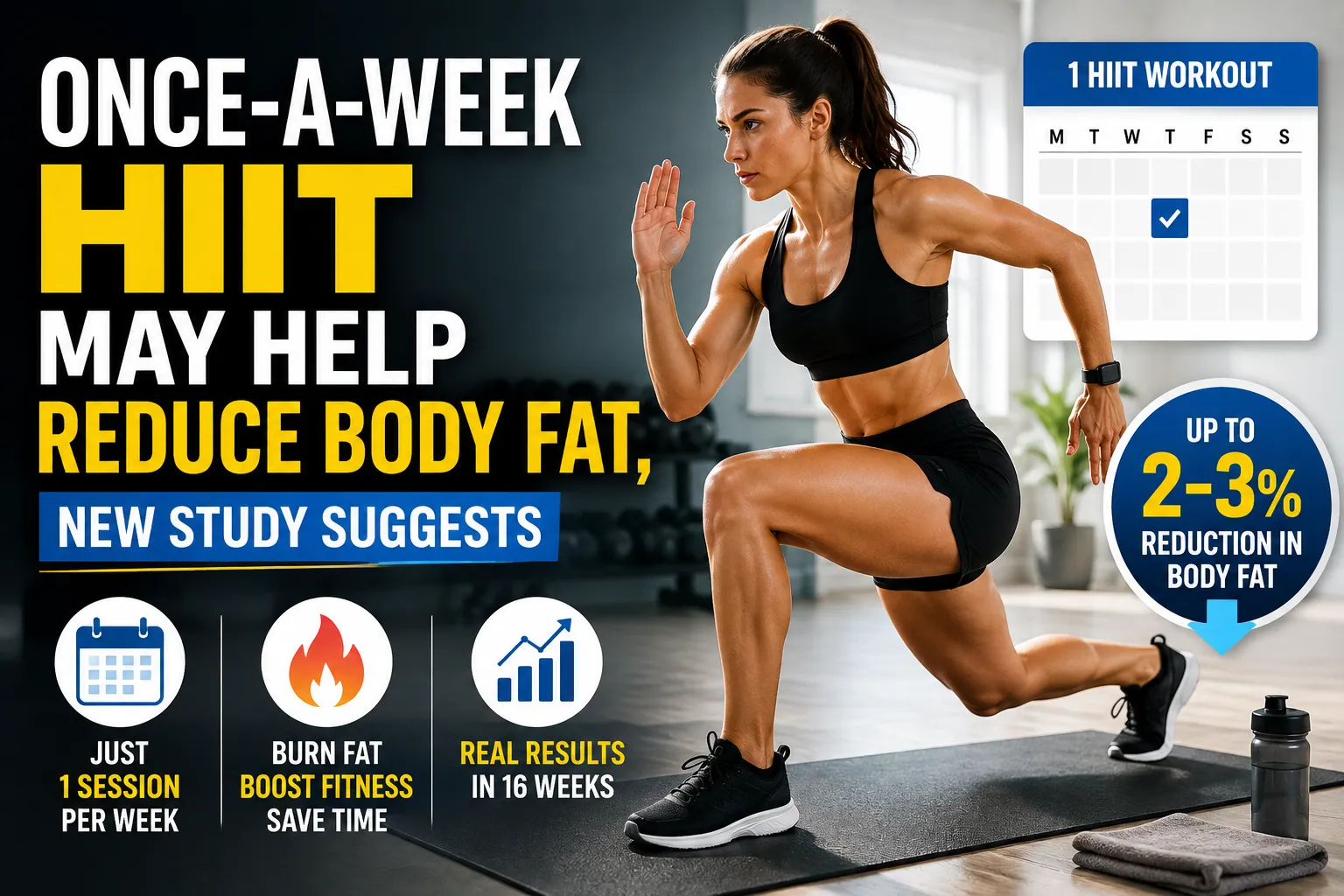

Once-a-Week HIIT May Help Reduce Body Fat, New Study Suggests
For people who struggle to fit exercise into an already crowded week, a new study offers an encouraging finding: one weekly session of high-intensity interval training (HIIT) may be enough to produce meaningful reductions in body fat for some adults with overweight and central obesity.
The randomized controlled trial, published in Nature Communications, compared once-weekly and three-times-weekly HIIT programs involving the same total amount of exercise. After 16 weeks, both groups had significantly lower total body fat mass than a control group, with no statistically significant difference between the two HIIT schedules.
The findings do not mean that everyone should exercise only once a week. Instead, they suggest that how much exercise people can realistically sustain may matter more than simply telling them to work out on several different days.
For broader context on sustainable body composition, physical activity, and lifestyle habits, see this Complete Guide to Healthy Weight Management.
What the Study Found
Researchers from the University of Hong Kong conducted a three-group randomized controlled trial involving 315 physically inactive adults with overweight and central obesity.
Participants were randomly assigned to:
- A once-weekly HIIT group
- A three-times-weekly HIIT group
- A control group that received health education
The participants had an average age of about 48 years, and roughly 65% were women. The study included adults with a BMI of at least 23 and central obesity based on waist-circumference criteria used by the researchers.
The intervention lasted 16 weeks, followed by assessments at both 16 and 32 weeks.
Importantly, the researchers gave both exercise groups the same total weekly exercise volume: 75 minutes.
The difference was how those 75 minutes were distributed.
One Long Workout vs. Three Shorter Workouts
The three-times-weekly group completed three separate HIIT sessions during the week.
The once-weekly group completed the equivalent amount of exercise in one weekly visit, but the session was divided into three 25-minute HIIT bouts, with a 15- to 30-minute break between bouts.
Each 25-minute workout included:
- Four 4-minute high-intensity intervals
- Three-minute active recovery periods between intervals
- High-intensity periods targeting approximately 85%–95% of peak heart rate
- Active recovery at approximately 50%–70% of peak heart rate
This is important because “once-a-week HIIT” in the study does not mean doing one short 10-minute workout and then being inactive for the rest of the week.
The participants completed a substantial 75 minutes of structured interval exercise in their weekly session.
For another example of research examining how a small amount of structured exercise may fit into a busy schedule, see Could One Workout a Week Be Enough?.
How Much Body Fat Did Participants Lose?
After 16 weeks, the once-weekly HIIT group experienced a relative reduction in total body fat mass of approximately 2.6%.
The three-times-weekly group experienced a reduction of approximately 3.5%.
Both reductions were statistically significant compared with the control group, while the difference between the two HIIT groups was not statistically significant.
When researchers looked at the adjusted difference in fat mass compared with the control group, the once-weekly group was down approximately 0.8 kilograms, while the three-times-weekly group was down approximately 1.0 kilogram.
In other words, exercising three times a week produced a somewhat larger numerical reduction, but the study did not find a statistically significant advantage over the once-weekly schedule for the primary outcome.
Waist Circumference Also Improved
The researchers did not look only at total body fat.
They also measured waist circumference and other indicators of body composition.
The findings suggested that both HIIT schedules produced improvements in body-fat-related measures compared with the control group. The study also reported that some reductions in waist circumference continued during the follow-up period, even after the main intervention had ended.
That is potentially relevant because abdominal fat is associated with a range of health risks.
However, waist circumference is only one measure of health and should not be interpreted as a direct measurement of visceral fat in every individual.
Fitness Improved Too
The study was not exclusively about fat loss.
Researchers also assessed cardiorespiratory fitness and found improvements among the HIIT participants.
This matters because exercise provides benefits that cannot be captured simply by looking at body weight or body-fat percentage.
Improved cardiovascular fitness can support overall physical function and health, even when changes on the bathroom scale are modest.
The study therefore adds to evidence that exercise can have meaningful health effects without necessarily producing dramatic weight loss.
Why the Findings Are Interesting
Traditional exercise advice often emphasizes spreading physical activity across several days.
That approach remains valuable.
But one of the biggest barriers to exercise is not necessarily a lack of knowledge about what people should do. It is the difficulty of fitting regular workouts around work, family responsibilities, commuting, education, and other commitments.
A person who cannot realistically exercise three times a week may simply stop exercising altogether.
The study suggests that a lower-frequency approach could provide a practical alternative for some people.
In that sense, the biggest message may not be that once-weekly exercise is superior.
It is that a manageable exercise schedule may be better than an ideal schedule that someone cannot maintain.
This broader principle also appears in research examining shorter workouts and whether they can still provide meaningful exercise benefits.
The “Weekend Warrior” Approach
The researchers describe the approach as a form of “weekend warrior” exercise.
The concept involves concentrating physical activity into fewer days rather than spreading it evenly across the week.
This idea has attracted growing interest because some people may find it easier to devote a larger block of time to exercise on a weekend than to fit shorter sessions into several workdays.
The new trial adds controlled evidence specifically examining whether weekly HIIT volume can be concentrated into one day while still producing improvements in body composition.
Does This Mean You Only Need to Exercise Once a Week?
Not necessarily.
This is perhaps the most important caveat.
The study examined a very specific exercise program in a specific population. It did not establish that one workout per week is the ideal amount of physical activity for everyone.
Current U.S. physical activity guidance recommends that adults get at least 150 minutes of moderate-intensity aerobic activity or 75 minutes of vigorous-intensity activity per week, along with muscle-strengthening activity on at least two days.
The guidelines also emphasize that some physical activity is better than none.
The new research should therefore be viewed as evidence that a concentrated 75-minute vigorous exercise schedule can have measurable benefits—not as a reason to abandon broader physical-activity recommendations.
More Exercise Can Still Offer More Benefits
The fact that once-weekly HIIT worked in this study does not mean that additional physical activity has no value.
Regular movement throughout the week can provide benefits beyond changes in body fat.
Walking, cycling, swimming, strength training, recreational sports, household activity, and other forms of movement can all contribute to a more active lifestyle.
For someone who has time for more exercise, combining HIIT with moderate-intensity activity and strength training may provide a more comprehensive approach to fitness.
That combination is particularly relevant to people interested in combining cardio and strength training for diabetes prevention.
Research on exercise for weight management also provides broader context on how physical activity can contribute to sustainable weight-management strategies.
HIIT Is Not the Same as an Ordinary Workout
High-intensity interval training involves alternating periods of vigorous effort with periods of lower-intensity recovery.
The exact format can vary considerably.
A session might involve running, cycling, rowing, brisk incline walking, or another aerobic activity.
The study’s protocol was much more demanding than simply going for a casual walk.
Participants were instructed to reach approximately 85%–95% of peak heart rate during the high-intensity intervals.
That level of effort is not appropriate for everyone, particularly people who are unaccustomed to vigorous exercise.
Who Was Studied?
Another important limitation is the study population.
The participants were physically inactive adults with overweight and central obesity, and the study was conducted in Hong Kong among ethnic Chinese adults.
That means the results should not automatically be generalized to:
- Highly trained athletes
- People with a healthy body composition
- Children
- Pregnant people
- Older adults with significant health limitations
- People with certain chronic diseases
- Individuals with different exercise backgrounds
More research would be useful to determine whether similar results occur across different populations.
What Makes HIIT Effective?
HIIT can produce substantial cardiovascular stress in relatively little exercise time.
The repeated periods of high effort require the body to work hard, while recovery intervals allow participants to continue performing additional efforts.
Researchers have proposed several mechanisms through which HIIT may influence body composition, including changes in fat oxidation, mitochondrial function, and other metabolic processes.
However, the precise biological mechanisms behind changes in body fat are complex.
Fat loss ultimately depends on the broader balance between energy intake, energy expenditure, metabolism, activity, and other individual factors.
One workout does not override an overall lifestyle.
Exercise Is Not a Substitute for Nutrition
The study focused on exercise, but nutrition remains an important component of body-composition goals.
Someone can complete a demanding workout and still consume enough calories afterward to offset the energy expenditure.
That does not make exercise pointless.
Physical activity has many benefits beyond calorie expenditure, including improvements in cardiovascular fitness and physical function.
But people seeking substantial fat loss should generally consider their overall eating habits, sleep, daily movement, and exercise rather than viewing HIIT as a standalone solution.
Why Consistency May Be More Important Than Frequency
One of the most practical lessons from the study is the importance of adherence.
An exercise program only works when people actually do it.
A theoretically perfect routine that someone repeatedly skips is unlikely to deliver meaningful results.
For a busy professional, parent, student, or business owner, one carefully planned weekly workout may be easier to maintain than three demanding sessions.
Once that habit is established, additional activity can potentially be added.
The first goal may therefore be simply to create a routine that survives a busy schedule.
Should Beginners Start With HIIT?
Not necessarily.
HIIT is demanding by design.
The CDC advises people who have been inactive, have overweight, have a disability, or have a chronic health condition to talk with a doctor before starting vigorous-intensity physical activity.
Beginners may benefit from building an aerobic base first through activities such as walking, cycling, swimming, or other manageable forms of exercise.
Intensity can then be increased gradually as fitness improves.
The goal should be challenging the body appropriately—not trying to turn the first workout into an all-out test.
A Safer Way to Approach High-Intensity Training
Anyone considering HIIT should prioritize preparation and recovery.
A sensible approach can include:
- Start with a warm-up.
- Build intensity gradually.
- Use appropriate footwear and equipment.
- Stay hydrated.
- Allow adequate recovery.
- Pay attention to unusual pain, dizziness, or other warning signs.
- Do not attempt maximum-effort intervals simply because they appear online.
A structured program supervised by a qualified exercise professional may be particularly useful for people who are new to vigorous exercise.
The Study’s Biggest Limitation
The most important limitation is that the trial was relatively specific.
It involved 315 participants, was conducted at a single center, and focused on adults with overweight and central obesity.
The intervention also lasted only 16 weeks, although participants were assessed again at 32 weeks.
The researchers found no study-related adverse events during the trial, but that does not mean HIIT is risk-free for every individual.
Larger and longer studies across different populations would help determine how broadly the findings apply.
What the Results Do—and Don’t—Prove
The study provides evidence that:
- A once-weekly HIIT schedule can reduce body fat mass in adults with overweight and central obesity.
- A three-times-weekly schedule using the same total weekly exercise volume can also reduce body fat.
- The difference between the two HIIT schedules was not statistically significant for the primary fat-mass outcome.
- Cardiorespiratory fitness also improved with the training programs.
- A concentrated weekly workout may be a practical alternative for some people who struggle with frequent exercise.
It does not prove that:
- One workout is better than three.
- Everyone can lose significant amounts of body fat by exercising once a week.
- Nutrition and other lifestyle factors do not matter.
- People should stop following general physical-activity recommendations.
- HIIT is appropriate for everyone.
Those distinctions are important when interpreting the headlines.
What This Could Mean for Busy People
For someone who currently does no structured exercise, the findings could be encouraging.
Instead of thinking:
“I don’t have time to work out three or five days a week.”
the person might ask:
“Can I consistently make time for one meaningful workout?”
That shift can make exercise feel more achievable.
Once a weekly routine becomes established, there may be opportunities to add walking, cycling, strength training, recreational activity, or shorter sessions during the rest of the week.
A Weekly Workout Can Be a Starting Point, Not the Finish Line
The new research offers a useful reminder that fitness does not have to be an all-or-nothing pursuit.
For adults with overweight and central obesity who struggle with time, a carefully structured once-weekly HIIT program produced measurable reductions in body fat over 16 weeks. The three-times-weekly group achieved a slightly larger numerical reduction, but the study found no statistically significant difference between the two exercise schedules for the primary outcome.
That makes the findings encouraging—but not a license to ignore the rest of the week.
For general health, current guidelines still encourage regular aerobic activity and muscle-strengthening exercise.
The more useful takeaway may be simpler: if one well-planned workout is what fits your life right now, it can be a meaningful place to start. From there, consistency can create the foundation for a more active lifestyle.
Continue Reading
Similar Posts

Just 3 Minutes of Intense Exercise Could Trigger Powerful Health-Related Changes, Study Finds
That does not mean three minutes of sprinting has been proven to replace a longer workout. Instead, the findings offer a closer look at why intense exercise may produce such a rapid and wide-ranging biological response.
Read article
Is Walking Enough Exercise? New Research Reopens the Fitness Debate
The study does not prove that walking faster or taking a particular number of steps prevents death. It does, however, add to a growing body of evidence suggesting that there is no single magic step count or perfect form of exercise.
Read article
Regular Exercise Linked to Lower Risk of Death in Older Adults, New Study Finds
The findings add to a growing body of evidence suggesting that staying physically active may be important not only for maintaining strength and independence in later life, but also for improving long-term health outcomes.
Read article

Join 10,000+ Readers Building Healthier Habits
Get actionable wellness tips every week plus our newest articles delivered straight to your inbox.