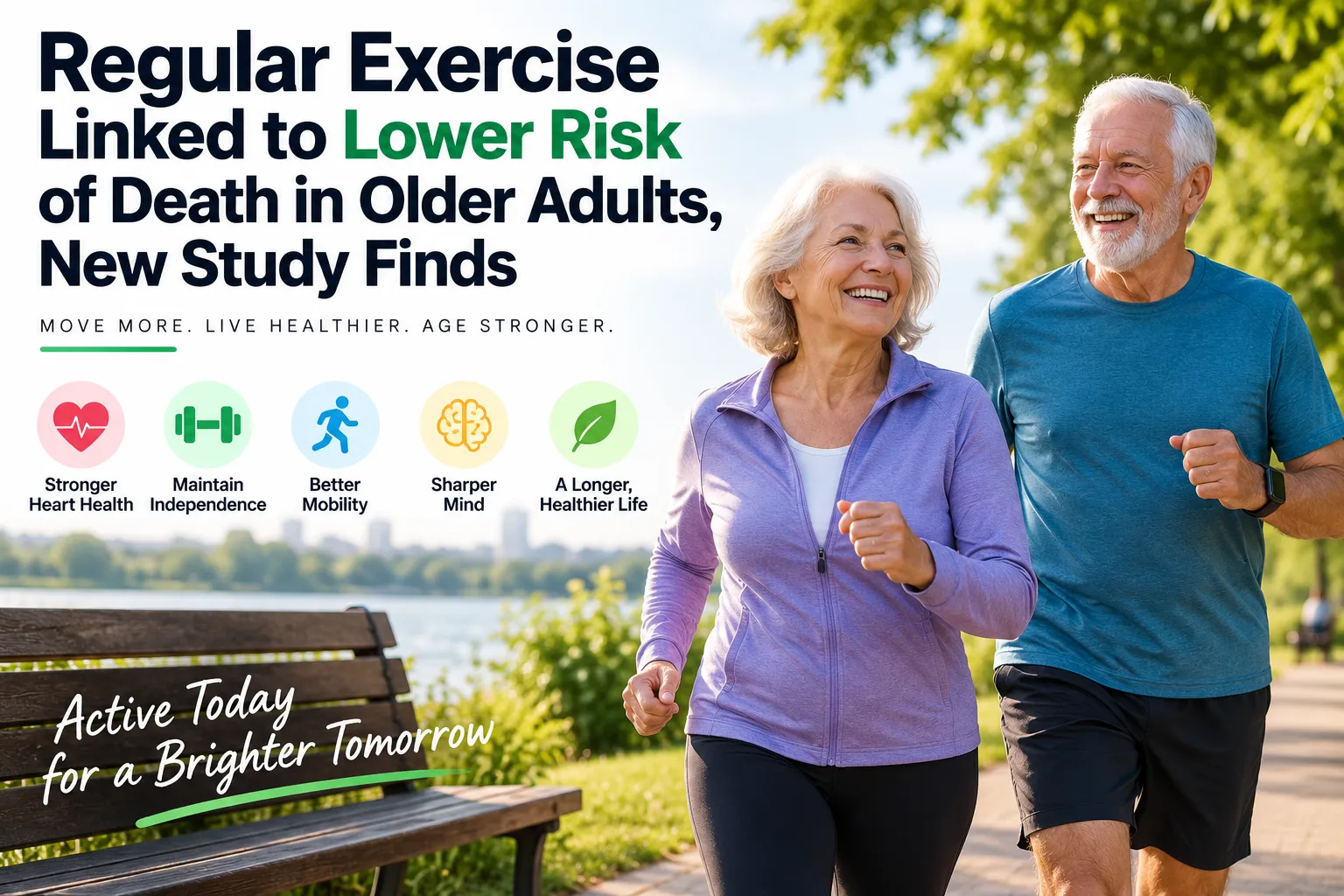

Regular Exercise Linked to Lower Risk of Death in Older Adults, New Study Finds
Regular exercise may be associated with a substantially lower risk of death among older adults, according to several new studies examining physical activity, fitness, and healthy aging.
One recent study published in JAMA Network Open followed 13,423 adults aged 65 and older and found that people with higher levels of objectively measured physical fitness had lower all-cause mortality during a median follow-up of about seven years. The strongest associations were seen for balance and agility, lower-body strength, and cardiorespiratory fitness.
The findings add to a growing body of evidence suggesting that staying physically active may be important not only for maintaining strength and independence in later life, but also for improving long-term health outcomes.
Importantly, the research does not mean exercise guarantees a longer life. It shows an association between better fitness and lower mortality risk, meaning other factors may also contribute.
Still, the message is encouraging: maintaining physical capability as people age may be one of the most practical ways to support healthier aging.
What the New Study Found
Researchers examined a nationwide cohort of older adults in Taiwan who completed standardized physical fitness assessments.
The participants had an average age of about 73 years, and researchers evaluated several different aspects of physical fitness, including:
- Balance
- Agility
- Lower-body strength
- Upper-body strength
- Cardiorespiratory fitness
- Flexibility
The researchers then linked these measurements with mortality records and followed participants for a median of approximately seven years.
During the follow-up period, 1,631 participants died, representing about 12.2% of the study population.
The researchers found that higher performance across several fitness tests was associated with lower all-cause mortality.
The strongest relationship appeared when multiple areas of fitness were considered together. Participants in the highest composite fitness group had an adjusted hazard ratio of 0.39 compared with those in the lowest group, indicating substantially lower observed mortality risk after accounting for several demographic and health-related factors.
Balance and Agility May Be Especially Important
One of the more interesting findings involved the relationship between balance, agility, and mortality.
Participants who performed best on the 8-foot up-and-go test, which evaluates mobility, balance, and agility, had an adjusted hazard ratio of 0.41 compared with those in the lowest performance group.
Balance becomes particularly important with age because maintaining stability can influence a person’s ability to move safely and remain independent.
Being able to stand, turn, walk, climb stairs, and recover from a loss of balance are everyday abilities that can become increasingly valuable as people get older.
Fitness therefore isn’t only about athletic performance.
It can also be about preserving the physical capabilities needed for ordinary life.
Strength Matters as We Age
The study also found a strong association between lower-body strength and mortality.
Researchers used a 30-second chair-stand test as one measure of physical capability. Participants with higher performance had lower observed mortality risk than those in the lowest performance group.
This is significant because lower-body strength supports many everyday activities.
Getting out of a chair, climbing stairs, walking outdoors, carrying groceries, and maintaining balance all require some combination of strength and coordination.
As muscle mass and strength naturally tend to decline with age, maintaining those capabilities can become increasingly important.
Strength training does not necessarily have to mean lifting extremely heavy weights.
Depending on an individual’s health and fitness level, activities such as:
- Bodyweight exercises
- Resistance bands
- Light weights
- Supported squats
- Chair stands
- Step-ups
- Functional strength exercises
may all have a role in an appropriate exercise program.
Cardiorespiratory Fitness Also Showed a Strong Association
The study measured cardiorespiratory fitness using a two-minute step test.
Participants with better performance had lower observed mortality risk than those with the lowest performance.
Cardiorespiratory fitness reflects the body’s ability to deliver and use oxygen during physical activity.
Walking, cycling, swimming, dancing, and other aerobic activities can help maintain this aspect of fitness.
The findings reinforce the idea that healthy aging involves more than preserving muscle strength alone.
A well-rounded approach should also support the heart, lungs, balance, mobility, and endurance.
Exercise Does Not Have to Mean Intense Workouts
One of the most useful messages emerging from recent research is that physical activity exists on a spectrum.
Exercise does not have to mean running marathons or spending hours in a gym.
For many older adults, useful forms of movement can include:
- Walking
- Gardening
- Swimming
- Cycling
- Dancing
- Household activities
- Resistance exercises
- Mobility exercises
- Balance exercises
- Recreational sports
The most appropriate activity depends on a person’s health, mobility, preferences, and current fitness level.
A sustainable routine that someone can maintain for years may be more valuable than an extremely demanding program that lasts only a few weeks.
For a broader explanation of how different forms of movement fit together, The Complete Guide to Physical Activity and Exercise provides a useful starting point.
Even Small Amounts of Activity May Matter
Another 2026 study examined physical activity and mortality among 594,285 U.S. adults using National Health Interview Survey data linked with mortality records.
The researchers found that even relatively low levels of physical activity were associated with lower all-cause mortality, with the largest benefit appearing when people moved from no activity to some activity.
That finding has an important practical implication.
Someone who is currently inactive does not necessarily need to begin with an ambitious exercise program.
Starting with manageable movement may be a more realistic first step.
A short daily walk, several minutes of gentle mobility work, or a few basic strength exercises may be easier to maintain than immediately attempting an intense workout schedule.
The 10,000-Step Goal Isn’t the Whole Story
Walking is one of the simplest ways to increase physical activity, but the popular idea that everyone needs exactly 10,000 steps per day can make exercise seem more rigid than it needs to be.
The relationship between movement and health is more complicated than a single step target.
People differ in age, fitness, mobility, health conditions, occupation, and daily routines.
For a closer examination of the evidence surrounding step counts, Do You Really Need 10,000 Steps a Day? What the Evidence Actually Says explores why the number should not necessarily be treated as a universal requirement.
The broader lesson is that meaningful physical activity can take many forms.
Sitting Less May Also Be Important
Exercise is only one part of the movement equation.
Older adults can spend substantial amounts of the day sitting, particularly when watching television, using computers, reading, or resting.
Research published in 2026 using data from more than 330,000 older adults in China and the United Kingdom found that greater sedentary time was associated with higher all-cause mortality, while replacing sedentary time with physical activity of different intensities was associated with lower mortality.
This suggests that healthy movement patterns may involve both adding physical activity and reducing prolonged inactivity.
Standing up periodically, walking around the house, doing household tasks, gardening, or taking short walks throughout the day can all break up extended periods of sitting.
Exercise Supports More Than Longevity
The mortality findings are important, but lifespan is only one reason to remain active.
Regular physical activity can also help older adults maintain:
- Muscle strength
- Balance
- Mobility
- Cardiovascular fitness
- Physical independence
- Confidence in movement
- Functional capacity
These benefits can influence quality of life even when longevity is not the immediate concern.
For example, maintaining enough leg strength to climb stairs independently may be more meaningful to someone than achieving a particular fitness score.
Likewise, being able to walk to a nearby store, play with grandchildren, work in a garden, or travel comfortably can represent important measures of healthy aging.
Physical Activity and Independence
One of the biggest challenges associated with aging is the gradual loss of physical independence.
Simple daily tasks can become more difficult when strength, balance, flexibility, or endurance declines.
Regular physical activity may help preserve the physical reserve needed to perform those tasks.
This is one reason researchers increasingly look at functional fitness rather than focusing only on traditional measures such as body weight.
A person can have a healthy weight and still have poor balance or limited strength.
Conversely, someone may not fit a conventional idea of athletic fitness but still maintain excellent functional capabilities.
The ability to move effectively matters.
Healthy Aging Requires More Than Exercise
Exercise is important, but it should be considered part of a larger healthy-aging strategy.
Other factors include:
- Adequate sleep
- Nutritious food
- Social connection
- Stress management
- Preventive healthcare
- Avoiding tobacco
- Moderate or limited alcohol consumption
- Maintaining cognitive and social engagement
- Managing chronic health conditions
This broader approach is why How Healthy Habits Support Healthy Aging is an important companion topic.
Exercise works best as part of a lifestyle rather than as an isolated activity.
Recovery Becomes Important Too
More exercise is not necessarily better.
Older adults, particularly those who are new to exercise or managing existing health issues, may need appropriate recovery between demanding activities.
Recovery gives the body time to adapt.
It can involve:
- Rest days
- Adequate sleep
- Hydration
- Appropriate nutrition
- Gentle movement
- Gradual progression
- Adjusting activity when pain or excessive fatigue occurs
Understanding how rest and recovery support healthy physical activity can help people create routines that are sustainable rather than overly demanding.
Why the Study Does Not Prove Exercise Prevents Death
The headline association is encouraging, but it is important to interpret the research carefully.
The JAMA study was an observational cohort study.
Researchers measured participants’ fitness and then examined how those measurements related to subsequent mortality.
This type of research can identify associations, but it cannot establish with certainty that exercise itself caused the lower mortality risk.
There may be factors that influence both fitness and longevity.
For example, people with better physical fitness may also differ in:
- Overall health
- Diet
- Healthcare access
- Socioeconomic circumstances
- Smoking habits
- Social support
- Existing medical conditions
- Other lifestyle behaviors
The researchers adjusted for several potential confounding factors, and the associations remained strong, but observational research cannot eliminate every possible source of bias.
That distinction matters when interpreting headlines about exercise and lifespan.
Fitness May Reflect Overall Physiological Reserve
One interesting way to interpret the findings is through the concept of physiological reserve.
As people age, the body’s ability to respond to challenges can decline.
A person with stronger muscles, better balance, and greater cardiovascular capacity may have more physical reserve when facing illness, injury, hospitalization, or other stressors.
Fitness measurements may therefore provide information about how well someone can handle challenges beyond ordinary daily activity.
The researchers suggested that objective fitness assessments could potentially complement traditional medical assessments when evaluating health risks in older adults.
Starting Later Can Still Be Worthwhile
People sometimes assume that exercise only matters if they have been active throughout their lives.
That can discourage older adults who have spent years being sedentary.
But physical capacity is not completely fixed.
Even when age-related changes occur, appropriate physical activity can help maintain or improve strength, mobility, endurance, and balance.
Someone who has been inactive should not necessarily attempt to replicate the exercise routine of a highly trained person.
A better approach is usually gradual.
That might begin with:
- Short walks
- Gentle mobility exercises
- Basic balance work
- Light resistance exercises
- Gradually increasing duration or intensity
The goal is to create a routine that can be repeated consistently.
Safety Should Come Before Intensity
Older adults should consider individual health circumstances before beginning or significantly changing an exercise program.
People with conditions affecting the heart, lungs, joints, balance, or other aspects of health may benefit from discussing appropriate activity with a qualified healthcare professional.
Exercise should also be progressed gradually.
Warning signs such as unusual chest pain, severe shortness of breath, fainting, or other concerning symptoms warrant medical attention rather than being treated as normal signs of a challenging workout.
The objective is not to exercise as hard as possible.
It is to remain active safely and consistently.
What This Means for Everyday Fitness
The latest evidence adds another reason to view exercise as a long-term health habit rather than a temporary fitness project.
The most useful routine may be one that combines several forms of movement:
Aerobic Activity
Walking, cycling, swimming, dancing, and similar activities can support cardiovascular fitness.
Strength Training
Resistance exercises can help maintain muscle strength and functional capacity.
Balance Work
Balance exercises can support stability and mobility.
Mobility and Flexibility
Gentle mobility work can help people maintain comfortable movement through everyday activities.
General Movement
Walking around throughout the day and reducing long periods of sitting can complement structured exercise.
Together, these activities create a more complete approach to physical fitness.
The Bigger Message From the Research
The latest findings do not suggest that older adults need to become athletes.
They point toward something much more practical.
Maintaining the ability to move well may be one of the most important investments people can make in healthy aging.
In the JAMA study, better performance in balance and agility, lower-body strength, and cardiorespiratory fitness was consistently associated with lower all-cause mortality among older adults.
Other recent research similarly suggests that even relatively modest amounts of physical activity can be associated with meaningful health benefits.
That makes the message particularly relevant for people who are not currently active.
The goal does not have to be perfection.
It can simply be to move more, build strength, protect balance, maintain endurance, and make physical activity a sustainable part of everyday life.
As people grow older, those capabilities can become about much more than fitness. They can help preserve independence, support quality of life, and give the body greater capacity to handle the challenges that come with aging.
Continue Reading
Similar Posts
Just 3 Minutes of Intense Exercise Could Trigger Powerful Health-Related Changes, Study Finds
That does not mean three minutes of sprinting has been proven to replace a longer workout. Instead, the findings offer a closer look at why intense exercise may produce such a rapid and wide-ranging biological response.
Read article
Is Walking Enough Exercise? New Research Reopens the Fitness Debate
The study does not prove that walking faster or taking a particular number of steps prevents death. It does, however, add to a growing body of evidence suggesting that there is no single magic step count or perfect form of exercise.
Read article
World Fitness Project Grand Park Pro Begins With Top Athletes Competing for Finals Spots
Unlike a standalone fitness competition, Grand Park Pro is part of a season-long points race. Athletes are competing not only for the weekend title and prize money but also to strengthen their position in the standings and secure a place at the Finals.
Read article

Join 10,000+ Readers Building Healthier Habits
Get actionable wellness tips every week plus our newest articles delivered straight to your inbox.