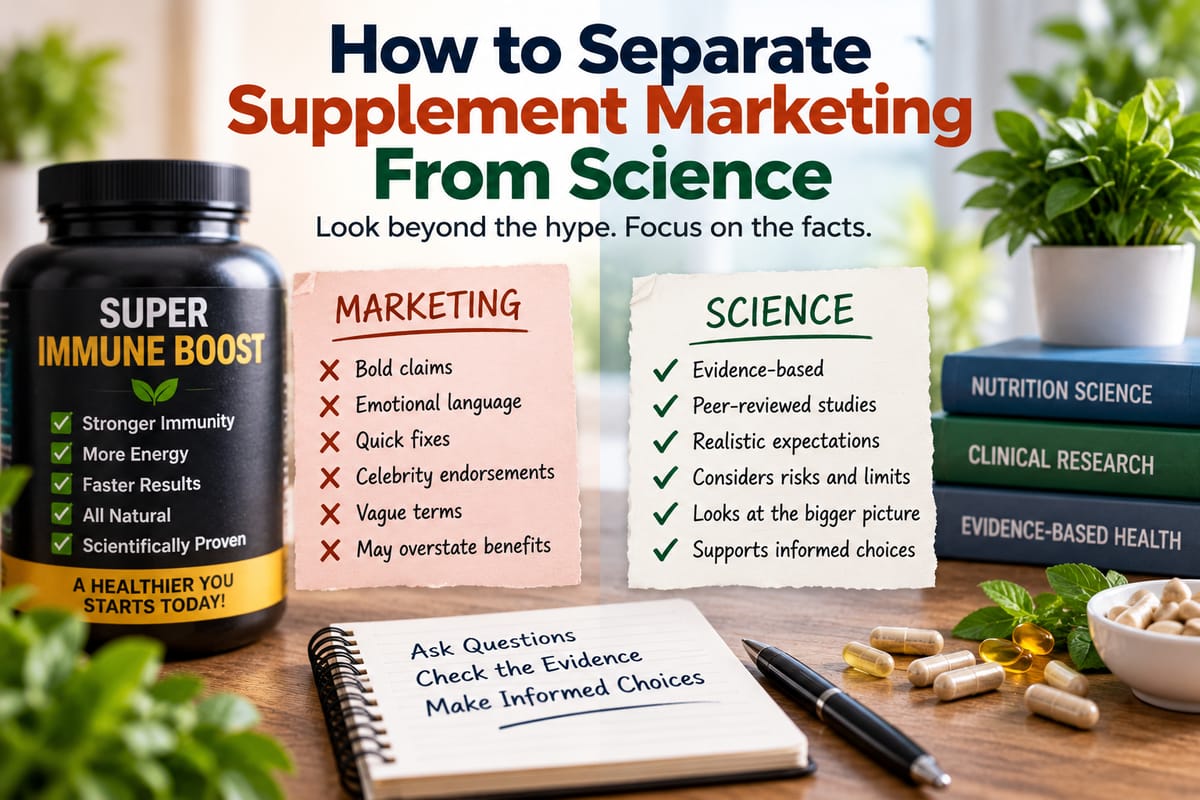

How to Separate Supplement Marketing From Science
Dietary supplements are surrounded by bold promises. A product may be described as supporting immunity, improving energy, promoting better sleep, enhancing athletic performance, or helping maintain overall wellness. Some of these claims may have scientific evidence behind them, while others can be based on limited research, exaggerated interpretations, or marketing language.
For consumers, the challenge is figuring out where the science ends and the advertising begins.
Separating supplement marketing from science does not require a scientific degree. It requires knowing what to look for, understanding how research works, reading labels carefully, and recognizing the difference between evidence and persuasive language.
A thoughtful approach can help people evaluate supplements based on what is actually known rather than what a product advertisement suggests.
What Is Supplement Marketing?
Supplement marketing includes the messages companies use to attract attention to their products and encourage purchases.
Marketing can appear in many forms, including:
- Product packaging
- Advertisements
- Social media posts
- Influencer promotions
- Company websites
- Email campaigns
- Customer testimonials
- Promotional articles
- Videos
- Retailer descriptions
Marketing itself is not necessarily misleading. Businesses need to explain what their products are and why consumers might consider them.
The problem occurs when promotional language creates an impression that goes beyond what scientific evidence supports.
For example, a statement such as “contains vitamin C” is a straightforward description. A statement suggesting that a supplement will produce a dramatic health transformation is a much stronger claim that requires considerably more evidence.
Why Supplement Claims Can Be Difficult to Evaluate
Scientific evidence exists on a spectrum.
Some nutrients and dietary ingredients have been extensively studied, while others have only a small number of studies. Research may also produce mixed results.
A single study rarely provides a complete answer.
Research can differ in:
- Number of participants
- Study duration
- Dosage
- Form of the ingredient
- Participant characteristics
- Study design
- Outcomes measured
- Quality of methodology
This means that consumers should be cautious when an advertisement highlights one positive study without explaining the broader evidence.
Understanding this distinction is an important part of using the Complete Guide to Dietary Supplements as a foundation for making sense of supplement categories, ingredients, and common uses.
Start With the Exact Claim
One of the easiest ways to separate marketing from science is to identify exactly what a product is claiming to do.
Consider the difference between these statements:
- “Contains magnesium.”
- “Provides magnesium to support normal body functions.”
- “Helps support relaxation.”
- “Reduces stress dramatically.”
- “Eliminates anxiety.”
These statements make increasingly stronger claims.
The stronger the claim, the more important it becomes to ask whether there is credible evidence supporting that specific outcome.
A product containing an ingredient that has been studied does not automatically prove that the finished product produces every benefit mentioned in its advertising.
Look for Evidence Behind the Ingredient
When evaluating a supplement, identify the specific ingredient that supposedly produces the benefit.
Then ask:
Has this ingredient actually been studied for the claimed purpose?
This question is more useful than simply asking whether the ingredient has “scientific studies.”
A nutrient can have hundreds of studies related to one function while having little evidence for a completely different claim.
For example, evidence concerning a nutrient’s role in normal physiological processes does not automatically establish that taking extra amounts improves a particular condition in healthy people.
The important question is whether the research matches the claim being made.
Understand the Difference Between Association and Cause
One common problem in health marketing is confusing association with causation.
Suppose researchers observe that people who consume more of a particular nutrient tend to have a certain health characteristic.
That observation does not automatically prove that consuming more of the nutrient caused the characteristic.
Other factors may explain the association.
People who consume more of one nutrient might also:
- Eat more fruits and vegetables
- Exercise more frequently
- Have different socioeconomic circumstances
- Smoke less
- Sleep differently
- Receive more preventive healthcare
Observational research can provide valuable information, but it does not always establish cause and effect.
Pay Attention to Study Design
Not all studies provide the same level of evidence.
A laboratory experiment, animal study, observational study, and randomized controlled trial can answer different questions.
For many questions about whether a supplement produces a particular effect in humans, randomized controlled trials can provide especially useful evidence because researchers can compare groups under controlled conditions.
However, even randomized trials have limitations.
A study may be:
- Very small
- Too short
- Conducted in a narrow population
- Using a particular formulation
- Measuring an indirect outcome
- Producing results that have not been independently replicated
The quality and relevance of the evidence matter as much as the existence of a study.
Don’t Treat a Single Study as Proof
A supplement advertisement may prominently mention a scientific study.
That can sound convincing, but one study does not necessarily settle a scientific question.
Researchers look at the broader body of evidence.
They consider whether findings have been:
- Repeated
- Independently investigated
- Consistent across studies
- Tested in appropriate populations
- Supported by plausible biological mechanisms
- Reflected in systematic reviews or evidence syntheses
A single favorable result should therefore be viewed as one piece of information rather than definitive proof.
For a deeper explanation of how to assess research quality and interpret supplement claims, see How to Evaluate Scientific Evidence Behind Dietary Supplement Claims.
Watch for Impressive-Sounding but Vague Language
Marketing language often relies on words that sound scientific without making a precise claim.
Examples include:
- “Advanced formula”
- “Clinically inspired”
- “Maximum strength”
- “Cellular support”
- “Detoxifying”
- “Optimized absorption”
- “Science-backed”
- “Doctor formulated”
- “Premium grade”
These phrases may attract attention, but they do not tell consumers how strong the evidence actually is.
A useful question is:
What measurable claim does this phrase actually make?
If the answer is unclear, the language may be primarily promotional.
Be Careful With “Clinically Proven”
The phrase “clinically proven” can sound definitive.
But the important questions are:
- Proven to do what?
- In which population?
- At what dosage?
- For how long?
- Using which formulation?
- Compared with what?
- How large were the studies?
- Were the findings replicated?
A product may contain an ingredient that has been studied in clinical research without the specific product itself having strong evidence for every benefit advertised.
The details behind the phrase matter more than the phrase itself.
Understand the Difference Between an Ingredient and a Product
This is one of the most important distinctions in supplement evaluation.
Research may investigate a particular ingredient under specific conditions. A commercial supplement may contain that ingredient alongside other substances and in a different formulation.
The study’s results cannot automatically be transferred to every product containing the same ingredient.
Factors such as these can matter:
- Chemical form
- Dosage
- Purity
- Extraction method
- Combination with other ingredients
- Timing
- Product stability
- Absorption
- Population studied
Therefore, “this ingredient has been studied” is not always equivalent to “this product has been proven to produce this result.”
Read the Supplement Label Carefully
The label can provide information that marketing materials leave out.
Look for:
- Serving size
- Amount of each active ingredient
- Ingredient forms
- Other ingredients
- Recommended use
- Warnings
- Allergen information where applicable
- Manufacturer information
- Expiration or best-before information where provided
It is also important to distinguish the amount of a nutrient from the amount of a proprietary blend.
A proprietary blend may list several ingredients while providing limited information about how much of each ingredient is present.
Learning How to Read Supplement Labels Correctly can make it easier to compare what a product actually contains with what its marketing suggests.
Look Beyond Testimonials
Testimonials can be emotionally persuasive.
A person may report that a supplement transformed their energy, sleep, digestion, workout performance, or general wellbeing.
That experience may be genuine, but a personal story cannot establish whether the supplement caused the improvement.
Other factors may have changed at the same time.
For example, someone might begin taking a supplement while also:
- Improving their diet
- Exercising more
- Sleeping longer
- Reducing alcohol consumption
- Changing another medication
- Managing stress differently
Individual experiences can be interesting, but controlled research is better suited to determining whether an intervention reliably produces a particular effect.
Be Skeptical of Extraordinary Promises
The size of a claim should influence the level of evidence you expect.
Statements promising modest nutritional support are different from claims suggesting that a supplement can transform health, reverse multiple problems, or provide dramatic results with little effort.
Warning signs can include claims that a product:
- Works for almost everyone
- Produces extremely rapid results
- Replaces multiple healthy habits
- Solves many unrelated problems
- Has no meaningful limitations
- Is being suppressed by conventional medicine
- Works because it is “natural”
- Has been used successfully by everyone who tried it
Extraordinary claims require particularly careful examination.
A practical guide to identifying these warning signs is How to Recognize Questionable Supplement Claims.
“Natural” Does Not Mean “Proven”
Natural ingredients can have biological effects, but the word “natural” does not establish effectiveness or safety.
Plants and other naturally occurring substances contain chemicals that can interact with the body.
A natural ingredient may be:
- Useful
- Ineffective
- Harmful at certain doses
- Interacting with medications
- Poorly studied
- Highly variable in composition
The relevant questions are whether the ingredient has evidence for the proposed use and whether its risks are understood.
“More” Is Not Automatically Better
Supplement marketing can sometimes create the impression that higher amounts produce stronger benefits.
That assumption is not generally safe.
Nutrients have biological roles, but the body does not necessarily benefit from increasingly large amounts. For some nutrients, excessive intake can cause adverse effects.
When evaluating a product, consider:
- The amount per serving
- How frequently it is intended to be taken
- Other supplements being used
- Nutrients obtained through food
- Individual circumstances
- Potential interactions
A high-dose product should not automatically be interpreted as a more effective product.
Check Whether the Research Matches the Dose
Dosage is an important part of interpreting evidence.
Suppose a study investigates an ingredient at a particular daily amount. A product containing substantially less may not provide the same exposure.
Likewise, taking considerably more than the amount studied does not necessarily produce greater benefits.
When reading research, compare the product’s dosage with the dosage used in relevant studies.
Consider the Population Studied
Scientific findings may apply only to the people who were studied.
Research involving older adults, athletes, people with a diagnosed deficiency, or people with a specific health condition may not produce the same results in healthy adults.
Ask:
- Who participated?
- How old were they?
- Were they healthy?
- Did they have a deficiency?
- Were they taking medications?
- How large was the study?
The closer the study population is to the person considering the supplement, the more relevant the findings may be.
Look for Independent Research
Companies may conduct or sponsor research on their own products.
Industry-funded research can provide useful information, but it is reasonable to consider who funded the study and whether independent researchers have reported similar findings.
Evidence becomes more informative when results are supported by multiple researchers and research groups rather than depending entirely on studies associated with one commercial product.
This does not mean industry-funded research is automatically invalid. Funding is one factor to consider when evaluating the overall evidence.
Separate Mechanisms From Proven Benefits
Marketing materials sometimes explain how an ingredient supposedly works inside the body.
For example, a product may describe an ingredient’s interaction with a biological pathway and then imply that this mechanism proves a particular health outcome.
A plausible mechanism can be scientifically interesting, but it is not the same as demonstrating a meaningful benefit in people.
The chain of evidence matters:
Biological mechanism → measurable effect → meaningful outcome in humans
Evidence at one stage does not automatically establish all the others.
Watch for Cherry-Picked Evidence
Cherry-picking occurs when someone highlights evidence supporting a particular position while ignoring relevant evidence that points in another direction.
A supplement advertisement may feature one positive study while failing to mention several studies with mixed or inconclusive results.
To reduce this problem, look for broader evidence reviews rather than relying on a company’s selected references.
The question should not simply be:
“Can I find a study supporting this claim?”
A better question is:
“What does the overall evidence show?”
Understand What “Supports” Actually Means
Words such as “supports,” “promotes,” and “helps maintain” can be less specific than consumers realize.
For example, “supports immune health” does not necessarily mean that a supplement prevents infections or treats an illness.
Similarly, “supports healthy energy metabolism” does not necessarily mean that a product will make someone feel dramatically more energetic.
When you encounter these phrases, translate them into a precise question.
Instead of asking whether a product “supports wellness,” ask:
What measurable outcome has been demonstrated, in whom, at what dose, and compared with what?
That approach makes marketing claims easier to evaluate.
Consider the Difference Between Correcting a Deficiency and Adding More
Some supplements are particularly relevant when someone has an inadequate intake or deficiency.
In such situations, providing an appropriate nutrient can address a nutritional need.
That does not automatically mean that taking large amounts when intake is already adequate will provide additional benefits.
This distinction is important because many nutrition studies involve people with different baseline nutritional status.
A result observed in people with inadequate intake may not apply to people who already consume sufficient amounts.
Think About Opportunity Cost
The cost of a supplement is not limited to the price printed on the bottle.
There is also an opportunity cost.
Money spent on an unproven product cannot be spent elsewhere.
For some people, resources may be better directed toward established health behaviors such as nutritious food, physical activity, adequate sleep, or appropriate healthcare.
The appropriate choice depends on the individual situation, but supplement spending should be considered as part of the broader health picture.
Questions to Ask Before Buying a Supplement
Before purchasing a product based on a health claim, consider asking:
- What exactly is the product claiming to do?
- Which ingredient is supposed to produce the effect?
- Has that specific outcome been studied in humans?
- How strong is the overall evidence?
- Does the research involve people like me?
- Was the studied dose similar to the product’s dose?
- Were the findings replicated?
- Are there credible studies showing different results?
- Is the product making unusually broad promises?
- What does the actual label say?
- Could the ingredient interact with medications or other supplements?
- Is there a meaningful reason to take it?
These questions can turn a quick purchasing decision into a more informed evaluation.
A Simple Marketing-vs-Science Checklist
When looking at a supplement advertisement, separate the information into two columns.
| Marketing Message | Scientific Question |
|---|---|
| “Clinically proven” | What clinical evidence supports the specific claim? |
| “Science-backed” | Which studies, and what did they actually find? |
| “Natural formula” | What ingredients are present and what evidence supports them? |
| “Maximum strength” | What dose is provided, and is that dose appropriate? |
| “Supports immunity” | What specific immune outcome has been demonstrated? |
| “Fast results” | How quickly did relevant studies observe an effect? |
| “Doctor formulated” | What evidence supports the product’s specific claims? |
| “Thousands of satisfied customers” | What controlled research supports the claimed effect? |
This simple exercise helps separate descriptive information from persuasive language.
When Professional Advice Makes Sense
Supplement decisions can become more complicated when someone has a medical condition, takes prescription medications, is pregnant or breastfeeding, is preparing for surgery, or is considering high-dose supplementation.
In these situations, a qualified healthcare professional can help assess whether a particular supplement is appropriate.
Professional advice can also be useful when several supplements are being combined because individual ingredients may overlap or interact.
The goal is not to assume that supplements are either universally beneficial or universally unnecessary. It is to evaluate them according to their intended purpose, evidence, dose, quality, and individual context.
A More Scientific Way to Think About Supplement Marketing
The most useful habit is to move from claims to questions.
When an advertisement says a supplement can produce a particular result, do not stop at the claim.
Ask what evidence would be needed to demonstrate it.
Look for human research. Examine study quality. Consider the population, dosage, duration, comparison group, and outcome. Look beyond individual studies and consider the broader evidence.
Then compare that evidence with what the product actually contains.
This approach makes it easier to recognize the difference between a scientifically supported possibility, an uncertain finding, and a marketing message designed primarily to persuade.
Supplement marketing can provide useful information about a product, but marketing is not the same thing as scientific evidence. The most reliable decisions come from looking past impressive wording and asking whether the available research genuinely supports the specific claim being made.
Continue Reading
Similar Posts

Bettergoods Pasta Recalled Over Listeria Risk: What Consumers Need to Know
The recall originally covered two specific lots, but consumers should now treat the broader recall as applying to the product regardless of lot number.
Read article
HHS Launches $10 Million Presidential Fitness Challenge for Schools and Youth Programs
Announced October 1 at Westlake High School in Austin, Texas, the initiative is designed to encourage organizations to implement the revived Presidential Fitness Test while creating positive experiences that can help children develop long-term exercise habits.
Read article
How Gender Can Influence Health Outcomes
Understanding these influences can help explain why some health conditions affect women and men differently and why healthcare cannot always take a one-size-fits-all approach.
Read article

Join 10,000+ Readers Building Healthier Habits
Get actionable wellness tips every week plus our newest articles delivered straight to your inbox.