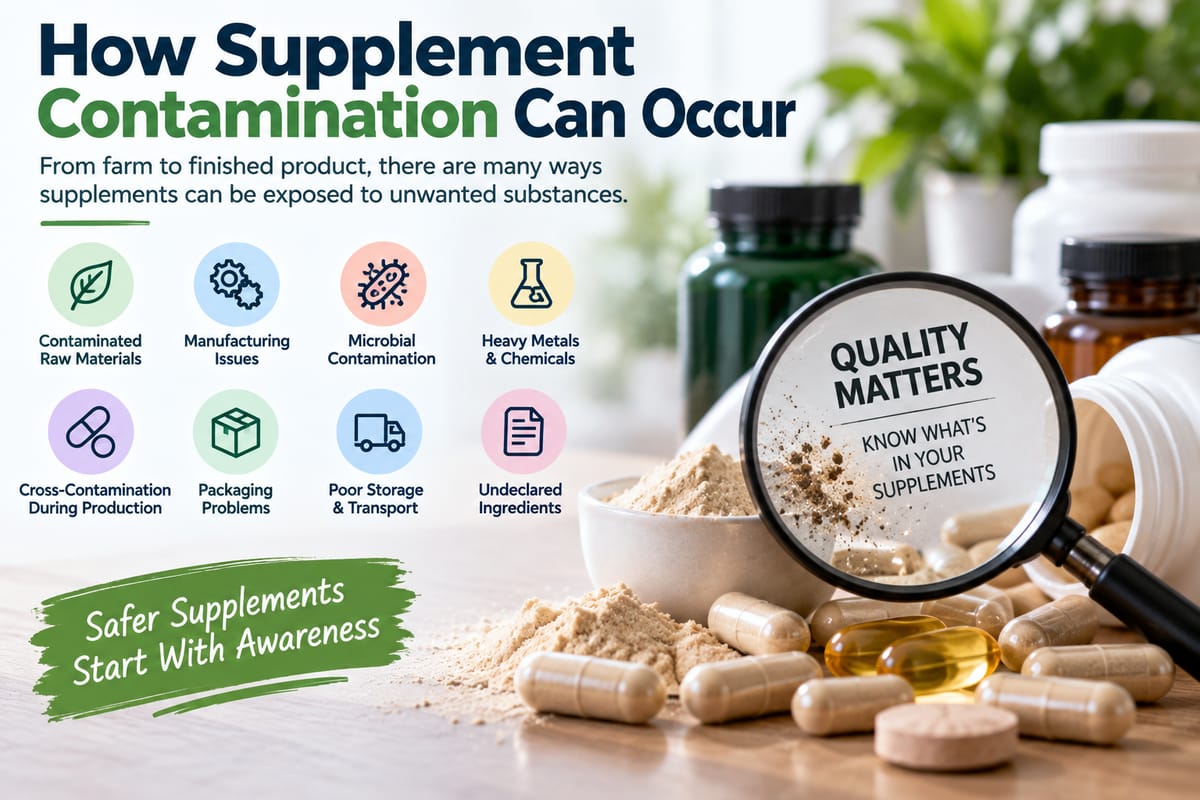

How Supplement Contamination Can Occur
Dietary supplements are designed to provide nutrients, botanical ingredients, amino acids, minerals, or other substances in concentrated forms. They can include products such as vitamins, protein powders, herbal preparations, sports supplements, and specialized nutritional formulas.
However, the quality of a supplement can be affected by contamination at several points between sourcing raw materials and manufacturing the finished product. Contamination does not necessarily mean that a product was deliberately made unsafe. It can result from environmental exposure, inadequate manufacturing controls, accidental cross-contact, poor storage, or problems involving raw ingredients.
Understanding how contamination can occur is an important part of evaluating supplement quality and making informed choices. The Complete Guide to Dietary Supplements provides broader context on the different types of supplements and how they are produced and used.
What Does Supplement Contamination Mean?
Supplement contamination occurs when an unwanted substance is present in a product.
The contaminant may be biological, chemical, physical, or another unwanted material. Examples can include microorganisms, heavy metals, undeclared pharmaceutical ingredients, pesticides, allergens, or foreign particles.
The significance of contamination depends on what the substance is, how much is present, how frequently someone consumes the product, and the individual’s circumstances.
Contamination is different from an ingredient that is intentionally included in a formulation. A properly declared ingredient may be part of the product’s intended composition, while a contaminant is an unwanted substance.
Where Can Contamination Enter the Supply Chain?
Supplement contamination can potentially occur at several stages.
Raw materials may become contaminated before they reach a manufacturer. Manufacturing equipment can introduce contaminants if it is not adequately cleaned. Ingredients can also come into contact with materials from another product during processing.
Potential points of concern include:
- Agricultural production
- Raw material harvesting
- Transportation
- Ingredient storage
- Manufacturing
- Mixing and processing
- Packaging
- Warehousing
- Distribution
This means that supplement safety depends on more than the finished product alone. Quality controls need to address the entire manufacturing process.
Contaminated Raw Materials
One potential source of contamination is the raw material itself.
Plants, herbs, minerals, animal-derived ingredients, and other materials can be exposed to contaminants before they are processed into supplements.
Agricultural ingredients may be exposed to environmental pollutants, pesticides, microorganisms, or contaminated soil and water. Mineral ingredients can also contain unwanted elements if they are not appropriately sourced and tested.
A manufacturer may therefore need to evaluate incoming ingredients before using them in production.
Heavy Metal Contamination
Heavy metals are among the contaminants that can receive attention during supplement testing.
Certain metals, including lead, arsenic, mercury, and cadmium, can occur naturally in the environment. They can also enter agricultural or mineral-based raw materials through environmental contamination.
The risk depends on the particular substance, concentration, exposure, and duration.
Testing raw materials and finished products can help manufacturers identify excessive levels of potentially harmful contaminants before products reach consumers.
Microbial Contamination
Microorganisms can also affect supplement quality.
Bacteria, molds, yeasts, and other microorganisms may enter products through contaminated ingredients, water, equipment, employees, facilities, or inappropriate storage conditions.
Products containing moisture or ingredients that are vulnerable to microbial growth can require particularly careful manufacturing and storage controls.
Manufacturers may conduct microbiological testing to determine whether products meet established quality specifications.
Pesticide Residues
Plant-based supplements can potentially contain pesticide residues if agricultural practices, sourcing, or processing introduce them into the raw material.
The presence of a pesticide residue does not automatically mean a product is dangerous. What matters includes the specific substance and concentration and whether applicable safety limits are met.
Quality programs can include testing for pesticide residues when appropriate for the ingredients being used.
Undeclared Pharmaceutical Ingredients
Another serious form of contamination involves pharmaceutical ingredients that are not declared on the product label.
This issue can be particularly concerning in products marketed for weight management, sexual enhancement, athletic performance, or other purposes where manufacturers may attempt to produce strong effects.
An undeclared drug ingredient can create risks because consumers may not know that they are taking it. It can also interact with medications or medical conditions.
This is one reason consumers should be cautious about products making unusually strong or rapid claims.
Cross-Contamination During Manufacturing
Contamination does not always originate from outside the manufacturing facility.
A product can potentially become contaminated when material from another product or production batch unintentionally enters it.
For example, if equipment is used to manufacture multiple products, inadequate cleaning could leave traces of an earlier ingredient.
Cross-contact can be particularly important for people with allergies or sensitivities. Even small amounts of an undeclared allergen may be problematic for some individuals.
Manufacturers therefore use cleaning procedures, equipment controls, production scheduling, and testing to reduce the possibility of cross-contamination.
Allergens Can Be an Important Concern
Some supplements contain ingredients derived from foods or other sources that can cause allergic reactions in susceptible people.
Potential allergens may include ingredients derived from milk, soy, eggs, fish, shellfish, wheat, peanuts, or tree nuts, depending on the product.
Contamination can occur when allergenic materials accidentally come into contact with another product during manufacturing.
Clear labeling and appropriate manufacturing controls are therefore important for consumers who need to avoid particular allergens.
Contamination From Equipment
Manufacturing equipment comes into direct contact with supplement ingredients.
If equipment is improperly cleaned, maintained, or inspected, unwanted substances can potentially enter subsequent production batches.
Equipment can also contribute physical contaminants if components deteriorate or break.
Good manufacturing practices are intended to reduce these risks through cleaning procedures, maintenance programs, inspections, and appropriate process controls.
Water Can Affect Product Quality
Water is used in some manufacturing processes and can therefore become another potential source of contamination.
If water used during production is not appropriately controlled, it can introduce microorganisms or chemical contaminants.
Manufacturers may therefore establish specifications for process water and monitor systems to help maintain consistent quality.
Poor Storage Can Cause Problems
A supplement that leaves a manufacturing facility in good condition can still experience quality problems if it is stored improperly.
Heat, humidity, oxygen, light, and moisture can affect some ingredients. Excess moisture may also contribute to microbial growth in susceptible products.
Storage conditions can vary according to the formulation and packaging. Consumers should therefore follow the product’s storage instructions and avoid storing supplements in unsuitable environments.
For example, leaving a moisture-sensitive supplement in a hot, humid location may affect its quality even if the product was manufactured correctly.
Packaging Problems
Packaging provides another layer of protection between a supplement and its environment.
Damaged, poorly sealed, or inappropriate packaging can allow moisture, air, contaminants, or foreign material to enter a product.
Packaging can also become important when products are transported over long distances or stored for extended periods.
Manufacturers may use seals, protective containers, moisture barriers, or other packaging technologies depending on the product’s requirements.
Counterfeit or Adulterated Products
Consumers can also encounter risks when purchasing supplements from unreliable sources.
A counterfeit product may not contain the ingredients or quantities represented on its packaging. In some cases, it may contain unexpected substances.
Adulteration is another concern when a product has been intentionally modified with an undeclared ingredient.
Buying from reputable retailers and examining packaging carefully can reduce some of the risks associated with questionable products.
However, packaging alone cannot prove that a supplement is free from contamination.
Why Testing Matters
Testing is an important part of supplement quality control.
Depending on the product and manufacturing process, testing can examine characteristics such as:
- Identity of ingredients
- Potency
- Microbial contamination
- Heavy metals
- Pesticide residues
- Physical contaminants
- Other unwanted substances
Testing can occur at different stages, including evaluation of incoming raw materials and testing of finished products.
The How Supplement Quality and Testing Work guide explains how testing and quality-control processes can be used to evaluate supplements.
Testing Does Not Mean Every Risk Disappears
Laboratory testing can provide valuable information, but it is only one part of quality assurance.
A single test provides information about the sample that was examined. It does not necessarily guarantee that every unit in a large production run is identical.
That is why manufacturers also need systems covering ingredient sourcing, supplier qualification, sanitation, equipment maintenance, production controls, recordkeeping, packaging, and storage.
A strong quality system combines preventive controls with appropriate testing rather than relying on laboratory analysis alone.
Why Labels Matter
Supplement labels can provide important information about the product’s ingredients, serving size, suggested use, warnings, and other details.
Reading the label can help consumers identify ingredients they need to avoid and understand what a product is intended to contain.
The How to Read Supplement Labels Correctly guide offers a more detailed look at the information consumers can examine when evaluating a supplement.
A label, however, should not be treated as independent proof that a product has been tested to a particular standard.
Third-Party Testing and Certification
Some supplement manufacturers use independent laboratories or certification programs to provide additional quality verification.
Third-party testing can involve independent analysis of products against specified criteria. Depending on the program, testing may examine factors such as ingredient identity, contaminants, potency, or manufacturing practices.
Consumers should look at what a particular certification actually verifies rather than assuming every certification provides the same level of assurance.
The specific testing criteria and scope matter.
Why Some People May Face Greater Risks
The consequences of contamination can vary significantly between individuals.
A healthy adult may respond differently to an unwanted substance than someone who is pregnant, taking prescription medication, living with a medical condition, or particularly sensitive to a specific ingredient.
Children and older adults may also have different considerations.
The amount consumed and duration of exposure can matter as well.
For these reasons, supplement safety cannot be evaluated solely by asking whether a product is “natural” or sold as a health product.
Interactions Can Add Another Layer of Risk
A contaminated supplement is not the only potential safety concern.
Even correctly manufactured supplements can interact with medications or other supplements. Some ingredients can affect how medicines are absorbed, metabolized, or eliminated.
A person taking multiple products may also unintentionally consume excessive amounts of particular nutrients or compounds.
The Supplement Safety Guide: Risks, Interactions and Dosage explains some of the broader safety issues that should be considered before using supplements.
Warning Signs That Deserve Attention
Consumers should be cautious when a supplement has characteristics that make its quality difficult to evaluate.
Potential warning signs include:
- Extremely strong health claims
- Claims of instant or guaranteed results
- Missing or incomplete ingredient information
- Damaged packaging
- Unusual changes in color, smell, or texture
- Products sold through questionable channels
- Ingredients that are difficult to identify
- Labels that make unsupported promises
- Pressure to use unusually large amounts
These signs do not prove that contamination has occurred, but they can justify taking a closer look at the product and its source.
How Manufacturers Reduce Contamination Risks
Responsible supplement manufacturing involves multiple layers of quality control.
These can include:
Supplier Qualification
Manufacturers can evaluate suppliers before purchasing raw materials and establish specifications for incoming ingredients.
Ingredient Testing
Raw materials can be tested or verified to ensure they meet defined requirements.
Sanitation Procedures
Facilities and equipment can be cleaned according to documented procedures designed to reduce contamination and cross-contact.
Environmental Controls
Manufacturers can control factors such as temperature, humidity, cleanliness, and airflow where appropriate.
Batch Testing
Finished products can undergo testing to verify that they meet established specifications.
Documentation
Detailed records can help manufacturers trace ingredients, production batches, testing results, and distribution.
Together, these measures create a system designed to identify and prevent problems rather than relying on consumers to discover them after a product reaches the market.
What Consumers Can Do
Consumers cannot independently inspect every stage of a supplement’s supply chain, but they can take several practical steps.
Choose products from established manufacturers, examine labels carefully, follow recommended serving instructions, and be cautious of products making extraordinary claims.
It can also be useful to check whether a manufacturer provides meaningful information about its quality-control procedures or uses appropriate independent testing.
People taking prescription medicines or managing specific health circumstances should discuss supplement use with an appropriate healthcare professional before adding new products.
Why Contamination Is a Supply-Chain Issue
Supplement contamination is not limited to what happens inside a manufacturing facility.
The process begins with raw material sourcing and continues through transportation, processing, testing, packaging, storage, and distribution.
A problem at any stage can potentially affect the finished product.
That is why comprehensive quality systems are important. A manufacturer that tests only the final product but does not adequately control its suppliers, equipment, production environment, and storage conditions may leave gaps in its quality program.
Understanding Quality Beyond the Label
Supplement contamination can happen in several ways, including contaminated raw materials, microbial growth, heavy metals, pesticide residues, cross-contact, undeclared pharmaceutical ingredients, equipment problems, packaging failures, and poor storage.
Not every supplement contains contaminants, and the presence of a contaminant does not automatically mean that every exposure will cause harm. Risk depends on the specific substance, concentration, exposure, and individual circumstances.
For consumers, the most useful approach is to look beyond marketing claims and consider the product’s ingredients, manufacturer, labeling, quality controls, testing information, storage conditions, and intended use.
A supplement may be packaged in an attractive bottle and carry impressive claims, but meaningful quality depends on what is actually inside the container and how carefully that product was sourced, manufactured, tested, and handled.
Continue Reading
Similar Posts

What Is Creatine and How Does It Work?
Understanding how that system works helps explain why creatine has become so closely associated with activities such as weightlifting, sprinting, and other forms of high-intensity exercise.
Read article
Why Excessive Vitamin Intake Can Be Harmful
Understanding the difference between adequate intake and excessive intake is an important part of using vitamin supplements responsibly.
Read article
How Dietary Supplements Can Cause Side Effects
Understanding why side effects happen can help people make more informed decisions about supplement use and recognize situations where professional guidance may be appropriate.
Read article

Join 10,000+ Readers Building Healthier Habits
Get actionable wellness tips every week plus our newest articles delivered straight to your inbox.