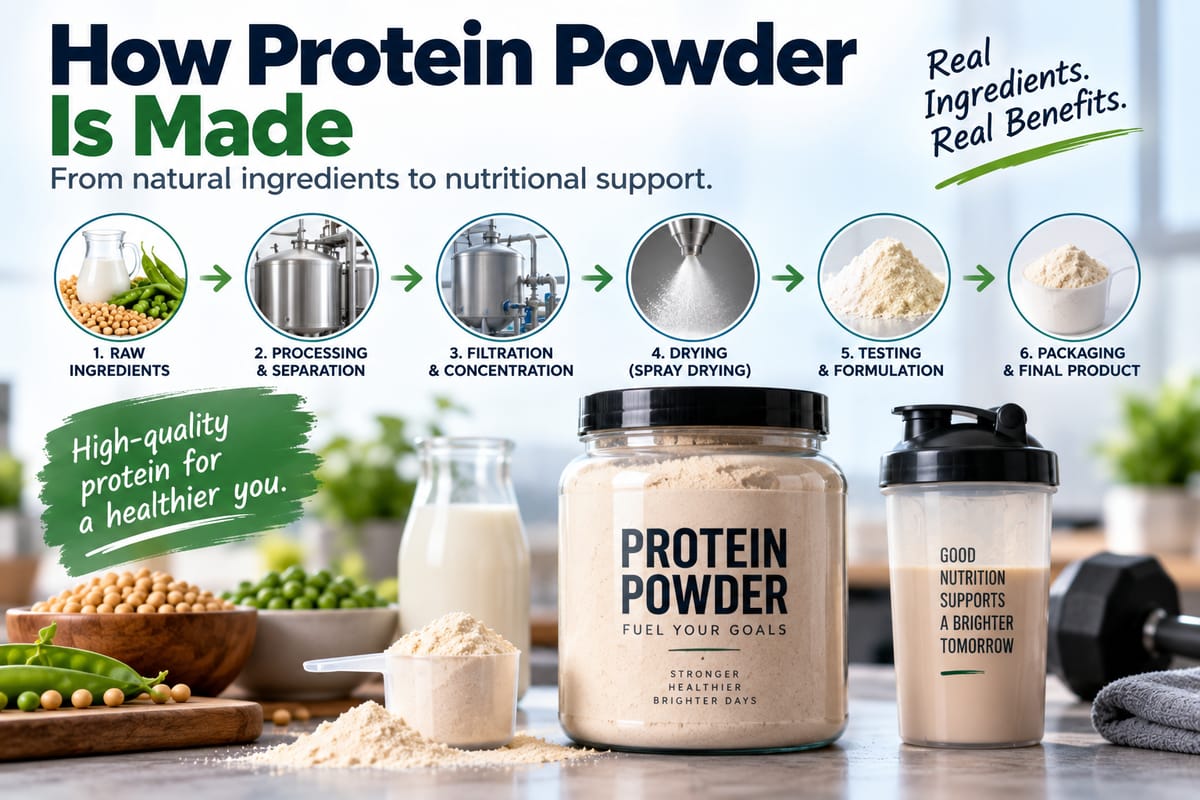

How Protein Powder Is Made
Protein powder may look like a simple product when it sits on a store shelf, but producing it involves a series of processing, filtration, drying, testing, and packaging steps.
The exact manufacturing process depends on the type of protein. Whey protein, casein, egg protein, soy protein, pea protein, rice protein, and other varieties begin with different raw materials and require different techniques to turn those materials into a concentrated powder.
Understanding how protein powder is made can also help consumers understand why products differ in protein content, texture, flavor, ingredients, and price.
For a broader overview of supplements and how they are formulated and used, the Complete Guide to Dietary Supplements provides useful background.
What Is Protein Powder?
Protein powder is a concentrated source of protein produced by processing a food or other protein-rich raw material.
Manufacturers remove or reduce other components of the original material so that the finished product contains a higher proportion of protein.
Depending on the product, the powder may also contain:
- Flavoring
- Sweeteners
- Vitamins and minerals
- Emulsifiers
- Thickeners
- Digestive enzymes
- Stabilizers
- Other nutritional ingredients
Some products contain almost entirely protein, while others are formulated as complete nutritional products with carbohydrates, fats, and additional ingredients.
Where Does Protein Powder Come From?
Protein powders can be made from both animal and plant sources.
Common sources include:
Milk
Milk is the starting material for whey and casein proteins.
Eggs
Egg whites can be processed into egg protein powder.
Soybeans
Soybeans provide a plant-based protein that can be concentrated or isolated.
Peas
Yellow peas are commonly processed to produce pea protein.
Rice
Rice can be processed to produce rice protein.
Other Plants
Protein powders can also be produced from ingredients such as hemp, potatoes, and other plant sources.
Each raw material requires a different manufacturing process because its protein is combined with different carbohydrates, fats, fibers, minerals, and other compounds.
How Whey Protein Is Made
Whey is one of the most widely used sources of protein powder.
It begins with milk.
When milk is processed to make certain dairy products, proteins can be separated into two major groups: casein and whey.
Whey is found in the liquid portion produced during this process.
Manufacturers then process the whey to increase its protein concentration and remove unwanted components.
A simplified process looks like this:
- Milk is processed.
- Whey is separated from the other milk components.
- The liquid whey is filtered.
- Additional components are removed or reduced.
- The protein concentration is increased.
- The liquid is dried into a powder.
- The powder may be flavored or otherwise formulated.
- The finished product is tested and packaged.
The exact process varies between manufacturers and products.
Whey Protein Concentrate
Whey protein concentrate is produced by removing some of the non-protein components from liquid whey.
The resulting product contains a relatively high proportion of protein, but it can still contain varying amounts of lactose, fat, minerals, and other components.
The exact protein percentage depends on the particular product and manufacturing specification.
Whey protein concentrate is widely used because it can provide a balance of protein content, flavor, texture, and cost.
Whey Protein Isolate
Whey protein isolate undergoes additional processing to remove more non-protein components.
The result is a product with a higher proportion of protein by weight than many whey concentrates.
Depending on the manufacturing process, whey protein isolate can also contain substantially less lactose and fat.
Additional processing, however, can increase manufacturing costs.
Hydrolyzed Whey Protein
Hydrolyzed whey protein undergoes an additional step in which some of the protein is broken down into smaller protein fragments, commonly called peptides.
This process is known as hydrolysis.
The resulting protein can have different functional and sensory characteristics from an unhydrolyzed protein.
Hydrolyzed products are sometimes included in specialized protein formulations, although the specific characteristics depend on how extensively the protein has been hydrolyzed.
How Casein Protein Is Made
Casein is another major milk protein.
During milk processing, casein can be separated from other components and further processed into a concentrated protein ingredient.
Like whey, casein can undergo filtration and drying before being converted into a finished powder.
Casein products can have different functional characteristics from whey because the proteins behave differently in liquid and during digestion.
How Plant Protein Powder Is Made
Plant-based protein powders generally begin with crops such as peas, soybeans, rice, or other protein-containing plants.
The goal is to separate protein from much of the plant’s other material.
A simplified process may involve:
- Cleaning the raw plant material.
- Grinding or milling it.
- Separating protein-rich material from other components.
- Concentrating or isolating the protein.
- Filtering or purifying the protein.
- Drying it into powder.
- Testing the finished ingredient.
- Formulating and packaging the final product.
The exact process differs considerably depending on the plant source.
How Pea Protein Is Made
Pea protein is commonly produced from yellow peas.
The peas are cleaned and processed to separate protein-rich material from starch, fiber, and other components.
Manufacturers can then concentrate the protein through additional separation and filtration steps.
The resulting pea protein can be used in powders, nutrition products, beverages, and other food formulations.
Pea protein is particularly common in plant-based products because it can provide a substantial amount of protein while fitting into dairy-free formulations.
How Soy Protein Is Made
Soy protein begins with soybeans.
The beans are cleaned, processed, and separated into components such as oil and protein-rich material.
Further processing can produce soy protein concentrate or soy protein isolate.
The level of processing determines how much of the original carbohydrate, fat, and other components remain in the finished ingredient.
Soy protein has been used in food products for many years and can be incorporated into both standalone protein powders and broader nutritional formulations.
How Rice Protein Is Made
Rice protein requires a different process because rice contains substantial amounts of starch alongside its protein.
Manufacturers process the rice to separate protein from starch and other components.
Additional filtration and purification can produce a protein-rich ingredient suitable for use in powdered supplements and foods.
Rice protein is another option used in plant-based protein formulations.
Filtration Plays an Important Role
Filtration is one of the key technologies used in protein manufacturing.
Different filtration methods can separate proteins from smaller molecules and other components based on characteristics such as molecular size.
Depending on the product, manufacturers may use processes such as membrane filtration.
Filtration can help increase protein concentration while preserving desired characteristics of the protein ingredient.
The number and type of processing steps vary depending on whether the manufacturer is producing a concentrate, isolate, or another specialized ingredient.
What Is Ultrafiltration?
Ultrafiltration uses a membrane to separate components according to their size and other physical characteristics.
For dairy proteins, ultrafiltration can help concentrate proteins while allowing certain smaller components to pass through the membrane.
It can be used as part of the production process for whey and other protein ingredients.
Because the process can occur without some of the more aggressive treatments used in other forms of processing, manufacturers may use it when seeking particular functional or nutritional characteristics.
What Is Microfiltration?
Microfiltration uses membranes with different pore characteristics to separate materials.
In protein manufacturing, it can help remove certain components while retaining proteins.
The exact application depends on the raw material and the desired final product.
Filtration technologies can therefore be an important part of producing protein ingredients with specific protein concentrations and characteristics.
Protein Powder Is Usually Spray-Dried
After filtration and concentration, protein is often still in liquid form.
Manufacturers need to remove most of the water before the product can become a stable powder.
Spray drying is a common industrial method.
During spray drying, the concentrated liquid is broken into small droplets and introduced into a stream of heated air. Water evaporates rapidly, leaving behind dry particles that can be collected as powder.
The process needs to be carefully controlled because excessive heat or unsuitable conditions can affect the physical properties of the final ingredient.
Why Is Protein Powder So Fine?
The drying and processing stages help create the fine particles associated with protein powders.
Manufacturers can also control particle characteristics to influence how easily the powder mixes with water or other liquids.
Particle size, moisture content, formulation ingredients, and processing conditions can all affect texture and solubility.
This is one reason two protein powders containing similar amounts of protein can behave differently when mixed into a drink.
Instantized Protein Powder
Some protein powders are specially processed to improve their ability to mix with liquids.
This can involve creating larger or more easily dispersed particles and adding small amounts of appropriate ingredients.
These products are sometimes described as instantized.
Better dispersion can reduce clumping and make a powder easier to mix in a shaker or glass.
Why Do Some Protein Powders Foam?
Foaming can occur when proteins interact with air and water during mixing.
Certain proteins have properties that allow them to stabilize air bubbles, producing foam when shaken vigorously.
The degree of foaming can vary depending on:
- Protein source
- Protein concentration
- Particle characteristics
- Added ingredients
- Mixing method
- Liquid temperature
Foaming is not necessarily an indication of poor quality.
Why Do Some Protein Powders Taste Different?
Protein itself can have a noticeable taste, and different protein sources have different flavor characteristics.
Plant proteins can sometimes have earthy, grassy, or bitter notes. Dairy proteins can have their own characteristic flavors.
Manufacturers may use:
- Cocoa
- Vanilla
- Fruit flavors
- Sweeteners
- Salt
- Natural or artificial flavoring
- Other masking ingredients
The goal is to create a more appealing finished product while maintaining the desired nutritional characteristics.
How Sweeteners Are Added
Many flavored protein powders contain sweeteners to improve taste.
These may include sugar, sugar alcohols, or high-intensity sweeteners, depending on the formulation.
Some products are deliberately formulated with little or no added sugar.
Consumers should therefore check the ingredient and nutrition information rather than assuming all protein powders have similar formulations.
Why Do Manufacturers Add Emulsifiers?
Some protein powders contain emulsifiers or similar ingredients that help the powder disperse more effectively in liquid.
These ingredients can influence:
- Mixability
- Texture
- Stability
- Mouthfeel
The specific ingredients used vary between products.
Vitamins and Minerals May Be Added
Protein powder does not necessarily contain only protein.
Some manufacturers add vitamins and minerals to create products designed for broader nutritional purposes.
Others keep the formulation relatively simple.
Added nutrients can be useful for particular formulations, but consumers should consider the total amount of nutrients they obtain from all foods and supplements rather than looking at one product in isolation.
What Happens Before Protein Powder Is Packaged?
The finished powder generally undergoes quality-control checks before packaging.
Manufacturers may evaluate characteristics such as:
- Protein content
- Moisture
- Microbiological safety
- Physical appearance
- Flavor
- Solubility
- Product consistency
- Ingredient identity
The specific tests depend on the manufacturer, raw material, product type, and applicable requirements.
Quality-control procedures are an important part of producing a consistent finished product.
How Supplement Quality and Testing Work
Protein powder is a dietary supplement ingredient or finished supplement in many commercial products, which means quality assurance can involve multiple stages.
The principles behind testing and quality control are explored in How Supplement Quality and Testing Work.
Testing can help manufacturers determine whether ingredients meet established specifications and whether finished products contain the expected components.
However, testing programs vary among manufacturers, so consumers should examine product information carefully rather than assuming every product undergoes identical testing.
Protein Content Is Tested
One of the most important characteristics of a protein powder is its protein content.
Manufacturers use analytical methods to determine how much protein is present in the finished product.
This helps verify whether the product meets its formulation specifications.
Protein content is commonly expressed in grams per serving, while the percentage of protein by weight can also be useful when comparing products.
Contaminant Testing Can Matter
Manufacturers may also test ingredients or finished products for contaminants.
Depending on the product and manufacturing environment, testing can address potential concerns such as:
- Microbial contamination
- Heavy metals
- Certain chemical contaminants
- Undeclared substances
- Other impurities
The exact testing program varies by product and manufacturer.
From Raw Ingredient to Finished Product
Although manufacturing methods vary, a simplified protein-powder production chain looks like this:
Raw material → Processing → Separation → Filtration → Concentration → Drying → Testing → Formulation → Packaging
For a dairy protein, the raw material may be milk-derived whey.
For a plant protein, it could be peas, soybeans, rice, or another crop.
The basic objective remains similar: separate and concentrate the desired protein while producing a stable ingredient that can be incorporated into a finished product.
What Happens When Flavors Are Added?
After the protein ingredient has been produced and dried, it can be blended with other ingredients to create the final formulation.
A chocolate protein powder, for example, may contain protein along with cocoa, sweetener, flavoring, and other ingredients.
Manufacturers need to mix these components evenly so that servings have consistent composition.
Large-scale blending equipment is designed to distribute ingredients throughout the powder.
Packaging Helps Protect the Product
Protein powder needs protection from moisture, oxygen, contamination, and other environmental factors.
Packaging can include:
- Plastic tubs
- Flexible pouches
- Sachets
- Single-serving packets
- Other sealed containers
The packaging format depends on the product and intended use.
Moisture control is particularly important because powdered products can absorb water from the environment and develop clumps or other quality problems.
Why Protein Powder Can Form Clumps
Clumping is often related to moisture exposure.
When powder particles absorb moisture, they can begin sticking together.
Poor storage conditions, an improperly sealed container, or exposure to humid environments can increase the likelihood of clumping.
Keeping the container properly sealed and storing the product according to the manufacturer’s instructions can help preserve its physical quality.
Does Processing Destroy Protein?
Protein processing does not automatically eliminate the nutritional value of protein.
However, processing conditions can affect the chemical and physical characteristics of proteins.
Heat, acidity, filtration, drying, and other manufacturing conditions may change protein structure.
Protein structure can also change naturally during cooking and digestion.
The practical nutritional characteristics of a finished product depend on the specific manufacturing process, protein source, formulation, and serving size.
Protein Quality Is More Than the Number on the Label
Two protein powders can contain similar amounts of protein but differ in amino acid composition and digestibility.
Protein quality is influenced by factors such as:
- Essential amino acid content
- Digestibility
- Protein source
- Processing
- Serving size
This is one reason it is useful to understand protein as a nutrient rather than simply a number on a supplement label.
The body’s daily need for this nutrient is discussed in Why Does the Body Need Protein Every Day?.
Why People Use Protein Supplements
Protein supplements can provide a convenient way to increase protein intake.
Some people use them because preparing a protein-rich meal is not always practical. Others incorporate protein powder into smoothies, yogurt, oatmeal, baked foods, or other meals.
Protein supplements are not fundamentally different from other foods in the sense that they still contribute nutrients and calories that should be considered as part of the overall diet.
The different types and uses of these products are covered in Protein Supplements Explained.
How Protein Powder Differs From Whole Foods
Protein powder is a processed food ingredient, while foods such as eggs, dairy products, fish, meat, legumes, nuts, and seeds provide protein alongside other nutrients and compounds.
Whole foods can also provide:
- Fiber
- Vitamins
- Minerals
- Healthy fats
- Carbohydrates
- Water
- Other naturally occurring compounds
Protein powder can be convenient, but it does not necessarily replace the variety provided by a balanced diet.
Common Types of Protein Powder
Consumers may encounter several major categories.
Whey Protein
Derived from milk and available in concentrate, isolate, and hydrolyzed forms.
Casein Protein
Another milk-derived protein with different functional characteristics from whey.
Egg Protein
Produced primarily from egg whites.
Soy Protein
A plant-derived protein that can be produced as a concentrate or isolate.
Pea Protein
Made from peas and commonly used in plant-based products.
Rice Protein
Produced from rice and often incorporated into plant-based protein blends.
Protein Blends
Some products combine several protein sources to create a particular nutritional or functional profile.
Why Manufacturers Blend Different Proteins
Blending proteins can change the amino acid profile, texture, flavor, and functional properties of a product.
A manufacturer might combine pea and rice proteins, for example, to create a plant-based formulation with complementary characteristics.
Other blends may combine dairy proteins with different digestion and texture properties.
The reason for a blend should be considered alongside the product’s overall ingredient list and nutritional information.
How Consumers Can Evaluate Protein Powder
Understanding manufacturing can make it easier to compare products.
Consumers can examine:
- Protein per serving
- Serving size
- Ingredient list
- Added sugars
- Sweeteners
- Protein source
- Calories
- Allergens
- Manufacturer information
- Quality-testing information
- Storage instructions
The cheapest product is not necessarily the simplest product, and the most expensive product is not automatically the highest quality.
Reading the Label Matters
A protein powder label can reveal considerably more than the large number displayed on the front of the package.
Consumers should examine the nutrition panel and ingredient list to understand what they are actually purchasing.
Important questions include:
- How much protein is in each serving?
- How large is the serving?
- What is the protein source?
- What other ingredients are present?
- How much sugar does it contain?
- Does it contain ingredients the consumer needs to avoid?
- Are there added vitamins or minerals?
A more informed comparison can help distinguish products with similar marketing claims but different formulations.
Protein Powder Manufacturing Is a Multi-Step Process
The finished scoop of protein powder represents considerably more processing than its appearance suggests.
Milk may be separated and filtered to produce whey or casein. Plants may be milled and processed to concentrate their proteins. Protein-rich liquids can undergo filtration and concentration before being spray-dried into stable powders. Additional ingredients may then be blended into the protein base before quality testing and packaging.
The result is a convenient source of concentrated protein, but the final product still varies according to its raw material, manufacturing process, formulation, and quality controls.
Understanding those steps gives consumers a clearer way to evaluate protein powders based on what they contain and how they are made, rather than relying solely on packaging claims or marketing language.
Continue Reading
Similar Posts

What Is Creatine and How Does It Work?
Understanding how that system works helps explain why creatine has become so closely associated with activities such as weightlifting, sprinting, and other forms of high-intensity exercise.
Read article
Why Excessive Vitamin Intake Can Be Harmful
Understanding the difference between adequate intake and excessive intake is an important part of using vitamin supplements responsibly.
Read article
How Dietary Supplements Can Cause Side Effects
Understanding why side effects happen can help people make more informed decisions about supplement use and recognize situations where professional guidance may be appropriate.
Read article

Join 10,000+ Readers Building Healthier Habits
Get actionable wellness tips every week plus our newest articles delivered straight to your inbox.