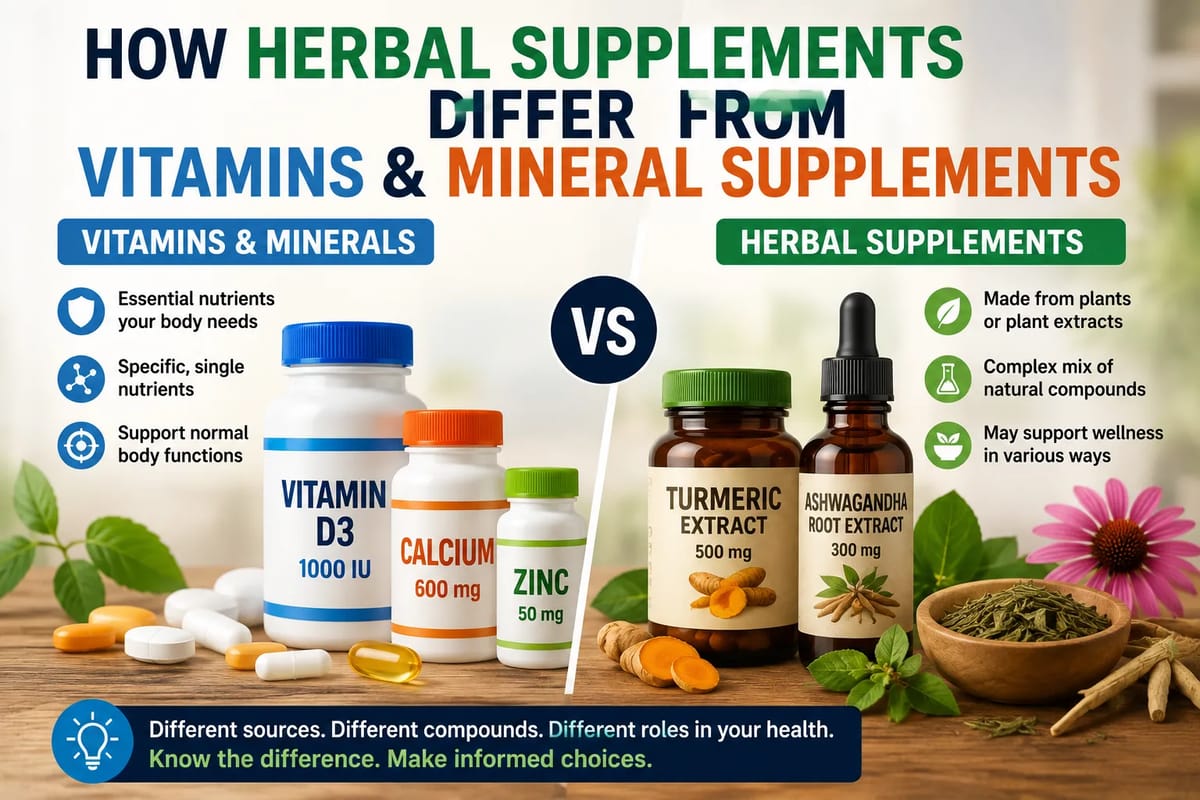

How Herbal Supplements Differ From Vitamins and Mineral Supplements
Supplements can look remarkably similar on a store shelf, but the substances inside them can be very different.
A bottle labeled vitamin D, an iron supplement and a product containing ginseng may all be sold in the same section, yet they belong to different categories. Vitamins and minerals are nutrients the body needs for normal biological functions, while herbal supplements are made from plants or plant-derived ingredients that may contain numerous naturally occurring compounds.
Understanding that distinction can help consumers make more informed choices about supplements and recognize why products should not automatically be treated as interchangeable.
What Are Vitamins?
Vitamins are organic compounds that the body needs in relatively small amounts to support normal functions.
Some vitamins can be produced by the body, while others generally need to come from food or, in certain circumstances, supplements.
Common vitamins include:
- Vitamin A
- Vitamin C
- Vitamin D
- Vitamin E
- Vitamin K
- Folate
- Thiamine
- Riboflavin
- Vitamin B6
- Vitamin B12
Each vitamin has different functions.
For example, vitamin D helps the body absorb calcium and plays an important role in bone health, while vitamin C is involved in collagen production and normal immune function.
A vitamin supplement is generally designed to provide a specific vitamin or combination of vitamins in measured amounts.
What Are Minerals?
Minerals are inorganic elements that the body requires for various physiological processes.
Important dietary minerals include:
- Calcium
- Iron
- Magnesium
- Zinc
- Potassium
- Iodine
- Selenium
- Copper
Some are required in relatively large amounts, while others are needed in much smaller quantities.
Calcium, for instance, is important for bones, muscles and normal nerve function. Iron is needed to produce hemoglobin, which allows red blood cells to carry oxygen.
Mineral supplements are intended to increase intake of a particular mineral when dietary intake may not be sufficient or when supplementation has been recommended.
What Are Herbal Supplements?
Herbal supplements are products made from plants or parts of plants.
Depending on the product, they may contain:
- Leaves
- Roots
- Flowers
- Seeds
- Bark
- Fruits
- Plant extracts
- Concentrated plant compounds
Examples include products made from herbs such as ginseng, ginger, turmeric, echinacea, valerian and various other botanical ingredients.
Unlike a vitamin or mineral, an herb can contain numerous biologically active compounds.
That makes herbal supplements a much broader category.
The Main Difference Is What They Contain
The simplest distinction is the source and type of active ingredient.
Vitamin supplements primarily provide specific vitamins.
Mineral supplements provide specific minerals.
Herbal supplements provide substances derived from plants, often containing mixtures of naturally occurring compounds.
This difference is important because a single herb does not necessarily behave like a single nutrient.
A vitamin supplement may contain a defined amount of vitamin C, for example. A botanical extract can contain several different compounds whose concentrations depend on the plant, growing conditions, extraction method and manufacturing process.
Vitamins and Minerals Are Essential Nutrients
Vitamins and minerals have established roles in normal human physiology.
The body requires them to carry out processes involving metabolism, growth, tissue maintenance, blood formation, nerve function and many other activities.
A deficiency can cause health problems.
For example, inadequate iron can contribute to iron-deficiency anemia, while insufficient vitamin C can lead to scurvy in severe cases.
This does not mean that taking additional vitamins or minerals automatically improves health.
The body needs appropriate amounts, not simply more.
Herbal Supplements Are Not Nutritional Replacements
Herbal products are sometimes marketed alongside vitamins and minerals, but they serve a different role.
An herb may be promoted for purposes such as supporting relaxation, digestion, energy or general wellbeing.
However, an herbal product should not automatically be considered a substitute for an essential nutrient.
For example, taking an herbal product does not replace the body’s requirement for vitamin B12, iron, calcium or other nutrients.
A varied diet remains the primary source of essential vitamins and minerals for most people.
Herbal Products Can Have Complex Effects
Plants contain chemicals that can interact with biological systems.
That is part of the reason some herbs have traditionally been used for particular purposes.
But it also means that herbal supplements can produce effects beyond simply supplying a nutrient.
The effects may vary depending on the plant, preparation, dose and individual taking the product.
Two products carrying the same general herbal name may also differ considerably in their formulations.
Standardization Can Be More Complicated With Herbs
The amount of a vitamin or mineral in a supplement can generally be expressed in a specific quantity.
Botanical products can be more difficult to characterize.
A plant extract may contain numerous compounds, and the amount of particular compounds can vary depending on factors such as:
- Plant species
- Growing conditions
- Harvesting
- Processing
- Extraction method
- Storage
- Manufacturing practices
Some manufacturers use standardized extracts designed to provide consistent levels of particular compounds.
Even then, the overall chemical profile of an herbal product can be more complicated than that of a single-nutrient supplement.
“Natural” Does Not Automatically Mean Safer
The word natural can create the impression that an herbal product is inherently safer than a vitamin or mineral supplement.
That assumption is misleading.
Plants can contain powerful biologically active substances. Some can cause side effects or interact with medications.
The fact that an ingredient comes from a plant does not determine whether it is safe for every person.
Safety depends on the specific substance, amount, formulation, individual circumstances and other products being taken.
Herbal Supplements Can Interact With Medications
Interactions are an important consideration when using botanical products.
Some herbal ingredients can affect how medications are absorbed, metabolized or eliminated.
That can potentially change the effectiveness or side effects of a medication.
For people taking prescription drugs or managing ongoing health conditions, discussing supplements with a doctor, pharmacist or other qualified healthcare professional can be especially important.
This is one area where herbal supplements should not be treated as harmless simply because they are sold without a prescription.
Vitamins and Minerals Can Also Cause Problems in Excess
The distinction should not be interpreted as meaning vitamins and minerals are automatically risk-free.
Taking excessive amounts of certain nutrients can cause adverse effects.
Some vitamins are fat-soluble, including vitamins A, D, E and K. These can accumulate in the body more readily than water-soluble vitamins.
Certain minerals can also become harmful when consumed in excessive amounts.
Iron is a good example. While iron is essential, too much can be dangerous.
Supplementation should therefore be based on appropriate amounts rather than the assumption that higher intake is always better.
Water-Soluble and Fat-Soluble Vitamins
Vitamins are often divided into two broad groups.
Water-Soluble Vitamins
These include vitamin C and the B vitamins.
They generally do not accumulate in the body to the same degree as fat-soluble vitamins, although this does not mean excessive intake is always harmless.
Fat-Soluble Vitamins
These include:
- Vitamin A
- Vitamin D
- Vitamin E
- Vitamin K
Because they can be stored in body tissues, excessive supplementation can sometimes lead to harmful accumulation.
This is one reason supplement doses should be considered carefully.
Herbal Supplements Can Contain Multiple Active Compounds
A vitamin tablet may contain a specific nutrient as its primary active ingredient.
An herbal capsule may contain an extract made up of numerous plant compounds.
This can make the biological effects of an herbal supplement less straightforward to predict.
Researchers may study individual compounds, whole extracts or traditional preparations, but evidence for one formulation does not necessarily prove that every product containing the same plant will have identical effects.
The exact product matters.
Evidence Can Differ Significantly
Another important difference involves the scientific evidence supporting particular uses.
Some vitamins and minerals have well-established physiological roles and clearly defined deficiency conditions.
Research on herbal supplements can vary substantially from one ingredient to another.
Some botanical ingredients have been studied extensively. Others have limited or inconsistent evidence for the claims made about them.
Consumers should therefore look beyond marketing language.
A product described as “clinically studied” does not necessarily mean that strong evidence exists for every health claim associated with it.
Supplements Should Not Replace a Balanced Diet
Vitamins, minerals and herbal products can have specific uses, but supplements are not a substitute for a nutritious diet.
Foods provide combinations of nutrients, fiber and other compounds that are difficult to reproduce with a handful of capsules.
For many people, the first step toward meeting nutritional needs is eating a varied diet that includes appropriate amounts of fruits, vegetables, whole grains, legumes, protein sources and other nutrient-rich foods.
Supplements can have a role when dietary intake is inadequate or when supplementation is specifically recommended.
Some People Have Different Nutritional Needs
Nutrient requirements can vary throughout life.
Pregnancy, aging, dietary restrictions and certain medical circumstances can affect nutritional needs.
For example, some people may need particular nutrients because they cannot obtain enough from their normal diet.
In such situations, a healthcare professional can help determine whether supplementation is appropriate and which nutrient is relevant.
Taking a broad collection of supplements without understanding the underlying need can result in unnecessary or excessive intake.
Read the Supplement Label Carefully
Labels can help consumers distinguish between different types of supplements.
For vitamin and mineral products, look for the specific nutrients and amounts provided.
For herbal products, examine:
- The exact plant name
- Plant part used
- Extract or preparation type
- Amount per serving
- Suggested serving size
- Additional ingredients
- Manufacturer information
- Warnings and precautions
A product containing several ingredients can be harder to evaluate than one containing a single clearly identified nutrient.
Dosage Matters
Two products may contain the same general ingredient but provide very different amounts.
With vitamins and minerals, excessive intake can create problems when people combine multiple products containing the same nutrient.
For example, someone might take a multivitamin, a separate mineral supplement and a fortified product without realizing that the same nutrient appears in all three.
Herbal products also require attention to serving sizes because concentrated extracts can differ substantially from the whole plant.
More is not necessarily more effective.
Quality Matters With All Supplements
Consumers should consider product quality regardless of whether they are purchasing a vitamin, mineral or herbal supplement.
Manufacturing standards, ingredient identity and accurate labeling all matter.
For herbal products in particular, the exact contents can be important because different preparations may vary.
Consumers should be cautious about products making dramatic promises, particularly claims that a supplement can cure diseases, replace prescribed treatment or deliver rapid and extraordinary results.
Such claims deserve careful scrutiny.
Vitamins, Minerals and Herbs Can Appear in the Same Product
The categories are not always completely separate.
A supplement may combine vitamins, minerals and botanical ingredients into one formula.
For example, a product marketed for general wellness could contain several vitamins, zinc and an herbal extract.
This makes reading the full ingredient list particularly important.
Taking multiple combination products can also make it harder to know how much of each ingredient someone is consuming.
Why the Difference Matters
Understanding the difference between these categories can improve supplement decisions.
If someone has a confirmed nutrient deficiency, the relevant supplement may be a particular vitamin or mineral rather than an unrelated herbal product.
If someone is considering an herbal supplement for a specific purpose, the appropriate questions are different: What evidence supports that use? What are the potential side effects? Could it interact with medications? Is the product’s composition reliable?
The answers cannot be determined simply by seeing the word “supplement” on a bottle.
A Practical Way to Think About Supplement Categories
A useful way to remember the distinction is:
Vitamins and minerals provide essential nutrients.
Herbal supplements provide plant-derived compounds.
Both can have biological effects, but they should not be evaluated in exactly the same way.
Nutrients have specific physiological functions and established dietary requirements. Herbal products can contain complex mixtures of compounds whose effects and evidence vary considerably.
That difference is especially important when evaluating health claims.
Making Smarter Supplement Choices
Supplements can be useful tools in the right circumstances, but choosing one should begin with a clear understanding of what it actually contains.
Vitamins and minerals are essential nutrients that support normal body functions, while herbal supplements are derived from plants and can contain a variety of biologically active compounds. Neither category should automatically be considered superior, safer or more effective than the other.
The smartest approach is to look beyond the front of the bottle.
Check the ingredients, understand the dose, consider the evidence behind the intended use and pay attention to possible interactions. When a supplement is being considered for a specific nutritional need, medication interaction or health concern, professional advice can help determine whether it is appropriate.
Knowing whether a supplement supplies a nutrient or delivers a complex plant extract is the first step toward understanding what that product can—and cannot—reasonably be expected to do.
Continue Reading
Similar Posts

What Is Creatine and How Does It Work?
Understanding how that system works helps explain why creatine has become so closely associated with activities such as weightlifting, sprinting, and other forms of high-intensity exercise.
Read article
Why Excessive Vitamin Intake Can Be Harmful
Understanding the difference between adequate intake and excessive intake is an important part of using vitamin supplements responsibly.
Read article
How Dietary Supplements Can Cause Side Effects
Understanding why side effects happen can help people make more informed decisions about supplement use and recognize situations where professional guidance may be appropriate.
Read article

Join 10,000+ Readers Building Healthier Habits
Get actionable wellness tips every week plus our newest articles delivered straight to your inbox.