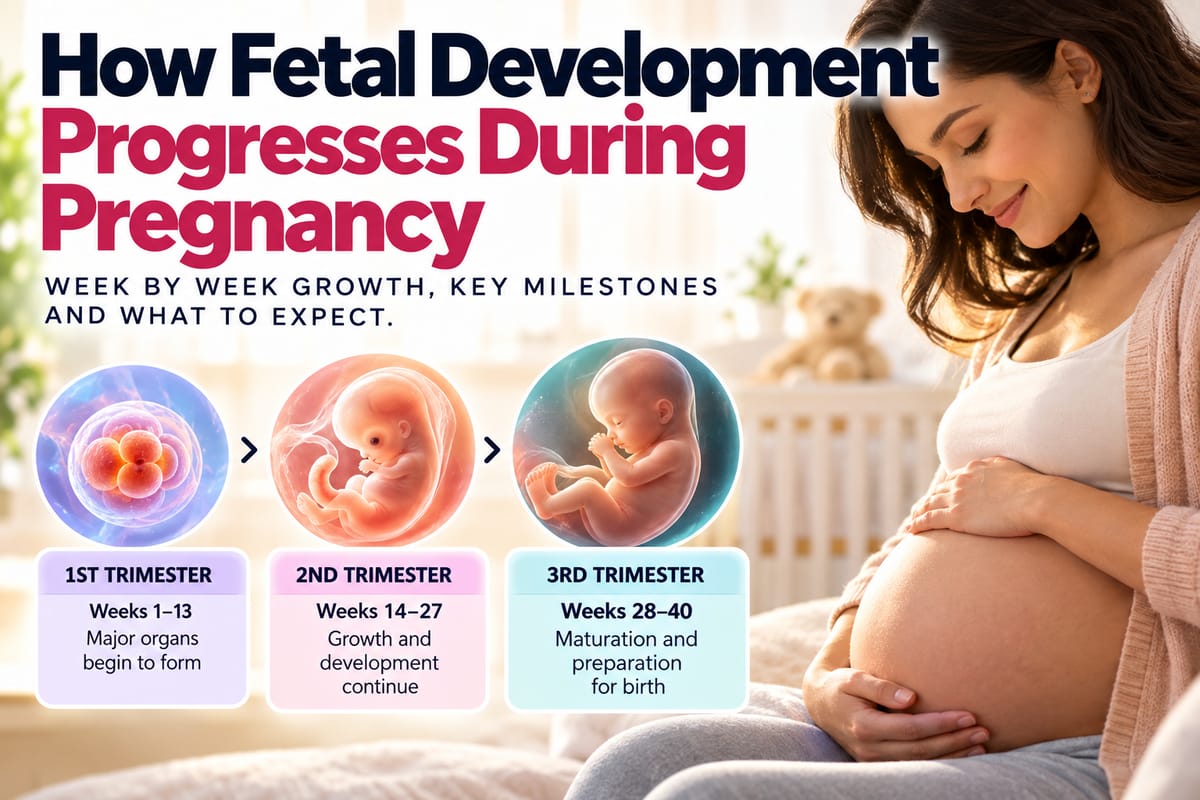

How Fetal Development Progresses During Pregnancy
Pregnancy is a remarkable period of development in which a fertilized egg gradually becomes a developing fetus and, eventually, a newborn ready for life outside the uterus. Over roughly 40 weeks, the body undergoes a carefully coordinated sequence of changes involving the brain, heart, organs, bones, muscles, lungs, and other systems.
Fetal development does not happen at the same pace throughout pregnancy. Different organs and body systems have particularly important periods of growth and maturation, while the mother’s body also changes to support the developing baby.
Understanding the general stages of fetal development can make pregnancy easier to understand and can provide useful context for prenatal care, pregnancy planning, and discussions with healthcare professionals.
What Happens at the Beginning of Pregnancy?
Pregnancy begins when sperm fertilizes an egg, creating a single cell that contains genetic material from both biological parents.
The fertilized egg begins dividing as it moves toward the uterus. Within several days, it develops into a structure capable of attaching to the uterine lining.
Once implantation occurs, the developing pregnancy begins establishing the biological connections needed for continued growth.
At this very early stage, the developing organism is extremely small. Nevertheless, rapid cellular division and specialization are already taking place.
The placenta will eventually become an important interface between the pregnant person’s circulation and the developing fetus, helping provide oxygen and nutrients while supporting the removal of waste products.
The First Trimester: Establishing the Foundations
The first trimester covers approximately the first 12 to 13 weeks of pregnancy.
This is an especially important period because many of the body’s major structures begin forming during these weeks.
During the earliest stages, cells become increasingly specialized. Some develop into tissues that will form organs, while others contribute to structures such as the placenta and umbilical cord.
The developing embryo undergoes substantial changes in a relatively short period.
Weeks 1 to 4
During the first several weeks, implantation and early embryonic development take place.
The foundations of the nervous system begin forming, while the structures that will eventually become the heart and other major organs start developing.
Although the embryo is still extremely small, the basic organizational plan for further development is already being established.
Weeks 5 to 8
The developing embryo begins taking a more recognizable form.
The early heart structures develop and begin functioning during this period. The brain and spinal cord continue developing, and the foundations of the eyes, ears, arms, and legs become increasingly distinct.
Small limb buds develop into more recognizable upper and lower limbs.
At the same time, major internal organs continue their early development.
Because so many fundamental structures are forming during the first trimester, prenatal care and attention to factors that can affect pregnancy are particularly important.
People considering pregnancy may also benefit from understanding the broader principles described in the Complete Guide to Reproductive Health.
Weeks 9 to 13
By around the ninth week, the developing baby is generally referred to as a fetus rather than an embryo.
The head remains proportionally large because the brain is developing rapidly, but the body becomes increasingly defined.
Facial structures continue developing, fingers and toes become more distinct, and bones and muscles begin maturing.
Movement also begins during this period, although it is generally too subtle to be felt by the pregnant person.
The fetus continues developing organs and body systems while growing in length and weight.
The Second Trimester: Growth and Increasing Development
The second trimester generally covers weeks 14 through 27.
During this period, the fetus continues developing while becoming larger and more physically recognizable.
Many of the basic organs and structures formed during the first trimester continue maturing rather than appearing for the first time.
Weeks 14 to 17
The fetus begins developing more coordinated movements.
The facial muscles become more developed, and structures such as the bones and joints continue maturing.
The skeletal system becomes increasingly organized, while the nervous system continues developing connections that help coordinate movement.
The fetus may also begin making movements involving the mouth and face.
These developments occur even though many aspects of organ function remain immature.
Weeks 18 to 22
This period is associated with continued growth and increasingly coordinated movement.
The fetus develops more defined facial characteristics, while the bones, muscles, nervous system, and sensory structures continue maturing.
Many pregnant people begin noticing fetal movement during the middle portion of pregnancy, although the timing varies considerably from one pregnancy to another.
The fetus also develops increasingly complex patterns of movement and activity.
Healthcare providers may perform detailed prenatal assessments during this stage to evaluate fetal growth and development.
Weeks 23 to 27
During the later part of the second trimester, the fetus continues gaining weight while the lungs and nervous system undergo further development.
The brain becomes increasingly complex, and connections between different parts of the nervous system continue forming.
The lungs are developing but remain immature, which is one reason babies born substantially before term may require specialized medical support.
The fetus also continues accumulating body fat, although considerably more development and growth remain before full term.
The Third Trimester: Maturation and Preparation for Birth
The third trimester generally begins around week 28 and continues until birth.
The fetus is now primarily focused on continued growth and maturation of systems that will support life outside the uterus.
The brain, lungs, digestive system, immune system, muscles, and other organs continue developing.
Weeks 28 to 31
Brain development accelerates, and the fetus becomes increasingly capable of coordinated movement.
The lungs continue maturing, although they may still require additional development before they can function independently after birth.
The fetus also continues gaining weight and accumulating fat beneath the skin.
These changes help prepare the body for temperature regulation and energy needs after delivery.
Weeks 32 to 36
Growth continues at a significant rate.
The fetus typically gains additional body fat and muscle while the lungs and nervous system continue maturing.
Movement remains important, although the character of movement can change as available space becomes more limited.
The fetus may gradually settle into a position that is suitable for birth, although not every baby is positioned head-down before labor begins.
During this period, healthcare professionals continue monitoring maternal and fetal health as pregnancy progresses toward delivery.
Information about recognizing potential problems is covered in How Pregnancy Complications Are Recognized and Managed.
Weeks 37 to 40 and Beyond
By approximately 37 weeks, a pregnancy has reached a stage at which the fetus is generally considered early term, with additional weeks allowing continued maturation and growth.
During the final weeks, the lungs, brain, nervous system, and other organs continue developing.
The fetus may gain additional weight, while the body becomes better prepared for the transition from the protected environment of the uterus to independent life.
Pregnancy does not always end precisely at 40 weeks. Some babies are born earlier, while others remain in the uterus beyond the estimated due date.
Healthcare providers consider the overall health of the pregnant person and fetus when determining appropriate monitoring and care near the end of pregnancy.
How the Placenta Supports Fetal Development
The placenta plays a central role throughout pregnancy.
It develops alongside the fetus and provides an interface through which oxygen and nutrients can reach the developing baby while waste products are transferred away.
The placenta also produces hormones that help maintain pregnancy and support changes in the mother’s body.
The umbilical cord connects the fetus to the placenta and contains blood vessels that facilitate the exchange of oxygen, nutrients, and waste products.
This system allows the fetus to develop without directly sharing the mother’s blood circulation in the same way that two individuals would share a bloodstream.
How the Fetal Brain Develops
Brain development begins very early and continues throughout pregnancy.
The nervous system starts with the formation of the neural tube, which eventually develops into the brain and spinal cord.
As pregnancy progresses, neurons are produced and organized while connections between different areas of the nervous system become increasingly complex.
Brain development does not end at birth. However, substantial prenatal development prepares the newborn for basic functions and continued neurological maturation after delivery.
The rapid pace of brain development is one reason pregnancy involves many factors that can influence fetal health.
How the Heart Develops
The cardiovascular system is among the earliest major systems to develop.
The primitive heart begins forming early in embryonic development and undergoes substantial changes as the pregnancy progresses.
Over time, the heart develops increasingly specialized structures that allow it to circulate blood through the developing body.
The fetal circulation also differs from circulation after birth because the fetus receives oxygen through the placenta rather than breathing air through the lungs.
After birth, major changes occur as the newborn begins breathing and the circulatory system transitions to supporting independent respiration.
How the Lungs Mature
The lungs begin developing relatively early but require much of pregnancy to mature.
Early lung structures gradually branch and develop into increasingly complex respiratory tissues.
Later in pregnancy, the lungs develop structures and substances that help prepare them for air breathing after birth.
Lung maturity is particularly important when considering premature birth because babies born significantly before term may have respiratory systems that are not yet fully prepared for independent breathing.
Medical teams can provide specialized support when premature delivery occurs.
How Bones and Muscles Develop
The skeletal system begins forming during early development and continues changing throughout pregnancy.
Some early skeletal structures begin as softer tissues that gradually become more bone-like through a process called ossification.
Muscles develop alongside the skeleton, allowing the fetus to move.
As the nervous system matures, movements become increasingly coordinated.
These movements are an important part of normal fetal development, although the timing and intensity of movements vary between pregnancies.
How the Senses Develop
The sensory systems also develop gradually.
The eyes begin forming early, while the structures responsible for hearing develop over the course of pregnancy.
The nervous system eventually becomes capable of processing increasingly complex sensory information.
Taste and smell systems also develop before birth, and research has shown that the prenatal environment provides opportunities for sensory exposure.
However, fetal sensory development is not identical to the fully mature sensory experience of a newborn or adult.
Factors That Can Influence Fetal Development
Fetal development is influenced by many biological and environmental factors.
These can include:
- Maternal nutrition
- Overall health
- Genetic factors
- Certain medications
- Alcohol and tobacco exposure
- Some infections
- Environmental exposures
- Placental health
- Maternal blood pressure and blood sugar
- Access to appropriate prenatal care
Not every pregnancy develops in exactly the same way, and individual circumstances can significantly affect fetal growth and development.
This is why prenatal healthcare is important. Healthcare professionals can monitor pregnancy and identify situations that may require additional evaluation or treatment.
Why Preconception Health Matters
Fetal development begins very early, sometimes before a person realizes that pregnancy has occurred.
For this reason, health before conception can be an important part of reproductive care.
The How Preconception Health Can Support Reproductive Health guide explores how health and lifestyle considerations before pregnancy can contribute to reproductive and pregnancy care.
Planning can also provide an opportunity to discuss existing health conditions, medications, nutrition, vaccinations, family medical history, and other factors with a healthcare professional.
The broader process of preparing for pregnancy is covered in the Pregnancy Planning Guide.
Why Every Pregnancy Develops at Its Own Pace
Pregnancy timelines are useful for understanding general developmental milestones, but they should not be treated as an exact schedule for every pregnancy.
Two healthy pregnancies can differ in the timing of fetal movement, growth patterns, positioning, and other developmental characteristics.
Healthcare professionals therefore consider multiple factors when assessing fetal development.
Ultrasound examinations, physical assessments, medical history, and other forms of prenatal monitoring can provide a more complete picture than any single developmental milestone.
From Early Cells to a Developing Baby
Fetal development is a continuous process rather than a series of isolated events.
The earliest weeks establish the foundations for major organs and body systems. The second trimester brings substantial growth and increasingly coordinated development, while the third trimester focuses heavily on maturation, weight gain, and preparation for life outside the uterus.
Understanding these stages can help explain why prenatal care begins early and continues throughout pregnancy. It also highlights how closely connected maternal health, placental function, fetal growth, and organ development are.
By the time birth approaches, the fetus has progressed through months of carefully coordinated biological changes, transforming from a microscopic beginning into a developing human being prepared to make the transition into the world.
Continue Reading
Similar Posts

How Gender Can Influence Health Outcomes
Understanding these influences can help explain why some health conditions affect women and men differently and why healthcare cannot always take a one-size-fits-all approach.
Read article
How Period Pain Differs From Severe Pain
Understanding the difference between typical menstrual cramps and pain that may be unusually severe can help people recognize when symptoms deserve additional attention.
Read article
Why Sex-Specific Health Research Matters
This does not mean that women and men need completely separate medical systems. Many diseases, treatments, and health recommendations apply broadly across populations. Instead, sex-specific research helps identify situations where biological differences are relevant and where medical knowledge can be improved by studying women and men appropriately.
Read article

Join 10,000+ Readers Building Healthier Habits
Get actionable wellness tips every week plus our newest articles delivered straight to your inbox.