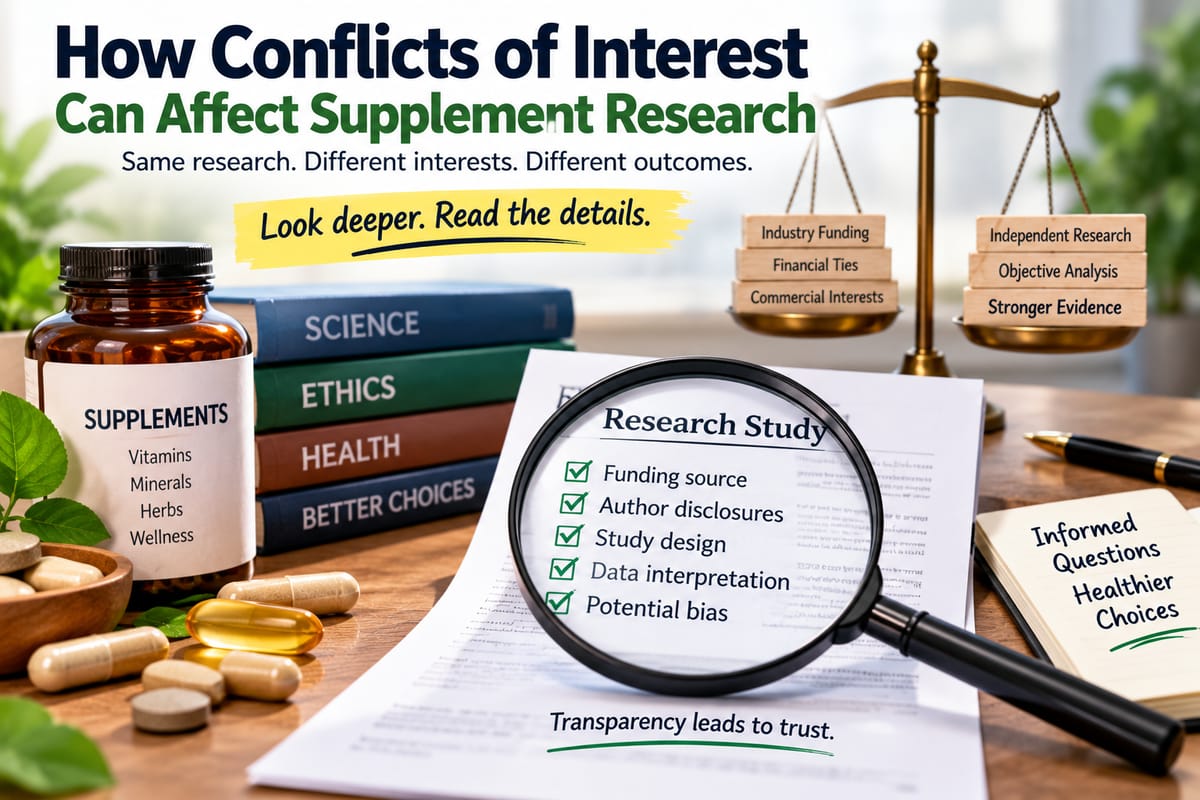

How Conflicts of Interest Can Affect Supplement Research
Dietary supplement research can provide valuable information about vitamins, minerals, herbs, botanical extracts, and other ingredients. But when evaluating that research, it is important to look beyond the results themselves.
One factor that deserves attention is the possibility of a conflict of interest.
A conflict of interest does not automatically mean that research is inaccurate, biased, or unusable. Researchers, universities, medical institutions, and companies can have legitimate financial or professional relationships that do not invalidate scientific findings.
However, these relationships can create circumstances in which researchers or organizations may have interests that could influence how a study is designed, conducted, analyzed, or communicated.
Understanding conflicts of interest can therefore help consumers, healthcare professionals, and researchers interpret supplement evidence more carefully.
What Is a Conflict of Interest?
A conflict of interest occurs when a person or organization has competing interests that could potentially influence professional judgment.
In supplement research, these interests can include:
- Financial relationships with supplement manufacturers
- Research funding from companies
- Consulting arrangements
- Speaking fees
- Stock ownership
- Patent ownership
- Licensing agreements
- Employment relationships
- Commercial interests in a product or ingredient
A conflict of interest does not prove that someone acted improperly.
Instead, it identifies a situation in which there may be a reason to examine the research and decision-making process more closely.
Transparency is therefore important.
Why Conflicts of Interest Matter in Supplement Research
Supplement research can have direct commercial consequences.
If a study finds that an ingredient appears beneficial, the manufacturer may use the findings in marketing or product development.
If research produces unfavorable results, it could affect sales, investment, or public perception.
These financial incentives do not necessarily determine the outcome of a study. Scientific researchers can conduct high-quality work while receiving industry funding.
However, potential conflicts matter because they can influence decisions at different stages of the research process.
For example, researchers may have choices about:
- What question to study
- Which participants to recruit
- How long the study should last
- Which dose to use
- What comparison group to include
- Which outcomes to measure
- How results are analyzed
- Which findings receive emphasis
These decisions can affect how informative a study ultimately becomes.
Industry Funding Is Not Automatically Bad
It is important not to treat industry-funded research as automatically unreliable.
Companies have an important role in researching products they manufacture, and commercial funding can make some research possible.
Industry-sponsored studies may use appropriate scientific methods, independent researchers, transparent protocols, and rigorous statistical analysis.
The important question is not simply:
“Who paid for the study?”
A better question is:
“How was the study designed, conducted, analyzed, reported, and independently evaluated?”
Funding is one factor in assessing evidence rather than a substitute for assessing the evidence itself.
How a Conflict Can Influence Study Design
Study design is one area where potential conflicts deserve attention.
Researchers must make decisions about what the study will actually test.
For example, suppose a supplement is marketed for supporting a particular aspect of health.
A study could measure a meaningful clinical outcome, or it could measure a less important biological marker.
Those outcomes may produce very different interpretations.
A study that uses a highly specific population, a particular dosage, or a short follow-up period may also produce results that do not apply broadly.
This is why understanding methodology is essential when evaluating supplement research.
A useful starting point is How to Evaluate Scientific Evidence Behind Dietary Supplement Claims.
The Importance of the Comparison Group
The comparison group can strongly influence how a supplement study is interpreted.
A supplement may be compared with:
- A placebo
- No treatment
- Another supplement
- Standard care
- A different dose
- A different formulation
A well-designed placebo-controlled trial can help researchers determine whether observed changes are likely to be associated with the intervention rather than expectations or other factors.
If the comparison is weak or inappropriate, interpreting the results can become more difficult.
Choosing the Study Population
Who participates in a study also matters.
Researchers may study:
- Healthy adults
- Older adults
- Athletes
- People with nutrient deficiencies
- People with a specific health condition
- People taking certain medications
A supplement may produce different results in different groups.
Potential conflicts of interest could become relevant if researchers select a population that is particularly likely to produce a favorable result or if the study population does not reflect the people who are likely to purchase the product.
That does not automatically mean the design is biased, but it is a reason to examine the research question carefully.
Dosage Can Affect the Results
The amount of an ingredient used in a study can significantly influence its results.
Researchers may test:
- A low dose
- A moderate dose
- A high dose
- Multiple doses
- A specific standardized extract
If a study uses a dosage that is substantially different from the amount found in a commercial product, consumers should be cautious about assuming that the study directly proves the product’s effectiveness.
The same applies to the form of an ingredient.
Different chemical forms or extraction methods can have different characteristics.
Selecting Outcomes Can Influence Interpretation
A supplement study may measure several outcomes.
Some may show an improvement while others do not.
Researchers must decide which outcomes are primary and which are secondary.
This distinction matters because a study can produce many measurements simply through the process of collecting data.
If a large number of outcomes are tested, some may appear statistically significant by chance.
Pre-specifying important outcomes helps researchers reduce this problem.
When reviewing a study, it can therefore be useful to ask:
- What was the primary outcome?
- Was it specified before the study began?
- How many outcomes were measured?
- Were secondary findings emphasized more than the primary result?
Statistical Significance Is Not the Same as Practical Importance
A result can be statistically significant without being especially meaningful in everyday life.
For example, a study might identify a small difference between groups that meets a statistical threshold.
The next question is whether that difference is large enough to matter.
Researchers and readers should consider:
- Size of the effect
- Confidence intervals
- Duration of the effect
- Clinical relevance
- Real-world importance
This distinction is particularly important when supplement marketing turns a small statistical difference into a much larger promotional claim.
Selective Reporting Can Affect the Evidence
Another concern is selective reporting.
Researchers may conduct studies that produce several findings, but not every result receives equal attention.
In extreme cases, unfavorable or nonsignificant results may receive less visibility than favorable findings.
This can create an incomplete picture of the evidence if positive findings are repeatedly highlighted while less favorable results remain difficult to find.
Researchers can reduce this problem through practices such as registering studies in advance and clearly reporting their planned outcomes.
Publication Bias
Publication bias occurs when studies with certain results are more likely to be published or become visible than studies with other results.
If positive supplement studies are more likely to appear in journals than studies finding little or no benefit, the published literature could make an ingredient appear more effective than it actually is.
This is one reason researchers often look beyond individual studies.
Systematic reviews and meta-analyses can help assess the broader body of evidence, although they can also be affected by limitations in the studies available for inclusion.
Why Replication Matters
A single study can produce an interesting finding.
Replication provides another layer of evidence.
If independent researchers conduct well-designed studies and obtain similar results, confidence in the finding generally increases.
If results vary widely across studies, researchers need to investigate why.
Differences may arise from:
- Study populations
- Dosages
- Product formulations
- Study duration
- Research methods
- Sample sizes
- Statistical approaches
A strong scientific conclusion usually develops from a body of evidence rather than one isolated result.
The Role of Independent Researchers
Independent research can be particularly useful when assessing commercially important claims.
If a company’s own research suggests that its product is effective, independent studies can help determine whether the finding holds under different research conditions.
Independent replication does not mean that industry research should be ignored.
Instead, multiple sources of evidence provide a more complete picture.
The broader the range of researchers, institutions, populations, and methodologies supporting a finding, the more useful the evidence becomes.
Funding Disclosure Helps Readers Evaluate Research
Scientific journals commonly require researchers to disclose relevant financial relationships and funding sources.
A disclosure might indicate:
- Who funded the study
- Whether a company supplied the product
- Whether researchers received consulting payments
- Whether authors have relevant patents
- Whether researchers have other financial relationships
This information allows readers to understand the context surrounding the research.
Transparency does not prove that a conflict affected the results, but it gives readers information that can be considered when evaluating the evidence.
Conflicts Can Affect More Than the Researcher
Potential conflicts can occur at multiple levels.
They may involve:
- Individual researchers
- Universities
- Research institutions
- Study sponsors
- Contract research organizations
- Scientific journals
- Professional organizations
- Product manufacturers
A researcher may have no personal financial interest while the institution conducting the research has a commercial relationship with a company.
That is why conflict-of-interest disclosures can include several types of relationships.
The Difference Between Bias and Fraud
A conflict of interest should not automatically be interpreted as scientific misconduct.
There is an important difference between:
Conflict of interest: A situation in which competing interests could potentially influence judgment.
Bias: A systematic tendency that can affect research design, interpretation, or conclusions.
Scientific misconduct: Deliberate wrongdoing such as fabricating or falsifying research data.
These concepts should not be treated as interchangeable.
A disclosed financial relationship is not evidence of fraud.
Likewise, a study with no disclosed conflict is not automatically free from all forms of bias.
How Marketing Can Magnify Research Findings
Even when a study is conducted appropriately, marketing materials may describe the findings more strongly than the research itself supports.
A scientific paper might report that an ingredient was associated with a modest improvement under specific conditions.
Marketing language might transform that into a broad statement suggesting that the product provides major benefits.
This creates another layer of interpretation between the research and the consumer.
The original study therefore matters more than a simplified promotional summary.
Watch for Claims That Go Beyond the Study
A useful habit is to compare the exact research question with the exact marketing claim.
Suppose a study investigates whether a particular supplement changes a specific laboratory measurement over eight weeks.
A product advertisement might instead suggest that the supplement:
- Improves overall health
- Produces rapid results
- Works for everyone
- Prevents a wide range of problems
Those broader claims may not be supported by the study.
The question should always be:
Did the research actually test the claim being made?
Look at the Product Being Studied
Another important issue is whether the research involved the same product consumers are purchasing.
A study might examine:
- A purified ingredient
- A specific botanical extract
- A particular chemical form
- A standardized preparation
- A combination of ingredients
A commercial product could contain a different formulation.
Differences in formulation, dosage, purity, manufacturing, and stability can affect how closely the research applies to the product on a store shelf.
This makes product quality another important part of interpreting supplement evidence.
More information about manufacturing, testing, identity, purity, and consistency can be found in How Supplement Quality and Testing Work.
Manufacturing Quality Can Complicate Research
Supplements are not always identical from one product to another.
Differences can occur in:
- Ingredient concentration
- Chemical form
- Extraction methods
- Contaminants
- Stability
- Manufacturing processes
- Storage conditions
If researchers use a carefully characterized product, their findings may not automatically apply to every product containing the same named ingredient.
This is another reason consumers should distinguish between evidence about an ingredient and evidence about a particular commercial formulation.
How Systematic Reviews Help
A systematic review attempts to identify and assess relevant research using a structured methodology.
Rather than relying on one study, researchers can examine multiple studies addressing a similar question.
A systematic review may evaluate:
- Study quality
- Sample sizes
- Different populations
- Dosages
- Outcomes
- Consistency of results
- Potential sources of bias
This broader perspective can make it easier to determine whether an isolated positive finding fits the overall evidence.
What Meta-Analysis Adds
A meta-analysis statistically combines results from multiple studies when appropriate.
Combining data can provide a more precise estimate of an effect than an individual small study.
However, a meta-analysis is not automatically reliable simply because it contains many studies.
If the underlying studies have serious methodological problems, combining them does not necessarily solve those problems.
Researchers must therefore consider the quality and similarity of the included studies.
How to Recognize Warning Signs
Consumers can watch for several signs that warrant closer examination.
These may include:
- Heavy emphasis on one favorable study
- Failure to disclose funding
- Claims that exceed the study’s findings
- Reliance primarily on testimonials
- Dramatic claims based on preliminary research
- Vague references to “clinical studies”
- No discussion of limitations
- Marketing that presents uncertainty as certainty
- A product claiming to solve numerous unrelated problems
- Studies using a formulation that differs from the product being sold
None of these factors automatically proves that a product is ineffective.
They simply indicate that additional scrutiny may be useful.
A practical guide to identifying problematic promotional language is How to Recognize Questionable Supplement Claims.
Consider the Entire Body of Evidence
The strongest way to evaluate a supplement claim is to consider multiple pieces of evidence together.
This can include:
- Randomized controlled trials
- Observational studies
- Systematic reviews
- Meta-analyses
- Mechanistic research
- Safety studies
- Replication studies
- Evidence from different research groups
A single study rarely answers every question.
The overall pattern is more informative than an isolated result.
Ask Who Benefits From the Result
One simple question can help identify potential conflicts:
Who could financially or professionally benefit if this result were accepted?
For example, a favorable finding may benefit:
- A supplement manufacturer
- An ingredient supplier
- A researcher with a patent
- A company developing a related product
- An organization promoting a particular intervention
Again, potential benefit does not prove that the research is wrong.
It simply provides context for interpreting the evidence.
Look for Transparency
Transparency is one of the strongest safeguards against hidden conflicts.
Useful signs include:
- Clear funding disclosures
- Declared financial relationships
- Registered study protocols
- Pre-specified outcomes
- Detailed methodology
- Transparent statistical analysis
- Disclosure of limitations
- Publication of unfavorable findings
- Independent replication
Research that openly explains how it was conducted gives readers more information with which to assess its reliability.
Conflicts of Interest Can Also Affect Interpretation
Potential conflicts are not limited to the way a study is conducted.
They can also affect how results are interpreted and communicated.
A study may produce a modest or uncertain result, but the interpretation could emphasize the most favorable aspect.
For example, researchers might describe a result as “promising” even when the evidence remains preliminary.
Readers should therefore distinguish between:
What the data showed
and
What the researchers believe the findings mean.
The first is based on measured results. The second involves interpretation.
Read the Limitations Section
Scientific papers generally include limitations.
These sections can reveal important information that promotional materials may not emphasize.
Limitations may include:
- Small sample size
- Short study duration
- Lack of diversity among participants
- High dropout rates
- Measurement limitations
- Potential confounding
- Uncertain long-term effects
- Limited generalizability
A study that openly acknowledges its weaknesses is not necessarily weak research.
In fact, recognizing limitations is an important part of scientific reporting.
Don’t Ignore Negative Results
Negative or null findings are part of science.
A study showing that a supplement did not produce a meaningful difference can be just as informative as a study showing a positive effect.
If only favorable results are considered, consumers can develop an unrealistic impression of an ingredient’s effectiveness.
This is why evidence evaluation should include studies that do not support the desired conclusion.
Natural Products Require Careful Evidence Evaluation
Herbal products and other natural remedies can face many of the same evidence challenges as conventional supplements.
An ingredient being traditionally used does not automatically establish that it is effective for every modern health claim.
Research may support some uses while leaving others uncertain.
The evidence surrounding traditional and natural approaches is discussed more broadly in the Complete Guide to Natural Remedies Evidence.
A Practical Framework for Evaluating Supplement Research
When reading a study, consumers can work through a simple checklist.
1. Identify the Research Question
What exactly were researchers trying to determine?
2. Examine the Funding
Who paid for the research?
3. Check Conflicts of Interest
Did the researchers disclose financial or professional relationships?
4. Examine the Study Design
Was the design appropriate for the question?
5. Look at the Participants
Who was studied, and does that population resemble the people making the claim?
6. Check the Dose
Was the amount studied similar to the amount found in the product?
7. Identify the Outcomes
What did researchers actually measure?
8. Review the Results
How large was the observed effect?
9. Read the Limitations
What weaknesses did the researchers identify?
10. Look for Other Studies
Do independent studies support the same conclusion?
This process provides a more balanced view than relying on a headline or advertisement.
Questions Consumers Can Ask About a Study
Before accepting a supplement claim, consider asking:
- Who funded the research?
- Did the authors disclose conflicts of interest?
- What exactly was tested?
- Was the study randomized?
- Was there a placebo or appropriate comparison group?
- How many people participated?
- How long did the study last?
- What was the dosage?
- What outcomes were measured?
- Was the result statistically significant?
- Was the effect practically meaningful?
- Were there limitations?
- Have independent researchers reproduced the finding?
- Does the commercial product match the product used in the study?
These questions can reveal important context that marketing summaries often leave out.
Why Transparency Builds Better Science
Conflicts of interest cannot always be eliminated.
Scientific research often requires funding, and industry can be an important source of financial support for studies involving commercially developed products.
The goal is therefore not necessarily to eliminate every financial relationship.
Instead, researchers and institutions can emphasize:
- Disclosure
- Independent oversight
- Pre-registration
- Rigorous methodology
- Transparent analysis
- Complete reporting
- Independent replication
These practices make it easier for the scientific community and the public to assess research fairly.
A Conflict Is a Reason to Examine Evidence, Not Reject It
One of the most important principles is avoiding two extremes.
The first is assuming that industry-funded research must be wrong.
The second is assuming that disclosed funding has no relevance at all.
A conflict of interest is best understood as context.
It tells readers that there may be competing interests worth considering. The actual reliability of the research still depends on its methodology, data, analysis, transparency, replication, and consistency with the broader evidence.
A well-designed study with industry funding can provide useful evidence.
A poorly designed study without an obvious financial conflict can still produce misleading results.
Building a More Complete Picture of Supplement Evidence
Supplement research is most useful when it is viewed as part of a larger evidence base.
Consumers can look beyond individual headlines and advertisements by examining study methods, funding disclosures, product formulations, research limitations, and independent evidence.
The most reliable conclusions generally emerge when multiple well-designed studies point in a similar direction.
Conflicts of interest are therefore neither proof of bad science nor something that should be ignored. They are one piece of information that helps readers understand the context surrounding research.
By combining transparency with careful evaluation of study quality, dosage, outcomes, limitations, product quality, and independent replication, people can make better sense of supplement research and distinguish promising evidence from claims that are stronger than the science currently supports.
Continue Reading
Similar Posts

What Is Creatine and How Does It Work?
Understanding how that system works helps explain why creatine has become so closely associated with activities such as weightlifting, sprinting, and other forms of high-intensity exercise.
Read article
Why Excessive Vitamin Intake Can Be Harmful
Understanding the difference between adequate intake and excessive intake is an important part of using vitamin supplements responsibly.
Read article
How Dietary Supplements Can Cause Side Effects
Understanding why side effects happen can help people make more informed decisions about supplement use and recognize situations where professional guidance may be appropriate.
Read article

Join 10,000+ Readers Building Healthier Habits
Get actionable wellness tips every week plus our newest articles delivered straight to your inbox.