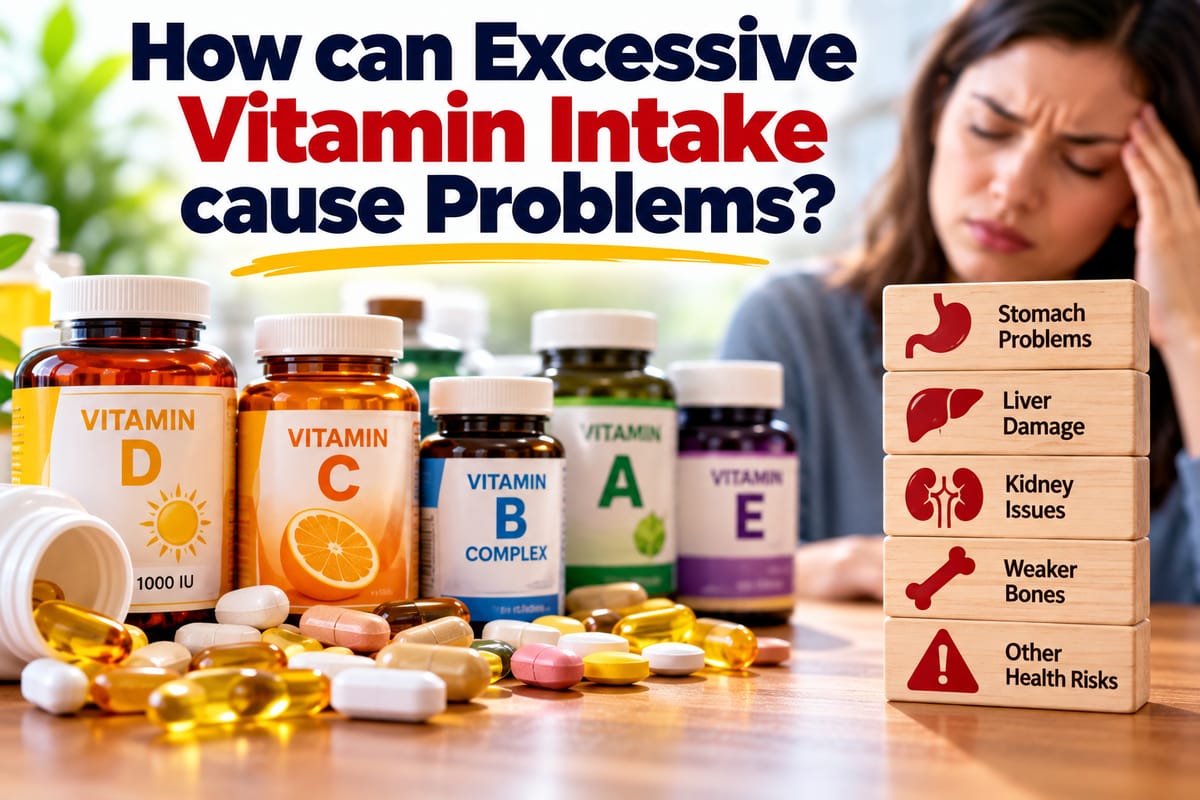

How Can Excessive Vitamin Intake Cause Problems?
Vitamins are essential nutrients that help the body perform a wide range of important functions. They support normal metabolism, immune function, blood formation, vision, bone health, nervous system activity, and many other processes.
Because vitamins are necessary for good health, it can be tempting to assume that taking more must provide additional benefits. That is not generally how nutrition works. Some vitamins can accumulate in the body, while excessive amounts of others can interfere with normal biological processes or cause unwanted effects.
The risk can be particularly relevant when people combine fortified foods, multivitamins, individual vitamin supplements, and other products without realizing that several sources contain the same nutrient.
Understanding how excessive vitamin intake can cause problems is therefore an important part of using supplements responsibly.
Why Does the Body Need Vitamins?
Vitamins are organic compounds required in relatively small amounts for normal physiological functions.
Some vitamins help enzymes carry out chemical reactions, while others participate in processes involving the immune system, blood cells, bones, skin, nerves, or energy metabolism.
The Complete Guide to Vitamins and Their Roles provides a broader overview of the different vitamins and the functions they perform in the body.
The fact that vitamins are essential does not mean the body benefits from unlimited quantities. Nutritional requirements generally fall within a range, and consuming substantially more than the body needs can sometimes create problems.
What Does Excessive Vitamin Intake Mean?
Excessive vitamin intake occurs when someone consistently consumes more of a vitamin than is appropriate for their circumstances.
This can happen in several ways.
A person might:
- Take a high-dose vitamin supplement every day
- Combine multiple supplements containing the same vitamin
- Use a multivitamin alongside individual vitamin products
- Consume large amounts of fortified foods while supplementing
- Take supplements at doses substantially above recommended amounts
- Continue taking a high-dose supplement without reassessing whether it is needed
Excess does not necessarily mean that a person experiences immediate symptoms. Some effects develop gradually, particularly when a nutrient accumulates in the body.
The amount that becomes excessive also varies according to the particular vitamin, the dose, how long it is consumed, and individual health circumstances.
Water-Soluble and Fat-Soluble Vitamins Behave Differently
One of the most important distinctions in vitamin nutrition is the difference between water-soluble and fat-soluble vitamins.
Water-Soluble Vitamins
Water-soluble vitamins include vitamin C and the B vitamins.
They generally do not accumulate in the body to the same extent as fat-soluble vitamins. The kidneys can remove some excess amounts through urine.
However, this does not mean that unlimited intake is harmless.
Large supplemental doses of certain water-soluble vitamins can still produce adverse effects. For example, excessive amounts may cause digestive problems or interfere with other nutrients and biological processes.
Fat-Soluble Vitamins
Vitamins A, D, E, and K are fat-soluble vitamins.
Because they can be stored in body tissues, excessive intake can sometimes result in accumulation over time.
This is one reason high-dose supplementation with fat-soluble vitamins deserves particular attention.
A person should not assume that a vitamin is safe simply because it is available without a prescription.
How Can Too Much Vitamin A Cause Problems?
Vitamin A is important for vision, immune function, reproduction, growth, and maintenance of various tissues.
However, excessive intake of preformed vitamin A can cause toxicity.
High amounts over time may contribute to symptoms such as headache, nausea, dizziness, fatigue, and changes involving the skin or hair. More serious effects can occur with substantial or prolonged excess.
Pregnancy is another important consideration because excessive intake of preformed vitamin A can be associated with risks to fetal development.
Vitamin A also illustrates why the form of a nutrient matters. Different compounds associated with vitamin A do not behave identically in the body.
People considering high-dose vitamin A supplements should therefore pay attention to the specific form and amount listed on the product label.
Can Too Much Vitamin D Be Harmful?
Vitamin D plays an important role in calcium regulation and bone health.
Because vitamin D deficiency has received considerable attention, some people take high-dose supplements without determining whether they actually need them.
Excessive vitamin D intake can cause the body to absorb too much calcium from the digestive tract. This can result in elevated calcium levels in the blood.
Potential symptoms can include:
- Nausea
- Vomiting
- Weakness
- Excessive thirst
- Frequent urination
- Confusion
- Loss of appetite
Severe vitamin D toxicity can cause serious complications, including problems involving the kidneys and other organs.
Importantly, excessive vitamin D intake is generally associated with supplementation rather than ordinary sun exposure. The body regulates vitamin D production from sunlight, whereas taking large amounts of supplemental vitamin D can bypass some of those regulatory mechanisms.
What Happens When Vitamin E Intake Is Too High?
Vitamin E is an antioxidant that helps protect cells from oxidative damage and has other roles in normal biological function.
Large supplemental doses, however, can affect blood clotting.
This can be particularly concerning for people taking medications that already influence clotting or bleeding.
The issue demonstrates an important principle of supplementation: a vitamin can have useful biological functions while still causing problems when consumed at unnecessarily high levels.
More is not automatically better.
Can Excessive Vitamin C Cause Problems?
Vitamin C is a water-soluble vitamin involved in collagen production, immune function, antioxidant activity, and other biological processes.
Because excess vitamin C can be excreted, it is sometimes perceived as being virtually impossible to overconsume.
However, very high supplemental doses can cause gastrointestinal symptoms such as:
- Diarrhea
- Nausea
- Abdominal discomfort
- Stomach cramps
High vitamin C intake may also increase urinary oxalate in some circumstances, which can be relevant to people who are susceptible to certain types of kidney stones.
The potential benefits of meeting vitamin C requirements do not necessarily increase proportionally as intake continues to rise.
What About Excessive B Vitamins?
The B vitamins are a group of water-soluble nutrients with different roles in metabolism, nervous system function, blood formation, and other processes.
They should not be treated as one substance because each B vitamin has different properties and potential risks.
For example, excessive supplemental vitamin B6 over prolonged periods can cause nerve-related problems. This is an important reason to check the amount of B6 in products that are taken regularly.
Some supplements contain combinations of B vitamins at doses far above ordinary nutritional requirements.
Taking several products at once can unintentionally increase total intake.
Why Combining Supplements Can Increase Risk
One of the easiest ways to accidentally consume too much of a vitamin is to use multiple products without checking their ingredients.
Consider a person who takes:
- A daily multivitamin
- A vitamin D supplement
- A vitamin C product
- A B-complex supplement
- A fortified nutritional drink
Each product may appear reasonable when considered separately.
The problem arises when the same nutrient appears across several products.
For example, a person may not realize that their multivitamin already contains vitamin D while also taking a separate high-dose vitamin D supplement.
This is why the Complete Guide to Dietary Supplements is useful for understanding how different types of supplement products fit into broader nutrition decisions.
Symptoms Do Not Always Identify the Cause
An important complication is that symptoms associated with excessive nutrient intake are often nonspecific.
Nausea, fatigue, headaches, digestive problems, or changes in appetite can have many possible causes.
Someone should not automatically assume that a symptom is caused by a vitamin supplement, but they should consider their supplement use when discussing unexplained symptoms with a healthcare professional.
Keeping a record of products, doses, and how frequently they are taken can make that discussion more useful.
Why Dosage Matters
The amount of a vitamin consumed is central to determining whether supplementation is appropriate.
Nutrition guidance often distinguishes between amounts needed to meet nutritional requirements and upper levels beyond which the likelihood of adverse effects may increase.
These values are not necessarily targets.
A person does not generally need to consume the highest amount considered tolerable.
For some nutrients, the gap between an ordinary nutritional requirement and a potentially excessive supplemental dose can be significant.
The appropriate intake can also depend on age, pregnancy status, diet, medications, health conditions, and other factors.
Supplement Labels Can Reveal Hidden Excess
Reading labels carefully is one of the simplest ways to reduce the risk of excessive vitamin intake.
A label can reveal:
- The amount of each vitamin per serving
- The recommended serving size
- The number of servings in a container
- Other ingredients
- Whether multiple servings are being consumed
- Whether a product contains several forms of the same nutrient
The How to Read Supplement Labels Correctly guide can help explain what to look for when evaluating supplement information.
People should pay particular attention when they use several products simultaneously.
Food and Supplements Are Not the Same Thing
Most vitamins can be obtained through a varied diet that includes nutrient-rich foods.
Food also contains protein, fiber, minerals, essential fats, carbohydrates, and numerous other compounds that work together as part of overall nutrition.
Supplements can be useful in situations where dietary intake does not adequately provide a particular nutrient or when a healthcare professional recommends supplementation.
However, using a supplement should not automatically be interpreted as an invitation to consume large amounts of a nutrient.
The goal is generally to meet nutritional needs rather than maximize vitamin intake.
Who Should Be Especially Careful With Supplements?
Certain circumstances can make supplement decisions more complicated.
Extra care may be appropriate for people who:
- Take prescription medications
- Use several supplements
- Are pregnant or trying to become pregnant
- Have kidney or liver problems
- Have conditions affecting nutrient metabolism
- Follow medically restricted diets
- Are considering high-dose supplements
- Are preparing for surgery
- Have been advised to restrict certain nutrients
In these situations, professional guidance can help determine whether a supplement is appropriate and whether the dose creates unnecessary risk.
Vitamin Interactions Can Matter Too
The effects of a supplement do not occur in isolation.
Vitamins and other nutrients can interact with medications, minerals, and physiological processes.
For example, certain supplements may influence how medications are absorbed or processed, while some nutrients can affect blood clotting or mineral balance.
The risk therefore cannot always be evaluated simply by asking whether a vitamin is generally considered safe.
The person’s overall diet, medications, health circumstances, and other supplements can all matter.
High Doses Are Not Always Better for Deficiency
There is an important difference between correcting a deficiency and taking large amounts indefinitely.
When someone has a documented deficiency, a healthcare professional may recommend a specific supplement and dose. In some cases, the amount used for a limited period can be higher than ordinary daily nutritional requirements.
That does not mean the same dose should be continued permanently.
Once nutritional status changes, the appropriate strategy may change as well.
This is one reason high-dose supplementation should have a clear purpose and, when appropriate, professional supervision.
Why “Natural” Does Not Mean Risk-Free
Some people assume that vitamins are automatically safe because they are naturally occurring substances.
That reasoning can be misleading.
Many substances found naturally in the body or in foods can become harmful at sufficiently high concentrations.
The relevant question is not simply whether a nutrient is natural. It is whether the amount being consumed is appropriate.
The same principle applies to supplements marketed as concentrated sources of vitamins or other nutrients.
How to Reduce the Risk of Excessive Vitamin Intake
Several practical habits can make supplement use more responsible.
Review Every Supplement You Take
Make a list of all vitamins, multivitamins, minerals, nutritional drinks, and other supplements you use.
This makes it easier to identify overlapping ingredients.
Check the Amount Per Serving
Do not look only at the name of the vitamin.
Check how much the product provides per serving and how many servings you actually consume.
Avoid Unnecessary Duplication
If two products provide the same nutrient, determine whether both are actually needed.
Taking multiple products with overlapping ingredients can increase total intake without providing a corresponding benefit.
Follow Product Directions
Do not automatically assume that taking more capsules will produce better results.
Follow the stated serving instructions unless a qualified healthcare professional has recommended a different approach.
Review Long-Term Use
A supplement that made sense temporarily may not necessarily be needed indefinitely.
Periodic review can help determine whether continued supplementation remains appropriate.
Discuss High-Dose Supplements With a Professional
If a product contains a particularly high amount of a vitamin, professional advice can help put the dose into context.
This is especially important when medications, pregnancy, chronic health conditions, or multiple supplements are involved.
Understanding the Balance Between Enough and Too Much
Vitamins occupy an important place in nutrition, but the relationship between intake and health is not simply “more is better.”
The body requires sufficient amounts to perform essential functions. Below an adequate level, deficiency can become a concern. At substantially higher levels, however, some nutrients can cause adverse effects.
The ideal approach is therefore based on adequacy rather than excess.
A balanced diet can provide many essential vitamins, while supplements can serve specific purposes when dietary intake or individual circumstances warrant them.
The Bigger Picture of Supplement Safety
Understanding excessive vitamin intake is only one part of responsible supplement use.
The broader issue involves knowing what a product contains, why it is being used, how much is being taken, how long it will be used, and whether it could interact with other products or medications.
A supplement routine should therefore be considered as part of a person’s overall nutrition and health picture rather than as a collection of isolated products.
For anyone using multiple supplements, regularly reviewing labels, doses, overlapping ingredients, and the reason for taking each product can help prevent unnecessary exposure to excessive amounts.
Vitamins are essential nutrients, but their benefits depend on getting appropriate amounts. The goal is not to consume as many vitamins as possible—it is to provide the body with what it needs while recognizing that excessive intake can sometimes turn an otherwise useful nutrient into a source of problems.
Continue Reading
Similar Posts

What Is Creatine and How Does It Work?
Understanding how that system works helps explain why creatine has become so closely associated with activities such as weightlifting, sprinting, and other forms of high-intensity exercise.
Read article
Why Excessive Vitamin Intake Can Be Harmful
Understanding the difference between adequate intake and excessive intake is an important part of using vitamin supplements responsibly.
Read article
How Dietary Supplements Can Cause Side Effects
Understanding why side effects happen can help people make more informed decisions about supplement use and recognize situations where professional guidance may be appropriate.
Read article

Join 10,000+ Readers Building Healthier Habits
Get actionable wellness tips every week plus our newest articles delivered straight to your inbox.