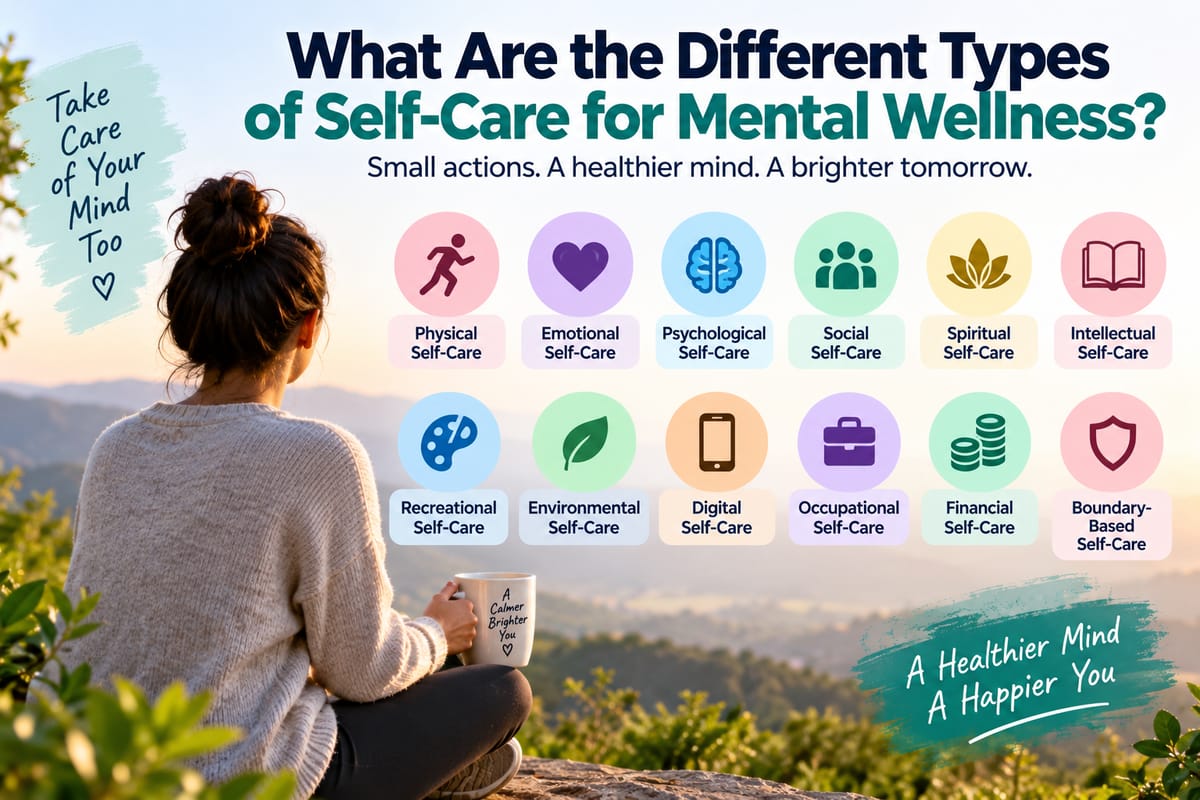

What Are the Different Types of Self-Care for Mental Wellness?
Self-care is often associated with relaxing activities such as taking a bath, watching a favorite show or spending a quiet afternoon away from work. While those activities can be useful, self-care for mental wellness is much broader.
It includes the everyday choices and practices that help people understand their needs, manage stress, maintain healthy routines, protect their energy and stay connected with others.
Mental wellness is not simply the absence of mental health problems. It also involves emotional balance, resilience, healthy relationships, a sense of purpose and the ability to respond to life’s challenges.
That is why effective self-care can look different from one person to another. Someone may need more rest, while another person may benefit from social connection, physical activity, better boundaries or time away from constant digital stimulation.
Understanding the different types of self-care makes it easier to build habits that support mental wellness in practical and sustainable ways.
What Is Self-Care for Mental Wellness?
Self-care refers to intentional actions people take to support their physical, emotional, psychological and social well-being.
For mental wellness, self-care can involve recognizing when stress is building, creating healthy routines, getting enough rest, expressing emotions appropriately, maintaining relationships and making time for activities that provide meaning or enjoyment.
It does not mean avoiding responsibilities or trying to eliminate every uncomfortable emotion.
Instead, self-care is about responding to personal needs in ways that support long-term well-being.
A broader understanding of What Is Mental Wellness? can help put self-care into context because mental wellness involves several interconnected parts of everyday life.
Why Different Types of Self-Care Matter
Mental wellness is influenced by many factors at the same time.
Poor sleep can make everyday stress harder to manage. Social isolation can affect mood. Constant work without recovery can contribute to exhaustion. Difficulty expressing emotions can create additional tension.
This means one self-care activity rarely addresses every need.
Someone who regularly exercises but never rests may still become overwhelmed. Someone who spends plenty of time relaxing but avoids important responsibilities may experience a different kind of stress.
A balanced approach considers multiple areas of well-being rather than treating self-care as a single activity.
1. Physical Self-Care
Physical self-care involves habits that support the body’s basic needs and, indirectly, mental well-being.
Common examples include:
- Getting adequate sleep
- Eating regular, nutritious meals
- Drinking enough water
- Engaging in physical activity
- Taking breaks from prolonged sitting
- Maintaining personal hygiene
- Attending routine health appointments
- Spending time outdoors
- Allowing the body to recover after demanding activities
Physical and mental wellness are closely connected. Lack of sleep, for example, can make it more difficult to regulate emotions, concentrate and cope with everyday challenges.
Physical self-care does not have to involve intense exercise or strict routines. A short walk, consistent bedtime or nutritious meal can be meaningful forms of self-care.
2. Emotional Self-Care
Emotional self-care focuses on recognizing, understanding and responding to emotions in healthy ways.
Everyone experiences difficult emotions. Feeling disappointed, frustrated, anxious, angry or sad is part of normal human experience.
Emotional self-care does not require suppressing these feelings.
Instead, it can involve acknowledging emotions and finding constructive ways to process them.
Examples include:
- Writing in a journal
- Talking with someone trustworthy
- Taking time to identify what you are feeling
- Practicing self-compassion
- Allowing yourself to rest when emotionally overwhelmed
- Expressing feelings respectfully
- Recognizing personal emotional triggers
- Taking a break before responding during conflict
Emotional self-care can also involve learning to distinguish between what can be changed and what must be accepted.
3. Psychological Self-Care
Psychological self-care involves supporting cognitive and mental functioning.
The mind needs periods of focus, stimulation and recovery.
Activities can include:
- Reading
- Learning something new
- Solving puzzles
- Practicing a creative skill
- Taking breaks from demanding tasks
- Challenging unhelpful thought patterns
- Setting realistic expectations
- Reducing unnecessary mental clutter
Psychological self-care can also involve becoming aware of the way thoughts influence emotions and behavior.
For some people, this might mean practicing more balanced thinking when they notice themselves becoming overly critical or pessimistic.
4. Social Self-Care
Humans generally need meaningful social connection.
Social self-care involves maintaining relationships and creating opportunities for positive interaction with other people.
It can include:
- Calling a friend
- Spending time with family
- Joining a community group
- Participating in shared activities
- Asking for support when needed
- Checking in with someone who matters to you
- Setting boundaries in unhealthy relationships
Social self-care does not mean constantly being around people.
People have different social needs, and solitude can also be valuable. The goal is to create a healthy balance between connection and personal space.
For someone experiencing loneliness, increasing meaningful social contact may be particularly helpful. For someone who feels socially overwhelmed, creating quiet time may be more appropriate.
5. Spiritual Self-Care
Spiritual self-care does not necessarily mean following a particular religion.
It can involve activities that help a person explore meaning, values, purpose or a sense of connection.
Depending on the individual, this could include:
- Prayer
- Meditation
- Spending time in nature
- Reflecting on personal values
- Practicing gratitude
- Participating in religious or spiritual communities
- Reading philosophical or spiritual material
- Volunteering or serving others
The central idea is creating space to consider questions about meaning and what matters most.
6. Intellectual Self-Care
Intellectual self-care involves keeping the mind engaged in interesting and meaningful ways.
Learning can provide stimulation and a sense of progress.
Examples include:
- Reading books
- Taking a course
- Learning a language
- Exploring a new subject
- Visiting museums
- Listening to educational podcasts
- Discussing ideas with other people
- Learning a new hobby
Intellectual self-care does not have to involve formal education. Curiosity itself can become a source of enjoyment and mental stimulation.
7. Recreational Self-Care
Recreational self-care involves making room for enjoyment, play and leisure.
Adults often become so focused on work, family obligations and responsibilities that enjoyable activities become secondary.
Recreation can include:
- Watching a movie
- Playing a game
- Listening to music
- Gardening
- Cooking
- Drawing
- Dancing
- Hiking
- Reading for pleasure
- Spending time on a favorite hobby
Enjoyment has value even when it does not produce something measurable.
Regular leisure can provide opportunities to recover from demanding periods and reconnect with activities that feel personally rewarding.
8. Environmental Self-Care
The spaces people live and work in can influence how comfortable and organized they feel.
Environmental self-care involves creating surroundings that support mental well-being.
This might include:
- Cleaning a living space
- Reducing unnecessary clutter
- Organizing a workspace
- Creating a comfortable sleeping environment
- Spending time in nature
- Reducing excessive noise
- Creating spaces for relaxation
- Limiting visual distractions
Environmental self-care does not require creating a perfect home.
Even small changes, such as clearing a desk or making a bedroom more comfortable, can make everyday routines feel more manageable.
9. Digital Self-Care
Modern life creates another area of self-care: digital habits.
Phones, social media, messaging platforms, streaming services and constant notifications can make it difficult to disconnect.
Digital self-care can involve:
- Turning off unnecessary notifications
- Taking regular screen breaks
- Creating phone-free periods
- Reviewing social media habits
- Avoiding excessive late-night screen use
- Unfollowing accounts that consistently create distress
- Protecting personal information
- Creating boundaries around work communication
Digital self-care is not necessarily about avoiding technology.
The goal is to use technology intentionally rather than allowing digital activity to constantly compete for attention.
10. Occupational or Academic Self-Care
Work and education can have a significant effect on mental wellness.
Occupational or academic self-care involves managing responsibilities in ways that reduce unnecessary strain and support sustainable performance.
Examples include:
- Taking appropriate breaks
- Setting realistic goals
- Prioritizing important tasks
- Avoiding unnecessary multitasking
- Creating boundaries between work and personal time
- Asking for clarification when expectations are unclear
- Using vacation or rest periods appropriately
- Recognizing signs of excessive workload
This type of self-care is particularly important because chronic overload can affect sleep, mood, relationships and physical health.
11. Financial Self-Care
Money-related stress can have a substantial impact on mental well-being.
Financial self-care involves taking practical steps to create greater clarity and control around personal finances.
It may include:
- Creating a realistic budget
- Tracking spending
- Planning for upcoming expenses
- Building an emergency fund when possible
- Addressing debts systematically
- Avoiding unnecessary financial commitments
- Seeking appropriate financial guidance
Financial self-care does not mean having a large income or eliminating every financial challenge.
It can simply mean replacing uncertainty with a clearer understanding of the situation and taking manageable steps where possible.
12. Boundary-Based Self-Care
Boundaries are another important part of mental wellness.
A boundary communicates what a person is comfortable with and what they are not able or willing to take on.
Examples include:
- Saying no to unreasonable requests
- Limiting conversations that become harmful
- Protecting personal time
- Separating work from home life
- Deciding when and how to respond to messages
- Communicating personal limits clearly
Healthy boundaries are not about controlling other people.
They are about making decisions regarding one’s own time, energy, attention and participation.
Self-Care and Healthy Coping Skills
Self-care and coping skills are closely related, but they are not identical.
Self-care often involves ongoing habits that support general well-being. Coping skills are strategies used to manage specific stressful situations, difficult emotions or challenging circumstances.
For example, maintaining a regular sleep schedule can be a form of self-care, while using breathing exercises during an intense moment of stress can be a coping strategy.
Learning different approaches can make it easier to respond flexibly when circumstances change. A Complete Guide to Healthy Coping Skills can provide a broader framework for understanding how coping strategies fit into emotional well-being.
Mindfulness as a Form of Self-Care
Mindfulness can be incorporated into several types of self-care.
It involves paying attention to present experiences with greater awareness rather than automatically reacting to every thought or feeling.
Simple mindfulness practices might include:
- Paying attention to breathing
- Eating without distractions
- Taking a mindful walk
- Noticing physical sensations
- Observing thoughts without immediately acting on them
- Spending a few quiet minutes focusing on the present moment
Mindfulness does not require clearing the mind of thoughts.
It is more about developing awareness of what is happening in the present.
The Complete Guide to Mindfulness and Present-Moment Awareness explores this practice in greater detail.
How to Choose the Right Types of Self-Care
There is no universal self-care routine.
The most useful approach is to consider what is currently missing or creating difficulty.
Someone who is exhausted may need more sleep and recovery. Someone who feels isolated may need meaningful social interaction. Someone overwhelmed by work may need stronger boundaries and better workload management.
A simple self-assessment can help:
- How am I feeling physically?
- What emotions have been strongest recently?
- Am I getting enough rest?
- Do I feel connected to other people?
- What responsibilities are creating the most pressure?
- Am I making time for activities I genuinely enjoy?
- What habits seem to improve my well-being?
- What habits consistently leave me feeling depleted?
These questions can reveal where additional attention may be useful.
Self-Care Does Not Have to Be Expensive
One common misconception is that self-care requires buying products, booking retreats or spending significant amounts of money.
Many effective practices cost little or nothing.
Taking a walk, calling someone you trust, getting enough sleep, writing in a notebook, spending time outside, practicing mindfulness or setting a reasonable boundary can all be forms of self-care.
The value of self-care comes primarily from whether an activity supports a genuine need rather than how much it costs.
For a broader look at practical approaches, The Complete Guide to Evidence-Based Self-Care can help distinguish sustainable self-care practices from ideas that may simply sound appealing.
Common Self-Care Mistakes
Self-care can become less helpful when it is approached as another source of pressure.
Common mistakes include:
Treating self-care as a luxury
Self-care is not limited to spa treatments, vacations or special occasions. Everyday habits can be just as important.
Trying to do everything at once
Starting ten new habits simultaneously can create another source of stress. Small changes are often easier to maintain.
Using self-care to avoid problems
Watching television or scrolling through social media may provide temporary relief, but avoidance does not necessarily resolve the underlying issue.
Ignoring basic needs
People sometimes search for complicated wellness strategies while overlooking sleep, nutrition, movement, rest and social connection.
Comparing routines with other people
A self-care practice that works for one person may not work for another. Individual needs, responsibilities and circumstances differ.
Turning self-care into another performance goal
Self-care should support well-being rather than become another area where someone feels they must be perfect.
When Self-Care May Not Be Enough
Self-care can support mental wellness, but it is not a substitute for professional mental health care when someone is experiencing significant or persistent difficulties.
Changes in mood, sleep, behavior or daily functioning that continue or become difficult to manage may deserve professional attention.
People experiencing a mental health crisis or immediate danger should seek appropriate emergency or crisis support in their location.
Self-care can complement professional support, treatment and healthy relationships, but it should not be treated as a solution to every mental health challenge.
Building a Sustainable Self-Care Routine
The most sustainable self-care routine is usually one that fits naturally into everyday life.
Instead of creating an elaborate schedule, someone might start with a few basic practices:
- A consistent sleep routine
- Regular movement
- Time away from screens
- Meaningful social contact
- A short period of quiet reflection
- One enjoyable activity each week
- Clear boundaries around demanding responsibilities
Over time, these habits can be adjusted according to changing needs.
Self-care is not a fixed checklist. It is an ongoing process of paying attention to well-being and responding appropriately.
Making Self-Care Part of Everyday Mental Wellness
The different types of self-care show why mental wellness cannot be reduced to one habit or activity.
Physical health, emotional awareness, relationships, rest, recreation, work, finances, environment and personal values can all influence how people experience everyday life.
The goal is not to create a perfect routine that covers every category every day. Instead, effective self-care means recognizing personal needs and choosing practical actions that support them.
When those habits become part of ordinary life rather than something reserved for moments of exhaustion, self-care can become a meaningful part of maintaining mental wellness over time.
Continue Reading
Similar Posts

How to Recognize Common Burnout Patterns
Understanding common burnout patterns can help people notice changes in their wellbeing and consider what needs to change before exhaustion becomes deeply established.
Read article
How People Recover From Difficult Experiences
Understanding how recovery works can make it easier to recognize healthy progress and identify when additional support may be useful.
Read article
How Belonging Supports Mental Wellness
Understanding the relationship between belonging and mental wellness can help explain why healthy social connections are an important part of a balanced life.
Read article

Join 10,000+ Readers Building Healthier Habits
Get actionable wellness tips every week plus our newest articles delivered straight to your inbox.