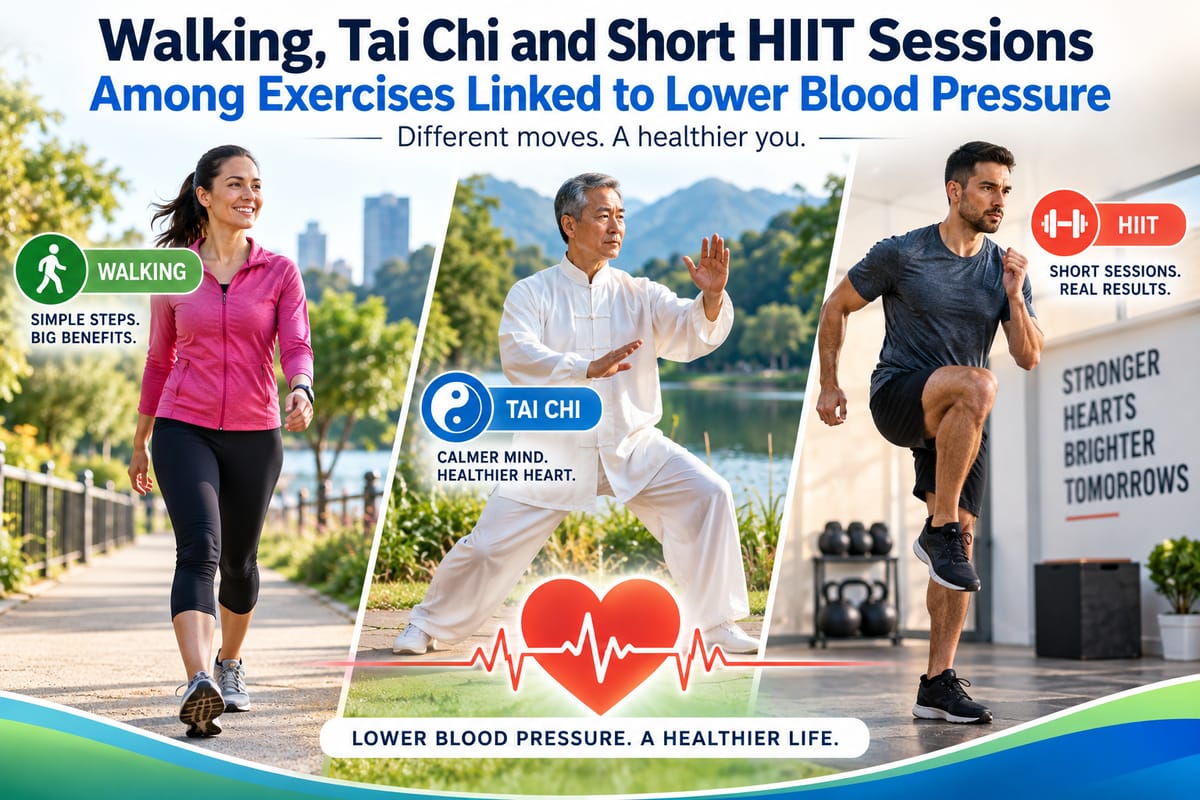

Walking, Tai Chi and Short HIIT Sessions Among Exercises Linked to Lower Blood Pressure
Regular physical activity is increasingly recognized as an important part of managing blood pressure, and the latest research suggests people may have more options than simply spending long hours doing traditional cardio.
Walking, Tai Chi, aerobic exercise, resistance training and high-intensity interval training (HIIT) have all been studied for their potential effects on blood pressure. Recent reviews of randomized trials suggest that aerobic and interval-based exercise can produce meaningful reductions in blood pressure, while other forms of movement may offer additional benefits depending on a person’s health, fitness level and preferences.
The findings reinforce a broader message: the most useful exercise routine may be one that can be performed consistently and safely over time.
Why Exercise Can Affect Blood Pressure
Blood pressure measures the force of blood against the walls of the arteries as the heart pumps and relaxes. When pressure remains elevated over time, it can place additional strain on the cardiovascular system.
Exercise can influence several systems involved in blood pressure regulation. Regular physical activity can improve cardiovascular fitness, support healthier blood vessels, increase energy expenditure and help with weight management.
For a broader look at how different types of movement fit into a healthy lifestyle, The Complete Guide to Physical Activity and Exercise provides an overview of aerobic activity, strength training, flexibility and other forms of exercise.
Understanding why blood pressure deserves attention is equally important. Why Blood Pressure Matters for Long-Term Health explores the relationship between persistent high blood pressure and long-term cardiovascular health.
Walking Remains a Practical Option
Walking may be one of the simplest ways to increase physical activity without requiring specialized equipment or a gym membership.
Research has found that planned walking can reduce blood pressure among people with hypertension. A systematic review and meta-analysis of walking interventions reported significant reductions in both systolic and diastolic blood pressure, although the size of the effect varied between studies.
Brisk walking may provide a useful middle ground for people who want more intensity without moving into vigorous exercise. A separate systematic review examining brisk walking found evidence of a significant reduction in systolic blood pressure among people with hypertension.
That does not mean every walk needs to be fast or strenuous. Building up gradually can make regular movement easier to maintain, particularly for people who are currently inactive.
Tai Chi Offers a Lower-Impact Approach
Tai Chi is another form of exercise receiving attention for its potential cardiovascular benefits.
The practice combines slow, controlled movements with balance, coordination and deliberate breathing. Its relatively low-impact nature can make it appealing to people who may find higher-intensity exercise uncomfortable or difficult.
Recent research has produced encouraging results. A 2025 meta-analysis of randomized controlled trials involving people with essential hypertension found that Tai Chi was associated with reductions in systolic and diastolic blood pressure compared with control groups. The researchers also reported particularly notable improvements in studies involving roughly 12 weeks of practice.
However, the evidence is not completely uniform. Earlier research has produced mixed findings, illustrating why individual studies should not be treated as definitive proof that one exercise method is universally better than another.
Short HIIT Sessions May Also Help
High-intensity interval training involves alternating periods of harder effort with periods of recovery. Because the intense intervals are relatively brief, HIIT sessions can sometimes provide a substantial training stimulus without requiring long continuous workouts.
Recent network meta-analyses have found that HIIT can reduce blood pressure. One 2026 analysis of 31 randomized trials involving 1,345 participants found that HIIT reduced 24-hour systolic and diastolic blood pressure compared with non-exercise controls. The study also found significant reductions with aerobic and combined training.
Another 2026 network meta-analysis found reductions in 24-hour systolic blood pressure with both aerobic exercise and HIIT, although the researchers cautioned that the available trials were relatively limited and that there was not enough evidence to establish one exercise mode as definitively superior to another.
This distinction matters. The research supports HIIT as one potentially effective approach, but it does not mean everyone needs to perform all-out workouts to improve blood pressure.
For some people, moderate walking may be more realistic. Others may prefer structured intervals, cycling, swimming or a combination of aerobic and strength exercises.
Aerobic Exercise Has a Strong Evidence Base
Traditional aerobic exercise remains an important part of the evidence surrounding blood pressure management.
Activities such as brisk walking, cycling, swimming and jogging increase the body’s demand for oxygen and require the cardiovascular system to work continuously. Over time, regular aerobic training can improve cardiovascular fitness and contribute to healthier blood pressure.
A 2026 network meta-analysis of randomized controlled trials found that aerobic training reduced 24-hour systolic and diastolic blood pressure in adults with hypertension.
For more detail on the connection between cardiovascular fitness and exercise, How Aerobic Exercise Supports Cardiovascular Health examines why aerobic activity is such an important part of long-term health.
Strength Training Should Not Be Overlooked
Blood pressure discussions often focus heavily on walking and cardio, but strength training can also have a role in a balanced exercise routine.
Resistance exercise involves muscles working against an external load, which can come from weights, resistance bands, machines or even body weight.
A 2026 systematic review and meta-analysis found that longer-term resistance training was associated with reductions in 24-hour systolic and diastolic blood pressure, although the researchers noted limitations in the quality and design of some of the available studies.
The relationship between strength and cardiovascular exercise is therefore less about choosing one permanently over the other and more about understanding what each contributes.
The differences are explored further in Strength Training vs Cardio for Long-Term Health.
There May Not Be One Perfect Exercise
One of the most important lessons from recent research is that exercise does not have to look the same for everyone.
A large 2026 network meta-analysis that included 105 randomized controlled trials found that combined training and HIIT produced substantial reductions in blood pressure, while yoga and Tai Chi also showed moderate effects. The researchers also identified a nonlinear relationship between exercise volume and blood pressure, suggesting that simply doing more exercise is not necessarily the answer.
Another recent analysis found that combined training, aerobic exercise and HIIT all lowered 24-hour blood pressure, while comparisons between individual exercise modalities were not conclusive enough to establish a universal winner.
That leaves room for personalization.
Someone who enjoys walking may be more likely to maintain a brisk walking routine than a demanding interval program. Another person may prefer short HIIT workouts because they fit more easily into a busy schedule. Someone looking for gentle, controlled movement may find Tai Chi more sustainable.
Consistency can therefore be an important practical consideration alongside intensity.
How to Approach Exercise Safely
People who have high blood pressure, cardiovascular disease or other medical conditions should consider their current health and fitness level before starting a demanding exercise program.
Beginning with manageable activity and gradually increasing duration or intensity can make exercise easier to sustain. A person who is new to exercise does not necessarily need to start with HIIT.
It is also important to remember that exercise is one part of blood pressure management. Depending on a person’s circumstances, healthcare professionals may recommend dietary changes, weight management, medication, stress management or other interventions.
Exercise should not be used as a reason to stop prescribed blood pressure medication without medical guidance.
Making Movement Part of Everyday Life
The growing evidence around walking, Tai Chi, aerobic exercise, strength training and HIIT gives people several possible routes toward a more active lifestyle.
A practical routine might involve regular walking, occasional strength sessions and another activity that the individual enjoys. For someone who is already accustomed to exercise, carefully structured intervals may provide another option.
The key is not necessarily finding the most demanding workout. It is finding an approach that is appropriate for the individual and can be repeated consistently.
As research continues to compare different exercise formats, the evidence increasingly points toward flexibility rather than a single universal prescription. Regular movement—whether it comes through a brisk walk, controlled Tai Chi practice, strength training or short intervals—can be an important component of a broader strategy for maintaining healthier blood pressure.
Continue Reading
Similar Posts

HHS Launches $10 Million Presidential Fitness Challenge for Schools and Youth Programs
Announced October 1 at Westlake High School in Austin, Texas, the initiative is designed to encourage organizations to implement the revived Presidential Fitness Test while creating positive experiences that can help children develop long-term exercise habits.
Read article
Peloton Tread Flex Launches October 1 as AI-Powered Running Enters a New Phase
Together, the hardware and software changes signal a broader shift in how connected fitness equipment can support runners. Instead of simply displaying workouts, newer machines are increasingly designed to interpret performance data and adapt the training experience around the individual.
Read article
Retatrutide Weight-Loss Results Put Exercise and Muscle Preservation Back in Focus
Those results make retatrutide an important development in obesity medicine. They also reinforce a broader lesson about weight management: **a successful outcome cannot be measured by the number on the scale alone.**
Read article

Join 10,000+ Readers Building Healthier Habits
Get actionable wellness tips every week plus our newest articles delivered straight to your inbox.