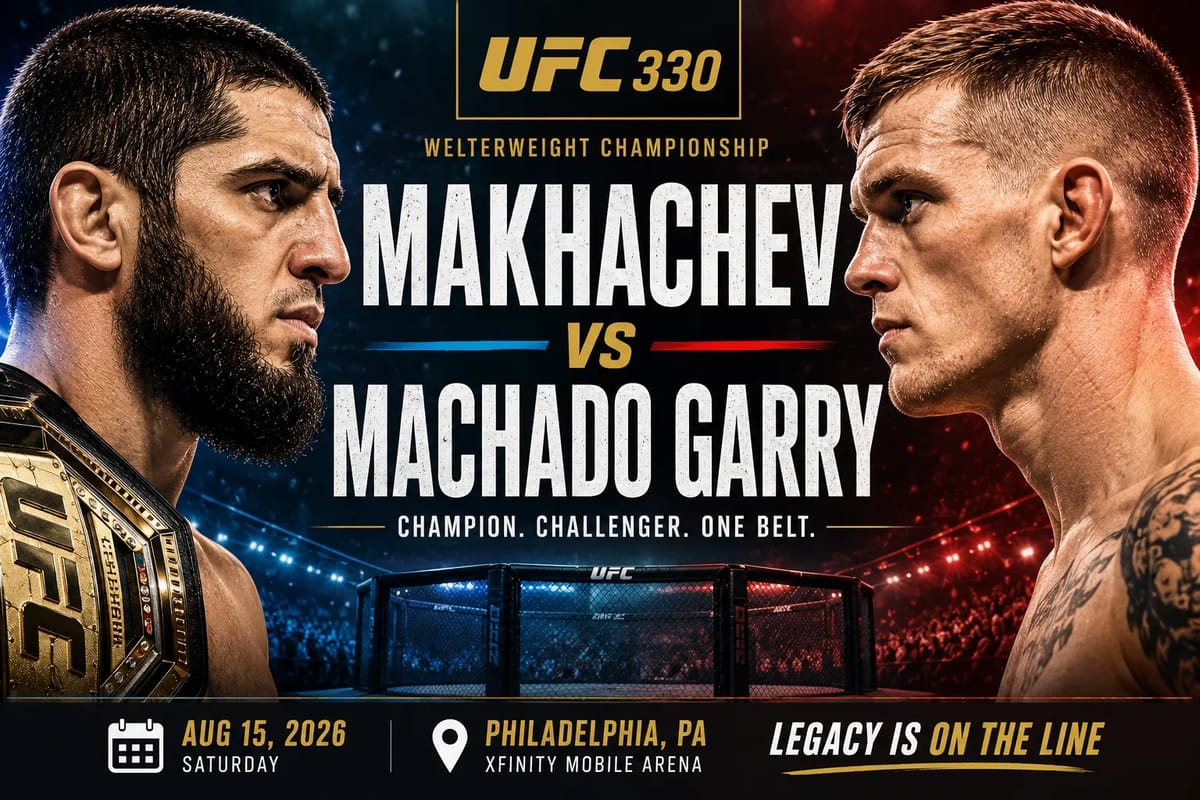

UFC 330: Makhachev vs Machado Garry Fight Preview, Predictions and Analysis
UFC 330 arrives in Philadelphia on August 15, 2026, with one of the most intriguing championship matchups of the year at the top of the card.
Former lightweight champion Islam Makhachev will defend the UFC welterweight title against the dangerous and highly technical Ian Machado Garry at the Xfinity Mobile Arena. The UFC officially lists Makhachev at 28-1 and Machado Garry at 17-1 heading into the contest. (UFC)
This is more than a conventional champion-versus-challenger fight.
Makhachev brings elite wrestling, positional control and submission ability, while Machado Garry presents a major challenge on the feet with his height, reach, movement and increasingly sophisticated defensive grappling.
The result could determine whether Makhachev establishes himself as the dominant force of a second division—or whether Machado Garry produces the biggest victory of his career.
UFC 330 Main Event at a Glance
| Detail | Information |
|---|---|
| Event | UFC 330 |
| Main Event | Islam Makhachev vs. Ian Machado Garry |
| Title | UFC Welterweight Championship |
| Date | August 15, 2026 |
| Venue | Xfinity Mobile Arena |
| Location | Philadelphia, Pennsylvania |
| Makhachev Record | 28-1 |
| Machado Garry Record | 17-1 |
The event is scheduled for Saturday, with the main card beginning at 9 p.m. ET, according to ESPN’s UFC event listing. (ESPN)
Makhachev’s Move to Welterweight
Makhachev enters UFC 330 with an unusual résumé.
After establishing himself as one of the leading fighters at lightweight, he moved up to welterweight and defeated Jack Della Maddalena at UFC 322 to capture the division’s championship. That victory gave him UFC gold in a second weight class. (Wikipedia)
The move is significant because Makhachev is no longer simply defending a championship he has held for years.
He is attempting to establish himself against naturally larger opponents.
That creates a different physical challenge.
At lightweight, Makhachev could often combine his strength, speed and wrestling against opponents closer to his natural size. At welterweight, he has to deal with fighters who can potentially match or exceed him physically.
Machado Garry represents exactly that kind of test.
Ian Machado Garry’s Road to the Title Shot
Machado Garry has built his reputation around technical striking, movement and an ability to control the range of a fight.
He enters UFC 330 with a 17-1 professional record. His only career defeat came against Shavkat Rakhmonov at UFC 310, after which he rebounded with victories over Carlos Prates and Belal Muhammad. (UFC Stats)
That recent run is particularly important.
Machado Garry has faced increasingly experienced opposition and demonstrated that he can fight effectively over five rounds.
His victory over Belal Muhammad was especially significant because it came against a former champion-level opponent with extensive experience in wrestling and high-level MMA strategy. (Wikipedia)
Now he faces perhaps the most difficult stylistic challenge of his career.
The Biggest Question: Can Garry Stop the Takedowns?
The central tactical question is straightforward:
Can Ian Machado Garry keep the fight standing?
Makhachev’s wrestling is the obvious weapon.
He has built much of his success around getting opponents to the mat, controlling their movement and gradually creating submission or ground-and-pound opportunities.
Machado Garry’s takedown defense will therefore be one of the most important aspects of the fight.
UFC statistics list Machado Garry with a 52% takedown-defense figure, although statistics alone cannot capture the full complexity of how a fighter defends takedowns against someone with Makhachev’s chain wrestling. (UFC Stats)
Stopping the first takedown is only part of the problem.
Makhachev rarely needs to rely on a single attempt.
He can attack the legs, change levels, push opponents toward the fence, transition between takedowns and continue attacking after the initial defense.
That chain reaction is what makes his wrestling so difficult to deal with.
Why the Fence Could Be Crucial
The open space of the Octagon should favor Machado Garry’s movement.
The fence is a different story.
If Makhachev can force Machado Garry backward, his opportunities to attack the hips and legs increase dramatically.
Machado Garry will need to manage distance without giving Makhachev predictable opportunities to close the gap.
That means constant footwork will be important.
He cannot simply retreat in a straight line.
He will need to angle away from the fence, maintain enough distance to land his strikes and punish Makhachev when the champion attempts to enter.
Machado Garry’s Striking Advantage
On the feet, the challenger has several reasons to be confident.
Machado Garry is the longer fighter and has developed a style built around controlling distance.
Rather than standing directly in front of opponents and exchanging power shots, he can use movement, kicks, straight punches and long combinations to make opponents work to reach him.
That could create a very different fight from the close-range grappling battles Makhachev has traditionally preferred.
The challenger does not necessarily need to knock Makhachev out.
He needs to make Makhachev pay every time he tries to enter.
Makhachev Is More Than a Wrestler
It would be a mistake, however, to reduce this matchup to “elite wrestler versus striker.”
Makhachev’s striking has evolved considerably.
He can attack with straight punches, kicks and combinations while using his striking to create wrestling opportunities.
That is important because the threat of a takedown can change how an opponent reacts to every punch.
If Machado Garry becomes overly concerned about the level change, his striking rhythm could suffer.
If he commits too heavily to defending takedowns, Makhachev can potentially exploit the openings created by that defensive posture.
This is where the champion’s MMA experience becomes especially valuable.
The Submission Threat
Getting Machado Garry to the ground is not necessarily the end of Makhachev’s job.
It could be the beginning.
Makhachev has repeatedly demonstrated his ability to turn positional control into submissions.
His victory over Renato Moicano, for example, came via a D’Arce choke in the first round at UFC 311. (Wikipedia)
That means Machado Garry cannot afford to focus exclusively on standing back up.
He must also avoid giving Makhachev opportunities to take his back, isolate an arm or establish a dominant position.
One defensive mistake on the ground can end the fight quickly.
Can Makhachev Handle Five Rounds at Welterweight?
Another interesting question concerns Makhachev’s endurance and physical performance at 170 pounds.
He has extensive experience in championship fights, including five-round contests.
That experience could be crucial if Machado Garry survives the early wrestling exchanges.
Makhachev is comfortable fighting patiently.
He does not necessarily need to finish an opponent in the first round.
He can spend several minutes establishing his timing, testing reactions and gradually increasing pressure.
That patience may be particularly important against a fighter with Machado Garry’s size.
Machado Garry’s Best Path to Victory
For the challenger, the ideal fight probably looks something like this:
- Maintain long range.
- Use kicks and straight punches to discourage entries.
- Avoid being trapped against the fence.
- Force Makhachev to repeatedly shoot from distance.
- Make the champion work for every takedown.
- Return to the center quickly after defending.
- Increase striking volume as the fight progresses.
The longer Machado Garry can keep the fight standing, the more opportunities he should have to use his physical advantages.
A five-round striking battle would likely be much more comfortable for him than spending extended periods underneath Makhachev.
Makhachev’s Best Path to Victory
The champion has a much clearer route.
He needs to make the fight physically uncomfortable.
That means:
- Pressure forward
- Close distance behind strikes
- Attack the legs and hips
- Use the fence
- Chain takedown attempts
- Maintain top control
- Force Machado Garry to repeatedly stand up
- Attack submissions when openings appear
Makhachev does not need to win every striking exchange.
He needs to make Machado Garry worry about what comes next.
Once the challenger starts reacting to the wrestling threat, Makhachev can potentially create opportunities for his striking.
The Mental Battle
There is also an interesting psychological element to this matchup.
Makhachev has publicly dismissed the idea that Machado Garry represents his toughest opponent, while acknowledging the challenger’s striking and defensive abilities. (MMA Fighting)
Machado Garry, meanwhile, has embraced the magnitude of the opportunity.
He has compared the matchup to the type of fight in which an established champion can be unexpectedly defeated by a younger challenger who enters with nothing to lose. (MMA Fighting)
That confidence could work either way.
If Machado Garry remains composed, it can help him stick to his game plan.
If emotions cause him to stand and exchange unnecessarily, he could give Makhachev exactly the kind of opportunities the champion wants.
What Happens If Makhachev Gets the First Takedown?
This could be one of the most important moments of the entire fight.
Machado Garry’s response will tell us a great deal.
If he immediately returns to his feet and forces Makhachev to reset, the challenger can regain confidence.
If Makhachev establishes prolonged control, the dynamic changes.
Every minute spent underneath the champion is another minute in which Machado Garry has to defend submissions, absorb ground strikes and expend energy trying to escape.
The second and third takedowns could become progressively more dangerous as fatigue develops.
What Happens If Garry Keeps It Standing?
This is where the upset becomes increasingly realistic.
Machado Garry has the technical ability to make Makhachev work at range.
If the champion repeatedly fails to close distance, he could find himself chasing a taller opponent around the Octagon.
That would force Makhachev to take more risks.
And every failed entry costs energy.
If Machado Garry is still moving effectively in the championship rounds while Makhachev is struggling to establish control, the fight could become much closer than the pre-fight expectations suggest.
Why This Is a Particularly Interesting Championship Fight
Many MMA title fights are built around one obvious advantage.
This one has several layers.
Makhachev has the wrestling and grappling advantage.
Machado Garry has significant advantages in size and range.
Makhachev has championship experience and a long history of controlling elite opponents.
Machado Garry has youth, physical dimensions and the confidence that comes from successfully navigating increasingly difficult competition.
That creates a genuine tactical puzzle.
The Legacy Stakes for Makhachev
Makhachev’s welterweight title run is already an important part of his career.
Winning a second UFC championship is difficult.
Successfully defending that championship against a dangerous top contender would make his move to welterweight look increasingly convincing.
A victory would also strengthen his argument as one of the best pound-for-pound fighters of his generation.
Makhachev’s current résumé already includes major wins over elite opposition, and his move up in weight gives him another opportunity to add a different type of achievement to it. (Wikipedia)
The Stakes for Machado Garry
For Machado Garry, the implications are even more immediate.
A victory would transform him from a highly regarded contender into a UFC champion.
It would also give him the biggest win of his career by a considerable margin.
More importantly, defeating Makhachev would validate Machado Garry’s belief that his size, striking and defensive skills can overcome one of the most sophisticated grappling systems in MMA.
He would not simply be winning a belt.
He would be solving one of the sport’s most difficult stylistic problems.
Could This Go Five Rounds?
A five-round fight is entirely plausible.
Makhachev has the patience and control to win rounds without necessarily chasing an early finish.
Machado Garry has already demonstrated an ability to compete in long fights, including five-round contests against high-level opposition. (Wikipedia)
The longer the fight goes, the more important energy management becomes.
For Machado Garry, every defensive wrestling exchange costs something.
For Makhachev, repeatedly attempting to close the distance against a moving, taller opponent also carries a cost.
The fighter who manages that physical battle better could have a significant advantage in the championship rounds.
UFC 330 Prediction
Makhachev should enter this fight as the favorite for good reason.
His wrestling, grappling, experience and ability to control where fights take place give him the most reliable route to victory.
Machado Garry nevertheless presents genuine problems.
His size and range make him difficult to pressure, while his striking gives him a realistic opportunity to punish Makhachev’s entries.
The key is whether he can consistently prevent the champion from establishing his preferred grappling positions.
My prediction: Islam Makhachev by decision.
I expect Machado Garry to have stretches of success on the feet, particularly when he can keep the fight in the center of the Octagon. But over five rounds, Makhachev’s ability to repeatedly mix striking with takedown attempts should eventually produce enough control to win the championship rounds.
The most likely scenario is not an effortless performance from the champion.
Machado Garry is too technically capable and too physically difficult to control for that.
Instead, expect a tactical fight in which Makhachev spends much of the contest trying to turn a long-range striking battle into a grappling match.
What Could Change the Prediction?
There are several factors that could produce an upset.
The biggest would be Machado Garry’s takedown defense.
If he consistently stops Makhachev’s entries, the fight could become dramatically different.
His ability to avoid the fence is another major factor.
If he can stay in open space, maintain distance and make Makhachev chase him, the challenger can force the champion into an uncomfortable striking battle.
A third factor is Makhachev’s ability to handle the physical size difference.
If the champion struggles to control Machado Garry once the fight reaches the ground, his usual grappling advantages may not translate as cleanly to welterweight.
More Than a Champion vs. Challenger Fight
UFC 330 represents a fascinating crossroads for both men.
For Makhachev, it is another opportunity to prove that his dominance was not limited to lightweight.
For Machado Garry, it is the chance to turn years of development into a championship breakthrough.
The matchup also represents a classic MMA question: what happens when elite grappling meets elite distance management?
If Makhachev gets his hands on Machado Garry consistently, the champion should be in control.
If Machado Garry can keep the fight at long range for extended periods, the challenger has the tools to make this a highly competitive championship fight.
Either way, Philadelphia is set for a main event in which the smallest tactical adjustments could have enormous consequences.
And with the welterweight championship on the line, Makhachev vs. Machado Garry could become one of the defining MMA matchups of 2026. UFC 330 is scheduled for August 15 at Xfinity Mobile Arena in Philadelphia. (UFC)
Continue Reading
Similar Posts

HHS Launches $10 Million Presidential Fitness Challenge for Schools and Youth Programs
Announced October 1 at Westlake High School in Austin, Texas, the initiative is designed to encourage organizations to implement the revived Presidential Fitness Test while creating positive experiences that can help children develop long-term exercise habits.
Read article
Peloton Tread Flex Launches October 1 as AI-Powered Running Enters a New Phase
Together, the hardware and software changes signal a broader shift in how connected fitness equipment can support runners. Instead of simply displaying workouts, newer machines are increasingly designed to interpret performance data and adapt the training experience around the individual.
Read article
Retatrutide Weight-Loss Results Put Exercise and Muscle Preservation Back in Focus
Those results make retatrutide an important development in obesity medicine. They also reinforce a broader lesson about weight management: **a successful outcome cannot be measured by the number on the scale alone.**
Read article

Join 10,000+ Readers Building Healthier Habits
Get actionable wellness tips every week plus our newest articles delivered straight to your inbox.