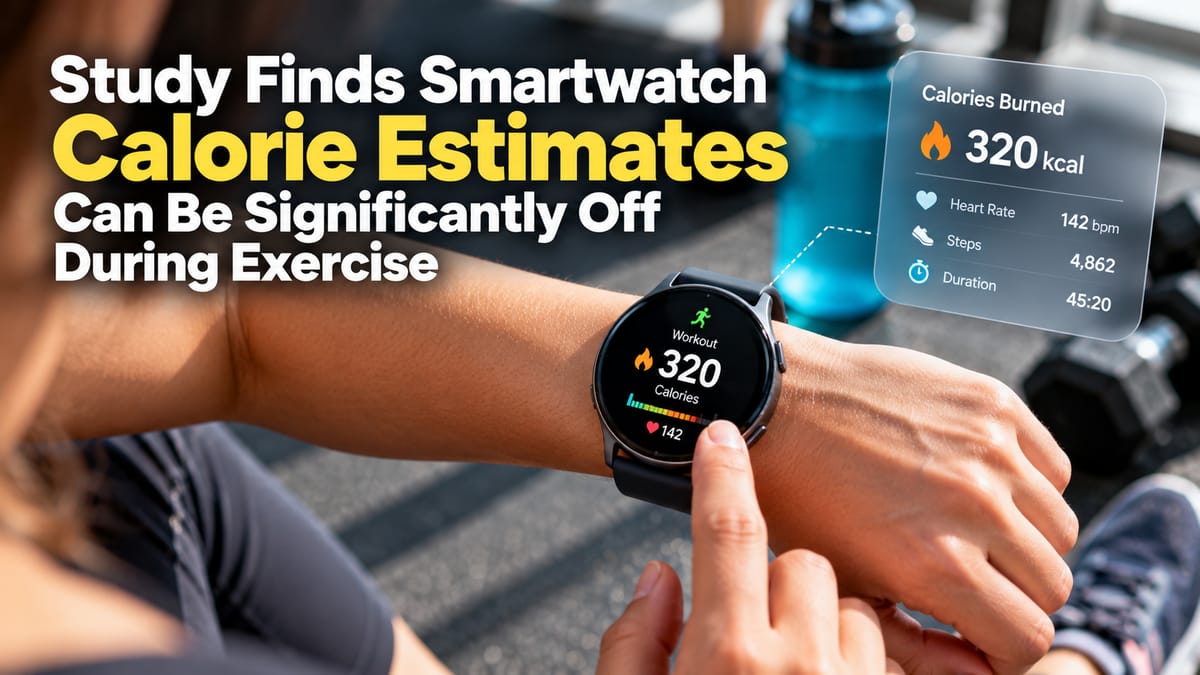

Study Finds Smartwatch Calorie Estimates Can Be Significantly Off During Exercise
Smartwatches have become everyday fitness companions, tracking steps, heart rate, workouts, sleep and estimated calories burned. But new research suggests one of the metrics many people watch most closely may be considerably less reliable than it appears.
A 2026 study examining four popular smartwatch brands found substantial differences between the devices’ estimates of calories burned during exercise and measurements obtained using indirect calorimetry, a laboratory method used to assess energy expenditure. The research also found that the size of the error varied according to the device and the user’s body-fat percentage.
The findings do not mean smartwatches are useless for fitness. Instead, they highlight an important distinction between metrics that wearable devices can measure relatively directly and those they must calculate using algorithms.
For people using watches to guide exercise, nutrition or weight-management decisions, understanding that distinction can make the numbers much more useful.
What the New Study Found
Researchers tested Apple Watch Series 8, Fitbit Sense 2, Samsung Galaxy Watch 5 and Garmin Forerunner 955 devices in 58 Hispanic adults with different body compositions and skin tones.
Participants completed a controlled exercise protocol on a recumbent bicycle while researchers measured their energy expenditure using a COSMED K5 metabolic system. The metabolic system served as the comparison standard for the smartwatch estimates.
The results showed statistically significant differences between estimated and measured energy expenditure for three of the four devices.
The average bias was approximately:
- Apple Watch: 21.6 calories
- Garmin: 68.6 calories
- Samsung: 56.8 calories
- Fitbit: 3.1 calories after the study’s device-specific data-quality filtering
Those averages do not tell the entire story. Researchers found considerable variation between individual measurements, and the relationship between body-fat percentage and estimation error was significant across the devices.
That means a smartwatch’s calorie estimate can look reasonably close in one workout while being substantially different from measured energy expenditure in another.
Why Calories Are Harder to Measure Than Steps
A smartwatch can count steps by detecting movement patterns through its accelerometers and other sensors.
Calories are different.
Energy expenditure is not something a wristwatch directly observes. Instead, the device estimates it using information such as movement, heart rate, age, sex, height, weight and other data, combined with proprietary algorithms.
The watch is essentially asking:
Given what I know about this person and what my sensors are detecting, how much energy did this activity probably require?
That is a much more complicated calculation than counting movement.
Laboratory indirect calorimetry takes a different approach by measuring oxygen consumption and carbon dioxide production to estimate the body’s energy expenditure.
The difference between these approaches helps explain why a wearable can provide useful exercise information while still producing an imperfect calorie estimate.
Body Composition May Affect the Results
One of the most significant findings from the new study was the relationship between body-fat percentage and calorie-estimation error.
Researchers found that physical-activity energy-expenditure error increased as adiposity increased across all four brands tested. They also identified an interaction between device brand and body-fat percentage, suggesting that the relationship was not identical for every smartwatch.
This matters because wearable algorithms are built using data and assumptions that may not represent every user equally.
Two people can perform the same workout at a similar heart rate and receive different energy-expenditure estimates because their bodies, fitness levels and physiological responses differ.
The finding reinforces the importance of treating calorie numbers as estimates rather than precise measurements.
Smartwatch Accuracy Can Depend on the Exercise
The new research is part of a much larger body of evidence showing that wearable accuracy varies according to the activity being performed.
A 2026 study published in Frontiers in Digital Health compared smartwatch energy-expenditure estimates with portable respirometry during outdoor walking and running. It found that an activity-specific smartwatch configuration produced about 13% error during outdoor walking, with substantially lower error than a generic smartwatch configuration and a predefined heart-rate model.
This suggests that the software’s understanding of the activity can matter.
A watch programmed specifically to recognize running, for example, may have more useful information than a generic mode attempting to estimate energy expenditure from movement and heart rate alone.
Other research has found that energy-expenditure accuracy can deteriorate during activities involving complex or irregular movement.
A systematic review published in 2020 concluded that energy-expenditure estimates from wrist- and arm-worn devices vary substantially according to activity type. It also found that adding physiological sensors such as heart-rate measurements can improve estimates for many activities.
Resistance Training Presents Another Challenge
Strength training can be particularly difficult for wearable calorie algorithms.
During running or cycling, movement patterns and cardiovascular responses can be relatively consistent. Resistance training can involve short bursts of exertion, rest periods, static contractions and movements that do not produce the same wrist motion as cardiovascular exercise.
A 2026 study comparing Apple, Galaxy, Fitbit and Garmin watches found that heart-rate measurements were generally much more accurate than energy-expenditure estimates. The study also found that energy-expenditure accuracy became worse during resistance exercise.
That distinction is important for people who use watches during weightlifting or circuit training.
A watch may give a useful picture of how hard the cardiovascular system is working while still providing a relatively uncertain estimate of total calories burned.
Heart Rate Is Not the Same as Calorie Burn
It is tempting to assume that if a smartwatch measures heart rate accurately, it must also know how many calories a person is burning.
That does not necessarily follow.
Heart rate is a physiological measurement. Calorie expenditure is an inference.
Heart rate can provide valuable information to an energy-expenditure algorithm, but the relationship between heart rate and calories burned varies between people and activities.
For example, two people can have the same heart rate during exercise while expending different amounts of energy because of differences in body size, fitness, movement efficiency and other physiological factors.
The research therefore supports using heart-rate data and calorie estimates for different purposes rather than treating them as interchangeable measures.
Why Wearable Fitness Technology Is Still Valuable
The limitations of calorie estimates should not overshadow the many useful functions of modern wearables.
Smartwatches can help people track:
- Exercise frequency
- Workout duration
- Heart rate
- Steps
- Distance
- Pace
- Training patterns
- Sleep
- Recovery indicators
- Activity consistency
For many users, the greatest value of a smartwatch is not the precision of one calorie number but the ability to identify patterns over time.
Someone might discover that they are consistently less active on workdays, that their walking volume increases on weekends or that their heart rate responds differently to different workouts.
Those observations can encourage more consistent physical activity.
The broader development of wearable technology is explored in Wearable Fitness Tech 2026 Trend, which examines how smartwatches and other connected devices are becoming increasingly integrated into everyday fitness.
Calorie Estimates Should Not Become a Food Budget
One potential problem arises when people treat smartwatch calorie estimates as exact numbers for deciding how much to eat.
Suppose a watch reports that a workout burned 700 calories.
It may be tempting to assume that those 700 calories can simply be added to a person’s daily food allowance.
The new research suggests that approach can create unnecessary uncertainty.
If the actual energy expenditure was substantially lower than the estimate, repeatedly compensating with additional food could undermine a person’s longer-term goals.
This does not mean people need to ignore calorie estimates completely. Instead, they can treat them as one piece of information alongside body-weight trends, hunger, activity levels, training performance and other relevant measures.
The Same Number Can Mean Different Things
A calorie estimate is also difficult to interpret without context.
A watch might estimate 400 calories for a particular workout on one day and 450 calories for a similar workout on another day.
That does not necessarily mean the second workout was meaningfully more demanding.
Algorithmic estimates contain uncertainty, and small differences between individual sessions may not represent meaningful physiological differences.
Longer-term trends can therefore be more informative than obsessing over individual numbers.
Someone who sees similar estimates for comparable workouts may reasonably use them to track consistency, even if the absolute calorie value is not perfectly accurate.
Wearables Are Improving, But the Problem Has Not Disappeared
Modern smartwatches are considerably more sophisticated than early activity trackers.
Today’s devices can combine accelerometers, gyroscopes, optical heart-rate sensors, GPS and other inputs. Machine-learning systems can also classify activities and interpret complex movement patterns.
A recent systematic review found that wearable accuracy has improved substantially over time, particularly for heart rate, step counting and activity-intensity classification. However, energy-expenditure accuracy remains one of the more difficult problems, with recent devices still showing meaningful errors compared with indirect calorimetry.
This is an important distinction.
Better sensors do not automatically solve every measurement problem.
The challenge is partly mathematical and physiological: the device must convert indirect signals into an estimate of how much energy a human body is using.
Recovery Tracking May Be More Useful Than Chasing Calories
As wearable technology develops, the focus of fitness tracking is also broadening.
Rather than concentrating entirely on calories burned, users are increasingly interested in recovery, sleep, heart-rate patterns and how their bodies respond to training.
That shift is discussed in Recovery Tracking Becomes One of Fitness’s Biggest Trends.
Recovery metrics are not necessarily perfect either, but they can provide a different type of information.
For someone training regularly, knowing whether their activity level is sustainable may be more useful than trying to determine whether a particular workout burned exactly 527 or 563 calories.
The Bigger Goal Is Consistent Physical Activity
The most important lesson from the research may be that wearable numbers should support exercise rather than become the entire purpose of exercise.
Regular movement has benefits that cannot be reduced to a calorie total.
Walking, cycling, swimming, strength training, recreational sports and other forms of activity can contribute to overall physical fitness in different ways.
The fundamentals are covered in The Complete Guide to Physical Activity and Exercise, which provides a broader framework for understanding different types of physical activity and their role in a healthy lifestyle.
A smartwatch can make those activities easier to track and can provide motivation through goals, reminders and progress data.
But the watch does not need to be perfectly accurate for every metric to be useful.
Movement Can Matter Even Without a Workout
Another reason not to focus too heavily on calorie estimates is that structured exercise represents only part of daily movement.
Walking around the house, taking the stairs, doing household chores, commuting on foot and standing throughout the day all contribute to daily activity.
A person who completes a 45-minute workout but spends most of the remaining day sitting may have a very different movement pattern from someone who performs a shorter workout while remaining active throughout the day.
Strategies for increasing everyday movement are covered in How to Reduce Sedentary Behavior and Add More Movement to Everyday Life.
For many people, building consistent movement into daily routines may be more practical than trying to maximize the calorie number displayed after each workout.
How to Use Smartwatch Calorie Estimates More Wisely
People who use smartwatches can still make practical use of calorie estimates by changing how they interpret them.
Instead of asking, “Exactly how many calories did I burn?”, it can be more useful to ask:
- Was today’s workout similar in intensity to previous sessions?
- Am I becoming more active over time?
- Is my exercise routine consistent?
- How does my heart rate respond to the same type of workout?
- Am I recovering adequately?
- Am I gradually improving fitness or performance?
- Does the activity fit into a sustainable routine?
This approach turns the smartwatch into a tracking tool rather than a laboratory instrument.
What the Research Means for Weight Management
For people managing body weight, the findings deserve particular attention.
Energy balance remains important, but estimating both calories consumed and calories burned involves uncertainty. Food labels, portion estimates and wearable energy-expenditure numbers can all contain errors.
A smartwatch therefore should not be treated as a precise calculator that determines exactly how much food someone has “earned” through exercise.
Longer-term changes in body weight and body composition, together with dietary patterns and activity levels, provide a more meaningful picture.
People with specific nutritional or medical needs should also work with an appropriate health professional rather than relying solely on consumer wearable data.
A Better Way to Think About the Numbers
Smartwatch calorie estimates are best understood as estimates with uncertainty.
The newest 2026 research adds to evidence showing that the size and direction of that uncertainty can vary according to the device, the activity and characteristics of the person wearing it.
That does not make the technology irrelevant.
A smartwatch can still encourage movement, document workouts, monitor heart rate and reveal useful patterns over weeks and months. Its greatest value may come from helping users understand their behavior rather than promising laboratory-level precision.
As wearable technology becomes more sophisticated, the next challenge will be making energy-expenditure estimates more accurate across different bodies, activities and real-world conditions.
Until then, the calorie number on a smartwatch is useful as a guide—but it is not a measurement that should be treated as exact.
Continue Reading
Similar Posts

HHS Launches $10 Million Presidential Fitness Challenge for Schools and Youth Programs
Announced October 1 at Westlake High School in Austin, Texas, the initiative is designed to encourage organizations to implement the revived Presidential Fitness Test while creating positive experiences that can help children develop long-term exercise habits.
Read article
Peloton Tread Flex Launches October 1 as AI-Powered Running Enters a New Phase
Together, the hardware and software changes signal a broader shift in how connected fitness equipment can support runners. Instead of simply displaying workouts, newer machines are increasingly designed to interpret performance data and adapt the training experience around the individual.
Read article
Retatrutide Weight-Loss Results Put Exercise and Muscle Preservation Back in Focus
Those results make retatrutide an important development in obesity medicine. They also reinforce a broader lesson about weight management: **a successful outcome cannot be measured by the number on the scale alone.**
Read article

Join 10,000+ Readers Building Healthier Habits
Get actionable wellness tips every week plus our newest articles delivered straight to your inbox.