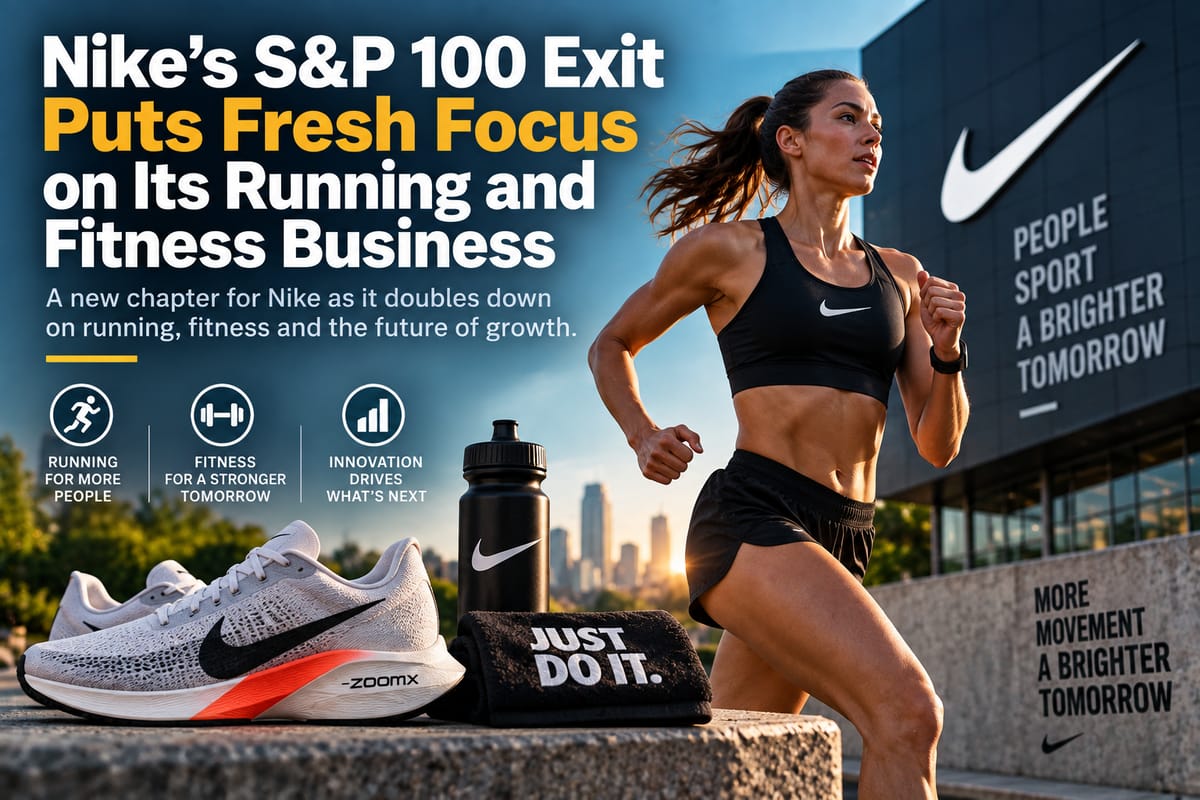

Nike’s S&P 100 Exit Puts Fresh Focus on Its Running and Fitness Business
Nike’s removal from the S&P 100 is putting renewed attention on one of the company’s most important long-term questions: can a stronger focus on sport, running and fitness help rebuild momentum for the global athletic giant?
S&P Dow Jones Indices confirmed that Nike was removed from the S&P 100 on September 21, 2026, with Arista Networks taking its place. The change is an index adjustment rather than a change to Nike’s underlying business, but it comes at a significant moment for a company working through weaker sales, intense competition and a broader effort to strengthen its product portfolio.
For Nike, the challenge goes beyond its standing in a major stock-market index. The company is trying to reconnect more closely with athletes and consumers, and running is emerging as one of the areas where that strategy is particularly visible.
Why the S&P 100 Exit Matters
The S&P 100 consists of major U.S. companies selected from the broader S&P 500 based on factors including market capitalization, sector representation and other index criteria. Being removed does not mean that Nike has stopped being a major global sports company.
Instead, the change reflects how the company’s market position has evolved relative to other large corporations.
Nike’s recent financial performance provides important context. For fiscal 2026, Nike reported revenue of $46.4 billion, essentially flat on a reported basis and down 2% on a currency-neutral basis. Nike Direct revenue fell 6% for the year, while Nike Brand revenue was up 1% on a reported basis but down 1% on a currency-neutral basis.
Those numbers help explain why investors are paying close attention to the company’s efforts to return to growth.
The index change itself does not determine whether Nike succeeds. What matters operationally is whether the company can develop products that consumers want, strengthen its relationship with athletes and compete effectively in an increasingly crowded sportswear market.
Running Is Becoming an Important Battleground
Running has traditionally been one of Nike’s core sporting categories, but competition has changed significantly.
Brands such as On and Hoka have expanded their presence in performance running, while established competitors such as Adidas continue to invest heavily in running footwear and apparel. Consumers also have more choices across different price points, cushioning technologies, training categories and specialized running products.
That makes product innovation particularly important.
Nike has recently emphasized performance products as part of its broader turnaround. The company said in its fiscal 2026 results that it was encouraged by progress in performance product and was focused on scaling areas where it was seeing momentum.
The company is also developing products that target runners beyond the traditional racing or training shoe.
In September, Nike introduced NikeLab Running, a collection designed around performance, materials, style and the broader experience surrounding a run. Nike described the collection as a system intended to support athletes before, during and after running, including training and recovery.
That approach reflects a larger opportunity in fitness: runners do not simply buy shoes. They increasingly participate in training programs, track performance, manage recovery and combine different forms of exercise.
The Business Opportunity Beyond Running Shoes
Nike’s fitness opportunity extends well beyond footwear.
Modern fitness consumers can combine running with strength training, cycling, mobility work, walking and other forms of physical activity. That creates opportunities for athletic brands to build broader relationships with consumers rather than relying on individual product purchases.
For people developing a balanced fitness routine, understanding the different forms of exercise can be useful. The Complete Guide to Physical Activity and Exercise provides a broader look at how different types of movement contribute to an active lifestyle.
For Nike, that broader ecosystem can translate into products across footwear, apparel and equipment.
A runner may need a daily trainer, a racing shoe, performance clothing, recovery apparel and accessories. The same consumer may also participate in strength training and purchase products designed for gym workouts.
That creates a potentially deeper relationship between the brand and the athlete.
Strength Training Adds Another Growth Avenue
Running remains a highly visible part of Nike’s performance strategy, but strength training is another major part of the fitness market.
Strength workouts can complement running by targeting muscles and movement patterns that may not receive the same emphasis during aerobic activity. For consumers, choosing between strength training and cardio is often less useful than understanding how the two can fit together.
The Strength Training vs Cardio: Which Is Better for Long-Term Health? explores the different roles these forms of exercise can play in a long-term fitness routine.
From a business perspective, the combination matters because it expands the potential market for sports apparel and equipment.
A company that can serve consumers across multiple forms of exercise has more opportunities to remain relevant throughout the week, rather than being associated with only one activity.
Cardiovascular Fitness Remains Central to Running
Running also occupies an important place within cardiovascular exercise.
Aerobic activities increase the demand placed on the cardiovascular system and can become an important component of a broader fitness routine. The How Aerobic Exercise Supports Cardiovascular Health guide looks more closely at the relationship between aerobic exercise and cardiovascular health.
That connection helps explain why running continues to have such a large role in the fitness industry.
The category serves everyone from occasional recreational runners to competitive athletes. It also creates opportunities for brands to develop products for different levels of experience, training distances and performance goals.
Nike’s challenge is making sure its products stand out as those consumers become more knowledgeable and selective.
The Rise of Everyday Movement Changes the Fitness Market
Another important shift is that fitness increasingly happens outside traditional gyms and organized training sessions.
Walking, commuting by foot, short workouts and movement throughout the day can all contribute to more active lifestyles. The How to Reduce Sedentary Behavior and Add More Movement to Everyday Life guide explores practical ways people can incorporate more movement into everyday routines.
That creates a much larger potential audience for athletic brands.
Nike does not need every consumer to be a competitive runner or dedicated gym enthusiast. Everyday movement can also create demand for comfortable footwear, active apparel and products that move between exercise and daily life.
This is particularly important as sportswear continues to blur the line between performance clothing and everyday fashion.
Nike’s Broader Turnaround Remains the Bigger Story
The S&P 100 removal arrives as Nike continues a turnaround under CEO Elliott Hill.
The company has said it is putting sport back at the center of its strategy, strengthening its product pipeline and improving how it serves consumers through both Nike Direct and wholesale partners.
Nike’s fiscal 2026 results show why that effort remains important. Although wholesale revenue increased 6% for the year, Nike Direct revenue declined 6%. Nike Brand digital revenue fell 12%, while revenue from Nike-owned stores declined 4%.
The figures suggest that the company cannot rely on a single sales channel or product category to drive its recovery.
Performance running, therefore, is part of a larger strategy rather than a standalone solution.
Competition Is Getting More Intense
Nike’s position in running is also being tested by competitors that have built strong identities around specific sports.
On has become particularly visible in premium running, while other brands have developed specialized products aimed at runners looking for cushioning, lightweight construction or race-day performance.
Nike’s challenge is to maintain its enormous global brand recognition while demonstrating that its latest products can compete on performance as well as marketing power.
That distinction matters because experienced athletes often make purchasing decisions based on factors such as fit, comfort, durability, weight, cushioning and performance characteristics.
Brand loyalty can help, but product performance remains critical.
Fitness Could Help Reconnect Nike With Consumers
One potential advantage for Nike is the breadth of its existing sports ecosystem.
Running can connect with training. Training can connect with strength work. Strength work can connect with recovery. And all of those activities can connect with apparel, footwear and digital experiences.
That gives Nike multiple opportunities to rebuild consumer engagement.
The company does not need running to carry its entire business. Instead, a stronger running franchise could become one part of a broader strategy centered on performance and participation in sport.
For consumers, that could mean more specialized products designed around particular training needs rather than a one-size-fits-all approach.
For Nike, it could provide a way to demonstrate that its return to sport is more than a marketing message.
What Comes Next for Nike
Nike’s removal from the S&P 100 is ultimately a financial-market development, not a direct measure of the quality of its running shoes or fitness products. But the timing gives investors another reason to examine whether the company’s turnaround is producing meaningful improvements.
The next major checkpoint will be Nike’s fiscal 2027 first-quarter results, scheduled for October 1, 2026.
Those results should provide additional information about sales trends, consumer demand and the progress of Nike’s strategy.
For the fitness business, the key questions will be more specific: Can Nike regain momentum in performance running? Can it make its products more compelling across different forms of exercise? And can the company turn its enormous global brand into renewed demand among athletes and everyday consumers?
The answers will help determine whether Nike’s renewed emphasis on sport can translate into a broader business recovery.
Continue Reading
Similar Posts

HHS Launches $10 Million Presidential Fitness Challenge for Schools and Youth Programs
Announced October 1 at Westlake High School in Austin, Texas, the initiative is designed to encourage organizations to implement the revived Presidential Fitness Test while creating positive experiences that can help children develop long-term exercise habits.
Read article
Peloton Tread Flex Launches October 1 as AI-Powered Running Enters a New Phase
Together, the hardware and software changes signal a broader shift in how connected fitness equipment can support runners. Instead of simply displaying workouts, newer machines are increasingly designed to interpret performance data and adapt the training experience around the individual.
Read article
Retatrutide Weight-Loss Results Put Exercise and Muscle Preservation Back in Focus
Those results make retatrutide an important development in obesity medicine. They also reinforce a broader lesson about weight management: **a successful outcome cannot be measured by the number on the scale alone.**
Read article

Join 10,000+ Readers Building Healthier Habits
Get actionable wellness tips every week plus our newest articles delivered straight to your inbox.