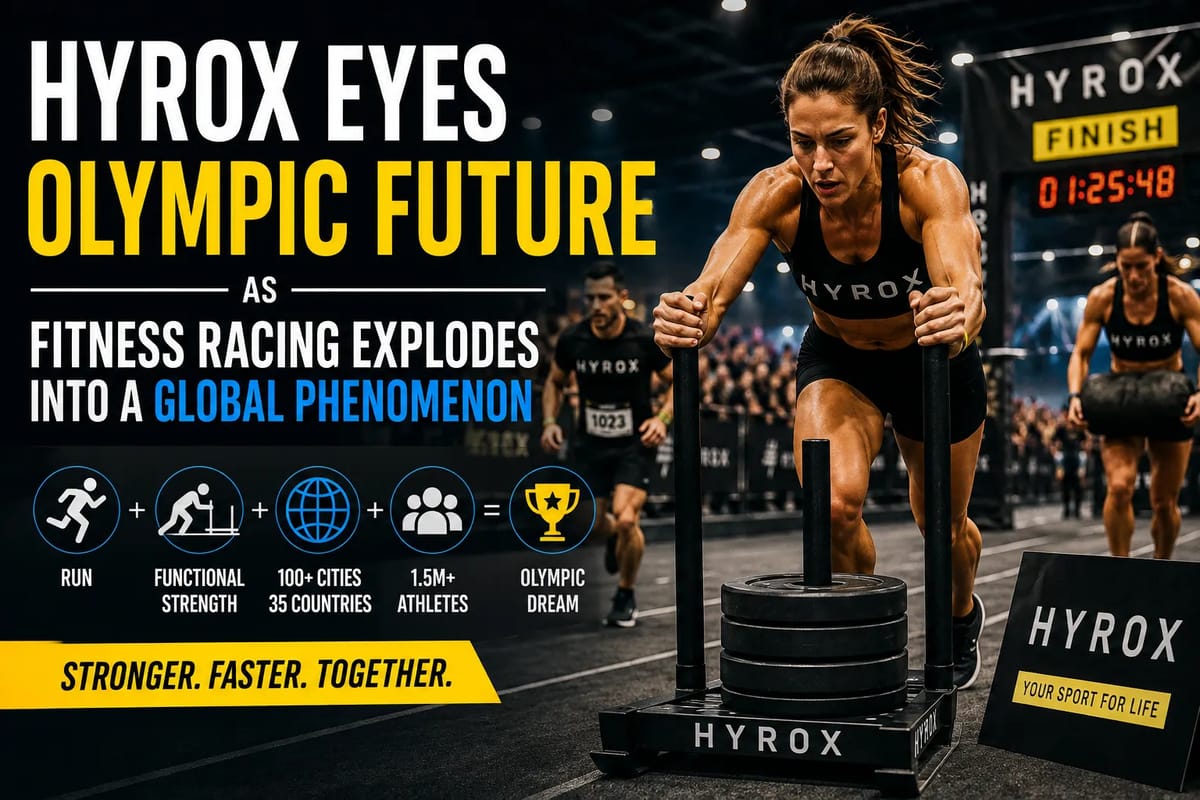

HYROX Eyes Olympic Future as Fitness Racing Explodes Into a Global Phenomenon
A fitness competition that began as a relatively niche event in Germany is now positioning itself for one of the biggest ambitions in sport: becoming an Olympic discipline.
HYROX, the hybrid racing format that combines running with functional fitness exercises, has expanded rapidly in recent years. Organizers are now pursuing a pathway toward Olympic inclusion, with the 2032 and 2036 Games among the potential targets. (Reuters)
The push comes as fitness racing moves beyond the traditional gym and endurance-race markets, attracting professional athletes, recreational exercisers and competitors across a growing number of countries.
What Is HYROX?
HYROX is built around a standardized combination of running and functional exercises.
A typical race consists of eight 1-kilometer runs, with a functional workout station following each run. The exercises can include movements such as sled pushes, sled pulls, rowing, burpee broad jumps, farmer’s carries, sandbag lunges and wall balls.
Unlike many traditional races, competitors around the world face essentially the same structure, making performances easier to compare across locations.
HYROX says its format is designed for a broad range of participants, with individual, professional, doubles and relay divisions. Competitors also receive official times and split information that feed into global rankings. (HYROX)
That standardization is one of the characteristics that could help the sport make a case for wider sporting recognition.
From German Experiment to Global Sport
HYROX was launched in Germany in 2017 by Christian Toetzke and former Olympic field hockey player Moritz Fürste.
Its early concept was relatively straightforward: create a competition that could give ordinary gym-goers a structured event to train toward while combining endurance and functional strength.
The idea has since scaled dramatically.
Reuters reported that HYROX has grown from an event with around 650 participants to a global competition attracting more than 1.5 million athletes. Events are now held in more than 100 cities across 35 countries. (Reuters)
HYROX itself currently describes its 2026 calendar as featuring more than 100 global events. (HYROX)
The expansion is particularly visible in Asia. A Bangkok event scheduled for August 2026 was expected to attract more than 22,000 participants, according to Bangkok’s Queen Sirikit National Convention Center, while HYROX said it had more than one million participants across five continents during its 2025/26 season. (qsncc.com)
Why Fitness Racing Is Connecting With So Many People
Part of HYROX’s appeal comes from its position between several established categories of fitness.
It isn’t purely a running race. It isn’t a traditional weightlifting competition. It isn’t CrossFit, either.
Instead, competitors have to manage both cardiovascular endurance and functional strength.
That combination creates a challenge that can appeal to people with very different fitness backgrounds. A strong runner has to develop strength and movement efficiency, while a powerful gym athlete must learn how to maintain pace and manage fatigue over repeated running intervals.
The standardized format also creates a clear progression system.
Participants can race again and attempt to improve their time, compare splits and measure progress against competitors from other locations.
For recreational athletes, that provides something many ordinary gym routines lack: a defined goal.
The Community Effect Behind the Growth
HYROX’s growth isn’t simply about the physical challenge.
The event environment has become an important part of the experience.
Large indoor venues allow thousands of competitors and spectators to gather in the same space, creating something closer to a stadium event than an ordinary fitness competition.
HYROX says some of its larger events have attracted thousands of participants and spectators, while its format allows athletes of different ability levels to compete within the same overall race structure. (HYROX)
That creates a social element that can encourage people to train together.
For many competitors, the objective isn’t necessarily winning. It can be finishing a first race, beating a previous time or completing the event alongside friends.
The accessibility of the format may be one of its strongest commercial and cultural advantages.
The Olympic Ambition
HYROX’s biggest challenge now is moving from being a successful commercial fitness competition to being recognized as a sport capable of fitting into the Olympic system.
Organizers are pursuing Olympic inclusion through a proposed format called Hyathlon, with the 2032 or 2036 Olympics identified as potential targets. (Reuters)
That ambition is significant.
The Olympic Games require sports to demonstrate more than popularity. International reach, governance, competitive standards, athlete structures and organizational credibility all matter.
HYROX already has several characteristics that could support such an argument.
Its races use a standardized format, athletes receive comparable times, and competitions are held across multiple countries. Its recent World Championship in Stockholm included representatives from 101 countries, according to Reuters. (Reuters)
But global popularity alone does not guarantee Olympic inclusion.
Standardization Could Be HYROX’s Biggest Advantage
One of HYROX’s most interesting features is how deliberately standardized the competition is.
A competitor can travel to another country and expect essentially the same race architecture: eight 1-kilometer runs separated by eight functional stations.
That makes the sport easier to understand.
It also makes performances easier to compare.
In traditional endurance sports, differences in course design, terrain and weather can make comparisons complicated. HYROX’s controlled indoor environment and standardized stations reduce some of those variables.
This creates a competition structure that resembles a measurable sporting test rather than an informal fitness challenge.
For a sport seeking international recognition, that consistency could prove valuable.
The Professional Athlete Path Is Developing
HYROX is also beginning to create opportunities for athletes to treat fitness racing as a serious profession.
Reuters highlighted competitors such as Alyssa McElheny, who have moved toward full-time competition and secured major sponsorship support. (Reuters)
That transition matters because the development of a professional athlete ecosystem can help transform a participation-based activity into a mature competitive sport.
Sponsors, elite divisions, rankings and international championships all contribute to that process.
At the same time, HYROX has retained its mass-participation identity.
That combination is unusual.
Most sporting competitions separate professional athletes and recreational participants almost completely. HYROX attempts to put both groups into the same broader sporting ecosystem.
Asia Could Become the Next Major Growth Engine
The rapid expansion of HYROX in Asia is another important part of the story.
India, China and Southeast Asian markets are becoming increasingly important to the sport’s international expansion.
Bangkok hosted what organizers described as the largest HYROX race in Asia in August 2026, while the official event calendar includes competitions in cities including Beijing, Mumbai, Guangzhou, Singapore, Kuala Lumpur, Hong Kong, Noida, Osaka and Nagoya. (HYROX)
China is also producing an interesting demographic development.
The Times reported growing participation among older Chinese fitness enthusiasts, including competitors in their 60s and 70s. (The Times)
That broadens the idea of who a fitness-racing athlete can be.
Instead of being exclusively associated with young elite competitors, HYROX is increasingly being presented as a participation sport spanning multiple generations.
Technology Is Becoming Part of the Ecosystem
The growth of fitness racing is also creating opportunities for wearable technology.
In April 2026, Amazfit and HYROX announced a three-year global partnership covering smartwatches, smart rings, smart glasses, smart straps and connected training experiences. The partnership also includes HYROX-specific training modes and performance-data integrations. (Zepp)
That relationship illustrates how the sport is becoming part of a broader fitness technology ecosystem.
Athletes can increasingly track training load, heart rate, recovery, pace and other performance indicators before, during and after competition.
For recreational athletes, this can turn a single race into a longer training journey.
What Could Stop HYROX From Reaching the Olympics?
The Olympic ambition still faces substantial hurdles.
First, HYROX would need to establish that its competitive structure meets the requirements expected of an internationally governed sport.
Second, the organization would need to maintain consistent rules and judging standards as participation continues to expand.
Third, it must demonstrate that the professional side of the sport can develop without undermining its mass-participation identity.
There is also the broader question of how HYROX would fit into an Olympic program that already has to balance a large number of sports and events.
The proposed Hyathlon concept could therefore become important because it may determine how the competition is presented as an Olympic discipline. (Reuters)
The Bigger Shift in How People Think About Fitness
Perhaps the most important development isn’t whether HYROX eventually appears at an Olympic Games.
Its growth reflects a broader change in fitness culture.
For years, exercise was often framed around appearance, weight management or general health. Fitness racing adds another dimension: performance as a personal goal.
Someone can train because they want to complete a race.
They can measure improvement through time rather than simply through appearance.
They can train with friends, compete against people around the world and return for another event with a specific performance target.
That model has helped blur the line between recreational exercise and organized sport.
Could Fitness Racing Become an Olympic Sport?
HYROX still has a long road ahead before Olympic inclusion becomes reality, and the 2032 or 2036 targets should be viewed as ambitions rather than guarantees. (Reuters)
But the underlying growth story is difficult to ignore.
The competition has moved from a small German fitness experiment to a global event series spanning dozens of countries. Its standardized format, international participation, professional divisions, mass-market appeal and growing commercial ecosystem give it several of the ingredients associated with an emerging global sport. (HYROX)
Whether HYROX ultimately reaches the Olympic stage may depend on how successfully it can turn rapid popularity into long-term sporting infrastructure.
For now, the bigger story is already unfolding: fitness racing is no longer simply something people do at the gym. It is becoming a global competitive culture of its own.
Continue Reading
Similar Posts

HHS Launches $10 Million Presidential Fitness Challenge for Schools and Youth Programs
Announced October 1 at Westlake High School in Austin, Texas, the initiative is designed to encourage organizations to implement the revived Presidential Fitness Test while creating positive experiences that can help children develop long-term exercise habits.
Read article
Peloton Tread Flex Launches October 1 as AI-Powered Running Enters a New Phase
Together, the hardware and software changes signal a broader shift in how connected fitness equipment can support runners. Instead of simply displaying workouts, newer machines are increasingly designed to interpret performance data and adapt the training experience around the individual.
Read article
Retatrutide Weight-Loss Results Put Exercise and Muscle Preservation Back in Focus
Those results make retatrutide an important development in obesity medicine. They also reinforce a broader lesson about weight management: **a successful outcome cannot be measured by the number on the scale alone.**
Read article

Join 10,000+ Readers Building Healthier Habits
Get actionable wellness tips every week plus our newest articles delivered straight to your inbox.