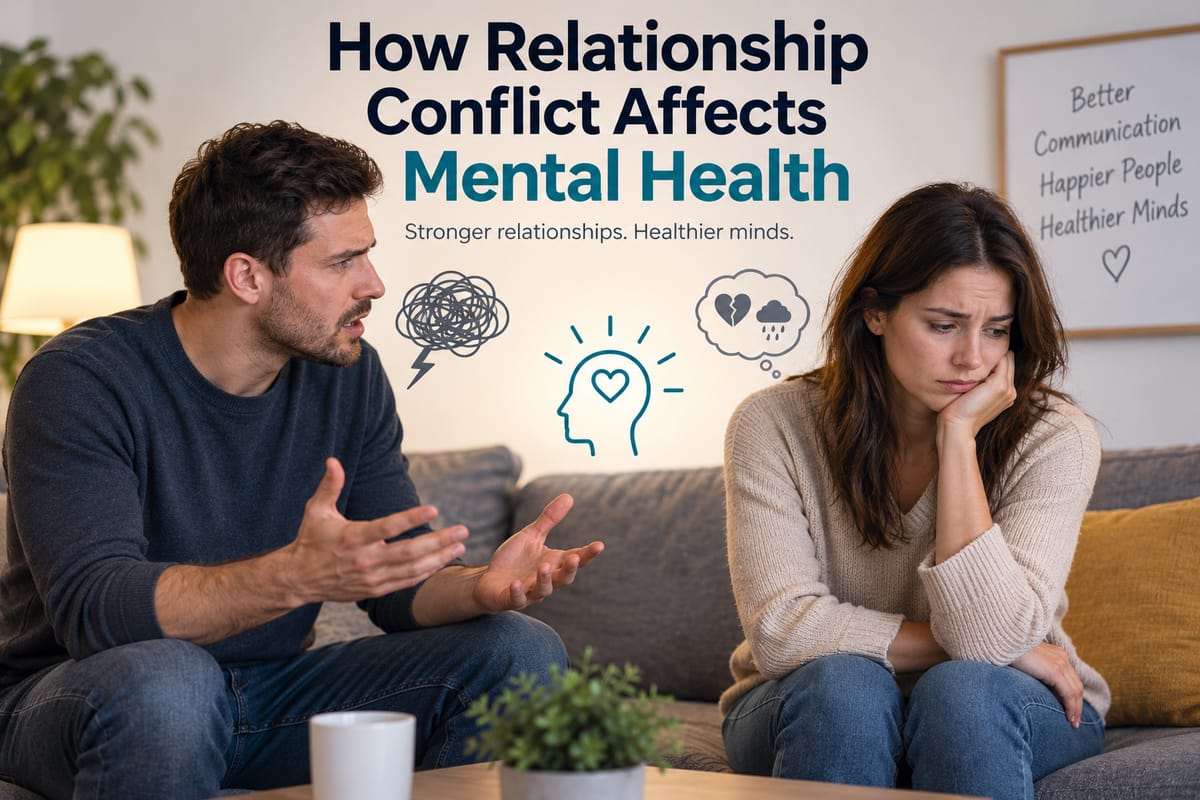

**How Relationship Conflict Affects Mental Health
Relationships can be an important source of companionship, support, and emotional security. They can also become a source of considerable stress when disagreements, misunderstandings, resentment, or unresolved problems occur repeatedly.
Conflict is a normal part of human relationships. Partners, family members, friends, and colleagues will not always agree. A disagreement does not automatically mean that a relationship is unhealthy. What matters is how conflict occurs, how often it happens, whether people feel safe expressing themselves, and whether problems can eventually be addressed.
When conflict becomes frequent, hostile, unpredictable, or unresolved, however, it can affect mental and emotional well-being. Persistent relationship stress may contribute to feelings such as anxiety, sadness, frustration, loneliness, anger, and emotional exhaustion.
Understanding this connection can help people recognize when relationship difficulties are beginning to affect their overall well-being.
Why Relationship Conflict Can Be Stressful
Conflict can activate the body’s stress response.
During an argument, a person may experience increased alertness, muscle tension, faster breathing, racing thoughts, or a strong emotional reaction. These responses can be useful in genuinely threatening situations, but repeated interpersonal conflict can keep a person feeling emotionally activated.
The psychological impact may continue even after an argument has ended.
Someone might replay the conversation, worry about what will happen next, anticipate another disagreement, or struggle to concentrate on other parts of life.
When this pattern happens repeatedly, relationship conflict can become an ongoing source of psychological stress.
Common Forms of Relationship Conflict
Relationship conflict can take many forms. It does not always involve a dramatic argument.
Examples include:
- Repeated disagreements over the same issue
- Poor communication
- Frequent criticism
- Jealousy or mistrust
- Unresolved resentment
- Arguments about finances
- Differences in expectations
- Disagreements about responsibilities
- Difficulties respecting boundaries
- Avoiding important conversations
- Passive-aggressive behavior
- Persistent misunderstandings
Some disagreements are temporary and resolved constructively. Others become recurring patterns that gradually increase emotional strain.
The nature and intensity of the conflict can make a significant difference to its effect on mental health.
How Conflict Can Affect Mood
Frequent relationship problems can influence a person’s emotional state.
After repeated disagreements, someone may feel frustrated, discouraged, angry, disappointed, or emotionally drained. When conflict becomes a persistent part of daily life, positive experiences may be overshadowed by anticipation of the next disagreement.
Over time, this can contribute to a lower overall sense of emotional well-being.
Learning about emotional well-being provides a broader perspective on how emotions, relationships, coping abilities, and daily experiences can interact.
Anxiety and Relationship Conflict
Unresolved conflict can sometimes contribute to anxiety.
A person may become preoccupied with questions such as:
- Will we argue again?
- Did I say something wrong?
- Is the relationship falling apart?
- How will the other person react?
- Can this problem actually be resolved?
Constantly anticipating conflict can create a state of heightened emotional tension.
In particularly unpredictable relationships, people may begin monitoring another person’s moods or behavior closely in an effort to avoid triggering another disagreement. This can become exhausting and make it difficult to relax.
The Connection Between Conflict and Sleep
Relationship stress can also interfere with sleep.
After an argument, people may lie awake thinking about what happened or worrying about an unresolved issue. Repeated stress can make it harder to mentally disengage at bedtime.
Poor sleep can then make emotional regulation more difficult the following day.
This can create a cycle:
Relationship conflict → stress and rumination → poor sleep → reduced emotional resilience → greater difficulty handling conflict
Not everyone experiencing relationship conflict will develop sleep problems, but persistent stress can make healthy sleep more difficult.
How Conflict Can Affect Concentration
Emotional stress can occupy considerable mental attention.
Someone dealing with ongoing relationship problems may find themselves thinking about arguments while working, studying, driving, or completing everyday tasks.
This does not necessarily mean that conflict permanently damages concentration. Instead, the emotional demands associated with unresolved problems can temporarily compete with attention needed for other activities.
Taking time to process emotions and resolve problems constructively can help reduce this mental burden.
Anger and Emotional Exhaustion
Repeated conflict can produce a mixture of anger and exhaustion.
Anger may develop when a person feels misunderstood, ignored, criticized, or treated unfairly. At the same time, constantly dealing with disagreements can become tiring.
Eventually, a person may feel emotionally depleted rather than angry.
They may stop wanting to discuss problems, withdraw from conversations, or feel that resolving another disagreement is simply too exhausting.
These responses can make communication more difficult and potentially prolong existing problems.
Emotional Regulation Matters During Conflict
The ability to manage emotions does not mean suppressing them or pretending that disagreements do not matter.
Healthy emotional regulation involves recognizing an emotional response and responding to it in a way that supports effective decision-making and communication.
For example, someone who notices that they are becoming extremely angry might pause a heated conversation rather than continuing to say things they may later regret.
The principles discussed in how emotional regulation works in everyday life can be especially relevant during difficult interpersonal situations.
Being able to identify emotions, tolerate discomfort, and choose an appropriate response can change the way disagreements unfold.
Conflict Does Not Always Mean a Relationship Is Unhealthy
Disagreement itself is not necessarily harmful.
Two people can have different opinions, needs, preferences, or expectations and still maintain a healthy relationship.
Constructive conflict can involve:
- Listening to each person’s perspective
- Expressing concerns clearly
- Avoiding personal attacks
- Acknowledging mistakes
- Respecting differences
- Finding compromises where appropriate
- Taking a break when emotions become overwhelming
- Returning to unresolved issues later
The goal is not necessarily to eliminate every disagreement. Healthy relationships involve differences because people are not identical.
The way those differences are handled is often more important than the simple existence of conflict.
Communication Can Change the Pattern
Communication plays a major role in how relationship problems develop and resolve.
A person might communicate a concern by describing how a situation affects them rather than immediately assigning blame.
For example, saying “I feel overwhelmed when responsibilities aren’t discussed” communicates a concern differently from “You never care about anything I have to do.”
The first approach focuses on the experience and the problem. The second can sound like a personal attack and may encourage defensiveness.
A broader discussion of communication, boundaries, and trust can be found in the Healthy Relationships Guide.
Boundaries Can Reduce Repeated Conflict
Boundaries help people communicate what they are comfortable with, what they need, and what behavior they will or will not accept.
Clear boundaries can sometimes prevent recurring disagreements by making expectations more explicit.
For example, people might establish boundaries around:
- Personal space
- Privacy
- Communication
- Time together
- Financial responsibilities
- Family involvement
- Digital communication
- Work-life separation
Boundaries do not guarantee that disagreements will disappear. They can, however, provide a clearer framework for navigating differences.
The Difference Between Conflict and Harmful Behavior
It is important to distinguish ordinary relationship conflict from behavior that involves intimidation, coercion, threats, or abuse.
A disagreement between two people who can safely express different opinions is different from a situation in which one person is afraid to speak, is being threatened, or is being deliberately controlled.
Warning signs of a potentially unsafe relationship can include:
- Threats of harm
- Physical violence
- Sexual coercion
- Intimidation
- Extreme controlling behavior
- Deliberate isolation from friends or family
- Monitoring someone excessively
- Financial control
- Repeated humiliation or degradation
When safety is at risk, the issue goes beyond ordinary communication problems. Seeking help from a trusted person, qualified professional, or appropriate local support service can be important.
Chronic Stress Can Affect Overall Well-Being
When relationship conflict becomes a persistent source of stress, its effects can extend beyond the relationship itself.
A person may become less interested in activities they normally enjoy, feel constantly tense, withdraw socially, or have difficulty maintaining routines.
Managing the stress response therefore becomes an important part of protecting overall well-being.
Strategies discussed in The Complete Guide to Stress Management can provide useful context for understanding how people can cope with stressors and build healthier ways of responding to pressure.
Stress management does not solve the underlying relationship problem by itself, but it can help someone maintain emotional resources while addressing difficult circumstances.
When Relationship Conflict Becomes a Pattern
One argument may be relatively easy to recover from.
A repeated pattern is different.
Consider a cycle in which two people disagree, become angry, stop communicating, temporarily reconcile without addressing the underlying problem, and then have the same argument again.
If this pattern continues, each new disagreement may carry the emotional weight of previous unresolved conflicts.
The problem can therefore become larger than the original issue.
Recognizing recurring patterns can be an important first step toward changing them.
Taking a Pause Can Sometimes Help
When emotions become intense, continuing a conversation may make matters worse.
Taking a temporary pause can give both people an opportunity to calm down and think about what they actually want to communicate.
A useful pause should not be used as a punishment or indefinite avoidance. If the issue needs to be discussed, both people can agree to return to the conversation when they are calmer.
This can help prevent temporary anger from turning into lasting statements or actions that damage trust.
When Professional Support May Help
Relationship conflict can sometimes become difficult to resolve without outside assistance.
Professional support may be worth considering when:
- The same conflict keeps returning
- Communication has broken down
- Arguments are affecting daily functioning
- One or both people feel emotionally overwhelmed
- Trust has been seriously damaged
- The relationship has become a persistent source of distress
Individual counseling or couples therapy may provide structured ways to understand communication patterns and address recurring problems.
A person does not need to wait until a situation becomes a crisis before seeking support.
Mental Health and Relationship Health Are Connected
Relationships are only one part of mental health, but they can have a significant influence on everyday emotional experiences.
Supportive relationships can provide connection and encouragement, while persistent conflict can become an important source of stress.
The relationship is also only one part of the picture. Sleep, work, financial pressures, physical health, social connections, personal coping skills, and other circumstances can influence how someone responds to interpersonal difficulties.
This means that relationship conflict should be understood within the broader context of a person’s life.
Building Healthier Ways to Handle Disagreements
Conflict is unavoidable in many relationships, but destructive patterns do not have to be.
Healthier approaches can include listening before responding, communicating concerns directly, respecting boundaries, recognizing emotional triggers, taking appropriate breaks, and returning to difficult conversations with a willingness to understand the other person’s perspective.
It is also important to recognize when a problem cannot be solved through communication alone, particularly when safety or abuse is involved.
When Conflict Stops Being Just an Argument
Relationship disagreements can be uncomfortable without necessarily being damaging. The greater concern is often what happens when conflict becomes frequent, unresolved, hostile, or frightening.
Persistent interpersonal stress can affect mood, sleep, concentration, emotional regulation, and overall quality of life. Recognizing these effects does not mean that every disagreement represents a mental health problem. Instead, it provides an opportunity to notice when relationship difficulties are becoming a sustained source of emotional strain.
Healthy relationships do not require perfect agreement. They require space for differences, respectful communication, appropriate boundaries, and the ability to address problems without making either person feel unsafe or diminished.
Continue Reading
Similar Posts

How to Recognize Common Burnout Patterns
Understanding common burnout patterns can help people notice changes in their wellbeing and consider what needs to change before exhaustion becomes deeply established.
Read article
How People Recover From Difficult Experiences
Understanding how recovery works can make it easier to recognize healthy progress and identify when additional support may be useful.
Read article
How Belonging Supports Mental Wellness
Understanding the relationship between belonging and mental wellness can help explain why healthy social connections are an important part of a balanced life.
Read article

Join 10,000+ Readers Building Healthier Habits
Get actionable wellness tips every week plus our newest articles delivered straight to your inbox.