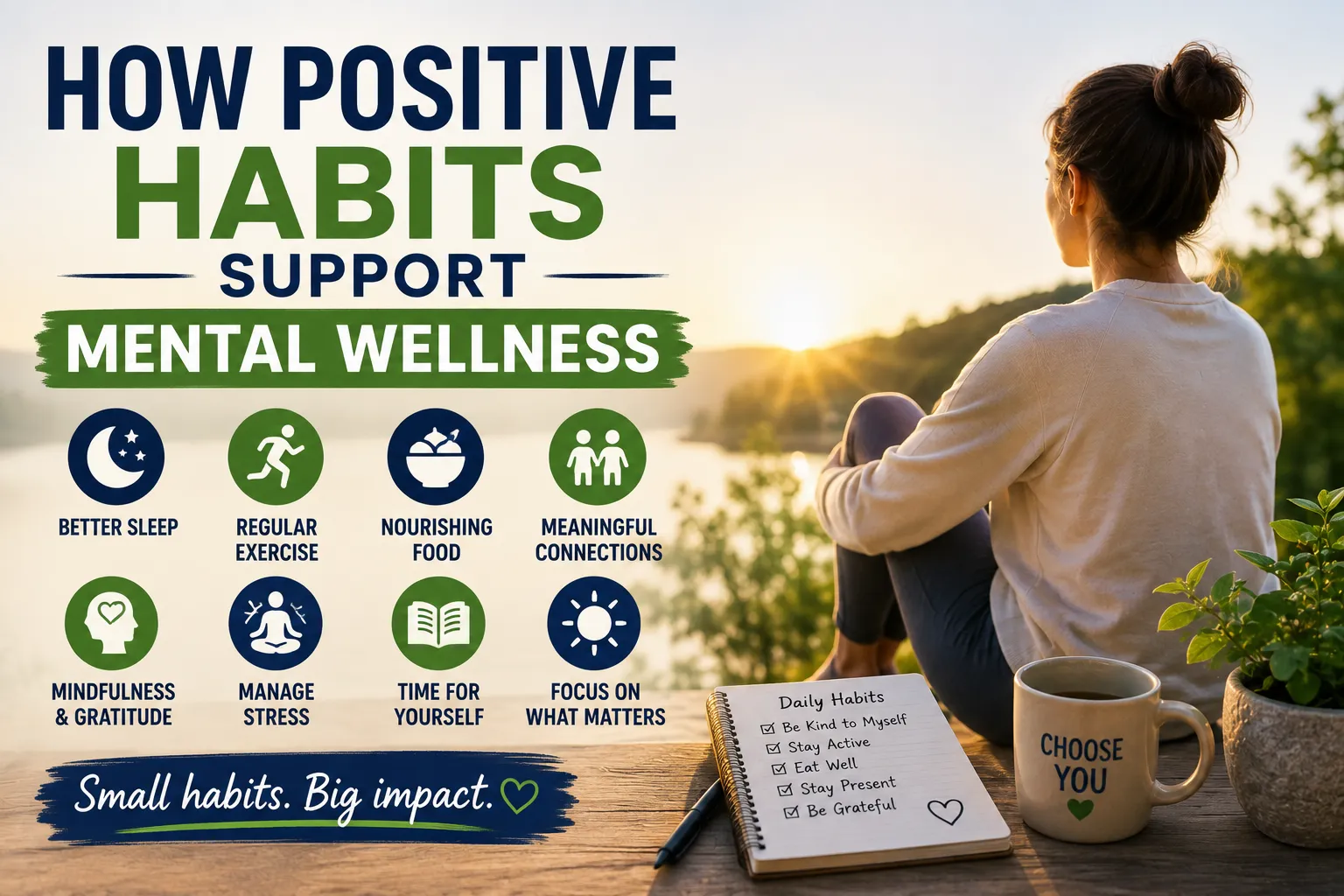

How Positive Habits Support Mental Wellness
Mental wellness is influenced by more than what happens during moments of crisis. The ordinary choices people make each day—from how they sleep and move to how they connect with others and manage stress—can shape how they feel, think and function over time.
Positive habits do not guarantee that someone will always feel happy or avoid difficult emotions. Life naturally brings stress, disappointment and uncertainty. But healthy routines can provide a stronger foundation for navigating those experiences.
Mental wellness is therefore less about feeling positive all the time and more about developing habits that support emotional balance, resilience, healthy relationships and a sense of purpose. These ideas form part of the broader picture explored in The Complete Guide to Emotional Well-Being.
What Does Mental Wellness Mean?
Mental wellness refers to a person’s overall emotional, psychological and social well-being.
It can influence how people:
- Respond to everyday stress
- Handle challenges
- Build relationships
- Make decisions
- Manage emotions
- Concentrate on tasks
- Find meaning and purpose
- Adapt to changes in life
Mental wellness exists on a spectrum. Someone can experience stress or sadness while still maintaining good overall well-being.
Likewise, appearing productive or cheerful does not necessarily mean a person is doing well internally.
The goal is not constant happiness. It is developing the resources and habits that help a person function, recover from setbacks and maintain a meaningful life.
Why Habits Matter
A habit is a behavior that becomes increasingly automatic through repetition.
Brushing your teeth, taking a morning walk, preparing meals or checking messages at a particular time can all become habitual.
Because habits require less conscious effort once established, they can provide structure during busy or stressful periods.
A single healthy choice may have a small effect. Repeated choices can become more meaningful over time.
For example, going to bed at a consistent time once may not transform someone’s well-being. Maintaining a reasonably consistent sleep routine for months can create a more stable foundation for daily functioning.
Sleep Is a Foundation for Mental Wellness
Sleep is one of the most important daily habits for overall well-being.
During sleep, the body and brain carry out processes associated with recovery, memory and emotional regulation.
Poor sleep can make ordinary challenges feel more difficult. People may find it harder to concentrate, regulate their emotions or maintain patience after a night of inadequate rest.
Developing consistent sleep habits can therefore support mental wellness.
Helpful practices may include:
- Keeping a relatively consistent sleep and wake schedule
- Creating a relaxing bedtime routine
- Limiting stimulating activities close to bedtime
- Making the bedroom comfortable and quiet
- Getting regular exposure to daylight
- Avoiding excessive caffeine late in the day
Individual sleep needs vary, but consistency can be more useful than trying to follow an unrealistic routine.
Physical Activity Can Support Emotional Well-Being
Movement is another important part of a healthy lifestyle.
Physical activity can influence mood, energy and stress levels while supporting broader physical health.
Exercise does not have to mean spending hours in a gym.
It can include:
- Walking
- Cycling
- Dancing
- Swimming
- Stretching
- Gardening
- Recreational sports
- Strength training
- Household activities
For someone who is not accustomed to regular exercise, starting with a manageable amount of movement can be more sustainable than attempting an intense routine immediately.
The most useful activity is often the kind a person can continue doing consistently.
Time Outdoors Can Provide a Mental Reset
Spending time outside can offer a break from screens, work and repetitive indoor environments.
A short walk through a park, sitting in a garden or simply spending time outdoors can create an opportunity to slow down and change surroundings.
Natural environments can also encourage movement and reduce the feeling of being constantly surrounded by digital notifications and other demands.
The activity does not need to be complicated.
Even a brief outdoor break can become a useful transition between work and personal time.
Nutrition Supports the Body and Brain
Food provides the energy and nutrients the body needs to function.
A balanced eating pattern can contribute to overall health, which is closely connected to well-being.
Rather than focusing on individual “superfoods,” a sustainable approach generally emphasizes a variety of nutrient-rich foods, including:
- Vegetables
- Fruits
- Whole grains
- Beans and legumes
- Nuts and seeds
- Fish, eggs or other protein sources
- Dairy or suitable alternatives
Regular meals can also help people avoid the extreme hunger and energy fluctuations that may make a stressful day feel even harder.
Mental wellness does not require a perfect diet. Consistency and overall dietary quality matter more than occasional indulgences.
Staying Hydrated Is a Simple Habit
Hydration is easy to overlook, particularly during busy days.
Water is essential for normal bodily functions, and inadequate fluid intake can contribute to symptoms such as tiredness and difficulty concentrating.
Keeping water accessible can make hydration easier.
A reusable bottle at a desk, in a vehicle or inside a bag can serve as a simple reminder to drink throughout the day.
Positive Social Connections Matter
Humans are social beings.
Supportive relationships can provide companionship, encouragement and a sense of belonging.
Regular interaction with friends, family members, colleagues, neighbors or community groups can help people feel connected.
Social connection does not necessarily mean having a large social circle.
A few meaningful relationships can be more valuable than maintaining dozens of superficial interactions. For more on this relationship between connection and emotional health, see How Loneliness and Social Connection Affect Mental Wellbeing.
Simple habits can strengthen those relationships:
- Calling someone regularly
- Sharing a meal
- Checking on a friend
- Taking a walk together
- Participating in a community activity
- Making time for face-to-face conversations
Small gestures can maintain connections that become particularly important during difficult periods.
Learning to Set Boundaries
Positive relationships also require boundaries.
Without boundaries, people can become overwhelmed by demands from work, family, social commitments or digital communication.
Healthy boundaries can involve:
- Saying no when necessary
- Protecting personal time
- Limiting unnecessary interruptions
- Communicating expectations clearly
- Separating work from personal life
- Recognizing when responsibilities have become excessive
Setting boundaries is not necessarily about rejecting other people.
It is about creating enough space to manage personal responsibilities and recover from everyday demands. Healthy Boundaries: Complete Guide to Setting Better Limits explores this balance in greater detail.
Mindfulness Can Help People Notice the Present
Mindfulness involves paying attention to the present moment rather than automatically becoming absorbed in thoughts about the past or future.
A simple mindfulness practice might involve sitting quietly and noticing:
- Breathing
- Physical sensations
- Sounds
- Thoughts
- Emotions
- Surroundings
The objective is not to eliminate thoughts.
Instead, it is to notice them without immediately reacting to every thought that appears.
Even a few minutes of deliberate attention can become a useful pause during a busy day. Learning more about mindfulness and present-moment awareness can help put this practice into a broader context.
Gratitude Can Shift Attention
Gratitude practices encourage people to deliberately notice things they appreciate.
This could involve writing down a few positive moments at the end of each day.
Examples might include:
- A good conversation
- A satisfying meal
- Time with family
- Progress on a project
- A beautiful sunset
- A helpful gesture from another person
Gratitude should not be used to dismiss genuine problems.
Instead, it can help broaden attention so that difficult experiences do not become the only things occupying the mind.
Journaling Can Help Organize Thoughts
Writing thoughts down can provide a way to process experiences and identify recurring patterns.
A journal does not need to be elaborate.
Someone might spend five minutes answering questions such as:
What went well today?
What was difficult?
What am I worried about?
What is within my control?
What would I like to do differently tomorrow?
Over time, these notes can reveal patterns that are difficult to notice when thoughts remain unstructured.
Taking Breaks Improves Sustainable Productivity
Modern work culture can make constant productivity seem desirable.
But working continuously without meaningful breaks can contribute to mental fatigue.
Short pauses give the mind an opportunity to shift away from demanding tasks.
A break might involve:
- Standing up
- Walking outside
- Stretching
- Drinking water
- Talking with a colleague
- Looking away from a screen
- Spending a few quiet minutes without notifications
Regular breaks are not necessarily wasted time. They can help make periods of focused work more sustainable.
Creating a Healthier Relationship With Technology
Phones, computers and social media are now part of everyday life.
Technology can support connection, entertainment and productivity, but constant digital stimulation can also make it difficult to disconnect.
Positive digital habits might include:
- Turning off unnecessary notifications
- Creating screen-free periods
- Avoiding work messages during personal time
- Keeping phones away during meals
- Taking regular breaks from social media
- Avoiding excessive scrolling before bed
The goal does not have to be eliminating technology.
It is about making sure technology remains a tool rather than becoming a constant source of interruption. For a deeper look at this issue, see How Digital Habits and Screen Time Affect Mental Wellness.
Curating Your Online Environment
What people see online can influence their mood and attention.
Social platforms can expose users to useful information and supportive communities, but they can also create pressure through constant comparisons.
A healthier digital environment may involve:
- Unfollowing accounts that consistently create unnecessary stress
- Following educational or inspiring content
- Limiting exposure to repetitive negative news
- Taking breaks from platforms when needed
- Being mindful of how online interactions affect mood
Digital boundaries can be particularly useful when social media begins to interfere with sleep, concentration or relationships.
Spending Time on Meaningful Activities
Mental wellness is not only about reducing stress.
People also need activities that provide enjoyment, creativity and meaning.
That could be:
- Reading
- Music
- Cooking
- Painting
- Gardening
- Photography
- Sports
- Volunteering
- Learning a language
- Building something
- Spending time with family
Hobbies create opportunities to engage with activities for their own sake rather than because they contribute directly to work or financial goals.
Learning New Skills Builds Confidence
Learning can provide a sense of progress.
A person might learn how to cook a new meal, repair something, play an instrument or develop a professional skill.
The process involves challenges, mistakes and gradual improvement.
That experience can reinforce an important idea: ability can grow through practice.
The skill itself may be useful, but the sense of progress can be equally valuable.
Making Time for Play
Adults often have fewer opportunities for unstructured play than children do.
Yet enjoyable activities can remain important throughout life.
Playing a sport, board game or video game, dancing, joking with friends or participating in a creative activity can provide a break from serious responsibilities.
Play can also strengthen social connections and provide a sense of enjoyment without requiring a measurable outcome.
Maintaining a Sense of Purpose
People often experience greater satisfaction when their daily activities connect to something meaningful.
Purpose can come from many sources.
For one person, it may involve family.
For another, it might be a career, creative work, community service, education, spirituality or helping others.
Purpose does not need to be a grand life mission.
It can be as simple as having meaningful responsibilities and knowing why they matter.
Breaking Large Goals Into Smaller Steps
Large goals can sometimes feel overwhelming.
Breaking them into smaller actions can make progress easier to see.
Instead of:
“I need to become healthier.”
A person might start with:
“I’ll take a 20-minute walk three times this week.”
Instead of:
“I need to organize my entire life.”
A more manageable goal could be:
“I’ll spend 10 minutes organizing one area today.”
Small successes can create momentum.
Avoiding the All-or-Nothing Mindset
Healthy habits do not need to be perfect.
Missing one workout, staying up late or eating an unhealthy meal does not erase previous progress.
An all-or-nothing approach can make people abandon useful habits after a single setback.
A more sustainable mindset is to return to the routine at the next opportunity.
Progress is often built through consistency over time rather than perfection every day.
Self-Compassion Can Make Habits More Sustainable
People often speak to themselves more harshly than they would speak to a friend.
A mistake may trigger thoughts such as:
- “I’m useless.”
- “I always fail.”
- “I’ll never change.”
Self-compassion involves responding to mistakes with greater understanding.
That does not mean ignoring responsibility.
Instead, it means acknowledging what went wrong without turning one mistake into a judgment about one’s entire identity.
A person can recognize a setback and still decide what to do next.
Organizing the Day Can Reduce Mental Clutter
A basic daily plan can reduce the number of decisions people need to make.
A simple routine might include:
- Identify the most important tasks.
- Schedule time for focused work.
- Include meals and breaks.
- Make room for movement.
- Set aside time for relationships or personal interests.
- Establish a reasonable end to the workday.
Structure does not mean every minute needs to be planned.
Some flexibility is important.
The purpose is to create enough organization that important activities do not consistently get pushed aside.
Managing Stress Through Small Daily Actions
Stress is a normal part of life.
The goal is not necessarily to eliminate it but to develop ways of responding to it.
Positive habits that may help include:
- Regular movement
- Adequate sleep
- Social connection
- Relaxation practices
- Time outdoors
- Reasonable workloads
- Organized routines
- Enjoyable activities
These habits can create opportunities for recovery between stressful events. Building the capacity to adapt to challenges is also part of The Complete Guide to Building Resilience.
Breathing Exercises Can Create a Pause
Simple breathing exercises can be practiced almost anywhere.
One approach is to slow the breath and deliberately focus attention on inhaling and exhaling.
The value may come partly from creating a pause between an emotionally demanding situation and an immediate reaction.
Breathing exercises are not a solution to every mental-health challenge, but they can be a simple tool for moments when someone wants to slow down and regain focus.
Spending Less Time Comparing Yourself With Others
Comparison can become especially intense in an environment where people constantly display selected parts of their lives online.
People may compare their careers, finances, appearance, relationships or achievements with carefully presented images of other people’s lives.
This can create unrealistic expectations.
A healthier approach is to focus more attention on personal progress.
Questions such as these can be useful:
Am I moving toward the things that matter to me?
What have I learned?
What has improved compared with a year ago?
Personal progress provides a different benchmark from competing with everyone around you.
Positive Habits Should Fit Real Life
A routine that looks impressive on paper but is impossible to maintain is unlikely to provide much benefit.
Someone who dislikes running does not need to become a runner.
Someone who finds meditation frustrating may prefer walking quietly.
Someone who cannot prepare elaborate meals every evening can develop simpler healthy options.
The best habits are often those that fit a person’s schedule, preferences, resources and responsibilities.
When Positive Habits Are Not Enough
Healthy habits can support mental wellness, but they are not a substitute for professional help when someone is struggling significantly.
Persistent emotional distress, major changes in daily functioning, difficulty managing ordinary responsibilities or other concerning experiences may be signs that additional support is appropriate.
Talking with a qualified mental-health professional can provide personalized guidance and support.
Seeking help should not be viewed as a failure to maintain positive habits.
Sometimes the healthiest habit is recognizing when additional support is needed.
Building a Routine That Can Last
A sustainable mental-wellness routine does not need to contain dozens of activities.
A person might begin with a few basic habits:
- Maintain a consistent sleep schedule.
- Move regularly.
- Eat balanced meals.
- Spend time with supportive people.
- Take breaks from screens.
- Make time for enjoyable activities.
- Practice reflection or mindfulness.
- Set reasonable boundaries.
Once these become comfortable, additional habits can be introduced gradually.
Small changes are often easier to maintain than dramatic lifestyle overhauls.
The Power of Ordinary Choices
Mental wellness is rarely shaped by one extraordinary decision.
It is more often influenced by the accumulation of ordinary choices: getting enough rest, taking a walk, calling a friend, eating a nourishing meal, stepping away from a screen, spending time outdoors or allowing yourself to recover after a demanding day.
None of these habits guarantees a stress-free life.
They can, however, create a foundation that makes everyday challenges easier to navigate.
The most effective approach is not to chase a perfect version of wellness. It is to build small, realistic habits that support the way you want to live—and return to them consistently when life inevitably knocks your routine off course.
Continue Reading
Similar Posts

How to Provide Emotional Support to Others
Good emotional support is also about respecting boundaries. People need different kinds of help at different times. Some may want to talk, while others may need practical assistance, quiet companionship, or simply reassurance that someone cares.
Read article
How Stress Affects Concentration and Memory
Understanding the connection between stress, concentration and memory can help explain why the mind sometimes feels less efficient during stressful periods—and why managing stress can be an important part of maintaining overall mental well-being.
Read article
When Should Someone Seek Professional Mental Health Support
Understanding **what mental wellness means** is a useful starting point. Mental wellness involves more than simply being happy or avoiding mental illness. It includes the ability to manage emotions, handle challenges, maintain relationships, make decisions, and function in everyday life.
Read article

Join 10,000+ Readers Building Healthier Habits
Get actionable wellness tips every week plus our newest articles delivered straight to your inbox.