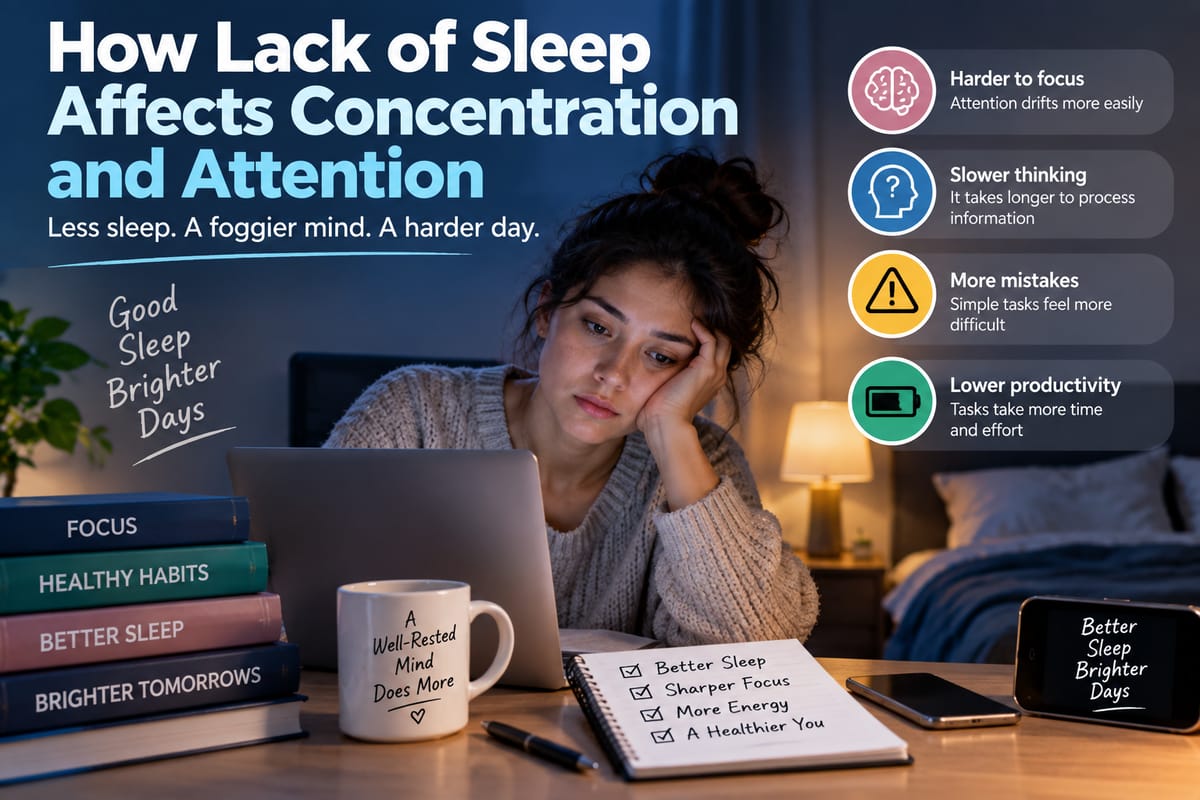

How Lack of Sleep Affects Concentration and Attention
Sleep plays an important role in how the brain processes information, maintains attention, and manages everyday mental tasks. When sleep is cut short or becomes consistently disrupted, concentration can become more difficult, reaction times may slow, and ordinary tasks can require more effort.
A person who has not slept well may notice that they lose track of conversations, make more mistakes, struggle to read for long periods, or find it harder to stay focused on work. These effects are not simply signs of feeling tired. Sleep loss can directly affect several processes that support attention, learning, memory, and decision-making.
Understanding the connection between sleep and concentration can make it easier to recognize why persistent sleep problems deserve attention.
Why Sleep Matters for the Brain
Sleep is an active biological process rather than simply a period when the body stops working. During sleep, the brain continues carrying out important functions that support physical and mental health.
Different stages of sleep contribute to processes involving memory, learning, emotional regulation, and brain function. Adequate sleep also helps the brain prepare for sustained attention during waking hours.
When someone consistently gets less sleep than they need, these processes can become disrupted. The result may be reduced alertness and a greater tendency to become distracted.
This is particularly noticeable when a person needs to perform a task for an extended period without frequent breaks.
What Happens to Concentration After Poor Sleep?
Concentration involves directing mental resources toward a particular activity while resisting distractions.
After insufficient sleep, maintaining that focus can become harder. A person may begin a task with reasonable attention but gradually lose focus as fatigue increases.
Common experiences include:
- Difficulty staying focused on reading or studying
- Frequently checking a phone or switching between tasks
- Losing track of instructions
- Forgetting what was just discussed
- Making simple mistakes
- Needing more time to complete familiar tasks
- Finding repetitive activities especially difficult
- Feeling mentally foggy
- Struggling to maintain attention during meetings or lectures
These effects can vary depending on how much sleep was lost and how frequently sleep deprivation occurs.
Sleep Loss Can Reduce Alertness
Attention depends partly on alertness. When the brain is tired, maintaining a consistently alert state becomes more challenging.
Someone experiencing sleep deprivation may have periods in which attention briefly drops. These lapses can be particularly problematic when performing activities that require continuous monitoring.
For example, a tired person working at a computer may reread the same paragraph several times without fully processing it. Someone driving may find it increasingly difficult to remain mentally engaged with the road.
The problem is not always a complete inability to concentrate. Instead, attention can become inconsistent.
Lack of Sleep Can Affect Working Memory
Working memory allows people to temporarily hold and manipulate information while completing a task.
It is involved in activities such as:
- Following several instructions
- Performing mental calculations
- Remembering a phone number long enough to enter it
- Comparing information
- Solving problems
- Following a conversation
- Keeping track of steps in a task
Insufficient sleep can make these activities more difficult.
A person might understand an instruction but forget part of it while carrying out the next step. This can create the impression that someone is simply being careless when fatigue is actually affecting their ability to hold information in mind.
Sleep and Learning Are Closely Connected
Concentration is important for learning because information generally needs to be attended to before it can be processed effectively.
Sleep also contributes to the processes through which newly learned information is consolidated.
This means that regularly sleeping poorly can create a cycle in which a person has difficulty concentrating during learning and then may not process or retain the information as effectively.
Students, employees learning new systems, and anyone developing a new skill may notice these effects when sleep becomes consistently inadequate.
Why Sleep Deprivation Can Increase Mistakes
Fatigue can affect attention, working memory, reaction time, and decision-making at the same time.
When several of these abilities are affected, mistakes can become more common.
A tired person might:
- Skip a step in a procedure
- Enter incorrect information
- Misread instructions
- Forget an appointment
- Send a message to the wrong person
- Overlook details in a document
- Miscalculate a simple figure
The more demanding the task, the more noticeable these difficulties may become.
Tasks that require sustained attention are particularly vulnerable because they depend on the brain maintaining focus over an extended period.
Sleep, Stress, and Concentration
Sleep problems and stress can influence one another.
Stress can make it harder to fall asleep or remain asleep, while insufficient sleep can make it more difficult to manage stress during the following day. This can create a cycle in which both sleep and concentration gradually deteriorate.
Stress itself can also interfere with attention and memory. For a broader look at managing stress and developing healthier strategies, The Complete Guide to Stress Management provides useful context.
Understanding this relationship is important because improving concentration may require addressing both sleep and the factors that are interfering with it.
How Stress Can Make Sleep-Related Concentration Problems Worse
Stress can occupy mental attention even when a person is trying to focus on another activity.
Someone who is worried about finances, relationships, work, school, or other responsibilities may continue thinking about those concerns while attempting to complete a task.
When poor sleep is added to that mental load, concentration can become even more difficult.
The relationship between these processes is explored further in How Stress Affects Concentration and Memory.
Reducing unnecessary sources of stress and establishing healthy routines can therefore support both sleep and daytime mental performance.
Caffeine Can Affect the Sleep-Concentration Cycle
Caffeine is commonly used to increase alertness when someone feels tired. It can temporarily make a person feel more awake, but consuming caffeine too late in the day may interfere with sleep for some people.
This can create an unhelpful cycle:
Poor sleep → daytime tiredness → caffeine use → disrupted sleep → more daytime tiredness
Individual sensitivity varies, and factors such as the amount consumed and timing can make a difference.
People who regularly use caffeine to compensate for tiredness may benefit from considering how their consumption affects their nighttime sleep. How Caffeine Intake Can Affect Sleep Quality explains this relationship in greater detail.
Chronic Stress and Long-Term Sleep Problems
Occasional poor sleep can happen for many reasons. Persistent sleep difficulties are different.
Long-term stress can contribute to ongoing sleep disruption, while repeated sleep problems can make it harder to cope with everyday demands.
Over time, this can affect more than concentration. Chronic stress and insufficient sleep may also influence mood, energy, emotional regulation, and other aspects of well-being.
The broader relationship is discussed in How Chronic Stress Affects Your Body and Mind.
Recognizing this pattern early can be useful because treating the underlying causes may be more effective than repeatedly trying to compensate for fatigue.
Signs That Poor Sleep May Be Affecting Attention
Not everyone experiences sleep deprivation in exactly the same way.
Possible signs include:
Difficulty Starting Tasks
A person may know what needs to be done but struggle to begin because they feel mentally sluggish.
Frequent Distractions
Small noises, notifications, conversations, or unrelated thoughts may interrupt concentration more easily than usual.
Repeated Reading
Someone may read the same sentence or paragraph several times because the information does not seem to register.
Forgetfulness
Short-term forgetfulness can become more noticeable when the brain is tired.
Slower Responses
Responses to questions, instructions, or changing situations may take longer.
Reduced Motivation
Fatigue can make mentally demanding tasks feel unusually difficult or unpleasant.
More Errors
Simple mistakes may occur more frequently, particularly during repetitive or detailed work.
Why Multitasking Can Become More Difficult
Many people try to compensate for tiredness by multitasking.
However, multitasking often involves rapidly switching attention between activities rather than performing several complex tasks simultaneously.
When someone is already experiencing reduced attention because of poor sleep, frequent task switching can make the situation worse.
For example, a person might attempt to answer messages while writing a report and listening to a meeting. Each switch requires attention to move from one activity to another.
A tired brain may take longer to reorient to each task, increasing the possibility of missed information and errors.
Sleep and Decision-Making
Concentration is only one part of cognitive performance.
Sleep deprivation can also affect judgment and decision-making. When people are tired, they may have greater difficulty evaluating information carefully, maintaining patience, or responding efficiently to changing circumstances.
This matters particularly in situations involving safety, complex decisions, or significant consequences.
People should be especially cautious about performing safety-sensitive activities when they are extremely tired.
How Better Sleep Can Support Daytime Focus
Improving sleep does not necessarily require complicated techniques.
Basic habits can support more consistent sleep for many people:
- Maintain a relatively consistent sleep and wake schedule.
- Create a bedroom environment that is comfortable and conducive to sleep.
- Reduce unnecessary sources of light and noise at night.
- Give yourself enough time for sleep.
- Develop a relaxing wind-down routine.
- Avoid relying heavily on caffeine to overcome persistent fatigue.
- Keep stimulating activities away from bedtime when possible.
- Exercise regularly while considering the timing of vigorous exercise.
- Address sources of stress rather than allowing them to dominate bedtime.
- Pay attention to recurring sleep problems.
These habits work best when practiced consistently rather than occasionally.
What to Do During a Day of Poor Sleep
Sometimes poor sleep is unavoidable.
After a difficult night, it can help to organize demanding work around periods when alertness is strongest. Taking appropriate breaks can also make prolonged concentration more manageable.
Other practical strategies include:
- Prioritizing the most important tasks
- Breaking complex work into smaller steps
- Reducing unnecessary distractions
- Writing down important instructions
- Using reminders for time-sensitive responsibilities
- Avoiding unnecessary multitasking
- Taking short breaks when attention begins to decline
These strategies cannot fully replace adequate sleep, but they may help someone manage a temporary period of fatigue.
When Persistent Sleep Problems Deserve Attention
Occasional difficulty sleeping is common. Persistent or severe sleep problems may require a closer look, particularly when they interfere with everyday activities.
Consider speaking with a qualified healthcare professional if sleep difficulties are persistent, daytime sleepiness is severe, concentration problems are significantly affecting daily life, or there are other concerning symptoms.
Conditions affecting sleep can have different causes, so identifying the underlying issue is important.
Professional guidance can help determine whether lifestyle changes, evaluation for a sleep disorder, or another approach is appropriate.
Sleep Is Part of Mental Wellness
Concentration does not operate independently from the rest of mental well-being.
Sleep, stress, mood, emotional regulation, physical health, and daily routines can all interact. When one area becomes disrupted, other areas may be affected as well.
Getting enough quality sleep gives the brain an opportunity to recover and prepare for another day of learning, problem-solving, communication, and sustained attention.
For anyone struggling with concentration, looking beyond productivity techniques can therefore be useful. Sometimes the most important change is not another focus app or time-management strategy, but addressing the basic conditions that allow the brain to function well.
Building a Better Foundation for Attention
Lack of sleep can make concentration less consistent, weaken working memory, increase distractions, and make everyday tasks require more mental effort. Occasional tiredness may be manageable, but repeated sleep disruption can create a much larger impact on daily functioning.
Protecting sleep is therefore an important part of maintaining attention and mental performance. A consistent sleep routine, sensible caffeine habits, stress management, and attention to persistent sleep problems can all contribute to better daytime functioning.
When the brain regularly gets the rest it needs, staying focused becomes less of a struggle and everyday mental tasks can become easier to manage.
Continue Reading
Similar Posts

How to Recognize Common Burnout Patterns
Understanding common burnout patterns can help people notice changes in their wellbeing and consider what needs to change before exhaustion becomes deeply established.
Read article
How People Recover From Difficult Experiences
Understanding how recovery works can make it easier to recognize healthy progress and identify when additional support may be useful.
Read article
How Belonging Supports Mental Wellness
Understanding the relationship between belonging and mental wellness can help explain why healthy social connections are an important part of a balanced life.
Read article

Join 10,000+ Readers Building Healthier Habits
Get actionable wellness tips every week plus our newest articles delivered straight to your inbox.